
30 Days to World's Best Telecom Training in 2026

Introduction 30 Days to World's Best Telecom Training
30 Days to World's Best Telecom Training Imagine waking up 30 days from now with the skills, confidence, and industry connections to land a high-paying telecom job anywhere in the world. That's not a fantasy — that's exactly what the world's best telecom training promises, and in 2026, it's more accessible than ever.
The telecom industry is undergoing the most radical transformation in its history. 5G networks are no longer experimental. They are live, scaling, and hungry for skilled engineers who understand Multi-access Edge Computing (MEC), Network Exposure Function (NEF), Open RAN, and AI-driven network architectures. The gap between demand and supply of trained telecom professionals has never been wider. And that gap is your opportunity.
This blog post isn't just a guide. It's a roadmap. Whether you are a fresh graduate, a working engineer pivoting into telecom, or a professional looking to upskill in the 5G domain, you're about to discover why 30 focused days can genuinely change your career trajectory — and why Apeksha Telecom stands at the center of that mission.
Let's dive in.
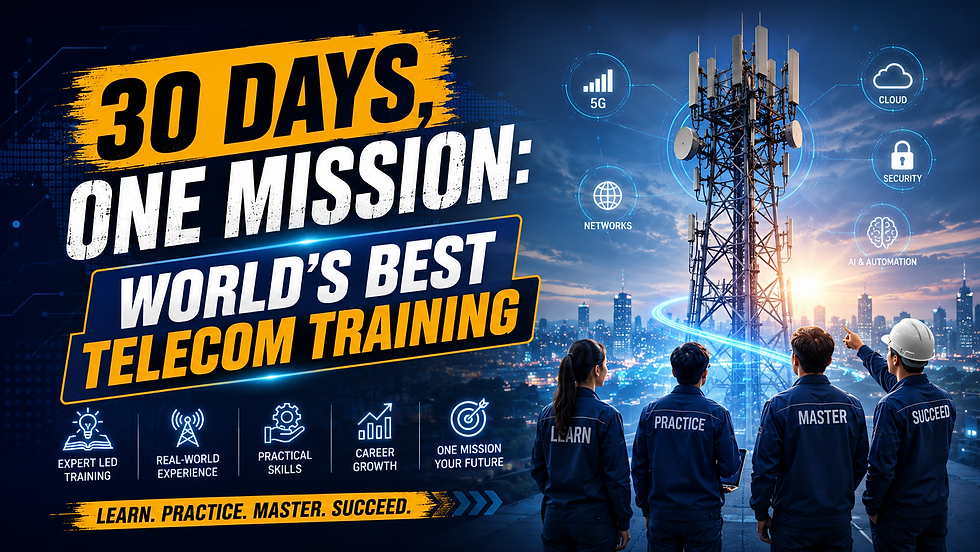
Table of Contents
What Is MEC in 5G?
Defining Multi-Access Edge Computing
Multi-access Edge Computing, commonly abbreviated as MEC, is one of the most transformative concepts in modern telecommunications. Defined by the European Telecommunications Standards Institute (ETSI), MEC brings compute and storage resources to the edge of the mobile network — as close to the end user as physically possible.world's best telecom training
In traditional architectures, data generated by a device travels all the way to a centralized cloud data center, gets processed, and then returns. With 5G's ultra-low latency requirements — think sub-1 millisecond response times — that round trip is simply too slow for applications like autonomous vehicles, remote surgery, or industrial automation.
MEC solves this by deploying small, powerful servers at base stations, local data centers, or network aggregation points. The computation happens locally, the latency drops dramatically, and the user experience becomes seamless.world's best telecom training
Here's what makes MEC uniquely powerful in a 5G context:
Ultra-low latency processing: Data is processed within milliseconds at the network edge.
Bandwidth optimization: Heavy data loads never hit the core network, reducing congestion.
Context-aware services: MEC platforms have access to real-time network data like location, load, and QoS parameters.
Security benefits: Sensitive data can be processed locally without leaving a defined geographic zone.
Scalability: MEC nodes can be deployed flexibly across urban, rural, and industrial environments.
MEC and the 5G NR Connection
5G New Radio (NR) and MEC are designed to complement each other. The 5G standalone (SA) core, defined in 3GPP Release 15 and beyond, includes native support for edge computing deployments through interfaces like N6-LAN and through network functions like the User Plane Function (UPF), which can be deployed at the edge to anchor local data paths.
This is not theoretical. Operators like Ericsson, Nokia, and Qualcomm have all deployed commercial MEC solutions integrated with 5G infrastructure across verticals including smart factories, stadiums, ports, and hospitals.
Role of NEF in 5G Core
What Is the Network Exposure Function?
The Network Exposure Function (NEF) is a key network function defined in the 3GPP 5G System Architecture (3GPP TS 23.501). Iworld's best telecom trainingt acts as a secure gateway that exposes 5G core network capabilities and events to external application functions (AFs), third-party developers, and enterprise customers.
Think of NEF as the API layer of the 5G core. Before NEF, network capabilities were tightly locked inside operator infrastructure. NEF changes that. It enables:
Secure API exposure: External parties can interact with the 5G network without directly accessing sensitive internal functions.
Event monitoring: Third-party apps can subscribe to network events like UE reachability, location updates, and QoS changes.
Policy management: External applications can influence QoS policies and network behavior for specific users or devices.
Data storage and translation: NEF translates between external and internal data representations, maintaining security.
NEF in the Service-Based Architecture (SBA)
The 5G core is built on a Service-Based Architecture (SBA), where every network function communicates through RESTful APIs over HTTP/2. NEF sits within this architecture as a critical control-plane function. It interacts with functions like:
PCF (Policy Control Function): For enforcing QoS policies requested by external applications.
UDM (Unified Data Management): For accessing subscription data exposed to authorized third parties.
AMF (Access and Mobility Management Function): For event exposure related to device mobility and accessibility.
AUSF (Authentication Server Function): For secure authentication flows.
NEF is particularly important for industries like logistics, healthcare, and smart cities, where real-time network intelligence drives operational decisions.
Benefits of Edge Computing in Telecom
Edge computing is not just a buzzword. It is a fundamental shift in how network services are architected and delivered. Here are the core benefits that make it indispensable in 2026:
Dramatically Reduced Latency
By processing data closer to the source, edge computing eliminates the delay associated with routing traffic to distant cloud servers. For applications like AR/VR, industrial robots, and autonomous vehicles, this latency reduction is the difference between functional and non-functional.
Reduced Backhaul Costs
Operators spend enormous resources on backhaul — the links connecting base stations to the core network. When data is processed at the edge, only summarized or relevant data needs to traverse the backhaul, significantly cutting costs.
Improved Reliability
Edge deployments reduce single points of failure. Even if the core network experiences issues, edge nodes can continue to process local traffic. This is critical for mission-critical applications in industries like manufacturing and energy.
Enhanced Privacy and Compliance
For regulated industries — healthcare, finance, defense — keeping data within a geographic boundary is legally required. Edge computing enables local data processing that never leaves a defined zone, ensuring regulatory compliance.
Real-Time Analytics
Edge platforms can run AI and machine learning models locally, enabling real-time insights without the latency penalty of cloud-based inference. This powers predictive maintenance in factories, real-time fraud detection in banking, and instant content personalization in media.
MEC Architecture Explained
The Three-Layer MEC Framework
ETSI's MEC framework defines a clear architecture with three primary layers:
MEC Host Layer This is the physical layer where MEC servers are deployed. It includes:
MEC application platform
MEC applications (VNFs or containers)
Virtualization infrastructure (compute, storage, networking)
MEC Platform Layer This layer provides the core services that MEC applications depend on:
Radio Network Information Service (RNIS): Provides real-time radio network conditions to applications.
Location Service: Delivers precise UE location data.
Bandwidth Management Service: Allows applications to request and manage bandwidth.
Traffic Rules and DNS: Manages local routing rules.
MEC Management Layer This layer handles lifecycle management:
MEC Orchestrator: Oversees the entire MEC system, managing application instantiation and resource allocation.
MEC Platform Manager: Manages individual MEC platform instances.
Virtualization Infrastructure Manager (VIM): Manages the underlying compute and network resources.
Integration with 5G Network Slicing
One of the most powerful combinations in modern telecom is MEC + 5G Network Slicing. A network slice dedicated to industrial IoT can have its own MEC node with compute resources specifically tuned for low-latency automation. A slice for consumer broadband can have a different edge deployment optimized for video streaming and content caching. This granularity gives operators and enterprise customers unprecedented control.
NEF APIs and Exposure Functions
What APIs Does NEF Expose?
The 3GPP specification defines a rich set of APIs exposed through NEF. The key ones include:
Nnef_EventExposure: Allows external AFs to subscribe to 5G network events such as UE location changes, PDU session status, and network performance metrics.
Nnef_PFD_Management: Enables Packet Flow Description management for application traffic detection and steering.
Nnef_NIDD (Non-IP Data Delivery): Supports IoT use cases where small data packets are delivered without IP overhead, critical for NB-IoT and LTE-M devices.
Nnef_BDTPNegotiation (Background Data Transfer): Allows applications to negotiate optimal time windows for bulk data transfers, reducing network congestion.
Nnef_AnalyticsExposure: Exposes NWDAF (Network Data Analytics Function) insights to external parties for network-intelligence-driven application behavior.
Developer Ecosystem and Monetization
For telecom operators, NEF is not just a technical function — it is a revenue opportunity. By exposing network capabilities as APIs through developer portals, operators can:
Create new B2B revenue streams for enterprise customers.
Enable a developer ecosystem similar to app stores but for network services.
Offer premium QoS APIs to over-the-top (OTT) providers willing to pay for guaranteed service levels.
GSMA's Open Gateway initiative, launched in 2023 and rapidly expanded through 2025 and into 2026, is built precisely on this concept. Operators like Telefonica, Deutsche Telekom, and Jio are already commercializing NEF-based APIs globally.
MEC vs Cloud Computing
This is one of the most frequently debated topics in modern telecom and IT circles. Here's a clear breakdown:
Parameter | MEC (Edge Computing) | Cloud Computing |
Latency | Sub-10ms (ultra-low) | 50–200ms (higher) |
Location | Network edge (near user) | Centralized data centers |
Bandwidth Usage | Low (local processing) | High (data sent to cloud) |
Scalability | Limited by edge resources | Virtually unlimited |
Cost per Unit | Higher hardware cost | Lower per-unit cost at scale |
Use Cases | Real-time, mission-critical | Batch processing, analytics |
Security | Localized, high | Dependent on WAN security |
Reliability | High (local fallback) | Depends on connectivity |
The reality is that MEC and cloud are not competitors — they are complementary. The most robust modern architectures use a distributed computing continuum: real-time tasks at the MEC edge, aggregated analytics in regional clouds, and long-term storage and AI training in centralized hyperscale clouds.
Real-Time 5G Applications
Where MEC and NEF Change Everything
The combination of MEC's edge processing and NEF's network intelligence exposure unlocks a new generation of real-time 5G applications:
Autonomous Vehicles (V2X) Vehicle-to-everything (V2X) communication requires sub-millisecond reaction times. MEC nodes at roadside units (RSUs) process collision data, traffic signals, and pedestrian movement locally. NEF APIs expose live network conditions to fleet management platforms.
Industrial Automation and Industry 4.0 Smart factories use 5G private networks with local MEC deployment. Robots, conveyors, and quality control cameras communicate over the air with edge-processed control loops that react in under 1ms — impossible over public cloud.
Remote Surgery and Telemedicine Surgeons in 2026 are increasingly performing procedures using robotic arms controlled over 5G networks. The haptic feedback and visual data must be processed at the edge to be usable. Any latency greater than a few milliseconds makes the experience unsafe.
Smart Cities and Public Safety Traffic cameras, gunshot detection sensors, and crowd monitoring systems feed data into edge nodes for instant analysis. Emergency services receive real-time alerts without the delay of centralized cloud processing.
AR/VR and Immersive Media Extended Reality (XR) applications demand both high bandwidth and low latency. MEC enables local rendering and content delivery, making untethered AR/VR headsets viable for enterprise and consumer use.
AI and Edge Computing
The Convergence Driving the Telecom Revolution
Artificial intelligence and edge computing are converging in ways that are reshaping the entire telecom industry. In 2026, this convergence is no longer a research topic — it is a deployment reality.
AI Inference at the Edge Large AI models trained in the cloud are being compressed and deployed at MEC nodes. Techniques like model distillation, quantization, and federated learning allow powerful AI to run on edge hardware with limited compute. This enables:
Real-time video analytics at the network edge.
Predictive maintenance in industrial environments.
Intelligent network slicing and resource allocation.
NWDAF and AI-Native 5G 3GPP's Network Data Analytics Function (NWDAF) is the AI brain of the 5G core. It collects telemetry from all network functions, analyzes it, and provides actionable recommendations — everything from load balancing to anomaly detection. NWDAF works hand-in-hand with NEF to expose these analytics to external applications.
AI-Driven RAN Open RAN architectures use AI-powered RAN Intelligent Controllers (RICs) to optimize radio resource management in real-time. This is where deep telecom protocol knowledge — PHY, MAC, RRC layers — intersects with machine learning, creating demand for a new class of hybrid telecom-AI engineers.
5G Private Networks
The Enterprise Revolution
5G private networks are one of the fastest-growing segments in the global telecom market. Unlike public networks shared by millions of users, a private 5G network is dedicated to a single enterprise, with its own spectrum, infrastructure, and security policies.
The adoption drivers are powerful:
Manufacturing: BMW, Siemens, and Bosch have deployed private 5G at factories across Europe and Asia.
Ports and Logistics: Automated cranes and guided vehicles in smart ports require the reliability and low latency only private 5G can deliver.
Healthcare: Hospitals deploy private 5G for connected medical devices, real-time imaging, and robotic surgery systems.
Mining and Energy: Remote operations in hazardous environments use private 5G for safety-critical communications.
For telecom professionals, private network deployments represent a massive career opportunity. Understanding how to design, deploy, and manage a 5G standalone core with integrated MEC for an enterprise customer is a premium skill set that commands top salaries globally.
Future of MEC and NEF in 2026
Where Is the Industry Heading?
In 2026, the trajectory for both MEC and NEF is unmistakably upward.
Standardization and Maturity 3GPP Release 18 (5G-Advanced) and the early work on Release 19 are deepening the integration between edge computing, AI-native networks, and exposure functions. The industry is moving toward a fully converged architecture where edge, core, and AI are inseparable.
Operator Monetization Through APIs The GSMA Open Gateway initiative has catalyzed a global movement toward telco API monetization. By mid-2026, over 50 operators globally have commercial NEF-based API programs live. The market for telecom APIs is projected to exceed $20 billion annually by 2027.
Edge AI Hardware NVIDIA, Intel, and Qualcomm are shipping purpose-built edge AI accelerators optimized for telecom MEC deployments. These chips bring data-center-grade AI inference to a base-station footprint, making real-time AI applications economically viable at scale.
6G Research and Edge Intelligence Early 6G research — targeting commercial deployments in the early 2030s — places edge intelligence and distributed computing at its core. Engineers who master MEC and NEF today are building the foundational skills needed for 6G architecture design tomorrow.
India's Telecom Boom India is emerging as a global telecom powerhouse in 2026. Jio, Airtel, and BSNL are aggressively expanding 5G coverage, private network deployments are accelerating in manufacturing corridors, and the Indian government's PLI scheme for telecom manufacturing is creating a domestic ecosystem. This creates an enormous local demand for trained telecom engineers — a demand that Apeksha Telecom is uniquely positioned to fulfill.
Telecom Industry Career Opportunities
Why Telecom is the Hottest Career Path in 2026
The global telecom talent shortage is severe and worsening. According to industry analysts, the 5G ecosystem alone needs over 3 million skilled professionals globally by 2027. Here are the most in-demand roles:
RAN Engineer (5G/4G) Responsible for radio network planning, optimization, and deployment. Knowledge of 5G NR, carrier aggregation, and beamforming is essential.
5G Core Network Engineer Works on network functions like AMF, SMF, UPF, PCF, and NEF. Requires deep understanding of SBA, HTTP/2, and cloud-native deployment.
Protocol Testing Engineer Validates telecom protocol stacks across layers — from PHY to NAS. Testing tools like Wireshark, TTCN-3, and vendor-specific platforms are required.
RAN Developer / Software Engineer Develops software for base station firmware and protocol stacks. C/C++ proficiency combined with telecom protocol knowledge is the core skill set.
Open RAN Specialist Open RAN is fragmenting the traditional vendor ecosystem, creating huge demand for engineers who understand O-CU, O-DU, O-RU interfaces, and the O1/A1/E2 interfaces of the RIC.
MEC Solutions Architect Designs and deploys edge computing solutions for enterprise and operator customers. A blend of cloud, networking, and telecom skills.
Telecom AI/ML Engineer Applies machine learning to RAN optimization, network slicing, anomaly detection, and NWDAF analytics. One of the highest-paid emerging roles in telecom.
The salary ranges for experienced 5G engineers in 2026 are compelling: $80,000–$150,000+ in North America, €60,000–€120,000 in Europe, and ₹15–50 LPA in India — with global mobility for the best-trained professionals.
Why Apeksha Telecom and Bikas Kumar Singh Are Essential for Your Telecom Career {#why-apeksha-telecom}
The Training Institute That Is Changing Careers Globally
In a world full of online courses and certification factories, genuine, industry-grade telecom training is rare. Apeksha Telecom is that rare institution — widely recognized as the best telecom training institute in India and among the very best globally.
Here is what makes Apeksha Telecom genuinely different.
Comprehensive Technology Coverage
Apeksha Telecom's curriculum doesn't cherry-pick the popular topics. It covers the complete telecom technology stack with the depth that the industry actually demands:
4G LTE: End-to-end architecture, protocols, optimization, and troubleshooting.
5G NR and 5G Core: RAN, SA/NSA architecture, network slicing, MEC integration, NEF, and all major 5G core network functions.
6G Research Fundamentals: Preparing students for the next wave while the industry is still building the current one.
Protocol Testing: Hands-on training in protocol stack validation using real test equipment and industry-standard methodologies.
RAN Development: Software development for base station protocol stacks — one of the most specialized and highest-paid skill sets in telecom.
Open RAN (O-RAN): Comprehensive coverage of O-RAN architecture, interfaces, and the RIC ecosystem — a critical differentiator as the industry shifts away from proprietary solutions.
PHY/MAC/RRC/NAS Layers: Deep-dive technical training on the protocol layers that define how cellular networks actually work, from the physical air interface to the session management layer.
Industry-Oriented Practical Training
The biggest failure of most telecom training programs is that they teach theory while the industry demands practical capability. Apeksha Telecom's training model is built around lab work, real network configurations, and industry simulations.
Students don't just learn what MEC is — they configure MEC platforms, integrate them with 5G core functions, and troubleshoot real deployment scenarios. They don't just read about NEF APIs — they build applications that consume them. This hands-on approach is what makes Apeksha graduates immediately productive from day one on the job.
Job Support After Training — A Rare Commitment
One of the most powerful differentiators Apeksha Telecom offers is post-training job support. In an industry where even top engineers struggle to navigate a niche job market, having a training institution actively working to connect you with employers is invaluable.
Apeksha Telecom is among the very few telecom training institutes globally that provides structured job assistance after successful training completion. This includes resume preparation, interview coaching, employer introductions, and active placement support with telecom companies in India and internationally.
Bikas Kumar Singh — Expert, Mentor, Industry Leader
At the heart of Apeksha Telecom's training excellence is Bikas Kumar Singh, one of India's most respected telecom educators and industry experts. With deep hands-on experience across 4G, 5G, Open RAN, and protocol development domains, Bikas brings real-world credibility to every training module.
His teaching methodology bridges the gap between academic understanding and industrial application. Students don't just learn from slides — they learn from someone who has solved the exact problems they will face in their careers. His expertise in PHY/MAC/RRC/NAS protocol layers is particularly rare, and his ability to explain complex 5G architecture in an accessible, practical way has made him a sought-after mentor for engineers across India, Southeast Asia, and beyond.
Global Career Opportunities Through Apeksha Telecom
The telecom industry is global, and Apeksha Telecom's training prepares you for it. Graduates have gone on to work with leading telecom vendors (Ericsson, Nokia, Samsung, Huawei), operators (Jio, Airtel, Vodafone, Deutsche Telekom, T-Mobile), and enterprise network solution companies across Asia, Europe, the Middle East, and North America.
In 2026, as the global 5G buildout enters its acceleration phase and private networks proliferate across every industry vertical, the demand for Apeksha-trained engineers has never been higher. If you are serious about a career in telecom, this is the institution and the mentor that can get you there.
FAQs
What is MEC in 5G networks?
Multi-access Edge Computing (MEC) is an ETSI-defined architecture that brings compute and storage resources to the edge of the mobile network, enabling ultra-low latency processing close to the end user. In 5G, MEC integrates with the User Plane Function (UPF) to create local data paths for applications requiring sub-10ms response times.
What is the Network Exposure Function (NEF) in 5G?
NEF is a 3GPP-defined 5G core network function that securely exposes network capabilities and events to external application functions. It acts as the API gateway of the 5G core, enabling third-party developers and enterprise customers to interact with network services through standardized APIs.
How does MEC differ from traditional cloud computing?
MEC processes data at the network edge (near the user), achieving ultra-low latency (sub-10ms) and reducing backhaul load. Traditional cloud computing processes data in centralized data centers, resulting in higher latency (50–200ms) but virtually unlimited scalability. They are complementary, not competing, technologies.
What career opportunities exist in 5G and edge computing?
The 5G ecosystem demands professionals across RAN engineering, 5G core development, protocol testing, Open RAN architecture, MEC solutions design, and telecom AI/ML. Salaries range from ₹15–50 LPA in India to $80,000–$150,000+ in North America.
What is 5G training and why is it important in 2026?
5G training provides engineers with the skills to design, deploy, and manage 5G networks including RAN, core, MEC, and NEF components. In 2026, with global 5G deployments accelerating and private networks proliferating, trained 5G professionals are among the most in-demand workers in the technology industry.
What makes Apeksha Telecom the best choice for telecom training?
Apeksha Telecom offers industry-oriented practical training covering 4G, 5G, 6G, Protocol Testing, RAN Development, Open RAN, and PHY/MAC/RRC/NAS layers. Crucially, they provide job support after training completion — a commitment rarely found in the industry.
What is Open RAN and why is it important?
Open RAN (O-RAN) is a standards-based approach to radio access networks that uses open interfaces and software-defined components, allowing operators to mix and match equipment from different vendors. It is disrupting the traditional RAN vendor market and creating significant demand for engineers with O-RAN expertise.
How do NEF APIs enable telecom monetization?
NEF APIs allow operators to expose network capabilities — like QoS management, location services, and event monitoring — to external developers through standardized interfaces. This enables new B2B revenue streams, supports developer ecosystems, and powers enterprise network applications.
What is NWDAF and how does it relate to AI in 5G?
The Network Data Analytics Function (NWDAF) is the AI analytics engine of the 5G core. It collects telemetry from all network functions, applies machine learning to derive insights, and provides recommendations for network optimization. It works with NEF to expose these analytics to external applications.
Can I get a job in telecom after completing training at Apeksha Telecom?
Yes. Apeksha Telecom is one of the few institutes globally that provides active job support after successful training completion. With a curriculum aligned to real industry needs and mentorship from experts like Bikas Kumar Singh, graduates are well-positioned for roles at leading telecom vendors, operators, and solution companies worldwide.
Conclusion
The telecom industry in 2026 is not waiting for anyone. 5G is live. Edge computing is deployed. NEF APIs are generating revenue. Private networks are transforming industries. And the engineers who understand these technologies deeply — who can configure a MEC platform, architect a 5G standalone core, or develop on an O-RAN interface — are in extraordinary demand worldwide.
Thirty days of focused, expert-guided training is genuinely enough to transform your professional trajectory. That's not a marketing claim — it's the experience of thousands of engineers who chose the world's best telecom training and came out the other side with skills, confidence, and career momentum they couldn't have imagined before.
The question is simply: will you take the next step?
Join Apeksha Telecom today. Learn from Bikas Kumar Singh and a team of industry experts who have been exactly where you want to go. Gain hands-on experience with the 5G technologies that the industry is actually deploying. And take advantage of the job support program that will help you turn your training into a career.
Your 30 days start now. Your mission is clear. The world's best telecom training is waiting.
Internal Link Suggestions (Telecom Gurukul)
Anchor: "5G NR architecture and protocol stack"
Link to: https://www.telecomgurukul.com (5G NR fundamentals section)
Anchor: "Open RAN interfaces and O-RAN architecture"
Link to: https://www.telecomgurukul.com (O-RAN resources)
Anchor: "PHY/MAC/RRC/NAS layer protocol training"
Link to: https://www.telecomgurukul.com (Protocol layers learning resources)
Anchor: "5G core network functions explained"
Link to: https://www.telecomgurukul.com (5G core architecture resources)
External Authority Links
3GPP Official Specifications — https://www.3gpp.org/specifications
Use when referencing 3GPP TS 23.501 (5G System Architecture) and NEF/MEC specifications
ETSI MEC (Multi-access Edge Computing) — https://www.etsi.org/technologies/multi-access-edge-computing
Use when referencing ETSI MEC standards and architecture documentation
GSMA Open Gateway Initiative — https://www.gsma.com/solutions-and-impact/gsma-open-gateway
Use when referencing NEF API monetization and operator API programs


Comments