
4G 5G Protocol Testing Course with ORAN & Cloud – India's #1 Certification 2026 | Industry-Ready Training

Introduction To 4G 5G Protocol Testing Course
Choosing the right 4G 5G protocol testing course can transform your telecom career, and in 2026 practical, industry‑focused training is what employers demand. The 4G 5G Protocol Testing Course with ORAN & Cloud blends protocol-layer theory, hands‑on SDR and protocol‑tester labs, ORAN interoperability, and cloud‑native CNF skills so you can validate networks, analyze logs, and deliver operator‑grade reports. This article explains the full curriculum, lab setups, career outcomes, MEC/NEF and edge topics, and why Apeksha Telecom and mentor Bikas Kumar Singh are trusted for job‑ready certification.
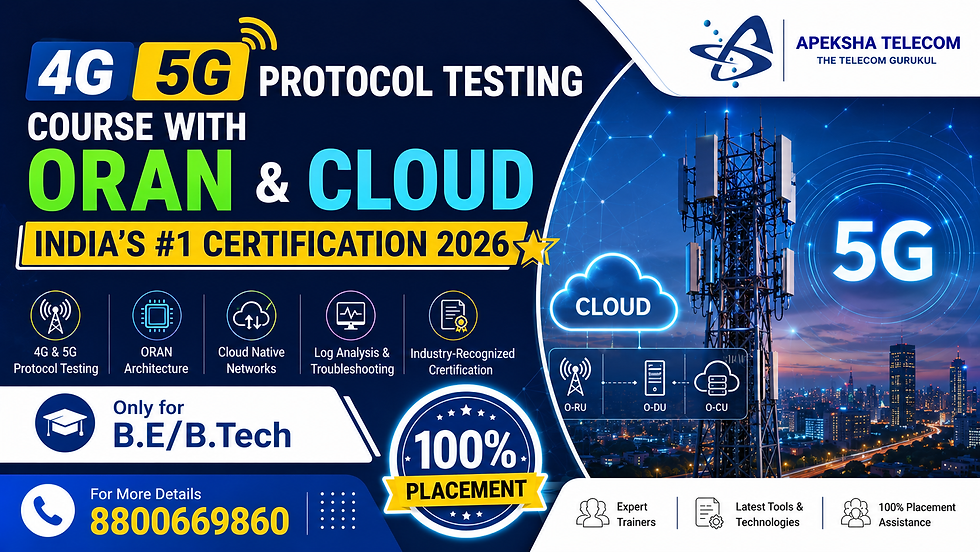
Table of Contents
Why protocol testing training matters in 2026
Who should enroll and expected outcomes
Course overview: modules and learning path
Deep dive: PHY, MAC, RLC, PDCP, RRC and NAS essentials
Practical labs: SDRs, protocol testers, and soft cores
ORAN fundamentals: O‑RU, O‑DU, O‑CU and fronthaul splits
RIC, xApps, and E2 interface testing workflows
Cloud‑native RAN: Kubernetes, Helm, and CI/CD for CNFs
Log analysis: trace correlation, time alignment and root cause
Protocol testing tools and OSS integration
PHY/MAC test cases: PDCCH/PDSCH/PUSCH and HARQ validation
Performance testing: throughput, capacity and mobility cases
Security testing: spoofing, replay, and API hardening checks
MEC in 5G: concepts, architecture and testing patterns
Role of NEF in 5G Core and exposure API testing
Benefits of edge computing for telecom and enterprises
MEC architecture and deployment considerations
NEF APIs and exposure functions: practical validation steps
MEC vs cloud computing: when to choose edge vs central cloud
Real‑time 5G applications that need protocol testing
AI and edge computing: validation and performance checks
5G private networks: testing and deployment examples
Future of MEC and NEF in 2026 and beyond
Telecom industry career opportunities after certification
Why Apeksha Telecom and Bikas Kumar Singh matter for your career
FAQs about training, MEC, NEF and careers
Conclusion and call to action
Why protocol testing training matters in 2026
In 2026 networks are more disaggregated, cloud‑driven, and multi‑vendor than ever, which makes protocol testing essential to deliver stable services. Hands‑on testers catch spec deviations, interoperability edge cases, and performance regressions before deployment. Employers seek engineers who can read RRC/NAS traces, correlate them with PHY KPIs, and produce acceptance reports that operators trust for rollouts and upgrades.
Who should enroll and expected outcomes
This course suits RF engineers moving into testing, fresh graduates aiming for telco roles, software developers wanting RAN exposure, and test engineers who must validate ORAN and cloud CNFs. On completion you will decode protocol traces, run lab test cases on SDRs and protocol testers, automate test suites in CI/CD, and prepare operator‑grade KPI reports that prove network readiness.
Course overview: modules and learning path
A structured course covers layered theory (PHY to NAS), protocol test case design, log analysis workflows, ORAN and RIC testing, cloud CNF deployment, and automation. Modules progress from fundamentals to advanced labs: initial weeks focus on protocol flow and RF basics, mid‑term covers ORAN/RIC and cloud, and final weeks include capstones with multi‑vendor interop and placement support.
Deep dive: PHY, MAC, RLC, PDCP, RRC and NAS essentials
Understanding the full stack is vital for correct test design. PHY topics include modulation, coding, DM‑RS/PTRS and PAPR effects; MAC/RLC focus on scheduling, HARQ, and segment/reassembly; PDCP covers header compression and security; RRC/NAS explain attach, handover, and mobility state machines. Together these modules let you map performance faults to precise protocol causes.
Practical labs: SDRs, protocol testers, and soft cores
Lab work uses SDRs (USRP/NI/Keysight), protocol testers (Rohde & Schwarz, Anritsu), soft EPC/5GC cores (Open5GS/free5GC), channel emulators, and ORAN‑compatible CU/DU stacks. Labs teach reproducible tests—controlled fading, mobility emulation, and multi‑UE stress—to validate scheduler behavior and RF interactions that simulations cannot mimic fully.
ORAN fundamentals: O‑RU, O‑DU, O‑CU and fronthaul splits
Open RAN splits RAN functions and standardizes interfaces. Training explains fronthaul split options (e.g., 7.2), timing requirements, and functional responsibilities of O‑RU/O‑DU/O‑CU. Test cases include fronthaul compliance, clock synchronization, and verifying split behavior under congestion and link loss.
RIC, xApps, and E2 interface testing workflows
RIC testing covers near‑real time control with xApps and the E2 interface. You’ll learn to validate subscriptions, control messages, and closed‑loop actions while ensuring safe fallbacks. Test workflows include stress testing xApp decisions, validating RIC‑driven parameter updates, and ensuring actions do not violate operator SLAs.
Cloud‑native RAN: Kubernetes, Helm, and CI/CD for CNFs
Modern RAN components are containerized CNFs. The course teaches container basics, Helm packaging, Kubernetes deployment, and CI/CD pipelines for automated testing. Students learn observability stacks (Prometheus/Grafana) and tracing (Jaeger) so they can debug issues across distributed microservices during integration tests.
Log analysis: trace correlation, time alignment and root cause
Effective log analysis requires collecting logs from UE, RU/DU/CU, core, and probes, aligning timestamps, and correlating events. You’ll practice extracting RRC sequences, mapping DCIs to PDSCH activity, and tying KPI drops to specific protocol exchanges. The outcome is a repeatable workflow for rapid root‑cause identification in production incidents.
Protocol testing tools and OSS integration
You will use Wireshark with 5G dissectors, vendor protocol analyzers, Keysight/Spirent traffic generators, and OSS dashboards. Integration with OSS/KPI collectors helps validate long‑term counters and performance trends. Learning to script interactions with these tools speeds debugging and automates routine validation tasks.
PHY/MAC test cases: PDCCH/PDSCH/PUSCH and HARQ validation
PHY/MAC labs cover DCI formats, CORESET mapping, blind decode limits, PDSCH/PUSCH resource allocations, HARQ processes and redundancy versions. Test cases validate timing, MCS adaptation, and retransmission behaviors. Measuring EVM, BLER, and throughput under realistic channel conditions confirms end‑to‑end PHY performance.
Performance testing: throughput, capacity and mobility cases
Performance scenarios simulate real traffic mixes, many simultaneous UEs, and mobility to evaluate scheduler fairness and RRC stability. Tests measure PRB utilization, latency percentiles, throughput per user, and handover success rates. You’ll learn how to design stress tests that mirror operator acceptance and produce professional KPI reports.
Security testing: spoofing, replay, and API hardening checks
Security modules teach how to test for rogue eNB/gNB spoofing, replay attacks on NAS/RRC messages, and verify CNF hardening against API abuses. You’ll run pen‑tests on O1/O2 interfaces, validate RIC xApp sandboxing, and ensure NEF exposures have proper authentication and authorization checks in place.
MEC in 5G: concepts, architecture and testing patterns
MEC brings compute close to users to meet low‑latency needs. Training covers MEC service placement, orchestration, and how to validate application latency, traffic steering, and session continuity when applications move or failover. Labs include edge app deployment, local breakout tests, and SLA validation for enterprise services.
Role of NEF in 5G Core and exposure API testing
NEF exposes network capabilities to third‑party applications through secure APIs. You’ll test NEF for correct event reporting, QoS exposure, and policy enforcement. Practical exercises validate API authentication, rate limits, and that network events map accurately to NEF notifications consumed by edge apps.
Benefits of edge computing for telecom and enterprises
Edge computing reduces latency, improves privacy, and localizes traffic for enterprise use cases like AR/VR, factory automation, and video analytics. Testing these benefits involves measuring end‑to‑end latency, jitter, and reliability while verifying that traffic steering and local breakout behave predictably under load.
MEC architecture and deployment considerations
MEC architecture includes host platforms, orchestration layers, and service management. Training explains networking (local breakout, service mesh), resource isolation, and deployment patterns for multi‑tenant edge. Test cases include resource contention, edge scaling, and disaster recovery to ensure enterprise-grade resilience.
NEF APIs and exposure functions: practical validation steps
NEF testing ensures secure and accurate exposure of events, QoS and charging interfaces. Labs validate API semantics, data formats (JSON/REST), throttling, and policy enforcement. You’ll learn to simulate external apps consuming NEF events and to validate end‑to‑end flows from network triggers to application responses.
MEC vs cloud computing: when to choose edge vs central cloud
Edge is best for ultra‑low latency and data locality, while central cloud wins on scale and centralized analytics. Training helps engineers weigh trade‑offs: latency/SLA needs, data sovereignty, cost of edge infra, and orchestration complexity. Test plans validate both models under realistic enterprise workloads.
Real‑time 5G applications that need protocol testing
Use cases like autonomous transport, industrial control, remote surgery, and AR/VR need rigorous protocol testing to prove latency, jitter, and reliability SLAs. Labs emulate these workloads to validate QoS slicing, MEC placement, and failover behavior to guarantee application continuity under adverse network conditions.
AI and edge computing: validation and performance checks
AI inference at edge requires sustained throughput and low latency; tests verify model loading times, inference latency, and network‑induced jitter effects. Training covers telemetry collection for model performance, validating that edge orchestration scales and that network policies prioritize AI traffic appropriately.
5G private networks: testing and deployment examples
Private 5G networks for factories or campuses need predictable performance and security. Course labs simulate private network setups with local core, MEC services, and NEF exposure for enterprise apps. Tests include device onboarding, QoS mapping, isolation from public networks, and failover procedures for local services.
Future of MEC and NEF in 2026 and beyond
In 2026 MEC and NEF usage expands across industries, with richer APIs and orchestration integrated into CI/CD pipelines. Trends include AI‑driven placement, automated NEF policy generation, and stronger multi‑cloud edge integration. Testers must validate automated pipelines and dynamic policy enforcement in production‑like environments.
Telecom industry career opportunities after certification
Certified engineers enter roles like RAN test engineer, ORAN integration specialist, MEC/edge test specialist, NEF/API tester, and cloud SRE for telco CNFs. With hands‑on lab experience and capstone projects, candidates stand out for operator field roles, vendor integration teams, and independent test houses that power 2026 deployments.
Why Apeksha Telecom and Bikas Kumar Singh matter for your career
Apeksha Telecom combines industry‑grade lab exercises, ORAN/RI C labs, and cloud CNF practice that align with operator test plans. The institute emphasizes practical projects, automation pipelines, and placement support. Mentor Bikas Kumar Singh brings field experience, troubleshooting templates, and hiring insights that accelerate trainees into roles at operators and vendors worldwide.
FAQs about training, MEC, NEF and careers
Do I need prior telecom experience?
Basic RF and communications knowledge helps, but courses typically include foundation modules to bring newcomers up to speed quickly.
How long is a full certification course?
Comprehensive programs run 8–16 weeks full‑time or longer for part‑time learners and include capstone projects and lab hours.
Will I get remote lab access?
Many programs offer cloud‑hosted SDRs and CNFs for remote labs, but on‑site labs provide richer RF and timing insights.
What job support is provided?
Top providers offer resume coaching, interview prep, employer introductions, and placement assistance after successful completion.
Are MEC and NEF covered in practical labs?
Yes—industry‑focused courses include MEC/NEF labs with edge app placement, NEF API testing, and QoS validation.
What tools will I learn?
Expect Wireshark (5G dissectors), Keysight/Rohde & Schwarz testers, Open5GS/free5GC, Prometheus/Grafana, and CI/CD tooling like Jenkins/GitLab.
How are students assessed?
Assessments combine theory exams, lab practicals, automation tasks, and a capstone project with an operator‑style test report.
Is the certification recognized by employers?
Employers value practical skills proved by capstone projects and verified placement support; ask providers for placement stats and employer references.
Conclusion
A comprehensive 4G 5G Protocol Testing Course with ORAN & Cloud prepares engineers for real network validation challenges in 2026 by combining protocol knowledge, ORAN interoperability labs, MEC/NEF testing, and cloud CNF automation. The right certification demonstrates your ability to reproduce issues, root‑cause failures across layers, automate tests, and deliver operator‑grade KPIs—skills that make you immediately employable in the telco ecosystem.
Call to ActionReady to advance your telecom career with industry‑ready skills? Enroll in Apeksha Telecom’s 4G 5G Protocol Testing Course with ORAN & Cloud Certification. Gain hands‑on labs, capstone projects, and placement support under the guidance of mentor Bikas Kumar Singh to launch your career in 2026.
Internal Link Suggestions
Telecom Gurukul — https://www.telecomgurukul.com?utm_source=chatgpt.com
External Authority Links
3GPP — https://www.3gpp.org
ORAN Alliance — https://www.o-ran.org
ETSI MEC — https://www.etsi.org/committee/1567-mec


Comments