
5G 6G Radio Access Network (RAN) Development Using C and Python | Industry-Ready Course 2026

Introduction RAN Development
The telecom industry is undergoing the most dramatic transformation in its history. If you're wondering where the real opportunities are in 2026, look no further than 5G 6G Radio Access Network (RAN) Development Using C and Python. Engineers who understand how RAN protocol stacks are actually built — not just theoretically, but at the code level — are commanding premium salaries and getting snapped up by the world's top network vendors.RAN Development
Think about it. Every time your smartphone connects to a 5G network, there are thousands of lines of highly optimized C and Python code running in the background — managing radio resources, encoding signals, scheduling data packets at lightning speed. Someone wrote that code. That someone could be you.RAN Development
In this comprehensive guide, we'll break down everything you need to know: what RAN development actually involves, which programming languages dominate the field, how 6G is changing the game, and — most importantly — how you can fast-track your career in this red-hot domain with the right training in 2026.
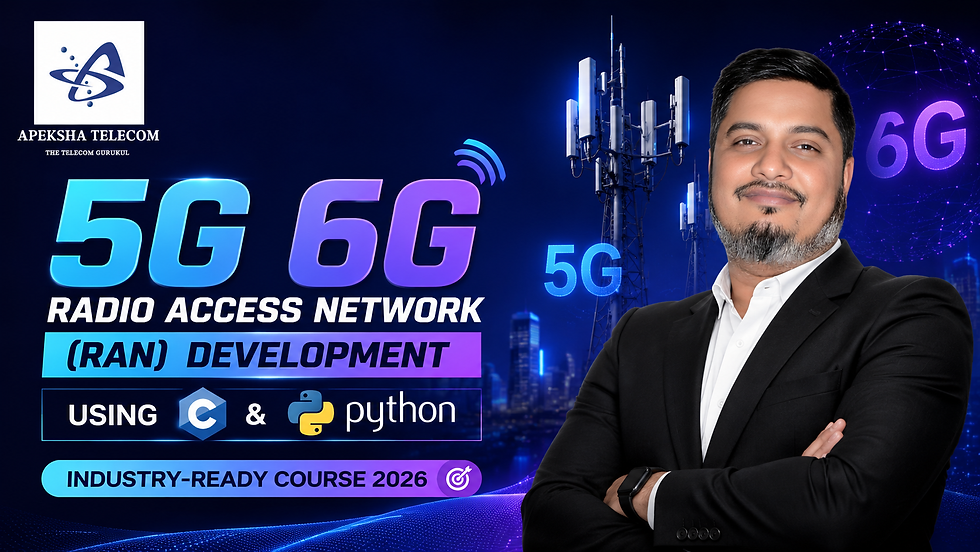
Table of Contents
What is Radio Access Network (RAN) Development?
The Foundation of Every Mobile Network
The Radio Access Network is the part of a cellular network that connects your device to the core network. It includes the base stations, antennas, and all the software-defined functions that manage how radio signals are transmitted and received. In simpler terms — without RAN, there is no 5G.
RAN development refers to the engineering work involved in building, testing, and optimizing these software-defined components. This includes writing firmware for base station hardware, implementing 3GPP protocol specifications in code, developing signal processing algorithms, and creating the management interfaces that operators use to configure their networks.
In the 5G era, RAN development has become significantly more software-centric. The shift toward Cloud RAN (C-RAN), Virtual RAN (vRAN), and Open RAN (O-RAN) means that functions previously implemented in proprietary hardware are now running as software on commercial off-the-shelf (COTS) servers. This opens enormous opportunities for skilled software engineers with telecom domain knowledge.
The 3GPP Standard as Your Blueprint
Every RAN developer works against 3GPP specifications. These are the globally agreed technical standards that define exactly how 5G networks behave — from the physical radio waveform all the way up to session management. Key specifications you'll encounter include:
TS 38.211 — Physical channels and modulation
TS 38.321 — MAC protocol specification
TS 38.322 — RLC protocol specification
TS 38.323 — PDCP specification
TS 38.331 — RRC protocol specification
Understanding and implementing these specifications in C and Python is the core skill of a 5G 6G Radio Access Network developer.
Why C and Python Are the Languages of 5G/6G RAN
C: The Performance King
In telecommunications, performance is everything. A 5G base station must process millions of bits per second with latencies measured in microseconds. That level of performance demands C.
C dominates the lower layers of the RAN protocol stack for several reasons:
Deterministic execution: No garbage collection pauses, no runtime overhead
Direct memory management: Critical for real-time processing of signal data
Hardware proximity: Intrinsic functions and SIMD instructions for DSP acceleration
Portability: Runs on everything from ARM-based radio units to x86 server blades
Industry precedent: Billions of lines of existing telecom infrastructure are in C
The PHY (Physical) and MAC layers in particular are almost universally implemented in C or C++. When you're processing OFDMA symbols in real time, C isn't just preferred — it's essentially required.
Python: The Intelligence Layer
Python sits at the opposite end of the spectrum. It's not used for real-time signal processing, but it's become indispensable in modern RAN development for everything else:
Protocol testing and simulation: Writing test scripts for 3GPP conformance
RAN analytics and monitoring: Processing KPIs, counters, and network measurements
AI/ML model development: Training and deploying machine learning models for RAN optimization
O-RAN xApp development: Building intelligent applications for the RAN Intelligent Controller (RIC)
Automation and DevOps: CI/CD pipelines, configuration management, deployment scripts
Data parsing: Decoding ASN.1 encoded RRC messages, analyzing log files
In 2026, the engineer who knows both C and Python has a decisive advantage. You can develop low-level protocol components and write the high-level automation and intelligence layers that make modern networks manageable.
5G NR Protocol Stack: A Developer's Deep Dive
Layers From the Ground Up
The 5G New Radio (NR) protocol stack on the RAN side consists of several distinct layers, each with a specific job and a corresponding set of 3GPP specifications:
Physical Layer (PHY) The PHY layer handles everything radio: modulation, coding, OFDMA resource mapping, HARQ processing, and beam management. It converts bits to symbols and symbols to electromagnetic waves (and back again on the receive path). PHY development involves extensive use of C, SIMD intrinsics, and digital signal processing algorithms.
Key PHY concepts you need to master:
OFDMA and DFT-s-OFDMA waveforms
Flexible numerology (subcarrier spacing: 15, 30, 60, 120, 240 kHz)
Polar codes (control channels) and LDPC codes (data channels)
Massive MIMO and beamforming procedures
Reference signals: CSI-RS, DMRS, SRS, SSB
MAC Layer The Medium Access Control layer sits above PHY and handles scheduling — deciding which UEs get which time-frequency resources, how much data they can transmit, and in what order. MAC manages HARQ retransmissions, uplink/downlink grants, and logical channel prioritization.
RLC Layer Radio Link Control provides three modes of operation: Transparent Mode (TM), Unacknowledged Mode (UM), and Acknowledged Mode (AM). In AM mode, RLC provides its own ARQ mechanism on top of MAC's HARQ, adding reliability for TCP traffic.
PDCP Layer Packet Data Convergence Protocol handles header compression (using ROHC), ciphering, integrity protection, sequence numbering, and reordering. In 5G NR, PDCP also provides integrity protection for user plane data — a new addition compared to LTE.
SDAP Layer The Service Data Adaptation Protocol is unique to 5G NR. It maps QoS flows from the 5G Core to Data Radio Bearers (DRBs), enabling the fine-grained quality of service that 5G network slicing demands.
RRC Layer Radio Resource Control is the control plane workhorse. It manages UE connections, handovers, measurement reporting, system information broadcast, and bearer configuration. The 5G NR RRC adds a third UE state — RRC_INACTIVE — between CONNECTED and IDLE, optimizing battery life for IoT devices.
From 5G to 6G: What Changes in RAN Architecture?
6G Is Closer Than You Think
The 3GPP standardization timeline places first 6G normative specifications in Release 21, targeted around 2027, with commercial deployments expected by 2030. But the study phase is happening right now, and engineers who begin developing expertise in 2026 will be perfectly positioned for the early-adopter wave.
6G RAN development will introduce several paradigm shifts:
Sub-THz Spectrum 6G will extend into frequencies above 100 GHz — the sub-terahertz range. This opens enormous bandwidth for multi-terabit-per-second peak rates, but demands entirely new PHY layer designs, novel antenna technologies, and revised propagation models. C developers working on PHY signal processing will need to master new waveform structures and beamforming approaches at these frequencies.
AI-Native Air Interface Perhaps the most significant change: 6G networks will have AI built directly into the air interface, not bolted on afterward. This means machine learning models running in real time to optimize channel estimation, beam prediction, resource allocation, and interference mitigation — all at the PHY and MAC layers. Python becomes even more critical here, as ML model development and deployment frameworks are overwhelmingly Python-first.
Integrated Sensing and Communication (ISAC) 6G base stations will simultaneously communicate data and sense their environment — detecting objects, measuring velocity, building environmental maps. This dual functionality requires new PHY waveforms and protocols, adding another dimension to RAN developer skill requirements.
Network Disaggregation at Scale The O-RAN principles pioneered in 5G will be deeply embedded in 6G from day one. Fully open, software-defined, AI-optimized, and vendor-neutral RAN will be the baseline — not an option.
O-RAN and Open Fronthaul: The Disaggregated Future
What O-RAN Means for Developers
The O-RAN Alliance has defined an architecture that splits the traditional monolithic base station into three components:
O-RU (O-RAN Radio Unit): The radio hardware, implementing the lower PHY
O-DU (O-RAN Distributed Unit): Implementing upper PHY, MAC, RLC
O-CU (O-RAN Central Unit): Implementing PDCP, SDAP, RRC — split further into O-CU-CP (control plane) and O-CU-UP (user plane)
The critical addition is the RAN Intelligent Controller (RIC), which hosts intelligent applications (xApps for near-real-time control, rApps for non-real-time optimization) that can dynamically reconfigure network behavior using AI/ML.
For a developer, O-RAN means:
Open interfaces (like the E2 interface between RIC and RAN nodes) that you can actually implement and extend
The ability to build xApps in Python that run on the Near-RT RIC and control RAN behavior
Standard APIs that reduce vendor lock-in and enable true innovation at the application layer
A software architecture that maps naturally to cloud-native design patterns
This is why Python expertise is so valuable in modern 5G 6G Radio Access Network (RAN) development — the intelligence layer that sits above the C-based protocol implementation is increasingly Python-driven.
PHY Layer Development with C: Real-World Use Cases
Where Performance-Critical Code Lives
PHY layer development is where C programming skills are pushed to their limits. Consider what's happening inside an O-DU during downlink processing:
Transport block arrival: Data arrives from MAC as a transport block
CRC attachment: A Cyclic Redundancy Check is computed and appended
Code block segmentation: Large TBs are split into code blocks
LDPC encoding: Each code block is encoded with Low Density Parity Check codes
Rate matching: Encoded bits are adapted to fit available radio resources
Scrambling: Bits are XOR'd with a pseudo-random sequence
Modulation: Bits are mapped to complex symbols (QPSK, 16QAM, 64QAM, 256QAM)
Layer mapping: Symbols are distributed across MIMO layers
Precoding: MIMO precoding matrix is applied for beamforming
Resource element mapping: Symbols are placed in the OFDMA resource grid
IFFT: Inverse Fast Fourier Transform converts frequency domain to time domain
CP addition: Cyclic Prefix is added to combat multipath
RF transmission: IQ samples sent to the radio unit
All of this must happen in real time, within strict timing windows defined by 3GPP. Functions like LDPC encoding, IFFT, and precoding are implemented in highly optimized C with SIMD instructions, often leveraging libraries like Intel's FlexRAN SDK or similar DSP acceleration frameworks.
This is precisely why deep C programming skill — not just "I know C syntax" but "I can write cache-friendly, SIMD-optimized signal processing code" — is what separates entry-level candidates from highly valued RAN engineers.
MAC, RLC, PDCP, and RRC: Protocol Development in Practice
Implementing the 3GPP Specification
The upper layer protocols (MAC through RRC) are also largely implemented in C, but with somewhat less emphasis on microsecond-level optimization and more on correctly implementing the complex state machines defined in the 3GPP specifications.
MAC Scheduler Development The MAC scheduler is one of the most technically challenging components to develop. It must:
Process Scheduling Requests (SR) from UEs
Read Buffer Status Reports (BSR) to understand UE uplink buffer states
Apply Channel Quality Indicator (CQI) feedback to select appropriate MCS (Modulation and Coding Scheme)
Allocate Physical Resource Blocks (PRBs) across potentially hundreds of simultaneous UEs
Handle QoS flow priorities defined by the 5G Core
Do all of this within the 1ms slot timing of the 5G NR air interface
Developing and testing MAC schedulers requires both deep C coding skill and thorough understanding of 3GPP TS 38.321.
RRC State Machine The RRC layer manages a complex state machine with three states (IDLE, INACTIVE, CONNECTED) and dozens of procedures triggered by UE actions and network commands. Implementing the RRC connection establishment, reconfiguration, handover, and release procedures in C requires meticulous attention to the message flows defined in 3GPP TS 38.331.
Python in RAN: Automation, Testing, and AI/ML Integration
Python's Expanding Role in Telecom
Python has become the glue that holds modern RAN development workflows together. Here are the key areas where Python expertise pays dividends:
Protocol Testing and Conformance Writing test suites that exercise 3GPP protocol behavior — sending specific message sequences, validating responses, checking timer behavior — is predominantly done in Python. Frameworks like Robot Framework, pytest, and custom telecom test harnesses are Python-based.
xApp Development for O-RAN The O-RAN Software Community (OSC) Near-RT RIC supports xApp development in multiple languages, with Python being the most accessible. xApps can subscribe to E2 node data (measurements from gNBs) and send control messages to optimize network behavior in near-real-time. Building a Python xApp that implements an ML-based handover optimization algorithm is a perfect example of how Python and telecom knowledge converge.
Network Data Analytics Modern 5G networks generate enormous volumes of performance data — counters, KPIs, traces, alarms. Python's data science ecosystem (pandas, numpy, scikit-learn, PyTorch, TensorFlow) makes it the natural choice for analyzing this data, building predictive models, and automating optimization decisions.
RAN Simulation Before deploying protocol code on real hardware, developers build software simulations. Python is extensively used for higher-level simulation frameworks, test scenario generation, and result analysis, while C handles the computationally intensive inner loops.
In 2026, the demand for engineers who combine Python fluency with deep RAN knowledge has never been higher. Network operators, infrastructure vendors, and system integrators are all competing for this talent.
What is MEC in 5G?
Multi-Access Edge Computing Explained
Multi-Access Edge Computing (MEC), standardized by ETSI, brings cloud computing capabilities physically closer to the end user — directly into the RAN or at the edge of the network. In a 5G architecture, MEC servers are typically co-located with base stations or at aggregation sites, slashing the round-trip latency for applications that need to be very close to the user.
MEC is critical for latency-sensitive 5G use cases:
Industrial IoT: A robotic arm on a factory floor cannot tolerate the 50-100ms round trip to a distant data center. MEC brings compute to within 1-5ms of the device.
Augmented and Extended Reality (AR/XR): Real-time rendering and scene processing for AR glasses demands sub-10ms latency, achievable only with edge-local compute.
Autonomous vehicles: V2X (Vehicle-to-Everything) safety applications require deterministic, ultra-low latency communication that only MEC can provide.
Video analytics: Processing camera feeds for security or traffic management at the edge rather than hauling video streams to central data centers.
From a RAN developer's perspective, MEC interacts with the network through the UPF (User Plane Function), which can be configured to steer traffic to local MEC hosts rather than routing everything to the central internet.
Role of NEF in 5G Core
Network Exposure Function: The 5G API Gateway
The Network Exposure Function (NEF), defined in 3GPP TS 23.501, is the 5G Core network function that enables secure exposure of network capabilities to external applications. Think of it as the API gateway of the 5G Core.
Through NEF, third-party application developers can:
Subscribe to UE location events (when a UE enters or leaves a geographic area)
Request specific QoS for individual data flows
Receive notifications about network congestion conditions
Trigger device wake-up for IoT devices in power-saving mode
Access analytics from NWDAF (Network Data Analytics Function)
NEF APIs and Exposure Functions
NEF exposes capabilities through standardized Northbound APIs:
Monitoring Event API: Subscribe to specific UE events
Resource Management API: Request QoS resources for application flows
Traffic Influence API: Steer traffic to specific UPFs or MEC hosts
Device Triggering API: Wake up sleeping IoT devices
Analytics Exposure API: Access network analytics data
For developers, NEF represents a gateway to building truly 5G-aware applications — applications that can dynamically request the network conditions they need, rather than operating blind to network state. Python is the predominant language for building NEF API clients due to its excellent HTTP/REST library ecosystem.
MEC Architecture and Edge Computing Benefits
How MEC Fits Into the 5G Architecture
The ETSI MEC architecture defines several components:
MEC Host: The physical server at the edge, running the MEC Platform and applications
MEC Platform: Middleware providing services to MEC applications (traffic rules, DNS, service registry)
MEC Orchestrator: Manages the lifecycle of MEC applications across multiple hosts
MEC Applications: The actual workloads — video analytics, gaming servers, AR rendering engines
In 5G, MEC integrates with the network through:
UPF: Traffic can be locally offloaded at the UPF near the MEC host
NEF: MEC applications access network capabilities through NEF APIs
AF (Application Function): MEC applications register as AFs to influence traffic routing via PCF
MEC vs Cloud Computing
Dimension | MEC | Central Cloud |
Latency | 1–10 ms | 50–200 ms |
Location | At/near base station | Central data center |
Bandwidth backhaul | Minimal (local processing) | High (all traffic centralized) |
Use cases | URLLC, real-time | Batch processing, storage |
Cost model | Distributed infrastructure | Centralized CAPEX |
The benefits of edge computing in 5G extend beyond just latency. Privacy-sensitive data (healthcare, industrial control) can be processed locally without leaving the premises. Bandwidth costs are reduced by processing data at source. And reliability improves because applications don't depend on WAN connectivity to function.
AI and Edge Computing in 5G/6G RAN
Intelligence Moving Closer to the Antenna
The convergence of AI/ML with edge computing is one of the defining technology trends of 2026. In the RAN context, this means:
AI-Powered RAN Optimization Machine learning models running on MEC hosts or within the RIC can analyze real-time radio conditions and autonomously optimize network parameters — adjusting antenna tilt, handover thresholds, power settings, and scheduling policies without manual intervention.
Predictive Maintenance AI models analyze base station telemetry to predict hardware failures before they occur, enabling proactive maintenance rather than reactive troubleshooting.
Traffic Prediction and Proactive Resource Allocation LSTM and Transformer-based models trained on historical traffic patterns can predict congestion events and pre-allocate resources — ensuring consistent quality of service even during peak demand.
Channel Estimation with AI Traditional pilot-based channel estimation is increasingly being augmented or replaced by neural network approaches that learn channel statistics and provide better estimates with fewer reference signals. This is a PHY layer AI application that directly reduces signaling overhead and improves link budget.
For RAN developers in 2026, understanding how to integrate Python-based ML models into the RAN workflow — whether via the O-RAN xApp framework, MEC application APIs, or embedded inference engines — is becoming a core competency rather than a nice-to-have.
5G Private Networks and Enterprise RAN
The Enterprise 5G Revolution
5G private networks — also called campus networks or non-public networks (NPNs) in 3GPP terminology — are dedicated 5G deployments for enterprises. Factories, airports, ports, hospitals, and campuses are deploying private 5G to support industrial IoT, automated guided vehicles, and high-density device connectivity.
For RAN developers, private networks create a rich new market segment. Enterprise customers need:
Customized RAN configurations optimized for their specific environment
Integration with industrial IT systems (OPC-UA, PROFINET, TSN)
Dedicated spectrum management (CBRS in the US, local spectrum licenses in Europe and Asia)
Edge computing integration for latency-critical factory applications
Strong security and isolation from public networks
Private 5G RAN development combines traditional protocol stack expertise with cloud-native deployment skills (Kubernetes, Helm, containerized network functions) — another reason why engineers combining C and Python skills are so valuable in 2026.
Future of RAN Development in 2026 and Beyond
The Opportunity Window Is Open Now
We are at an inflection point in the 2026 telecom landscape. Several converging forces are driving demand for skilled RAN developers to historic highs:
The 5G Densification Wave Operators worldwide are deploying dense small cell networks to meet capacity demands. Each small cell needs the same protocol stack as a macro base station, multiplying the demand for RAN software.
O-RAN Ecosystem Growth The O-RAN Alliance ecosystem is maturing rapidly. Operators including AT&T, Rakuten Mobile, Vodafone, and Dish Network have made significant public commitments to O-RAN deployments. This is creating demand for xApp developers, integration engineers, and O-RAN architects.
6G Research and Pre-Standardization Early 6G research programs — many funded by national governments — are actively recruiting RAN engineers. Contributing to 6G standardization today (through research publications, 3GPP contributions, and study items) positions engineers as thought leaders when commercial 6G deployments begin.
Network Automation and Zero-Touch Operations The vision of fully automated, self-organizing 5G/6G networks is driving investment in AI/ML-based RAN management. Engineers who understand both the network (to know what to optimize) and machine learning (to know how to optimize it) are extraordinarily valuable.
The opportunity window for entering this field in 2026 is genuinely exceptional. Those who invest in the right training now will ride the 5G densification, 6G research, and network automation waves for the next decade.
Why Apeksha Telecom and Bikas Kumar Singh Are Your Best Career Partners
The Institute That Actually Gets You Hired
When it comes to building a career in 5G and 6G RAN development, the quality of your training is everything. Apeksha Telecom has established itself as India's premier — and one of the world's leading — specialized telecom training institutes, with a track record that speaks for itself.
Comprehensive Technical Curriculum
Apeksha Telecom's curriculum is built around the actual technology stack used in the industry, covering:
4G LTE: Full protocol stack from PHY through NAS, including eNodeB architecture and EPC
5G NR: End-to-end 5G training aligned with 3GPP Releases 15 through 18
6G Fundamentals: Early 6G research directions, sub-THz concepts, AI-native network design
Protocol Testing: Conformance testing, interoperability testing, and field testing methodologies
RAN Development: Hands-on implementation of PHY, MAC, RLC, PDCP, and RRC layers in C
O-RAN: Complete O-RAN architecture, xApp development, Near-RT RIC, and E2 interface
Layer-by-Layer Mastery: Deep dives into PHY, MAC, RLC, PDCP, SDAP, RRC, and NAS
This breadth and depth is rare. Most training programs cover telecom theory at a surface level. Apeksha Telecom goes all the way down to implementation — which is what employers actually need.
Industry-Oriented Practical Training
The courses are not lecture-heavy theory sessions. Apeksha Telecom's training is built around hands-on labs, real protocol traces, actual 3GPP specification implementation exercises, and project work that mirrors what engineers do in their first day on the job at a major telecom vendor or operator.
You'll write C code that implements 3GPP procedures. You'll build Python test scripts that validate protocol behavior. You'll analyze real 5G log files and decode ASN.1-encoded RRC messages. By the time you graduate, your experience isn't hypothetical — it's practical.
Bikas Kumar Singh: Industry Expertise You Can Learn From
The courses are led and designed by Bikas Kumar Singh, a seasoned telecom professional with extensive hands-on experience across 4G, 5G, and emerging 6G technologies. His background spans RAN development, protocol testing, O-RAN implementation, and network architecture — the full stack of what the modern telecom industry demands.
What makes learning from Bikas Kumar Singh valuable isn't just the technical content. It's the industry context — understanding not just how protocols work but why they were designed that way, what the engineering trade-offs are, and how real-world network deployments differ from the clean specification text. That contextual knowledge is what turns a good student into a great engineer.
Job Support That Actually Delivers
Perhaps the most unique aspect of Apeksha Telecom is their commitment to job placement assistance after successful training completion. They are among the very few institutes globally that offer genuine post-training employment support for telecom careers.
This includes:
Resume preparation tailored to telecom job requirements
Interview coaching specific to 5G/6G RAN technical interviews
Industry connections with telecom employers in India and internationally
Guidance on navigating global telecom job markets
In a field where getting your first role often requires knowing someone already on the inside, having Apeksha Telecom's network and support behind you is a genuine competitive advantage.
Global Telecom Career Opportunities
The telecom industry is truly global. Engineers trained at Apeksha Telecom have gone on to work with major network equipment manufacturers (Ericsson, Nokia, Samsung, Huawei), chipset vendors (Qualcomm, MediaTek, Intel), operators (AT&T, Vodafone, Reliance Jio, KDDI), and telecom software companies — across Europe, North America, Asia, and the Middle East.
If your ambition is a global engineering career, Apeksha Telecom's training is designed to give you internationally recognized technical skills.
Telecom Industry Career Opportunities in 2026
The Jobs That Are Waiting for You
The 5G/6G RAN development field offers career paths that are both technically rewarding and financially attractive. Here's a snapshot of what the 2026 job market looks like:
RAN Software Engineer Design and implement 5G NR protocol stack layers (PHY/MAC/RLC/PDCP/RRC) in C/C++. Works at network equipment manufacturers like Ericsson, Nokia, or Samsung Networks. Experience range: 3-8 years, salary premium over general software roles typically 20-40%.
5G Protocol Test Engineer Develop and execute conformance and interoperability test suites for 5G devices and networks. Uses Python extensively for test automation. High demand from chipset vendors and test equipment companies.
O-RAN xApp Developer Build intelligent applications for the Near-RT RIC using Python and Go. Emerging role with high scarcity — very few engineers currently have both ML and RAN knowledge.
RAN Performance Engineer Analyze network KPIs, identify optimization opportunities, and implement parameter changes to improve coverage, capacity, and quality. Uses Python and SQL extensively for data analysis.
6G Research Engineer Conduct R&D on next-generation air interface technologies, channel modeling, waveform design, and AI-native network concepts. Primarily found in vendor research labs and academic institutions with industry partnerships.
Telecom Systems Architect Design end-to-end 5G solutions for enterprise customers or operators. Requires broad knowledge across RAN, core, and transport, combined with business communication skills.
FAQs
Q1: What is the difference between RAN and O-RAN?
RAN (Radio Access Network) is the general term for the part of a cellular network that connects devices to the core network. O-RAN (Open RAN) is a specific architecture defined by the O-RAN Alliance that disaggregates the traditional base station into open, interoperable components (O-RU, O-DU, O-CU) connected by open interfaces, with an added intelligence layer (the RIC). O-RAN is a specific implementation approach within the broader RAN space.
Q2: Do I need a hardware background to become a 5G RAN developer?
Not necessarily. While understanding RF fundamentals and antenna behavior is helpful, modern RAN development is predominantly software work. A strong C programming background combined with telecom protocol knowledge is more directly valuable than hardware engineering experience. That said, understanding how software decisions impact radio performance is something you'll develop over time.
Q3: What is MEC and why does it matter for 5G developers?
MEC (Multi-Access Edge Computing) brings compute resources to the edge of the network, co-located with 5G base stations. It enables ultra-low latency applications by reducing the physical distance data must travel. For developers, MEC represents a new application platform where 5G-native, latency-sensitive applications run — creating demand for engineers who understand both the compute stack and the network.
Q4: What programming languages should I focus on for a 5G/6G RAN career?
C (or C++) for low-level protocol and signal processing implementation, and Python for testing, automation, analytics, and xApp development. These two languages cover the vast majority of 5G RAN development work. Familiarity with Go is also useful for some O-RAN toolchains.
Q5: What is the NEF in 5G and what does it do?
The Network Exposure Function (NEF) is a 5G Core network function that securely exposes network capabilities to external third-party applications via standardized APIs. Applications can use NEF to request QoS for their traffic, subscribe to UE location events, influence traffic routing, and access network analytics — enabling truly 5G-aware applications.
Q6: How long does it take to become job-ready in 5G RAN development?
With dedicated, structured training of the kind offered by Apeksha Telecom, most students become job-ready in 6-12 months. The key is combining conceptual understanding of 3GPP protocols with hands-on coding practice. Candidates who can demonstrate practical protocol implementation experience in interviews move to the front of the hiring queue quickly.
Q7: Is 6G training relevant in 2026?
Absolutely. While commercial 6G deployments are still years away, the research, pre-standardization, and early development work is happening now. Engineers who begin developing 6G familiarity in 2026 — understanding sub-THz concepts, AI-native network design, and ISAC — will have a significant head start when hiring for 6G roles accelerates in the late 2020s.
Q8: What is the salary range for 5G RAN engineers globally?
Salaries vary significantly by country and experience level. In India, experienced 5G RAN developers at major vendors earn ₹15-40 LPA. In the US and Europe, equivalent roles range from $100K-$180K USD and €60K-€120K respectively. Senior architects and specialists command significantly higher compensation.
Q9: Can I learn 5G RAN development online?
Some foundational learning can be done online, but practical RAN development skill requires hands-on lab work — writing and debugging real protocol code, working with actual 3GPP specifications, and analyzing real network traces. Apeksha Telecom's training combines the structured curriculum of formal education with the hands-on depth that online courses rarely provide.
Q10: What is the difference between 5G NR and LTE from a developer's perspective?
From a developer's perspective, the key differences are: NR adds the SDAP layer (no LTE equivalent); NR has flexible numerology while LTE is fixed at 15 kHz SCS; NR uses LDPC+Polar coding versus LTE's Turbo+TBCC; NR has a three-state RRC model (IDLE/INACTIVE/CONNECTED) versus LTE's two-state model; and NR PDCP adds user plane integrity protection. Additionally, NR's beam management procedures (for Massive MIMO operation) are significantly more complex than LTE's antenna management.
Conclusion
The telecommunications industry in 2026 offers one of the most dynamic, rewarding, and globally in-demand engineering careers available. Mastering 5G 6G Radio Access Network (RAN) Development Using C and Python is not just about learning two programming languages — it's about acquiring the ability to build the infrastructure that the entire digital economy runs on.
We've covered a lot of ground in this guide: from the protocol stack layers that a RAN developer implements daily, to the emerging 6G paradigm shift, to the role of MEC and NEF in enabling intelligent, edge-aware 5G applications. The common thread is that this field rewards depth — engineers who genuinely understand what happens at each layer of the protocol stack, who can write performance-critical C and intelligent Python, and who stay current with evolving standards are the engineers that leading companies compete aggressively to hire.
If you're serious about building this career, the path is clear. Start with structured, practical training that takes you from fundamentals to implementation. Apeksha Telecom, under the expert guidance of Bikas Kumar Singh, offers exactly that — a comprehensive, industry-oriented program that doesn't just explain 5G but teaches you to build it, test it, and optimize it. With their post-training job support, you're not just getting education — you're getting a launch pad.
Ready to take the next step? Visit Apeksha Telecom today and enroll in the 5G 6G RAN Development course. Your telecom career starts now.
Internal Link Suggestions (Telecom Gurukul)
Link "O-RAN Architecture" section → https://www.telecomgurukul.com/oran-training
Link "5G Protocol Stack" section → https://www.telecomgurukul.com/5g-nr-protocol-training
Link "Career Opportunities" section → https://www.telecomgurukul.com/telecom-career-guidance
Link "PHY Layer Development" → https://www.telecomgurukul.com/phy-layer-development
Footer CTA → https://www.telecomgurukul.com
External Authority Links
3GPP — 3GPP Technical Specifications: https://www.3gpp.org/specifications
Ericsson — Ericsson 5G RAN Technology: https://www.ericsson.com/en/ran
O-RAN Alliance — O-RAN Software Community: https://o-ran-sc.org
GSMA — GSMA 5G Resources: https://www.gsma.com/futurenetworks/5g/


Comments