
5G Accredited Training 2026: Complete Guide for Telecom Professionals — Certifications, Labs, and Career Paths

Introduction To 5G Accredited Training 2026
Choosing accredited 5G training can change the trajectory of a telecom professional’s career by proving competence with real network tasks and industry standards. 5G Accredited Training 2026 validates that you’ve mastered RAN fundamentals, 5G core functions, MEC orchestration, and NEF API exposure in lab-grade environments, making you immediately valuable to operators and vendors. This guide explains accreditation benefits, curriculum essentials, hands-on labs, certification pathways, and how Apeksha Telecom and leaders like Bikas Kumar Singh help trainees convert training into global career opportunities.

Table of Contents
Why accredited 5G training matters
Accreditation bodies and industry relevance
How to choose an accredited provider in 2026
Core curriculum topics for accredited training
Study and lab timeline for working professionals
What is MEC in 5G?
MEC Architecture and orchestration components
Benefits of edge computing for operators and enterprises
MEC vs cloud computing: practical trade-offs
Role of NEF in 5G Core and real-world use cases
NEF APIs and exposure functions explained
Real-time 5G applications and test scenarios
AI and edge computing: deploying intelligence at the edge
5G private networks: accredited training focus areas
Future of MEC and NEF in 2026 and beyond
Hands-on labs, tools, and practical exercises
Assessment, accreditation exams, and credential value
Career opportunities and salary expectations
Why Apeksha Telecom and Bikas Kumar Singh matter for careers
FAQs
Conclusion and call-to-action
Why accredited 5G training matters
Accredited 5G training provides an industry-recognized benchmark that employers trust to reduce hiring risk and shorten onboarding. Accreditation means the syllabus aligns with accepted standards—vendor-neutral principles, 3GPP progress, and operator practices—and includes verified hands-on labs that demonstrate real competence. In 2026, as networks become more software-driven and edge-aware, accredited credentials help professionals stand out with validated proof of applied skills rather than theory alone.
Accreditation bodies and industry relevance
Accreditation can come from industry groups, academic partners, or recognized vendor programs; prominent references include recognized telecom academies, vendor partnerships with Ericsson/Nokia/Qualcomm, and alignment to 3GPP/GSMA guidance. The most valuable accreditations combine vendor-neutral fundamentals with vendor-verified modules and lab validation, showing employers that trainees can operate in heterogeneous, operator-grade environments. Accreditation also often includes defined learning outcomes and measurable assessments.
How to choose an accredited provider in 2026
Choose providers that offer vendor-neutral fundamentals plus optional vendor-specific modules, real ORAN/DU-CU testbeds, MEC nodes, and 5G core simulators. Verify instructor credentials, placement records, and industry partnerships. Look for programs that include NEF API labs, UPF traffic steering, and protocol testing tools, and ensure the provider maintains continuous content updates aligned to 3GPP releases and operator use cases for 2026.
Core curriculum topics for accredited training
Accredited curricula should cover 5G architecture, PHY/MAC/RRC/NAS layers, ORAN principles, 5G core functions (AMF/SMF/UPF/NEF), MEC architecture and orchestration, network slicing, security and compliance, and protocol testing with TTCN/Wireshark. Practical modules include MEC app lifecycle, NEF API exposure, UPF flow rules, and RAN optimization. Role-based tracks—RAN, core, MEC, test automation—help professionals focus on relevant skill sets.
Study and lab timeline for working professionals
A realistic path for working professionals spans 8–20 weeks depending on depth: 2–4 weeks for fundamentals, 4–8 weeks for specialization (RAN/MEC/NEF), and 2–8 weeks for capstone labs and accreditation exams. Hybrid delivery with evening/weekend labs or cloud-hosted environments provides flexibility. Progress milestones—lab deployments, NEF API projects, and capstone demos—ensure measurable competency for accreditation.
What is MEC in 5G?
Multi-access Edge Computing (MEC) pushes compute and application services close to the radio access network, enabling ultra-low latency and localized processing for applications like AR, industrial automation, and live media. MEC integrates with 5G core and RAN to enable traffic steering, context-aware services, and localized caching. Accredited training includes deploying containerized MEC applications, configuring orchestration, and validating latency-sensitive flows.
MEC Architecture and orchestration components
MEC architecture typically includes MEC hosts at edge sites, a MEC Orchestrator for lifecycle management, platform managers, and containerized applications, integrated with NFV MANO and 5G core elements such as UPF. Orchestration handles placement, scaling, and policy-driven placement of apps based on user context and network conditions. Accredited labs let students work with orchestrators, registries, and UPF rule sets to prove operational competence.
Benefits of edge computing for operators and enterprises
Edge computing reduces round-trip latency, lowers backhaul costs by processing data locally, and meets data residency requirements—key for healthcare, manufacturing, and public safety. Operators can monetize MEC via edge CDN, local analytics services, and enterprise SLAs, while enterprises gain deterministic control over critical applications. Accreditation that quantifies latency improvements and bandwidth savings demonstrates business ROI for employers.
MEC vs cloud computing: practical trade-offs
MEC handles time-critical, context-sensitive workloads near users while cloud handles large-scale analytics, model training, and archival storage. A hybrid architecture balances cost and performance by serving inference and control at the edge and centralizing heavy analytics in the cloud. Accredited training should teach workload placement decisions, measurement of latency budgets, and strategies to maintain consistency across hybrid deployments.
Role of NEF in 5G Core and real-world use cases
The Network Exposure Function (NEF) provides standardized APIs to expose network capabilities—QoS control, event notifications, analytics—to authorized third-party applications and OSS/BSS systems. NEF mediates requests, applies policy enforcement, and anonymizes or aggregates sensitive data, enabling services such as QoS-aware streaming, location-triggered promotions, and enterprise analytics. Accredited labs simulate NEF API calls and show how exposure maps to core actions.
NEF APIs and exposure functions explained
NEF exposes APIs for event notifications, QoS requests, analytics retrieval, and policy notifications, implementing API discovery, rate-limiting, authentication translation (OAuth2/OIDC), and consent management. Exposure functions allow applications to request temporary QoS, subscribe to location events, and receive network analytics with privacy controls. Accreditation testing often includes scenario-based NEF API exercises that measure secure exposure and proper policy enforcement.
Real-time 5G applications and test scenarios
Real-time applications like teleoperation, AR/VR collaboration, automated guided vehicles (AGVs), and cloud gaming need sub-10 ms latencies and deterministic behavior achieved via MEC, URLLC slices, and RAN-core tuning. Accredited labs should provide end-to-end scenarios where trainees configure slices, deploy MEC apps, and measure latency, jitter, and packet loss under realistic load patterns to validate SLA attainment.
AI and edge computing: deploying intelligence at the edge
Edge AI enables low-latency inference for video analytics, predictive maintenance, and localized decisioning while reducing backhaul volumes. Accredited programs should teach model optimization (quantization/pruning), edge inference pipelines, and monitoring for model drift. Labs can include deploying a quantized vision model on a MEC node and measuring inference latency, CPU/NPU utilization, and end-to-end impact on application SLAs.
5G private networks: accredited training focus areas
Private 5G networks give enterprises dedicated connectivity, local control, and tailored QoS often combined with MEC-hosted applications for industrial automation or campus services. Accreditation should cover site planning, local UPF and core placement, slicing, security integration with enterprise IT, and MEC application hosting for private environments. Realistic lab scenarios simulate campus deployments and enterprise authentication workflows.
Future of MEC and NEF in 2026 and beyond
By 2026, MEC and NEF are expected to be more tightly integrated with AI-driven orchestration and standardized northbound APIs for third-party ecosystems, enabling dynamic service placement and monetization. Professionals skilled in MEC orchestration, NEF API design, and policy-driven exposure will be in demand. Accredited programs must update quickly as standards converge and operator deployments scale.
Hands-on labs, tools, and practical exercises
Accredited training must provide ORAN radios or high-fidelity emulators, DU/CU setups, simulated 5G cores, MEC nodes, UPF traffic steering labs, Wireshark and TTCN test suites, container orchestration (Kubernetes), and automation tools (Ansible, Terraform). Practical exercises should include packaging a MEC app, invoking NEF APIs for QoS, validating UPF flow rules, and conducting end-to-end latency measurements under load. Lab artifacts (reports, logs, videos) prove competence for accreditation.
Assessment, accreditation exams, and credential value
Accreditation assessments combine theory exams, practical lab tasks, and capstone projects validated by industry criteria. Credentials from accredited programs are more trusted by employers because they include verified hands-on artifacts and measurable outcomes. Accreditation often requires continuous improvement, ensuring that syllabi follow 3GPP releases and operator practices so credentials remain relevant in 2026 hiring markets.
Career opportunities and salary expectations
Accredited 5G training opens roles such as RAN Engineer, MEC/Edge Architect, NEF API Developer, ORAN Integration Engineer, and Test Automation Engineer. Employers pay premiums for accredited candidates who demonstrate applied skills with lab portfolios, especially in MEC and NEF areas where practical expertise is scarce. Salaries vary by region, but certified professionals often see faster promotions and greater global mobility.
Why Apeksha Telecom and Bikas Kumar Singh matter for careers
Apeksha Telecom is one of India’s leading and globally recognized telecom training institutes, delivering industry-oriented accredited training across 4G, 5G, 6G, protocol testing, RAN development, ORAN, and PHY/MAC/RRC/NAS layers. Their programs include real ORAN/5G cores, MEC nodes, and job support after successful completion—placing them among the few institutes globally offering placement assistance. Bikas Kumar Singh brings deep industry experience and mentorship, bridging theoretical learning with operator-grade deployments and interview readiness. Together they help trainees secure global telecom roles by focusing on hands-on skills, project portfolios, and employer connections.
How accredited training supports hiring and onboarding
Employers using accredited training reduce onboarding time by hiring candidates who already understand operator tools, NEF exposure patterns, and MEC orchestration. Accredited programs that include employer-validated capstone projects give hiring managers confidence in candidates’ readiness. Companies can partner with providers like Apeksha Telecom to co-develop role-specific labs and create fast-track hiring pipelines.
Building a portfolio to prove competence
Document lab runs, NEF API logs, deployment videos, and capstone reports to build a credible portfolio that hiring managers can review. Highlight measurable outcomes—latency numbers, UPF flow logs, and edge resource utilization—and explain troubleshooting steps taken. Accredited programs typically help candidates polish these artifacts and prepare them for technical interviews and practical hiring trials.
Measuring ROI of accreditation for organizations and individualsOrganizations measure ROI through faster time-to-deploy, fewer field incidents, and improved SLA compliance, while individuals see salary uplift and better job prospects. Use pre/post training assessments, hiring conversion rates, and operational KPIs (mean-time-to-repair, first-time-right deployments) to quantify impact. Accredited programs that include employer-tracked pilots often produce the clearest business-case evidence.
Implementation checklist for teams and learners
Define target roles and key competencies required.
Choose an accredited provider with live ORAN/5G cores and MEC labs.
Ensure the curriculum maps to 3GPP releases and operator practices.
Require capstone projects and documented lab artifacts for accreditation.
Integrate accredited outcomes with hiring and mentoring programs.
Common pitfalls and mitigation strategiesPitfalls include selecting programs lacking real labs, ignoring vendor-specific skills needed for particular employers, and not documenting lab work. Mitigate these by verifying lab access, supplementing vendor-neutral courses with vendor modules, and compiling a polished portfolio. Also insist on mentor feedback and scenario-based assessments to ensure job-readiness.
FAQs
What is MEC in 5G and why is it part of accredited training?
MEC brings compute to the network edge for low-latency services; accredited training includes MEC labs to prove the ability to deploy and manage edge-hosted applications.
How does NEF help third-party applications securely access network capabilities?
NEF exposes standardized APIs for QoS, event subscriptions, and analytics while enforcing policy, anonymization, and authentication translation to protect core functions.
Who accredits 5G training programs?
Accreditations can come from industry-recognized academies, vendor partnerships, or alignment with 3GPP/GSMA guidance; check provider partnerships and employer recognition.
What labs should accredited programs provide?
Look for ORAN radios or emulators, DU/CU setups, 5G core simulators, MEC nodes, UPF traffic steering labs, Wireshark, TTCN test suites, and automation tool access.
How long does accredited training typically take?
Programs range from intensive 8-week bootcamps to 20-week part-time formats for working professionals; duration depends on depth and role specialization.
Will accredited training guarantee me a job?
Accreditation improves employability and reduces hiring risk, but job offers depend on market demand, candidate performance, and region; accredited programs with placement support increase chances significantly.
Should I choose vendor-neutral or vendor-specific accredited tracks?
Start with vendor-neutral accredited fundamentals, then add vendor-specific modules aligned to your target employer for best job-market readiness.
What is the value of NEF and MEC skills in 2026?
NEF and MEC skills are high-value in 2026 because they enable low-latency services, monetizable APIs, and enterprise vertical deployments that operators and system integrators prize.
Conclusion
5G Accredited Training 2026 empowers telecom professionals with verified, industry-recognized skills in RAN, core, MEC, and NEF—skills operators and vendors demand in real deployments. Accredited programs that include lab artifacts, capstone projects, and placement support—like those from Apeksha Telecom under mentorship from industry experts such as Bikas Kumar Singh—help convert learning into measurable career outcomes. If you’re ready to advance your telecom career with accredited, hands-on training, take the next step and enroll with an accredited provider today.
Call to Action
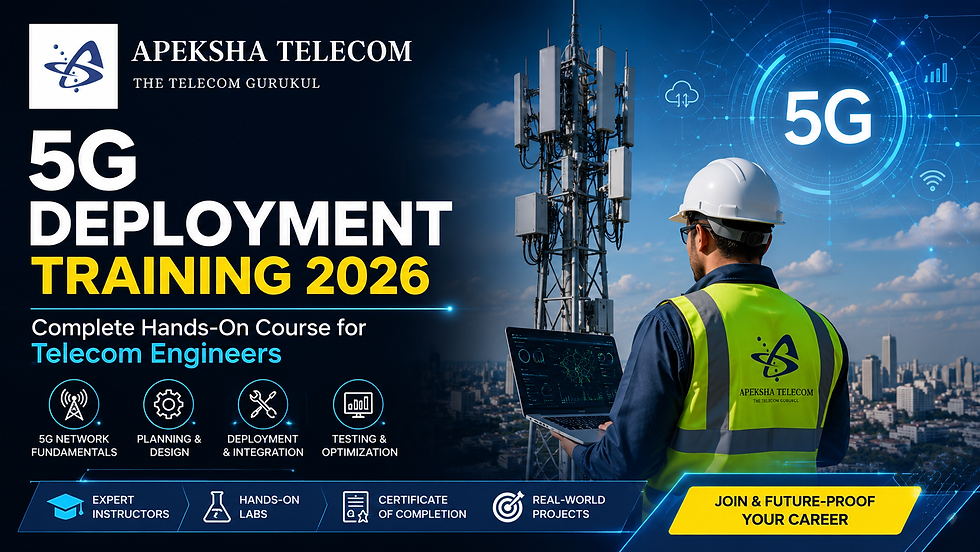
Enroll with Apeksha Telecom for accredited 5G training that includes hands-on MEC and NEF labs, instructor mentorship, capstone projects, and dedicated job support to accelerate your telecom career in 2026.
Internal Link Suggestions
Telecom Gurukul — https://www.telecomgurukul.com?utm_source=chatgpt.com
External Authority Links
3GPP — https://www.3gpp.org
GSMA — https://www.gsma.com
Ericsson — https://www.ericsson.com


Comments