
5G Advanced Training 2026: Complete 5G-Advanced Architecture, AI, ORAN & Network Evolution Course

Introduction 5G Advanced Training 2026
The telecommunications industry is entering a new phase of innovation. While many operators are still expanding their 5G deployments, the focus is already shifting toward 5G-Advanced technologies that bridge the gap between current 5G capabilities and the future vision of 6G. For professionals looking to stay ahead in this rapidly changing industry, 5G Advanced Training 2026 provides a valuable opportunity to understand the technologies shaping the next generation of wireless communication.
5G-Advanced introduces major improvements in artificial intelligence, network automation, Open RAN (ORAN), edge computing, energy efficiency, and intelligent connectivity. These advancements are transforming how networks are designed, deployed, optimized, and managed.
Whether you are a telecom engineer, protocol tester, ORAN developer, network architect, or student, gaining expertise in 5G-Advanced technologies can significantly improve your career prospects and technical capabilities.
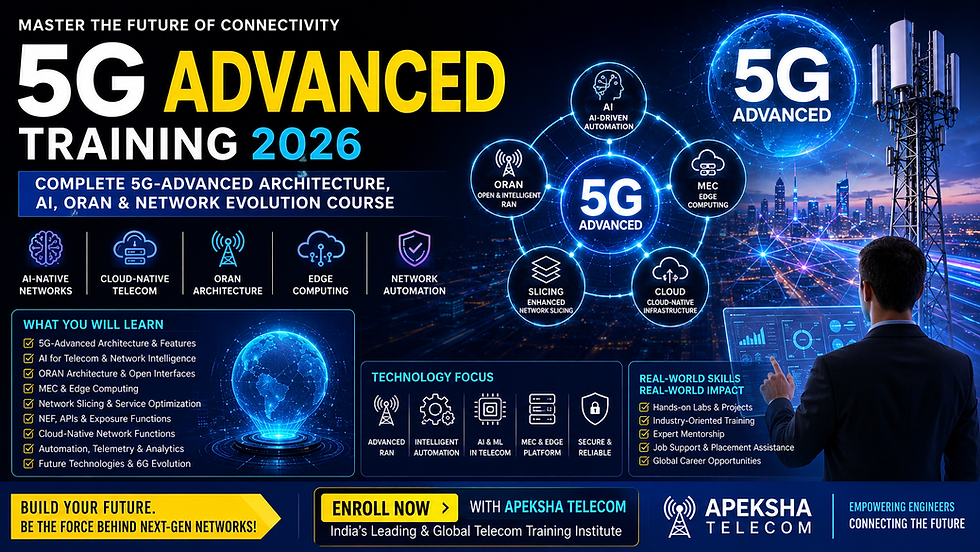
Table of Contents
Evolution from 5G to 5G-Advanced
What is 5G-Advanced?
Why 5G-Advanced Matters
Key Features of 5G-Advanced
AI-Native Networks
Advanced RAN Evolution
ORAN in 5G-Advanced
Enhanced Network Slicing
Cloud-Native Telecom Evolution
Energy-Efficient Networks
Intelligent Automation
Telecom Industry Use Cases
MEC and Edge Computing Overview
Future Trends in 2026
Evolution from 5G to 5G-Advanced
The wireless industry has continuously evolved to support increasing demands for speed, capacity, reliability, and intelligent services.
The progression has followed a clear path:
2G introduced digital voice communication.
3G enabled mobile internet access.
4G LTE delivered broadband connectivity.
5G introduced ultra-fast, low-latency communication.
5G-Advanced expands and optimizes existing 5G capabilities.
5G-Advanced is not a completely new generation of wireless technology. Instead, it represents a major enhancement of current 5G systems through improved intelligence, automation, and efficiency.
Industry organizations and standards bodies are incorporating advanced capabilities that prepare networks for future 6G evolution while maximizing existing investments.
As operators continue network modernization efforts, demand for engineers trained in 5G Advanced Training 2026 concepts is growing rapidly across global telecom markets.
What is 5G-Advanced?
5G-Advanced is the next phase of 5G evolution introduced through enhanced standards and advanced network capabilities.
It focuses on improving performance across several critical areas:
Artificial Intelligence integration
Radio network optimization
Network automation
Energy efficiency
Edge computing
Extended reality applications
Industrial connectivity
Many industry experts refer to 5G-Advanced as the bridge between 5G and 6G.
Its primary goal is to create smarter, more autonomous, and more efficient networks capable of supporting increasingly complex digital services.
Core Objectives of 5G-Advanced
Enhanced User Experience
Deliver higher throughput and improved service quality.
Network Intelligence
Introduce AI-driven optimization throughout the network.
Operational Efficiency
Reduce costs through automation and intelligent resource management.
Sustainability
Improve energy efficiency while supporting growing traffic demands.
New Business Models
Enable operators to monetize advanced network capabilities.
These objectives are driving significant investment across the telecom ecosystem.
Why 5G-Advanced Matters
The telecommunications industry faces several challenges:
Explosive traffic growth
Increasing operational complexity
Rising energy consumption
Demand for real-time applications
Enterprise digital transformation
Traditional network management approaches are becoming insufficient.
5G-Advanced addresses these challenges through:
AI-powered automation
Intelligent resource allocation
Advanced analytics
Enhanced radio performance
Cloud-native architectures
These capabilities help operators deliver better services while improving efficiency and reducing operational expenses.
Organizations adopting these technologies throughout 2026 are expected to achieve substantial improvements in network performance and customer experience.
Key Features of 5G-Advanced
Several technological innovations distinguish 5G-Advanced from earlier network generations.
AI-Native Operations
Artificial Intelligence becomes deeply integrated into network management.
Benefits include:
Predictive optimization
Automated troubleshooting
Intelligent scheduling
Dynamic resource allocation
Enhanced Massive MIMO
Advanced antenna technologies improve:
Coverage
Capacity
Spectral efficiency
Improved Beamforming
More intelligent beam management enhances user connectivity.
Extended Reality Support
Networks become optimized for:
Augmented Reality
Virtual Reality
Mixed Reality
Advanced Positioning
Higher location accuracy enables new industrial and enterprise applications.
These enhancements significantly improve network capabilities while supporting emerging digital services.
AI-Native Networks
One of the most transformative aspects of 5G-Advanced is the integration of artificial intelligence into network operations.
Traditional telecom networks often rely on manual optimization and rule-based management.
AI-native networks introduce:
Self-optimization
Self-healing
Predictive maintenance
Autonomous operations
AI Use Cases in Telecom
Traffic Prediction
AI models forecast network demand and proactively allocate resources.
Fault Detection
Potential issues can be identified before they impact customers.
Capacity Optimization
Resources are dynamically adjusted based on real-time conditions.
Energy Savings
AI helps reduce power consumption during low-traffic periods.
These capabilities enable operators to manage increasingly complex networks more efficiently.
Professionals interested in 5G Advanced Training 2026 should understand AI-driven networking because it is becoming a foundational element of future telecom systems.
Advanced RAN Evolution
The Radio Access Network continues to evolve rapidly.
5G-Advanced introduces several enhancements that improve radio performance and efficiency.
Improved Spectral Efficiency
Networks can deliver higher capacity using available spectrum resources.
Enhanced Mobility Management
Users experience more seamless connectivity during movement.
Intelligent Scheduling
AI-based scheduling improves resource utilization.
Better Coverage
Advanced radio techniques extend network reach and improve signal quality.
Reduced Latency
Critical applications benefit from faster response times.
These improvements support a wide range of consumer and enterprise use cases.
ORAN in 5G-Advanced
Open Radio Access Network (ORAN) plays a major role in the evolution of future telecom infrastructure.
ORAN promotes:
Open interfaces
Vendor interoperability
Cloud-native deployment
Software-driven innovation
Benefits of ORAN
Vendor Flexibility
Operators can combine solutions from multiple vendors.
Faster Innovation
Open ecosystems accelerate technology development.
Reduced Costs
Competition and interoperability lower deployment expenses.
Intelligent Automation
ORAN supports AI-powered network optimization.
Many operators are actively expanding ORAN deployments throughout 2026 to improve network flexibility and accelerate innovation.
As a result, ORAN expertise is becoming increasingly valuable for telecom professionals.
Enhanced Network Slicing
Network slicing is one of the most important capabilities introduced by 5G.
5G-Advanced expands these capabilities significantly.
A network slice is a virtual network tailored for specific service requirements.
Examples include:
Smart Manufacturing Slice
Supports:
Low latency
High reliability
Industrial automation
Healthcare Slice
Enables:
Telemedicine
Remote surgery
Medical imaging
Consumer Broadband Slice
Optimized for:
Video streaming
Gaming
High-speed internet
Public Safety Slice
Provides dedicated resources for emergency services.
Advanced slicing capabilities improve service differentiation and create new revenue opportunities for operators.
Cloud-Native Telecom Evolution
Cloud-native technologies continue transforming telecom infrastructure.
Modern networks increasingly rely on:
Containers
Kubernetes
Microservices
DevOps practices
Service orchestration
Benefits include:
Faster Deployment
New services can be launched quickly.
Improved Scalability
Resources expand dynamically based on demand.
Greater Flexibility
Applications can be updated independently.
Reduced Costs
Automation lowers operational expenses.
Cloud-native architectures are becoming the standard foundation for future telecom networks.
Energy-Efficient Networks
Sustainability is becoming a strategic priority across the telecom industry.
Network operators are seeking ways to reduce energy consumption while supporting growing traffic volumes.
5G-Advanced introduces:
AI-driven power optimization
Intelligent sleep modes
Efficient radio resource utilization
Dynamic energy management
Benefits include:
Lower operational costs
Reduced environmental impact
Improved sustainability goals
Energy efficiency will remain a major focus area as networks continue expanding globally.
Intelligent Automation
Automation is no longer optional in modern telecom environments.
Network complexity requires advanced management capabilities.
Key automation areas include:
Fault management
Performance optimization
Resource orchestration
Service provisioning
Security monitoring
Intelligent automation enables operators to maintain service quality while reducing manual intervention.
For engineers pursuing 5G Advanced Training 2026, automation expertise is becoming one of the most valuable career skills in the industry.
Telecom Industry Use Cases
The technologies introduced by 5G-Advanced support numerous real-world applications.
Smart Factories
Enable:
Robotics
Machine vision
Predictive maintenance
Connected Transportation
Support:
Autonomous vehicles
Intelligent traffic systems
Fleet management
Healthcare
Enable:
Remote monitoring
Telemedicine
Advanced diagnostics
Smart Cities
Support:
Public safety
Environmental monitoring
Traffic optimization
Immersive Experiences
Improve:
AR applications
VR services
Interactive entertainment
These use cases demonstrate how advanced wireless technologies are transforming industries worldwide.
MEC and Edge Computing Overview
Multi-Access Edge Computing (MEC) is becoming increasingly important in 5G-Advanced environments.
By moving computing resources closer to users, MEC reduces latency and improves application responsiveness.
Edge computing enables:
Real-time analytics
Industrial automation
AI inference
Autonomous systems
Combined with AI and advanced radio technologies, MEC forms a critical component of next-generation telecom infrastructure.
The future of wireless communication depends heavily on the successful integration of intelligent edge computing platforms.
What is MEC in 5G?
Multi-Access Edge Computing (MEC) is a transformative technology that brings computing resources closer to end users and devices. Instead of sending all data to centralized cloud data centers, MEC processes information at the network edge, significantly reducing latency and improving responsiveness.
MEC has become a critical component of advanced 5G deployments because many modern applications require near real-time processing.
Examples include:
Autonomous vehicles
Industrial automation
Smart manufacturing
Remote healthcare
Augmented reality
Virtual reality
By placing computing capabilities near users, MEC enables faster decision-making and enhanced service quality.
As networks continue evolving, MEC is becoming one of the most important technologies supporting advanced telecom services.
Benefits of Edge Computing
Edge computing offers significant advantages for telecom operators, enterprises, and end users.
Reduced Latency
One of the biggest benefits is lower latency.
Data can be processed close to the user instead of traveling to distant cloud servers.
This is particularly important for:
Industrial robotics
Autonomous transportation
Gaming
Extended reality applications
Improved User Experience
Applications become more responsive and reliable.
Users experience:
Faster response times
Reduced buffering
Improved application performance
Lower Network Congestion
Processing data locally reduces traffic sent through backhaul networks.
Benefits include:
Better network efficiency
Reduced bandwidth consumption
Lower operational costs
Enhanced Security
Sensitive data can remain within local environments, improving privacy and compliance.
Increased Reliability
Critical services can continue operating even if cloud connectivity becomes unavailable.
These advantages make edge computing a strategic investment for modern telecom networks.
MEC Architecture
A typical MEC deployment consists of several integrated components that work together to deliver low-latency services.
MEC Host
The MEC Host provides:
Computing resources
Storage
Networking infrastructure
It serves as the execution environment for edge applications.
MEC Platform
The MEC Platform manages:
Service orchestration
Resource allocation
Application lifecycle management
It provides APIs that enable developers to interact with edge services.
MEC Applications
Examples include:
Video analytics
AI inference engines
Smart factory controllers
Autonomous vehicle platforms
Network Connectivity Layer
This layer connects:
User devices
Radio networks
Core network functions
Cloud platforms
Together, these components create a scalable architecture capable of supporting advanced telecom services.
Role of NEF in 5G Core
The Network Exposure Function (NEF) is one of the most important service-based functions within the 5G Core.
Its primary role is to securely expose network capabilities and information to external applications.
NEF acts as a controlled gateway between telecom networks and application developers.
Key Responsibilities of NEF
API Exposure
Provides standardized interfaces for accessing network services.
Event Exposure
Allows applications to receive:
Location updates
Connectivity notifications
Session status information
Policy Integration
Supports application-specific policy management.
Security Enforcement
Ensures only authorized applications access network capabilities.
NEF enables operators to transform networks into programmable platforms that support innovation and new business models.
NEF APIs and Exposure Functions
NEF exposes various network capabilities through secure APIs.
These APIs allow enterprises and developers to create innovative applications.
Location APIs
Applications can access device location information for:
Logistics
Asset tracking
Fleet management
Quality of Service APIs
Applications can request specific QoS characteristics.
Examples include:
Low latency
Guaranteed bandwidth
High reliability
Analytics APIs
Provide insights into network performance and user behavior.
Event Notification APIs
Applications receive real-time notifications regarding:
Connectivity changes
Mobility events
Session activities
These APIs are becoming increasingly important as telecom operators expand digital service offerings.
Professionals pursuing 5G Advanced Training 2026 should understand NEF because programmable networking is becoming a key industry trend.
MEC vs Cloud Computing
Although MEC and cloud computing often work together, they serve different purposes.
Feature | MEC | Cloud Computing |
Processing Location | Network Edge | Centralized Data Centers |
Latency | Very Low | Higher |
Real-Time Performance | Excellent | Moderate |
Scalability | Moderate | Very High |
Storage Capacity | Limited | Extensive |
AI Inference | Excellent | Good |
Bandwidth Efficiency | High | Moderate |
When MEC is Preferred
Industrial automation
Autonomous systems
Real-time analytics
AR and VR applications
When Cloud is Preferred
Large-scale data processing
Long-term storage
Enterprise applications
Big data analytics
The future telecom ecosystem will rely on hybrid architectures combining both edge and cloud resources.
Real-Time 5G Applications
The combination of 5G, MEC, AI, and advanced networking capabilities enables a wide range of real-time applications.
Autonomous Vehicles
Self-driving vehicles require:
Ultra-low latency
Reliable communication
Real-time decision-making
MEC helps process critical information close to the vehicle.
Smart Manufacturing
Factories use advanced connectivity for:
Robotics
Predictive maintenance
Automated quality control
Remote Healthcare
Healthcare providers can deliver:
Telemedicine
Remote diagnostics
Connected patient monitoring
Smart Cities
Municipalities use advanced networks for:
Traffic management
Public safety
Environmental monitoring
These applications highlight the transformative potential of advanced telecom technologies.
AI and Edge Computing
Artificial Intelligence and edge computing are increasingly converging.
By deploying AI models at the edge, organizations can make faster decisions and improve operational efficiency.
Benefits of Edge AI
Faster Decision Making
Data does not need to travel to centralized cloud systems.
Reduced Latency
Applications can respond almost instantly.
Improved Privacy
Sensitive information remains local.
Reduced Network Load
Only relevant information is transmitted to central locations.
Telecom AI Use Cases
Examples include:
Network optimization
Traffic prediction
Fault detection
Security monitoring
Predictive maintenance
AI-driven edge computing is expected to become a core element of future telecom infrastructures.
5G Private Networks
Private 5G networks are dedicated wireless networks designed for specific organizations.
Unlike public mobile networks, private networks provide greater control, security, and customization.
Advantages of Private 5G
Enhanced Security
Organizations control network access and data flows.
Reliable Performance
Dedicated resources improve service quality.
Customizable Policies
Networks can be optimized for specific applications.
Low Latency
Ideal for mission-critical operations.
Industries Using Private 5G
Manufacturing
Supports industrial automation and robotics.
Mining
Enables remote operations and safety monitoring.
Logistics
Improves warehouse automation and asset tracking.
Healthcare
Supports connected medical devices and remote care.
Private networks are expected to remain a major growth area throughout 2026 and beyond.
Future of MEC and NEF in 2026
Several emerging trends are shaping the future of edge computing and network exposure technologies.
API Monetization
Operators are increasingly generating revenue through network APIs.
Developers can leverage these APIs to build innovative services.
Edge AI Expansion
More artificial intelligence workloads will move closer to users and devices.
Benefits include:
Faster inference
Improved responsiveness
Better scalability
Industry 4.0 Integration
Manufacturing organizations continue adopting:
Private 5G
Edge computing
Intelligent automation
Cloud-Native Telecom Growth
Containerized and microservice-based network functions will become increasingly common.
Enhanced Network Intelligence
AI-driven optimization will automate:
Resource allocation
Capacity planning
Service assurance
These developments are creating exciting opportunities for telecom professionals.
Telecom Industry Career Opportunities
The telecom industry is experiencing significant demand for professionals skilled in advanced wireless technologies.
Organizations are actively recruiting experts in:
5G-Advanced
ORAN
AI for Telecom
MEC
Cloud-Native Networking
Network Automation
High-Demand Career Roles
5G RAN Engineer
Responsible for deployment, optimization, and performance management.
ORAN Engineer
Develops and integrates open RAN solutions.
Telecom Software Developer
Builds cloud-native network applications.
AI Telecom Specialist
Implements machine learning solutions for network automation.
Protocol Stack Developer
Works on:
PHY
MAC
RLC
PDCP
RRC
Telecom Test Engineer
Validates network functionality and performance.
Edge Computing Engineer
Designs and manages MEC infrastructure.
The growing adoption of advanced telecom technologies is creating substantial career opportunities across operators, vendors, cloud providers, and technology companies worldwide.
Engineers who invest in 5G Advanced Training 2026 gain valuable skills that align with the future direction of the global telecommunications industry.
Why Apeksha Telecom and Bikas Kumar Singh Are Important for a Career in the Telecom Industry
The telecom industry is evolving faster than ever. Technologies such as 5G-Advanced, ORAN, AI-driven automation, cloud-native networks, edge computing, and emerging 6G research are creating a strong demand for highly skilled telecom professionals. To succeed in this competitive environment, engineers need practical, industry-focused training that goes beyond theory.
Why Apeksha Telecom Stands Out
Apeksha Telecom has established itself as one of the leading telecom training institutes in India and globally by delivering practical, career-oriented telecom education.
Expertise Across Multiple Telecom Domains
Apeksha Telecom provides specialized training in:
4G LTE
5G NR
5G Core Networks
5G-Advanced
6G Technologies
Protocol Testing
RAN Development
ORAN Architecture
PHY Layer
MAC Layer
RRC Layer
NAS Protocols
Cloud-Native Telecom Networks
Network Automation
This comprehensive approach helps learners develop end-to-end telecom expertise.
Industry-Oriented Practical Training
Unlike many theoretical programs, Apeksha Telecom focuses on hands-on implementation and real-world telecom scenarios.
Students gain practical exposure to:
Protocol message analysis
Network architecture design
Call flow procedures
ORAN deployments
RAN optimization
Telecom troubleshooting
Edge computing applications
AI-driven network automation
This practical experience significantly improves employability.
Telecom Job Support
One of the biggest advantages is career assistance after successful course completion.
Support includes:
Resume building
Technical interview preparation
Career mentoring
Industry referrals
Placement guidance
Apeksha Telecom is among the few telecom training organizations globally that actively provide telecom job assistance and career support.
Global Telecom Opportunities
Telecom professionals are increasingly being hired by:
Mobile Network Operators
Network Equipment Vendors
Semiconductor Companies
ORAN Vendors
Cloud Providers
Telecom Software Organizations
System Integrators
Professionals trained in advanced telecom technologies have opportunities across Asia, Europe, North America, the Middle East, and emerging digital economies worldwide.
Expertise of Bikas Kumar Singh
Bikas Kumar Singh is widely recognized for his practical telecom industry knowledge and strong technical mentoring capabilities.
His areas of expertise include:
4G LTE Architecture
5G NR Networks
5G Core Technologies
ORAN Systems
Protocol Stack Development
Telecom Testing
Wireless Communication Systems
Network Optimization
His ability to simplify complex telecom concepts using practical industry examples makes learning more effective and career-focused.
Frequently Asked Questions (FAQs)
What is 5G-Advanced?
5G-Advanced is the next evolution of 5G technology that introduces AI-native networking, enhanced automation, improved radio performance, advanced edge computing, and intelligent network management.
How is 5G-Advanced different from traditional 5G?
5G-Advanced enhances existing 5G capabilities through:
AI integration
Improved ORAN support
Better network automation
Advanced positioning
Enhanced energy efficiency
Superior network intelligence
What is MEC in 5G?
Multi-Access Edge Computing (MEC) processes data closer to users and devices, reducing latency and enabling real-time applications such as industrial automation, autonomous vehicles, and AR/VR.
What is the role of NEF in 5G Core?
The Network Exposure Function (NEF) securely exposes network capabilities through APIs, enabling developers and enterprises to access network services.
Why is ORAN important?
ORAN promotes open interfaces and multi-vendor interoperability, helping operators reduce costs, improve flexibility, and accelerate innovation.
What are the benefits of Edge Computing?
Benefits include:
Lower latency
Faster application performance
Reduced network congestion
Improved security
Better user experience
What telecom skills are most valuable in 2026?
Highly demanded skills include:
5G-Advanced
ORAN
MEC
AI for Telecom
Cloud-Native Networking
Protocol Testing
RAN Development
Network Automation
Is telecom a good career option?
Yes. The telecom industry continues to expand globally due to 5G deployment, private networks, AI integration, ORAN adoption, and future 6G developments.
What jobs are available after telecom training?
Common roles include:
5G RAN Engineer
ORAN Engineer
Protocol Test Engineer
Telecom Software Developer
Core Network Engineer
Network Automation Specialist
Edge Computing Engineer
Conclusion
The future of telecommunications is being shaped by AI-native networks, ORAN ecosystems, cloud-native architectures, edge computing, and intelligent automation. Organizations across the world are investing heavily in these technologies to improve network performance, efficiency, and customer experience.
For professionals looking to remain competitive in the rapidly evolving telecom landscape, 5G Advanced Training 2026 provides a strong foundation in next-generation wireless technologies and network evolution. From advanced radio access networks and ORAN architectures to MEC, NEF, AI, and private 5G deployments, these skills are becoming essential across the global telecom ecosystem.
If your goal is to build a successful telecom career, now is the ideal time to invest in specialized telecom education. Apeksha Telecom offers practical training, industry mentorship, job support, and exposure to real-world telecom technologies that can help accelerate your professional growth and open doors to exciting global opportunities.
Internal Link Suggestions
Recommended internal links for Telecom Gurukul:
5G Core Network Training
ORAN Training Course
5G RAN Development Program
Telecom Protocol Testing Training
LTE to 5G Evolution Guide
Cloud Native Telecom Training
Wireless Communication Fundamentals
Telecom Career Development Courses
Reference:


Comments