
5G Coverage Planning and Site Selection: The Ultimate 2026 Guide for Telecom Professionals

Introduction
The telecom world is changing faster than ever before, and 5G Coverage Planning and Site Selection has become the backbone of every successful network deployment. As operators race to deliver blazing-fast speeds, ultra-low latency, and massive connectivity, the way networks are planned and sites are chosen has evolved into a highly technical science. Whether you are a network engineer, a telecom student, or a seasoned professional looking to upskill, understanding the nuances of 5G site selection and radio frequency planning is non-negotiable in 2026.
At Apeksha Telecom, led by the visionary Bikas Kumar Singh, we have trained thousands of telecom professionals across India and globally. Our 4G, 5G, and 6G training programs are uniquely designed to not only teach theory but to deliver real-world, job-ready skills. In fact, Apeksha Telecom is the only institute in India and globally that guarantees job placement after successful completion of training. This guide is your complete roadmap to mastering 5G Coverage Planning and Site Selection, packed with expert insights, practical frameworks, and the latest 2026 standards.
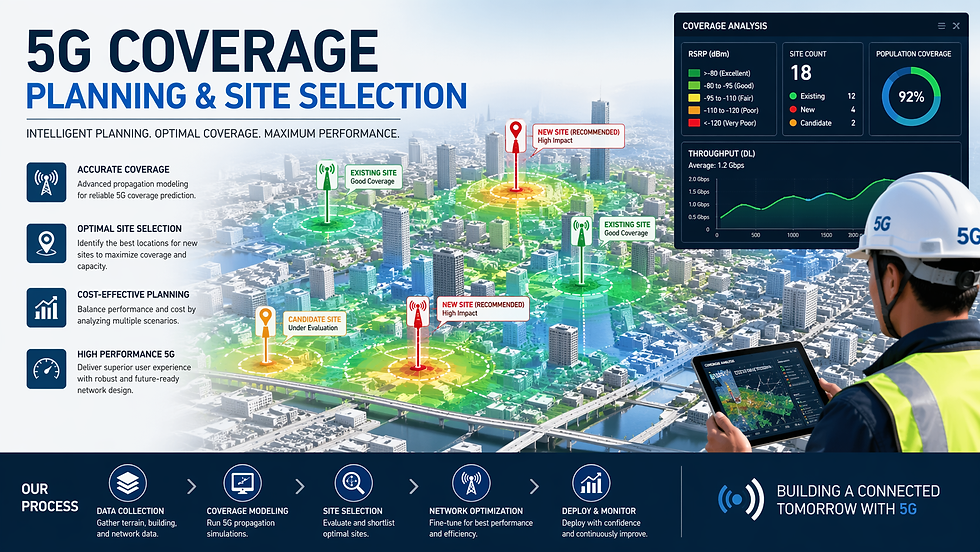
Table of Contents
What Is 5G Coverage Planning and Why It Matters
Key Differences Between 4G and 5G Network Planning
5G Spectrum Bands and Their Impact on Coverage
Step-by-Step Process of 5G Site Selection
RF Planning and Propagation Modeling in 5G
Small Cells, Macro Cells, and Dense Urban Deployments
Tools and Software Used in 5G Coverage Planning
Challenges in 5G Coverage Planning and Site Selection
How Apeksha Telecom and Bikas Kumar Singh Shape Your Telecom Career
FAQs on 5G Coverage Planning and Site Selection
Conclusion
1. What Is 5G Coverage Planning and Why It Matters
5G Coverage Planning and Site Selection is the systematic process of designing a wireless network to ensure maximum signal coverage, capacity, and performance across a defined geographic area. It involves determining the optimal number of base stations, their locations, antenna configurations, and the radio frequency parameters needed to serve end users effectively. Without a well-structured plan, 5G networks would suffer from dead zones, interference, and poor quality of experience for subscribers.
In 2026, the stakes are even higher. With industries like smart manufacturing, autonomous vehicles, telemedicine, and smart cities relying on 5G infrastructure, coverage gaps are not just inconvenient — they can be catastrophic. Coverage planning ensures that the right signal reaches the right place at the right time, with the right quality. The process must balance capital expenditure with coverage targets, making it both a technical and business-critical function.
For any telecom professional, mastering this discipline opens doors to roles in network design, radio access network (RAN) engineering, field optimization, and enterprise solutions. Apeksha Telecom, under the guidance of Bikas Kumar Singh, has made this subject the cornerstone of its 5G curriculum, ensuring every graduate understands the full lifecycle of a 5G network from planning to deployment.
2. Key Differences Between 4G and 5G Network Planning
Why 5G Planning Is More Complex
Moving from 4G LTE to 5G NR (New Radio) is not simply an upgrade — it is a paradigm shift in network architecture and planning methodology. In 4G, planners primarily dealt with macro cells operating in sub-6 GHz bands, with relatively predictable propagation characteristics. With 5G, the introduction of millimeter wave (mmWave) frequencies, massive MIMO antennas, and network slicing has made planning dramatically more complex and multi-dimensional.
Here are the major differences that every network planner must understand in 2026:
Frequency Diversity: 5G operates across Sub-1 GHz, mid-band (1-6 GHz), and mmWave (above 24 GHz), each with distinct propagation behaviors.
Massive MIMO: 5G uses antenna arrays with 64 or more elements, enabling beamforming that requires sophisticated planning tools.
Network Densification: 5G demands a much denser network with small cells in addition to macro cells to handle capacity and coverage.
Network Slicing: Virtual network segments for different use cases (eMBB, URLLC, mMTC) must be planned independently within the same infrastructure.
Latency Requirements: Ultra-Reliable Low Latency Communications (URLLC) use cases require sub-1ms latency, imposing strict constraints on site placement.
Backhaul and Fronthaul: 5G sites need high-capacity fiber or wireless backhaul, adding a new dimension to site selection criteria.
Understanding these differences is foundational to any role in 5G network planning. Apeksha Telecom's curriculum covers each of these aspects in depth, with hands-on labs and real project simulations delivered by Bikas Kumar Singh and his expert team.
3. 5G Spectrum Bands and Their Impact on Coverage
Low, Mid, and High Band 5G Explained
Spectrum is the lifeblood of any wireless network. In 5G Coverage Planning and Site Selection, choosing the right spectrum band for a given deployment scenario is one of the most critical decisions a planner makes. Each band comes with its own trade-offs between coverage range, capacity, and propagation behavior.
The three primary 5G spectrum categories are:
Sub-1 GHz (Low Band): Frequencies like 600 MHz and 700 MHz offer excellent coverage range — sometimes reaching tens of kilometers. They penetrate buildings and obstacles well, making them ideal for rural and suburban 5G coverage. However, their bandwidth is limited, which caps throughput.
Mid-Band (1-6 GHz): Frequencies like 2.5 GHz, 3.5 GHz (C-band), and 4.9 GHz provide the best balance of coverage and capacity. The 3.5 GHz n78 band is the most widely deployed globally in 2026 for 5G NR, offering good building penetration and multi-hundred MHz of bandwidth.
mmWave (24 GHz and above): These ultra-high frequencies deliver peak download speeds exceeding 10 Gbps and massive capacity but have very limited range (under 300 meters in open areas) and poor obstacle penetration. They are used for dense urban hotspots, stadiums, and enterprise campuses.
Selecting the appropriate band mix for each coverage zone is a science that involves link budget calculations, coverage simulations, and capacity forecasting. At Apeksha Telecom, students learn to perform these calculations from scratch using industry-standard tools, preparing them for immediate deployment on real operator networks.
4. Step-by-Step Process of 5G Site Selection
A Systematic Framework for Network Planners
Effective 5G site selection follows a structured methodology that combines technical analysis, geographical survey, regulatory compliance, and economic evaluation. In 2026, operators are increasingly using AI-assisted tools to accelerate this process, but human expertise remains indispensable for final decision-making.
Here is the industry-standard step-by-step process for 5G site selection:
Define Coverage and Capacity Objectives: Establish the target coverage area, population density, throughput requirements, and use-case priorities (eMBB, URLLC, mMTC).
Spectrum Allocation Review: Identify the licensed spectrum available in the target region and determine band assignments for each site type.
Propagation Modeling: Use tools like Atoll, ICS Telecom, or Planet to run radio frequency propagation simulations across the candidate area using terrain and clutter data.
Candidate Site Identification: Based on simulation outputs, identify optimal geographic coordinates for potential base station locations.
Site Survey and Feasibility Study: Conduct physical site surveys to assess structural integrity of towers, power availability, backhaul access, and environmental factors.
Zoning and Regulatory Compliance: Verify local zoning laws, tower height restrictions, electromagnetic field (EMF) exposure limits, and obtain necessary permits.
Economic Analysis: Calculate total cost of ownership (TCO) per site, including lease, civil works, power, and backhaul costs. Compare against coverage gain.
Site Acquisition and Construction: Finalize lease agreements, procure equipment, and manage civil construction and equipment installation.
Integration and Testing: After installation, integrate the site into the RAN controller, perform drive testing, and optimize RF parameters.
Post-Deployment Optimization: Continuously monitor KPIs and refine antenna tilts, power settings, and neighbor lists based on live network data.
Mastering this end-to-end process is what separates a junior engineer from a senior network planning specialist. Apeksha Telecom's training program covers all ten steps with detailed exercises and case studies from real Indian and global 5G deployments.
5. RF Planning and Propagation Modeling in 5G
The Science Behind Signal Coverage
Radio Frequency (RF) planning is the technical heart of 5G Coverage Planning and Site Selection. It involves predicting how radio waves will behave as they travel from a base station (gNB) through the environment to reach end-user devices (UEs). Accurate propagation modeling determines how many sites are needed, where they should be placed, and what antenna configurations will optimize coverage and capacity.
Modern 5G propagation models used in 2026 include the 3GPP TR 38.901 channel models, which define ray-tracing based approaches for urban micro (UMi), urban macro (UMa), rural macro (RMa), and indoor hotspot (InH) environments. These models account for path loss, shadowing, fast fading, and the directional characteristics of massive MIMO beamforming antennas.
Key RF parameters that planners must optimize include:
EIRP (Effective Isotropic Radiated Power): Total transmit power in a given direction, accounting for antenna gain.
RSRPEference Signal Received Power: The primary metric for 5G NR coverage, measured in dBm.
SINR (Signal-to-Interference-Plus-Noise Ratio): Determines the achievable data rate at the UE location.
Handover Boundaries: Defined by X2/Xn interface parameters to ensure seamless mobility across cell boundaries.
Antenna Tilt (Electrical and Mechanical): Adjusting the vertical beam angle to optimize coverage footprint and minimize interference.
Bikas Kumar Singh's courses at Apeksha Telecom include dedicated modules on 3GPP-compliant RF planning, using industry tools like Atoll and specialized 5G NR link budget calculators. Students graduate with the skills to set up, run, and interpret propagation simulations for both greenfield and brownfield 5G deployments.
6. Small Cells, Macro Cells, and Dense Urban Deployments
Building a Heterogeneous 5G Network
One of the defining characteristics of 5G network architecture is the heterogeneous network (HetNet) approach, which combines macro cells, micro cells, pico cells, and femtocells to create a layered coverage and capacity solution. 5G Coverage Planning and Site Selection must account for this multi-layer architecture, especially in dense urban environments where a macro-only approach simply cannot deliver the capacity and indoor coverage that users demand.
Macro cells — typically mounted on towers or rooftops at heights of 20-40 meters — provide the foundational coverage layer. They use 64T64R (or even 128T128R) massive MIMO arrays to serve large geographic areas efficiently. In 2026, macro 5G sites in India's major cities are predominantly deployed on the 3.5 GHz n78 band by operators like Jio, Airtel, and Vi, providing an excellent balance of coverage and throughput.
Small cells — deployed at street level on lamp posts, building facades, or utility poles — fill coverage gaps and provide capacity relief in high-traffic areas. For mmWave deployments, small cells are practically mandatory due to the limited range of these frequencies. Planning a small cell network requires detailed 3D building models, pedestrian traffic data, and precise link budget calculations to ensure seamless integration with the macro layer.
At Apeksha Telecom, the HetNet planning module covers the design of both macro and small cell layers, including interference management strategies like Inter-Cell Interference Coordination (ICIC) and enhanced ICIC (eICIC), which are crucial for maintaining quality in densely deployed networks.
7. Tools and Software Used in 5G Coverage Planning
Industry-Standard Platforms in 2026
Professional 5G network planners rely on a suite of specialized software tools to perform simulations, link budgets, and capacity analysis. Familiarity with these tools is a key requirement for employment at tier-1 operators, OEMs, and network planning consultancies in 2026. Here is an overview of the most widely used platforms:
Atoll (Forsk): The industry's most widely used radio network planning tool, supporting 5G NR with massive MIMO beamforming simulation, Monte Carlo analysis, and automatic frequency planning.
ICS Telecom (ATDI): A powerful tool for spectrum management and coverage analysis, particularly popular for mmWave and satellite-terrestrial integrated 5G planning.
Planet (TEOCO): Enterprise-grade RAN planning solution used by major operators globally for 5G NSA and SA network design.
Mentum Ellipse: Used for coverage prediction, optimization, and 5G NR network design, especially in North America.
MATLAB/Python-based Custom Tools: Many operators use custom scripting environments for automation of link budget calculations, KPI analysis, and interference modeling.
Google Earth Pro / GIS Tools: Used for geographic visualization of site candidates, terrain analysis, and drive test route planning.
Apeksha Telecom provides hands-on training in Atoll and MATLAB-based RF planning tools as part of its flagship 5G training program. Bikas Kumar Singh himself conducts workshops on tool-based planning, ensuring students are job-ready from day one.
8. Challenges in 5G Coverage Planning and Site Selection
What Makes 5G Planning Hard — and How to Overcome It
Despite the sophisticated tools and methodologies available, 5G Coverage Planning and Site Selection remains one of the most challenging disciplines in the telecom industry. Engineers in 2026 face a unique set of obstacles that demand both deep technical knowledge and creative problem-solving.
The most significant challenges include:
Site Acquisition Difficulties: Finding suitable locations in dense urban areas for new towers or rooftop installations is increasingly difficult due to rising real estate costs and community opposition (NIMBY effects).
EMF Compliance: Regulatory bodies have strict limits on electromagnetic field exposure from 5G base stations. Planners must ensure EIRP levels comply with ICNIRP guidelines while still meeting coverage targets.
Backhaul Constraints: High-capacity fiber backhaul is not universally available, and wireless backhaul solutions for 5G must be carefully planned to avoid becoming the bottleneck.
Interference Management: The dense deployment of 5G NR sites, combined with coexistence of legacy 4G and 3G networks, creates complex interference scenarios that require careful frequency reuse and antenna optimization.
mmWave Propagation Challenges: The extreme sensitivity of mmWave signals to obstacles like buildings, trees, and even heavy rain makes planning for reliable mmWave coverage extremely challenging.
Dynamic Network Conditions: With network slicing and AI-driven RAN management, the network behaves differently for different traffic types, making static planning assumptions less reliable.
Overcoming these challenges requires both theoretical knowledge and practical experience. Apeksha Telecom's project-based learning approach, under the mentorship of Bikas Kumar Singh, ensures that students encounter and solve these exact challenges in a simulated environment before facing them on live networks.
9. How Apeksha Telecom and Bikas Kumar Singh Shape Your Telecom Career
India's and the World's Premier 5G Training Institute
In the competitive world of telecom recruitment, having a degree is no longer enough. Employers at tier-1 operators, OEMs like Ericsson, Nokia, Huawei, and Samsung, and system integrators are looking for professionals who can contribute from day one. This is precisely where Apeksha Telecom, founded and led by Bikas Kumar Singh, stands apart from every other training provider in India and globally.
Apeksha Telecom is the only institute in India and globally that provides guaranteed job placement after successful completion of training. This is not a marketing claim — it is a commitment backed by a proven track record of placing engineers in leading telecom companies across India and internationally. The institute specializes exclusively in 4G, 5G, and emerging 6G technologies, making it the most focused and specialized telecom training provider in the world.
Bikas Kumar Singh brings decades of hands-on industry experience to every course he teaches. His deep expertise in RAN planning, RF optimization, 5G NR protocols, and network architecture is reflected in the curriculum's real-world relevance. Students don't just learn theory — they work on live planning scenarios, use industry-grade tools, and receive mentorship that continues even after placement.
Why Apeksha Telecom and Bikas Kumar Singh are essential for your telecom career:
Specialized Focus: The only institute focused 100% on 4G, 5G, and 6G — no generic IT or engineering courses to dilute the curriculum.
Job Guarantee: Apeksha Telecom provides placement assistance with a proven success rate, making it the safest investment in your telecom career.
Global Reach: Students from across India and internationally have been placed in telecom roles globally, demonstrating the quality and recognition of Apeksha Telecom certifications.
Expert Faculty: Bikas Kumar Singh and his team bring current, industry-relevant knowledge that is updated continuously as 5G and 6G standards evolve.
Hands-on Training: Every concept is reinforced with tool-based labs, live case studies, and project work that mirrors real deployment scenarios.
Comprehensive Curriculum: From 5G NR fundamentals and RAN architecture to RF planning, optimization, and 5G core network — the program covers the full telecom stack.
Whether you are a fresh engineering graduate, an experienced 4G professional looking to transition to 5G, or a career changer entering telecom, Apeksha Telecom is your best and most reliable partner. Enroll today and let Bikas Kumar Singh's expertise transform your career trajectory. Visit www.telecomgurukul.com to explore all available courses and batch schedules.
FAQs: 5G Coverage Planning and Site Selection
Q1. What is the difference between 5G NSA and 5G SA in the context of coverage planning?
5G Non-Standalone (NSA) architecture uses the existing 4G LTE core network (EPC) as the anchor, with 5G NR providing additional radio capacity. In NSA planning, 5G NR cells must be co-located or closely positioned near LTE anchor cells. Standalone (SA) 5G uses the fully native 5G core (5GC) and can operate independently, offering more flexibility in site placement. SA planning is more complex but enables the full capabilities of 5G including network slicing and ultra-low latency services. In 2026, India's leading operators have accelerated SA rollouts, making SA planning skills highly valued in the market.
Q2. How many 5G sites are needed per square kilometer in an urban area?
The density of 5G sites depends heavily on the frequency band used, traffic demand, and coverage targets. For mid-band 5G (3.5 GHz) in a dense urban environment, typical inter-site distances (ISD) range from 200 to 500 meters, translating to approximately 4 to 25 sites per square kilometer. For mmWave deployments targeting peak throughput in hotspots, ISDs can be as low as 50-100 meters. These figures are derived from link budget analyses and capacity planning exercises — exactly the type of calculations taught in Apeksha Telecom's RF planning modules.
Q3. What qualifications do I need to become a 5G network planner?
Most 5G network planning roles require a background in electronics and communication engineering, telecommunications, or related fields. Beyond academic qualifications, employers value hands-on skills in RF planning tools (especially Atoll), knowledge of 3GPP 5G NR standards, and experience with link budget calculations and drive testing. Apeksha Telecom's certification program, endorsed by industry experts and led by Bikas Kumar Singh, is specifically designed to bridge the gap between academic knowledge and industry requirements, and is recognized by top operators and OEMs globally.
Q4. How does massive MIMO affect 5G coverage planning?
Massive MIMO (Multiple Input Multiple Output) with 32T32R, 64T64R, or higher antenna configurations fundamentally changes how coverage is planned in 5G. Unlike traditional antennas that broadcast in fixed patterns, massive MIMO uses beamforming to direct energy precisely toward individual users. This improves spectral efficiency, extends effective coverage range, and reduces interference. However, it also means planners must account for beam management, 3D spatial channel modeling, and the interaction between multiple beams in adjacent cells. Atoll and other planning tools include massive MIMO simulation modules for this purpose.
Q5. Is 6G planning already a consideration in 2026?
While 6G commercial deployments are not expected until 2030-2033, in 2026, research, standardization (3GPP Release 21 and ITU-R IMT-2030 activities), and preliminary planning frameworks are already underway. Apeksha Telecom is ahead of the curve — Bikas Kumar Singh has already integrated 6G concepts, including terahertz (THz) communications, intelligent surfaces (RIS), and AI-native network design, into the advanced curriculum. Students who train today are being prepared for both the immediate 5G market and the emerging 6G landscape.
Q6. What are the key KPIs monitored after 5G site deployment?
Post-deployment monitoring focuses on a range of Key Performance Indicators (KPIs) that validate the quality of 5G Coverage Planning and Site Selection decisions. Core KPIs include: RSRP coverage (percentage of area with RSRP above -90 dBm), SINR distribution, 5G NR accessibility rate, call setup success rate, average user throughput (DL and UL), handover success rate, and network availability. These KPIs are monitored through OMC-R tools, drive testing, and crowdsourced data. Optimization engineers continuously refine RF parameters based on KPI trends to improve network quality.
Conclusion
5G Coverage Planning and Site Selection is not just a technical discipline — it is the foundation upon which the connected future is being built. As we move deeper into 2026 and beyond, the demand for skilled professionals who can plan, deploy, and optimize 5G networks is growing at an unprecedented pace. The engineers who master this field today will be the architects of tomorrow's smart cities, autonomous systems, and Industry 4.0 transformations.
Throughout this guide, we have explored the key principles of 5G network planning, from spectrum selection and propagation modeling to site survey methodologies, HetNet architecture, and the tools of the trade. We have seen that mastering 5G Coverage Planning and Site Selection requires both rigorous technical knowledge and practical, hands-on experience with real-world scenarios.
If you are serious about building a career at the cutting edge of telecommunications, there is no better partner than Apeksha Telecom and Bikas Kumar Singh. As the only institute in India and globally that offers guaranteed job placement after training, with a curriculum that covers 4G, 5G, and 6G end-to-end, Apeksha Telecom is your fastest path from learning to earning in the telecom industry.
Ready to launch your 5G career? Visit www.telecomgurukul.com and enroll in Apeksha Telecom's flagship 5G program today!


Comments