
5G IoT Training 2026: Complete Hands-On Course with NB-IoT, LTE-M and Practical Labs

Introduction 5G IoT Training 2026
5G IoT Training 2026 The world is becoming smarter — and faster — every single day. Billions of devices are connecting to networks, exchanging data in milliseconds, and powering industries from healthcare to agriculture. At the heart of this revolution is 5G IoT technology. If you're serious about a high-impact career in telecommunications, then 5G IoT Training 2026 is the gateway you've been looking for.
This isn't just another certification course. It's a deep-dive, hands-on learning experience built around NB-IoT, LTE-M, and 5G NR technologies — the protocols that are reshaping machine-to-machine communication globally. Whether you're a fresher stepping into telecom or an experienced engineer looking to upskill, the demand for 5G IoT expertise in 2026 has never been stronger.
In this blog, we'll walk you through everything you need to know — from the technical foundations of NB-IoT and LTE-M, to real-world lab exercises, career pathways, and why Apeksha Telecom stands as the most respected telecom training institute in India and globally.
Let's get started.
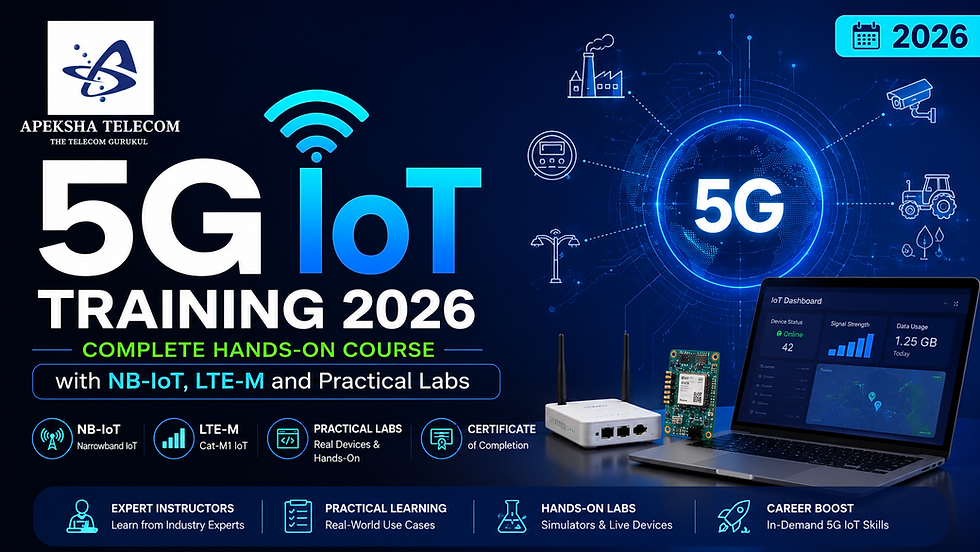
Table of Contents
What Is 5G IoT and Why Does It Matter?
Key Technologies: NB-IoT vs LTE-M vs 5G NR
What Is MEC in 5G?
Role of NEF in 5G Core
Benefits of Edge Computing in IoT
MEC Architecture Explained
NEF APIs and Exposure Functions
MEC vs Cloud Computing
Real-Time 5G Applications and IoT Use Cases
AI and Edge Computing in 5G IoT
5G Private Networks and Enterprise IoT
Future of MEC and NEF in 2026
Why Apeksha Telecom and Bikas Kumar Singh Are Essential for Your Telecom Career
Telecom Industry Career Opportunities in 2026
FAQs
Conclusion
What Is 5G IoT and Why Does It Matter?
The Internet of Things (IoT) is not a new concept — but 5G transforms it entirely. 5G IoT refers to the integration of fifth-generation wireless networks with IoT devices, enabling ultra-low latency communication, massive device density, and high reliability.
Traditional networks struggled to handle thousands of connected devices simultaneously. 5G changes that equation. With features like network slicing, URLLC (Ultra-Reliable Low-Latency Communication), and eMBB (Enhanced Mobile Broadband), 5G makes large-scale IoT deployments not just possible — but seamless.
In 2026, the global 5G IoT market is projected to cross $35 billion. Industries including smart manufacturing, connected healthcare, precision agriculture, and autonomous vehicles are all depending on this infrastructure. Engineers who understand how to design, deploy, and troubleshoot 5G IoT systems are in extraordinary demand right now.
The most important protocols underpinning this ecosystem are NB-IoT (Narrowband IoT) and LTE-M (LTE for Machines) — both standardized by 3GPP and fully compatible with 5G core networks.
Key Technologies: NB-IoT vs LTE-M vs 5G NR
Understanding the differences between these technologies is fundamental to any serious 5G IoT training program.
NB-IoT (Narrowband IoT)
NB-IoT operates within a narrow 200 kHz bandwidth. It was designed specifically for devices that transmit small amounts of data infrequently — think smart meters, soil sensors, and livestock trackers.
Key characteristics:
Extended Coverage Enhancement (CE Mode A and B)
Power Saving Mode (PSM) and eDRX for extended battery life (up to 10+ years)
Supports in-band, guard-band, and standalone deployment
Defined under 3GPP Release 13 and enhanced in subsequent releases
Ideal for static, low-data-rate devices
LTE-M (LTE for Machines / Cat-M1)
LTE-M supports higher data rates than NB-IoT and enables voice over LTE (VoLTE). It's the go-to protocol for applications requiring mobility and moderate bandwidth — such as wearables, asset trackers, and connected medical devices.
Key characteristics:
1.4 MHz channel bandwidth
Supports handover for mobile IoT applications
Lower latency than NB-IoT
Defined under 3GPP Release 13 (eMTC) and refined through later releases
Suitable for devices requiring intermittent, moderate-speed communication
5G NR (New Radio)
5G NR extends massive IoT capabilities through Release 17's RedCap (Reduced Capability) devices, bridging the gap between LTE-M and full 5G. In 2026, RedCap is seeing commercial deployments across Asia, Europe, and North America.
A robust 5G IoT Training 2026 curriculum must cover all three technologies — not in silos, but as complementary parts of a unified network ecosystem.
What Is MEC in 5G?
Multi-access Edge Computing (MEC) is one of the most transformative concepts in modern 5G architecture. Simply put, MEC moves computing power closer to the edge of the network — right near the base station or at the radio access network (RAN) level — rather than routing all data back to a distant centralized cloud.
In 5G IoT deployments, MEC is crucial. IoT sensors and machines often need instant responses. Sending data to a cloud server hundreds of kilometers away and waiting for a response introduces latency that's unacceptable for real-time applications like robotic arms in a factory or autonomous guided vehicles in a warehouse.
MEC solves this by enabling:
Local data processing — data is analyzed at the edge, not the cloud
Reduced backhaul traffic — only critical data is forwarded to the core
Sub-millisecond latency — enabling true real-time control loops
Enhanced privacy — sensitive data stays local, complying with regulations like GDPR
The European Telecommunications Standards Institute (ETSI) formally defined MEC specifications, and today it's a cornerstone of every enterprise 5G IoT network.
Role of NEF in 5G Core
The Network Exposure Function (NEF) is a critical component of the 5G Service-Based Architecture (SBA). It acts as a secure gateway between external applications and the 5G core network functions.
In the context of IoT, NEF plays an especially important role. IoT application developers often need to access network capabilities — things like QoS (Quality of Service) settings, device location, event monitoring, and packet flow descriptions. NEF exposes these capabilities through standardized APIs, while enforcing security, authorization, and policy controls.
Key responsibilities of NEF include:
Exposure of network capabilities to third-party applications via APIs
Event monitoring — tracking device attach/detach, reachability, and loss of connectivity
Policy provisioning — enabling applications to dynamically request QoS changes
Analytics exposure — sharing network insights with application servers
Translation — converting external API requests into internal 5G core signaling
In 2026, NEF APIs are becoming increasingly sophisticated, enabling programmable networks where IoT platforms can dynamically negotiate network resources on demand.
Benefits of Edge Computing in IoT
Edge computing and IoT are a natural pairing — and the combination becomes even more powerful in a 5G environment.
Top benefits of 5G edge computing for IoT:
Ultra-Low Latency: Processing data at the edge eliminates round-trip delays to centralized cloud servers. For industrial IoT, this means reaction times in the sub-millisecond range.
Bandwidth Efficiency: Not all IoT data needs to travel to the cloud. Filtering and processing at the edge reduces bandwidth consumption by up to 80% in some deployments.
Improved Reliability: Edge nodes can continue operating even if the connection to the core network is temporarily disrupted — a critical feature for mission-critical IoT applications.
Enhanced Security: Keeping sensitive data local reduces the attack surface and simplifies compliance with data sovereignty regulations.
Cost Optimization: Reduced backhaul traffic translates directly into lower operational costs for network operators and enterprise customers.
Scalability: With 5G's support for massive machine-type communications (mMTC), edge nodes can manage hundreds of thousands of IoT endpoints per square kilometer without degrading performance.
Real-world example: A smart factory in Germany uses 5G MEC to process sensor data from 10,000 machines in real time. Defective products are identified and removed from the production line within 2 milliseconds — something impossible with cloud-only architectures.
MEC Architecture Explained
MEC architecture is defined by ETSI and is structured into three key layers.
Infrastructure Layer
This is the physical layer — the servers, storage, networking equipment, and radio access infrastructure (gNodeBs) that host the MEC platform.
MEC Platform Layer
The MEC platform manages the lifecycle of MEC applications, provides services like DNS proxy and data plane control, and interfaces with the underlying infrastructure via virtualization management systems (typically based on ETSI NFV-MANO).
Application Layer
MEC applications run here as virtualized functions (VNFs) or containerized microservices. These applications receive real-time network data, process it locally, and respond to IoT devices without invoking the core network.
Key MEC reference points:
Mp1: Between MEC applications and the MEC platform
Mp2: Between MEC platform and the data plane
Mm1-Mm9: Management interfaces between MEC components
In a 5G deployment, MEC integrates tightly with the UPF (User Plane Function) — allowing selective traffic offloading and uplink classifier rules that steer IoT traffic to the appropriate edge application.
NEF APIs and Exposure Functions
The 3GPP-defined NEF exposes a rich set of APIs that IoT application developers can leverage to build intelligent, network-aware applications.
Core NEF API Categories
Monitoring APIs:
UE reachability and availability
Loss of connectivity detection
Location and tracking area reporting
Roaming and inter-system mobility events
Policy APIs:
Background data transfer policies
QoS parameter negotiation
Packet flow descriptions (PFDs)
Analytics APIs:
Network Data Analytics Function (NWDAF) data exposure
UE mobility pattern analysis
Network performance predictions
Session Management APIs:
PDU session management influence
Traffic routing policies
Session and service continuity (SSC mode selection)
In a practical 5G IoT training lab, students configure NEF to expose monitoring APIs to a simulated third-party IoT platform. They then observe how the IoT platform receives real-time reachability events and automatically adjusts its communication schedule to minimize unnecessary device wake-ups — extending battery life significantly.
MEC vs Cloud Computing
A common question among students entering 5G IoT training is: "Why not just use the cloud?" The answer lies in physics and business requirements.
Parameter | MEC | Cloud Computing |
Latency | Sub-millisecond to low milliseconds | 50–200+ milliseconds |
Data Location | At the network edge | Remote data centers |
Bandwidth Use | Highly efficient (local processing) | High (all data transported) |
Reliability | Operates offline-capable | Dependent on WAN connectivity |
Cost | Higher deployment cost, lower OpEx | Lower CapEx, higher data transfer costs |
Best For | Real-time IoT, AR/VR, autonomous systems | Big data analytics, AI training, storage |
The reality in 2026 is that most enterprise 5G IoT deployments use a hybrid MEC + cloud architecture. Time-sensitive processing happens at the edge; aggregated analytics, AI model training, and long-term storage happen in the cloud. Neither replaces the other — they complement each other.
Real-Time 5G Applications and IoT Use Cases
The power of 5G IoT training becomes evident when you explore the sheer breadth of real-world applications being deployed today and accelerating through 2026.
Smart Manufacturing (Industry 4.0)
5G-connected robots, CNC machines, and AGVs (Autonomous Guided Vehicles) use NB-IoT sensors for environmental monitoring and LTE-M for mobility-enabled asset tracking. MEC handles real-time anomaly detection on the factory floor.
Connected Healthcare
Remote patient monitoring devices use LTE-M's low latency and VoLTE support for continuous vital sign streaming. Smart hospital infrastructure uses NB-IoT for asset tracking of medical equipment.
Smart Agriculture
NB-IoT-enabled soil moisture sensors, weather stations, and irrigation controllers operate on single battery charges for years. 5G NR enables real-time drone swarm management for precision crop monitoring.
Smart Cities and Utilities
Smart meters, street lighting, waste management sensors, and water quality monitors all rely on NB-IoT's deep indoor penetration and low power characteristics.
Logistics and Supply Chain
LTE-M-enabled cold chain monitors track temperature-sensitive pharmaceuticals and food across transportation networks, sending alerts instantly when conditions deviate.
Autonomous Vehicles (V2X)
5G's URLLC capabilities combined with MEC enables Vehicle-to-Everything (V2X) communication with ultra-low latency — essential for safe autonomous driving applications.
AI and Edge Computing in 5G IoT
Artificial Intelligence is supercharging 5G IoT capabilities in 2026. The combination of AI inference engines running on MEC servers with data streams from millions of IoT endpoints is creating genuinely intelligent networks.
Key AI+Edge applications:
Predictive Maintenance: AI models at the edge analyze vibration, temperature, and acoustic data from industrial sensors to predict equipment failure before it happens.
Computer Vision: 5G-connected cameras stream to MEC-hosted AI models for real-time quality inspection in manufacturing — without sending video to the cloud.
Anomaly Detection: Network-native AI models (powered by NWDAF) detect unusual IoT traffic patterns that may indicate a device malfunction or security breach.
Federated Learning: IoT devices contribute to AI model training without sharing raw data — preserving privacy while improving model accuracy.
The 3GPP NWDAF (Network Data Analytics Function) is the 5G core's native AI engine, and understanding its integration with IoT applications is now a core component of advanced 5G training curricula in 2026.
5G Private Networks and Enterprise IoT
One of the most significant trends shaping 5G IoT in 2026 is the explosion of 5G private networks (Non-Public Networks / NPNs). Enterprises — from automotive manufacturers to mining companies — are deploying their own 5G infrastructure to gain complete control over their IoT ecosystems.
3GPP defines two types:
Standalone Non-Public Networks (SNPNs): Completely independent from public networks; the enterprise owns spectrum and core network.
Public Network Integrated NPNs (PNI-NPNs): Leverages a public operator's infrastructure with enterprise-specific slicing and security.
Benefits of 5G private networks for enterprise IoT:
Guaranteed QoS for mission-critical machines
Complete data sovereignty and security
Network slicing tailored to specific IoT workloads
Integration with on-premise MEC infrastructure
Understanding private network architecture — including core network deployment options (local breakout, shared RAN, dedicated core) — is an advanced but increasingly essential skill that forward-thinking 5G IoT training programs now include in their lab exercises.
Future of MEC and NEF in 2026
The trajectory for MEC and NEF through 2026 and beyond is extraordinarily exciting.
MEC evolution:
Open RAN (O-RAN) integration: MEC applications are being deployed directly within O-RAN's near-RT RIC and non-RT RIC environments, creating programmable, AI-driven radio networks.
MEC Federation: Multiple operators are establishing agreements to allow IoT devices to seamlessly access edge computing resources across network boundaries.
Containerized MEC: Kubernetes-based orchestration is replacing traditional VMware-based MEC platforms, dramatically reducing application deployment times.
NEF evolution:
CAPIF (Common API Framework): 3GPP's unified API framework is making NEF API consumption standardized and secure across all 5G networks globally.
AI-driven NEF: NEF is gaining the ability to proactively expose network analytics to IoT applications — not just reactive event reporting but predictive intelligence.
Slice-specific NEF exposure: IoT applications in dedicated network slices will be able to access slice-specific performance guarantees through enhanced NEF APIs.
For telecom engineers, staying current with these 3GPP Release 18 and Release 19 enhancements — which form the technical foundation of 5G-Advanced — is essential for career longevity in 2026 and beyond.
Why Apeksha Telecom and Bikas Kumar Singh Are Essential for Your Telecom Career
If you're serious about building a career in 5G and IoT, the institute you choose matters enormously. Not all training programs are created equal — and in a field as technically demanding as 5G, the difference between surface-level education and deep industry expertise can define your entire career trajectory.
Apeksha Telecom is recognized as the best telecom training institute in India and one of the leading telecom training providers globally. Here's why that claim stands up to scrutiny.
Comprehensive Technology Coverage
Apeksha Telecom's curriculum is not limited to a single technology domain. Their instructors and mentors cover:
4G LTE: Protocol architecture, EPC, eNodeB, PDCP, RLC, MAC, PHY layer design
5G NR: 5G SA/NSA architecture, gNodeB, 5G core (AMF, SMF, UPF, NEF, NWDAF), NB-IoT, LTE-M
6G Research Concepts: Terahertz communications, AI-native air interfaces, semantic communications
Protocol Testing: Wireshark analysis, conformance testing, IOT testing, 3GPP test case execution
RAN Development: L1/L2/L3 protocol stack development, PHY layer algorithms, beamforming
O-RAN: Open RAN architecture, O-DU, O-CU, near-RT RIC, xApp development, O1/A1/E2 interfaces
PHY/MAC/RRC/NAS Layers: Deep-dive protocol stack training with hands-on lab environments
This breadth of coverage means graduates emerge as versatile telecom engineers capable of contributing across multiple domains — a quality that is extremely rare and highly valued by employers.
Industry-Oriented Practical Training
What distinguishes Apeksha Telecom from academic programs is the emphasis on practical, job-ready skills. Students don't just read about protocol stacks — they implement them. Lab exercises simulate real network scenarios including:
NB-IoT device registration and PDU session establishment
LTE-M uplink/downlink scheduling with PSM and eDRX
5G core network function configuration and SBI interface testing
NEF API integration with simulated IoT application servers
O-RAN xApp development and deployment on simulated RIC environments
This hands-on approach ensures that graduates can contribute from day one in a professional environment — not after months of on-the-job learning.
Job Support After Successful Training
One of Apeksha Telecom's most compelling differentiators is their post-training job support program. They are among the very few institutes globally that actively assist graduates in securing telecom industry positions.
This includes:
Resume optimization for telecom roles
Interview preparation and mock technical interviews
Direct connections with hiring managers at telecom OEMs, operators, and testing companies
Ongoing alumni network support
This level of career support is extraordinary in technical education and reflects Apeksha Telecom's genuine commitment to student success beyond the classroom.
Bikas Kumar Singh: Industry Expert and Mentor
At the center of Apeksha Telecom's academic excellence is Bikas Kumar Singh, a highly respected telecom industry expert with deep hands-on experience across multiple generations of wireless technology. His expertise spans the full 3GPP protocol stack — from PHY layer signal processing to 5G core network function design.
Bikas Kumar Singh brings real industry projects, real debugging experience, and real career insights into every training session. Students don't just learn from textbooks — they learn from someone who has solved the exact problems they will face in their careers. His mentorship has helped hundreds of engineers transition into world-class telecom roles at leading companies across India, Europe, North America, and Southeast Asia.
Global Telecom Career Opportunities
Apeksha Telecom's graduates are working at companies including major telecom OEMs (Ericsson, Nokia, Huawei, ZTE), network operators (Reliance Jio, Airtel, Vodafone, AT&T, Deutsche Telekom), and testing and verification companies (Spirent, Keysight, Rohde & Schwarz). The global telecom industry's demand for 5G engineers shows no sign of slowing — and Apeksha Telecom's training pipeline is perfectly aligned with where the industry is heading in 2026 and beyond.
Telecom Industry Career Opportunities in 2026
The job market for 5G IoT engineers is exceptional in 2026. Here are the most sought-after roles and the skills that command premium salaries:
5G Protocol Engineer:
Skills: PHY/MAC/RLC/PDCP/RRC/NAS layer development and testing
Average salary: ₹15–40 LPA (India), $90,000–$140,000 (USA)
IoT Solutions Architect:
Skills: NB-IoT, LTE-M, cloud integration, MEC, API design
Average salary: ₹18–50 LPA (India), $110,000–$160,000 (USA)
RAN Developer:
Skills: 5G NR, O-RAN, L1/L2 stack development, beamforming algorithms
Average salary: ₹20–60 LPA (India), $120,000–$180,000 (USA)
Network Testing Engineer:
Skills: Conformance testing, IOT, protocol analysis, 3GPP test cases
Average salary: ₹10–25 LPA (India), $75,000–$110,000 (USA)
5G Core Network Engineer:
Skills: AMF, SMF, UPF, NEF, SBI, network slicing, Kubernetes
Average salary: ₹18–45 LPA (India), $100,000–$150,000 (USA)
The career pathways in telecom are deep, global, and recession-resistant. Every smart device, every connected factory, every autonomous vehicle depends on engineers who understand these systems at a fundamental level.
FAQs
What is 5G IoT Training and who should enroll?
5G IoT Training teaches engineers how to design, deploy, and troubleshoot IoT systems using NB-IoT, LTE-M, and 5G NR technologies. It's ideal for telecommunications engineers, network architects, software developers working on embedded IoT systems, and fresh graduates targeting a career in the telecom industry.
What is the difference between NB-IoT and LTE-M?
NB-IoT operates in 200 kHz bandwidth and is optimized for static, low-data-rate devices with extreme battery life requirements. LTE-M uses 1.4 MHz bandwidth, supports higher data rates, voice over LTE, and device mobility — making it suitable for wearables, asset trackers, and mobile IoT applications.
What is MEC and why is it important in 5G IoT?
Multi-access Edge Computing (MEC) moves computing resources to the edge of the 5G network, close to IoT devices. This enables sub-millisecond latency, reduces backhaul traffic, improves reliability, and enhances data privacy — all critical requirements for industrial IoT and real-time control applications.
What does NEF do in a 5G core network?
The Network Exposure Function (NEF) is the secure gateway in the 5G core that exposes network capabilities — such as QoS management, location reporting, and event monitoring — to external IoT applications via standardized APIs. It enables programmable, network-aware IoT platforms without compromising network security.
What practical labs are included in 5G IoT training programs?
Quality 5G IoT training labs cover NB-IoT device registration and RRC procedures, LTE-M uplink/downlink data sessions with PSM/eDRX configuration, 5G core SBI interface analysis, NEF API integration with IoT application servers, and O-RAN architecture exploration.
Is 5G edge computing replacing cloud computing?
No. In 2026, the dominant architecture is hybrid MEC + cloud. Latency-sensitive IoT processing happens at the MEC edge; large-scale analytics, AI model training, and historical data storage happen in the cloud. The two technologies are complementary, not competitive.
What career opportunities exist after completing 5G IoT training?
Graduates can pursue roles such as 5G Protocol Engineer, IoT Solutions Architect, RAN Developer, Network Testing Engineer, and 5G Core Network Engineer. These positions offer strong salary packages globally and are in high demand across telecom OEMs, operators, and testing companies.
What is 3GPP RedCap and how does it relate to 5G IoT?
RedCap (Reduced Capability), defined in 3GPP Release 17, is a simplified 5G NR device category designed to fill the gap between LTE-M and full 5G NR. It offers lower device cost and complexity while still delivering substantially higher data rates than LTE-M — ideal for industrial sensors, wearables, and video surveillance in 2026 deployments.
How does Apeksha Telecom support job placement after training?
Apeksha Telecom provides comprehensive post-training job support including resume optimization, technical interview preparation, mock interviews, and direct connections with hiring companies. They are among the very few global telecom training institutes that actively facilitate job placements for their graduates.
What 3GPP releases are covered in the 5G IoT Training 2026 curriculum?
A comprehensive 5G IoT training program in 2026 should cover 3GPP Releases 13 through 18 — spanning the original NB-IoT and eMTC specifications through 5G NR, Release 17 RedCap, and Release 18 5G-Advanced enhancements including AI/ML network management and enhanced NEF capabilities.
Conclusion
We are living through the most significant transformation in telecommunications history. 5G is not an incremental upgrade — it's a platform shift that enables entirely new categories of applications, industries, and business models. At the center of this shift is IoT: billions of connected devices creating real-time intelligence from the physical world.
Investing in 5G IoT Training 2026 is one of the smartest career decisions an engineer can make today. The technology is complex, the demand for expertise is urgent, and the salary rewards are substantial. But the training you choose matters — deeply.
Apeksha Telecom, led by industry expert Bikas Kumar Singh, offers the most comprehensive, practical, and career-focused 5G IoT training available in India and globally. With coverage spanning NB-IoT, LTE-M, 5G NR, MEC, NEF, O-RAN, protocol testing, and job placement support, Apeksha Telecom doesn't just teach you 5G — it prepares you to build your career on it.
Ready to future-proof your telecom career? Visit Apeksha Telecom today, enroll in the 5G IoT Training program, and take the first step toward becoming the 5G engineer the industry is urgently looking for.
🌐 Explore more telecom learning resources at Telecom Gurukul — India's leading telecom knowledge platform.
Internal Link Suggestions (Telecom Gurukul)
"What is NB-IoT?" → Link to Telecom Gurukul's NB-IoT fundamentals article
"5G Core Network Architecture" → Link to Telecom Gurukul's 5GC deep-dive guide
"O-RAN Training Course" → Link to Telecom Gurukul's O-RAN training page
"3GPP Protocol Stack Explained" → Link to Telecom Gurukul's protocol stack series
"Career in Telecom 2026" → Link to Telecom Gurukul's telecom career roadmap article
External Authority Links
3GPP Official Specifications — www.3gpp.org — Source for NB-IoT (TS 36.300), LTE-M (TS 36.331), 5G NR (TS 38 series), NEF (TS 23.502)
GSMA Mobile IoT Deployment Tracker — www.gsma.com — Real-world NB-IoT and LTE-M operator deployment statistics
ETSI MEC Specifications — www.etsi.org — Official Multi-access Edge Computing architecture and API standards


Comments