
5G Technology Training Course – Boost Your Telecom Career in 2026 | Complete Guide

Introduction 5G Technology Training Course
5G Technology Training Course The telecom industry is not slowing down — it's accelerating faster than ever before. If you've been wondering whether now is the right time to invest in a 5G Technology Training Course, let us answer that clearly: 2026 is your window of opportunity. And that window won't stay open forever.
Global 5G subscriptions are projected to cross 5.5 billion by the end of 2026, according to GSMA Intelligence. Operators from Mumbai to Munich are rolling out 5G standalone networks, deploying private 5G for industrial applications, and integrating AI-powered edge computing into their infrastructure. This explosive growth is creating an unprecedented demand for skilled telecom professionals — engineers who understand not just the theory, but the actual protocol layers, architecture decisions, and real-world deployment scenarios.
Whether you're a fresh engineering graduate, an LTE professional looking to upgrade your skills, or an IT professional pivoting into telecom, this guide will show you exactly why enrolling in a 5G training program in 2026 could be the smartest career decision you ever make.5G Technology Training Course
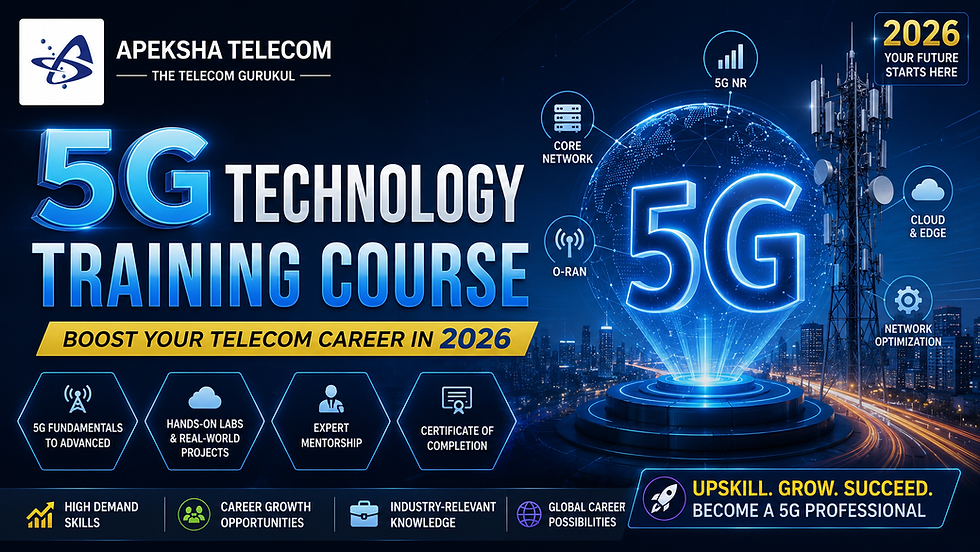
Table of Contents
What Is 5G Technology and Why Does It Matter in 2026?
What Is MEC in 5G? Understanding Multi-Access Edge Computing
Role of NEF in 5G Core Networks
Benefits of Edge Computing in 5G Networks
MEC Architecture: How It Works
NEF APIs and Exposure Functions Explained
MEC vs Cloud Computing: Key Differences
Real-Time 5G Applications Transforming Industries
AI and Edge Computing: The Intelligence at the Network Edge
5G Private Networks: Enterprise Revolution
Future of MEC and NEF in 2026 and Beyond
Telecom Industry Career Opportunities in 2026
Why Apeksha Telecom and Bikas Kumar Singh Are Essential for Your Telecom Career
FAQs
Conclusion
What Is 5G Technology and Why Does It Matter in 2026?
5G — the fifth generation of mobile network technology — is more than just faster internet on your phone. It represents a fundamental shift in how networks are designed, deployed, and consumed. Built on 3GPP Release 15 and evolving through Release 17 and beyond, 5G introduces three cornerstone capabilities that earlier generations simply couldn't deliver at scale.
The first is eMBB (Enhanced Mobile Broadband) — delivering peak data rates up to 20 Gbps with broad coverage. The second is URLLC (Ultra-Reliable Low Latency Communications) — enabling sub-1ms latency critical for industrial automation and connected vehicles. The third is mMTC (Massive Machine-Type Communications) — connecting up to one million devices per square kilometer, making the Internet of Things truly viable at scale.
In 2026, these capabilities are no longer theoretical. They are live, operational, and being expanded. Countries across Asia, Europe, and North America are rolling out 5G Standalone (SA) networks with full 5G Core (5GC) architecture — replacing the older Non-Standalone (NSA) Option 3x deployments that relied on 4G cores. This shift demands engineers who understand Service-Based Architecture (SBA), Network Functions like AMF, SMF, UPF, NEF, and the nuances of protocol stacks from PHY through RRC and NAS layers.
Enrolling in a structured 5G Technology Training Course right now means you step into this expanding market armed with practical, job-relevant knowledge — not just theoretical familiarity.
What Is MEC in 5G? Understanding Multi-Access Edge Computing
Multi-Access Edge Computing (MEC), sometimes called Mobile Edge Computing, is one of the most transformative technologies in the 5G ecosystem. At its core, MEC brings computing power and application hosting physically closer to the end user — at the edge of the radio access network — rather than routing all traffic back to a distant centralized cloud data center.
Think of MEC as a mini cloud deployed inside or near a base station or local network node. When a factory robot sends a sensor reading, MEC processes it locally in milliseconds rather than routing it across the internet to a server farm thousands of kilometers away. This eliminates round-trip latency, reduces backhaul congestion, and enables real-time decision-making that centralized cloud simply cannot match.
The European Telecommunications Standards Institute (ETSI) has been a driving force in standardizing MEC. According to ETSI GS MEC 003, MEC is defined as a system that provides IT and cloud-computing capabilities within the radio access network — and in 5G, this integration is seamlessly supported through the 5G Core's User Plane Function (UPF) and local breakout capabilities (as defined in 3GPP TS 23.501).
Key characteristics of MEC in 5G include:
Ultra-low latency: Processing at the edge eliminates core network round trips
Local data processing: Sensitive data stays local, enhancing privacy and compliance
Bandwidth optimization: Only processed results — not raw data — traverse the backhaul
Context-aware services: Location, network condition, and user context available in real time
Application flexibility: Support for third-party application deployment at the edge
For telecom engineers in 2026, MEC is not optional knowledge — it's table stakes. Understanding how MEC integrates with gNBs (5G base stations), UPFs, and the 5G Core is essential for any deployment or architecture role.
Role of NEF in 5G Core Networks
The Network Exposure Function (NEF) is one of the most strategically important Network Functions (NFs) in the 5G Core's Service-Based Architecture. Defined in 3GPP TS 23.502, NEF serves as the secure gateway through which external applications and third-party services can interact with 5G network capabilities — without directly accessing internal network functions.
In simple terms, NEF is the API broker of the 5G world. It sits between the internal 5G Core network functions and the external Application Functions (AFs), translating and brokering requests while enforcing security, policy, and authorization rules.
Here's what NEF enables in practical terms:
Event exposure: External applications can subscribe to network events like UE location updates, session status changes, and QoS notifications
Policy influence: Third-party AFs can request specific QoS treatments for their traffic flows via NEF
Analytics exposure: NWDAF (Network Data Analytics Function) insights can be surfaced to external systems through NEF
Monitoring: Applications can request UE reachability monitoring without requiring direct access to core functions
Background data transfer: NEF enables negotiation of time windows and transfer policies for IoT background data uploads
NEF becomes especially powerful when combined with MEC deployments. An edge application can use NEF APIs to request specific network resources, monitor QoS in real time, and adapt its behavior based on network conditions — all securely and in real time. For engineers building 5G-native applications or designing private network integrations in 2026, deep knowledge of NEF is indispensable.
Benefits of Edge Computing in 5G Networks
Edge computing in 5G networks unlocks a set of benefits that are reshaping entire industries. The combination of 5G's radio capabilities with edge processing power creates a platform for applications that simply weren't possible before.
Ultra-low latency: By processing data at the network edge — sometimes within 1–5ms — 5G MEC enables applications like real-time surgical robotics, autonomous vehicle coordination, and industrial automation that require near-instantaneous responses.
Bandwidth efficiency: Consider a smart factory with 500 cameras generating terabytes of raw video per hour. Without edge computing, all that data would need to travel across the backhaul network to a central cloud. With MEC, AI inference runs locally — only alerts and metadata are sent upstream, reducing backhaul load by up to 90%.
Enhanced security and data sovereignty: Healthcare, finance, and government sectors have strict data residency requirements. Edge computing keeps sensitive data local, within defined geographic boundaries, satisfying GDPR, HIPAA, and similar regulatory requirements without sacrificing performance.
Carrier-grade reliability: Unlike public cloud outages that affect global services, MEC operates independently. A local edge node continues functioning even if the backhaul connection to the internet is disrupted — critical for industrial and safety applications.
Cost optimization: Reduced backhaul consumption translates directly into lower operational costs. Telecom operators can also monetize edge infrastructure by offering MEC-as-a-Service to enterprise customers, creating new revenue streams beyond traditional connectivity.
Support for AI/ML at the edge: Running machine learning inference locally — rather than sending data to a central cloud for processing — reduces latency, improves privacy, and enables AI-powered services in environments where cloud connectivity is unreliable.
MEC Architecture: How It Works
Understanding MEC architecture is crucial for anyone pursuing a serious telecom career in 2026. The ETSI MEC framework defines a hierarchical, layered architecture that integrates with the 5G network in a clean, standardized way.
The MEC Host is the fundamental building block. It consists of:
MEC Platform: The software environment that manages MEC applications, provides APIs, and enforces traffic rules
Virtualization Infrastructure: The compute, storage, and networking resources (typically an NFV Infrastructure or bare-metal server)
MEC Applications: Third-party or operator-deployed applications running on the MEC host
The MEC System Level includes the MEC Orchestrator, which manages the lifecycle of MEC applications across multiple MEC hosts — determining where to deploy applications, managing resource scaling, and enforcing operator policies.
In 5G integration, MEC works tightly with the UPF. The UPF can be configured for Local Area Data Networks (LADNs) and N6-LAN architectures that steer traffic directly to MEC hosts without traversing the full 5G Core. This local traffic breakout — guided by Session Management Function (SMF) policies — is what enables the ultra-low latency MEC promises.
The 5G MEC reference architecture also supports:
ULCL (Uplink Classifier): A UPF insert that inspects uplink traffic and directs it to the appropriate MEC host or internet based on packet filters
Multi-homing: UEs can simultaneously maintain connections to both the local MEC and the central internet
Dynamic app deployment: The MEC Orchestrator can spin up new application instances near users as they move
NEF APIs and Exposure Functions Explained
NEF in 5G exposes a rich set of standardized APIs that enable a new generation of network-aware applications. These APIs are defined in 3GPP TS 29.522 and use RESTful HTTP/2 interfaces consistent with the broader 5G Core SBA design.
The core NEF API categories include:
Monitoring Event APIs (TS 29.508): Applications can subscribe to UE-specific events such as location reporting, UE reachability, loss of connectivity, and roaming status. A logistics company, for example, can use these APIs to track delivery vehicles without requiring the vehicles to run separate GPS reporting apps.
Policy Authorization APIs: Via NEF, an AF can influence the PCF (Policy Control Function) to apply specific QoS policies to a user's session. A gaming company could request guaranteed low-latency treatment for their game traffic, and NEF would relay this request to the PCF after validation.
Traffic Influence APIs (TS 29.522): These allow AFs to influence how UPF routes traffic — for instance, directing a user's video traffic to an edge MEC node running a video CDN rather than routing it to a distant origin server.
Background Data Transfer APIs: IoT device fleets — smart meters, environmental sensors — can use these APIs to negotiate optimal time windows for bulk data uploads, reducing network congestion during peak hours.
Analytics Exposure APIs: NWDAF's machine learning insights can be selectively exposed to external partners via NEF. A smart city operator could subscribe to receive predicted congestion events on specific network slices, enabling proactive traffic management.
For engineers and architects designing 5G ecosystem integrations in 2026, mastering these NEF API categories is a highly marketable skill. It bridges the gap between network engineering and application development — a rare and valuable combination.
MEC vs Cloud Computing: Key Differences
A common question from professionals entering the 5G space is: "Why not just use the public cloud?" It's a fair question. Hyperscalers like AWS, Azure, and Google Cloud offer enormous scale, global reach, and rich service catalogs. But for specific 5G use cases, they simply cannot compete with MEC on the dimensions that matter most.
Dimension | MEC (Edge Computing) | Centralized Cloud |
Latency | 1–10ms (local processing) | 50–200ms (round-trip to cloud) |
Data location | Stays on-premises or local PoP | Transmitted to remote data centers |
Reliability | Operates independently of WAN | Dependent on internet connectivity |
Bandwidth cost | Minimal backhaul consumption | High bandwidth charges for raw data |
Compliance | Supports data sovereignty requirements | Complex for regulated industries |
Best for | URLLC, AR/VR, industrial IoT, V2X | Analytics, CRM, global applications |
The key insight for 2026 telecom engineers is that MEC and cloud are complementary, not competing. Real-world architectures use both — MEC handles the latency-sensitive, data-intensive real-time processing, while the central cloud handles analytics aggregation, model training, billing, and business intelligence. This hybrid architecture requires engineers who understand both worlds.
Real-Time 5G Applications Transforming Industries
The applications enabled by 5G — particularly when combined with MEC and NEF — are not futuristic projections anymore. In 2026, they are live, operational deployments generating real business value.
Smart Manufacturing and Industry 4.0: Automotive factories like those operated by BMW and Toyota have deployed private 5G networks for autonomous guided vehicles (AGVs), robotic assembly coordination, and real-time quality control using AI-powered vision systems. Latency requirements of less than 5ms — met only by 5G URLLC with MEC — make these applications possible.
Connected Healthcare: Remote surgical assistance systems, where a surgeon in one city guides procedures in another, require sub-millisecond reliable communications. 5G MEC nodes deployed within hospital networks deliver the required latency and reliability, while NEF APIs enable secure integration with hospital information systems.
Smart Ports and Logistics: Ports in Hamburg, Singapore, and Rotterdam use 5G private networks and MEC to coordinate autonomous cranes, track container movements in real time, and optimize berth scheduling. The ability to process sensor data locally — without sending it to a cloud data center — is what makes this economically and operationally viable.
Augmented Reality (AR) and Extended Reality (XR): AR applications for field technicians — showing repair instructions overlaid on equipment — require consistent low-latency rendering. With MEC running the rendering server close to the user, even complex holographic content streams with acceptable quality.
V2X (Vehicle-to-Everything): 5G NR V2X (defined in 3GPP Release 16) enables vehicles to communicate with each other, infrastructure, pedestrians, and networks for cooperative collision avoidance, intersection management, and platooning. In 2026, this is moving from trials to early commercial deployment in multiple countries.
AI and Edge Computing: The Intelligence at the Network Edge
The convergence of AI and 5G edge computing is arguably the most transformative technical development in telecoms in 2026. Rather than sending vast streams of sensor, video, or telemetry data to centralized servers for AI processing, edge AI runs inference models directly on MEC platforms — eliminating the latency and bandwidth overhead of cloud-based AI.
This convergence is enabled by several key developments:
AI-optimized edge hardware: Purpose-built chips from NVIDIA, Qualcomm, and Intel now deliver high AI inference performance in compact, power-efficient form factors suitable for MEC deployments at the base station level.
5G-native AI/ML integration: 3GPP Release 18 (5G-Advanced) formally introduces AI/ML support in the radio interface, including AI-aided beam management, channel prediction, and positioning. This means AI is no longer just a workload on the edge — it's embedded in the network itself.
NWDAF (Network Data Analytics Function): This 5GC function collects network performance data, trains ML models, and distributes predictions to other network functions. Integrated with MEC, NWDAF enables adaptive network slicing, predictive resource allocation, and anomaly detection at the edge.
Federated Learning for Telecom: Rather than centralizing sensitive user data for model training, federated learning distributes the training process across edge nodes. Models are trained locally and only model updates — not raw data — are shared centrally. This approach is increasingly being explored by major operators for network optimization and fraud detection.
For telecom engineers and architects, the intersection of AI and edge computing represents one of the highest-value skill domains in 2026.
5G Private Networks: Enterprise Revolution
5G private networks — sometimes called Non-Public Networks (NPNs) as defined in 3GPP Release 16 — are enabling enterprises to deploy their own dedicated 5G infrastructure tailored to their specific operational needs.
Unlike public 5G networks shared among millions of users, a private 5G network offers guaranteed QoS, complete data sovereignty, configurable network slicing, and the ability to integrate directly with OT (Operational Technology) systems. Industries adopting private 5G rapidly include:
Manufacturing: Replacing legacy Wi-Fi with 5G for reliable, mobile, high-density connectivity on factory floors
Mining: Underground 5G networks for autonomous equipment control and worker safety
Ports and Logistics: High-density IoT connectivity and autonomous vehicle coordination
Military and Defense: Secure, resilient tactical networks
Healthcare: Hospital-wide private 5G for connected medical devices and AR-assisted care
According to Ericsson's 2025 Mobility Report, the global market for private 5G networks is expected to exceed $8 billion annually by 2026. For telecom professionals, private network deployment and management is one of the fastest-growing specialty areas — and one where deep technical knowledge commands premium compensation.
Private 5G also creates new integration complexity. Engineers must understand how to configure network slicing (using S-NSSAI identifiers), design UPF local breakout for MEC integration, configure O-RAN components for flexible RAN sharing, and integrate with enterprise IT systems through NEF APIs.
Future of MEC and NEF in 2026 and Beyond
The trajectory of both MEC and NEF in 2026 points firmly toward deeper integration, broader adoption, and growing technical sophistication.
5G-Advanced (Release 18/19) enhancements: 3GPP Release 18 introduces AI/ML for the RAN air interface, enhanced positioning (down to centimeter accuracy), and XR (Extended Reality) optimizations — all of which have direct implications for MEC deployments. Release 19 further extends these capabilities with network sensing and intelligent resource management.
MEC federation: Multiple MEC operators are beginning to explore federation frameworks that allow applications to seamlessly migrate between edge nodes across operator boundaries — similar to roaming in mobile networks but for compute workloads.
NEF evolution toward API monetization platforms: Telecom operators are increasingly recognizing NEF as an infrastructure for creating API-as-a-Service revenue streams. Initiatives like GSMA's Open Gateway program, which standardizes operator APIs across the industry, are built on NEF-like exposure frameworks.
Integration with satellite networks (NTN): 5G Non-Terrestrial Networks — LEO satellite-based 5G access — are creating new edge scenarios where MEC platforms aboard satellites or on the ground handle processing for satellite-connected users.
Quantum-safe security: As quantum computing threatens current encryption standards, 3GPP and ETSI MEC standards bodies are already working on quantum-resistant cryptographic solutions for edge and core network security.
For professionals entering the telecom field through a 5G Technology Training Course today, these evolution paths mean that the knowledge you build in 2026 will remain relevant and valuable for years to come — particularly as 5G-Advanced and early 6G deployments accelerate through the decade.
Telecom Industry Career Opportunities in 2026
The demand for 5G-skilled telecom engineers in 2026 is not just strong — it is structural. Meaning it won't go away after 5G deployment peaks; it will shift into maintenance, optimization, private networks, 6G research, and eventually full network lifecycle management.
Here are the highest-demand roles in the global telecom job market right now:
RAN Engineers (Radio Access Network): Design, deploy, and optimize 5G NR gNBs. Deep knowledge of PHY, MAC, RRC layers and RF planning is required. Salary range in India: ₹12–35 LPA; globally: $90,000–$160,000.
5G Core Network Engineers: Work with AMF, SMF, UPF, NEF, and other 5GC Network Functions. Understanding of SBA, NF registration via NRF, and RESTful API interactions is key.
O-RAN Engineers: Specialize in the Open RAN disaggregated architecture — O-CU, O-DU, O-RU, and the RIC (RAN Intelligent Controller). One of the fastest-growing telecom specialties globally.
Protocol Testing Engineers: Verify 5G protocol stack behavior across PHY/MAC/RLC/PDCP/RRC/NAS layers. Use tools like Spirent, Keysight Ixia, and Viavi for conformance and interoperability testing.
MEC/Edge Solutions Architects: Design and deploy MEC solutions for enterprise customers. Combine networking, cloud, and application architecture expertise.
5G Private Network Specialists: End-to-end deployment and management of enterprise private 5G networks. Rapidly growing with industrial digitalization.
Telecom AI/ML Engineers: Apply ML to RAN optimization, network anomaly detection, predictive maintenance, and NWDAF integration. Increasingly in demand as 5G-Advanced AI features roll out.
Companies actively hiring in 2026 include Ericsson, Nokia, Samsung Networks, Huawei, ZTE, Qualcomm, Intel, AWS (for Wavelength MEC), Microsoft (for Azure Private 5G), and thousands of operators and system integrators globally.
Why Apeksha Telecom and Bikas Kumar Singh Are Important for a Career in the Telecom Industry
If you're serious about building a career in 5G, the quality of your training matters enormously. The telecom industry is highly technical, standards-driven, and competitive. Employers aren't just looking for theoretical awareness — they want engineers who can walk into day one of a project and contribute meaningfully. That's precisely the gap that Apeksha Telecom fills.
Apeksha Telecom: India's Leading Telecom Training Institute
Apeksha Telecom has established itself as the best telecom training institute in India and is increasingly recognized as a leading institution globally for specialized telecommunications education. What sets Apeksha Telecom apart from conventional engineering courses and generic IT training programs is its singular focus on the telecom domain — combined with a curriculum that evolves in real time with industry developments.
The training portfolio at Apeksha Telecom covers the full spectrum of modern telecommunications:
4G LTE: EPC architecture, LTE RAN, handover procedures, VoLTE
5G NR: Complete 5G Core SBA, NR radio interface, protocol layers, network slicing, MEC integration
6G Foundations: Research-level understanding of sub-THz spectrum, AI-native networks, ISAC
Protocol Testing: Hands-on lab work with industry-standard test equipment and frameworks
RAN Development: PHY, MAC, RLC, PDCP, RRC, and NAS layer implementation knowledge
O-RAN: Disaggregated RAN architecture, O-CU/O-DU/O-RU splits, RIC applications, open fronthaul interfaces
Layer-specific Deep Dives: From the PHY OFDMA air interface through to NAS signaling procedures
Industry-Oriented Practical Training
Apeksha Telecom's training is not classroom theory recycled from textbooks. It is designed with direct input from the industry — structured around the protocols, architectures, and scenarios that engineers actually encounter on the job. Labs are conducted using real protocol stacks, network simulators, and test tools. Trainees work through actual call flows, trace analysis, and troubleshooting exercises that mirror production network challenges.
This practical orientation means that when Apeksha Telecom graduates join an operator or vendor, they hit the ground running. The learning curve that typically takes months is compressed because the training already covered the real-world scenarios — not just the theory.
Job Support After Training Completion
One of the most distinctive features of Apeksha Telecom's program is its comprehensive job support service for trainees who complete the program successfully. In an industry where breaking in without experience is the single biggest barrier for new entrants, this support is genuinely career-changing.
Apeksha Telecom is among the very few institutes globally that offers active telecom job placement assistance — connecting trained graduates with hiring partners, preparing them for technical interviews specific to telecom roles, and providing ongoing support through the placement process. For candidates who complete the program, this transforms training from a cost into a career investment with measurable ROI.
Bikas Kumar Singh: The Expertise Behind the Training
The quality of any training institute ultimately comes down to the quality of its instructors. Bikas Kumar Singh, the founder and lead trainer at Apeksha Telecom, brings extensive industry experience that spans multiple generations of mobile technology and real-world deployment projects.
Bikas Kumar Singh's expertise covers:
Deep hands-on experience with 4G LTE and 5G NR protocol stacks
Working knowledge of O-RAN architectures and RIC implementations
PHY, MAC, RRC, and NAS layer implementation and testing
Private 5G network design and deployment consulting
Protocol conformance testing and interoperability analysis
What distinguishes Bikas Kumar Singh as an instructor is that his knowledge comes from doing — not just studying. He brings real project experiences, real failure modes, real design decisions into the classroom. Trainees don't just learn what the 3GPP spec says; they learn how the spec plays out in actual network implementations, what goes wrong in practice, and how experienced engineers troubleshoot complex issues.
Global Career Opportunities Through Apeksha Telecom
The telecom industry is truly global. 5G deployments are happening simultaneously across 100+ countries, and operators everywhere face the same shortage of qualified engineers. Apeksha Telecom's training is explicitly designed to prepare graduates for global career opportunities — not just the Indian job market.
Graduates from Apeksha Telecom's programs have gone on to work with tier-1 operators and vendors across Europe, the Middle East, Southeast Asia, and North America. The combination of strong technical foundations, practical lab experience, and job support makes Apeksha Telecom-trained engineers competitive in international hiring processes.
If you are serious about building a long-term, globally competitive career in telecommunications — and you want more than a PDF certificate and a course completion badge — Apeksha Telecom and Bikas Kumar Singh's mentorship is the investment that delivers real results.
FAQs
Q1: What is MEC in 5G networks?
MEC (Multi-Access Edge Computing) in 5G refers to the deployment of computing and application hosting resources at the edge of the Radio Access Network — physically close to users and devices. Defined by ETSI and integrated into 5G through UPF local breakout (3GPP TS 23.501), MEC enables ultra-low latency processing, local data handling, and real-time application execution that centralized cloud computing cannot match.
Q2: What is the role of NEF in the 5G Core?
The Network Exposure Function (NEF), defined in 3GPP TS 23.502, is the secure gateway that allows external applications (Application Functions) to interact with 5G Core network capabilities. NEF handles event subscriptions, QoS policy influence, traffic steering, monitoring, and analytics exposure — all through standardized REST APIs — without exposing internal network functions directly to external systems.
Q3: How is MEC different from conventional cloud computing?
The key differences are latency, data location, and reliability. MEC processes data locally at the network edge (1–10ms latency), keeps data on-premises for compliance, and operates independently of internet connectivity. Conventional cloud computing routes traffic to remote data centers (50–200ms latency), stores data remotely, and depends on stable internet connections. MEC and cloud are complementary, not competing technologies.
Q4: What 5G applications require edge computing?
Applications requiring MEC in 5G include: industrial robot control, AR/XR rendering, V2X (vehicle-to-everything) communications, remote surgery assistance, real-time quality control using AI vision, smart port automation, and any use case requiring latency below 10ms. These applications cannot tolerate the round-trip delay to centralized cloud data centers.
Q5: What are the main NEF API categories in 5G?
The main NEF API categories include: Monitoring Event APIs (UE location, reachability, loss of connectivity), Policy Authorization APIs (QoS influence), Traffic Influence APIs (UPF routing control for edge traffic steering), Background Data Transfer APIs (IoT scheduling), and Analytics Exposure APIs (NWDAF insights for external partners). All APIs use HTTP/2 REST interfaces per 3GPP TS 29.522.
Q6: What is a 5G private network and why is it important?
A 5G private network (Non-Public Network / NPN as per 3GPP Release 16) is a dedicated 5G infrastructure deployed for a specific organization — offering guaranteed QoS, data sovereignty, custom network slicing, and direct OT integration. Industries like manufacturing, mining, ports, healthcare, and defense are deploying private 5G networks for reliable, high-performance industrial connectivity in 2026.
Q7: What career roles require 5G and MEC knowledge?
High-demand roles include: RAN Engineer (PHY/MAC/RRC expertise), 5G Core Network Engineer (SBA, NEF, UPF), O-RAN Engineer (O-CU/O-DU/O-RU, RIC), Protocol Testing Engineer, MEC Solutions Architect, Private Network Specialist, and Telecom AI/ML Engineer. All these roles command premium salaries both in India and globally.
Q8: Is AI integrated into 5G edge computing?
Yes, deeply. 3GPP Release 18 (5G-Advanced) formally introduces AI/ML into the radio interface for beam management, channel prediction, and positioning. At the edge, AI inference runs on MEC platforms for real-time video analytics, predictive maintenance, and autonomous systems control. NWDAF (Network Data Analytics Function) in the 5G Core also provides AI-driven network analytics.
Q9: How long does a 5G Technology Training Course typically take?
A comprehensive 5G training program covering protocol stacks, 5G Core, RAN, O-RAN, MEC, and testing typically runs 3–6 months depending on depth and lab intensity. Apeksha Telecom offers industry-oriented programs with flexible schedules designed to balance professional development with working commitments.
Q10: Why is 2026 the right time to enroll in 5G training?
In 2026, 5G Standalone deployments are expanding rapidly, private 5G is moving from pilots to full enterprise adoption, and operators are scaling up 5G Core and O-RAN deployments globally. The demand for skilled 5G engineers is at an all-time high and supply remains constrained. Engineers who complete quality training now will enter a seller's market for their skills — with strong salary leverage and global opportunity.
Conclusion
The 5G era isn't approaching — it's already here, and it's accelerating. From MEC platforms enabling real-time industrial automation to NEF APIs unlocking new revenue streams for operators, the technology landscape of 2026 demands a new generation of telecom professionals who understand these systems at a deep, practical level. The engineers who thrive will be those who invested in real, structured education — not surface-level familiarity.
A quality 5G Technology Training Course is not an expense. It's the foundation of a career that can span multiple technology generations — from 5G through 5G-Advanced to 6G — in an industry that operates at global scale and offers genuinely world-class compensation for those with the right skills.
If you are ready to make that investment, there is no better place to start than Apeksha Telecom. With Bikas Kumar Singh's industry expertise, a curriculum built for the actual demands of the telecom job market, hands-on lab training, and active job support after successful completion, Apeksha Telecom gives you not just knowledge — but a real pathway into a high-value global career.
Don't wait for the industry to pass you by. Enroll in Apeksha Telecom's 5G training program today and build the career you deserve in 2026 and beyond.
👉 Visit Apeksha Telecom or explore additional telecom learning resources at Telecom Gurukul to get started.
Internal Link Suggestions (Telecom Gurukul)
Anchor: "5G Core Network Architecture" → Link to related 5G Core explainer on Telecom Gurukul
Anchor: "O-RAN training and career guide" → Link to O-RAN specific content on Telecom Gurukul
Anchor: "Protocol Testing in 5G networks" → Link to protocol testing tutorial on Telecom Gurukul
Anchor: "4G LTE to 5G migration guide" → Link to LTE evolution content on Telecom Gurukul
Anchor: "telecom career opportunities 2026" → Link to career resources section on Telecom Gurukul
Base URL: https://www.telecomgurukul.com
External Authority Links
3GPP Official Specifications — https://www.3gpp.org/specifications For: 5G Core architecture (TS 23.501), NEF procedures (TS 23.502), NEF APIs (TS 29.522)
ETSI MEC Standards — https://www.etsi.org/technologies/multi-access-edge-computing For: MEC reference architecture, ETSI GS MEC 003, MEC deployment guidelines
GSMA Intelligence — https://www.gsma.com/solutions-and-impact/gsma-intelligence For: 5G subscription statistics, global deployment data, Open Gateway API program


Comments