
5G Training for Network Engineers 2026: Complete Guide to 5G Core, RAN & Network Architecture

Introduction 5G Training for Network Engineers 2026
The global telecommunications industry is moving away from classical, hardware-bound infrastructure. Network engineering is no longer just about configuring standard routers, switches, and local gateways. Instead, modern deployments rely entirely on cloud-native software layers, automated network slices, and decentralized processing topologies. To navigate this highly complex transition, network professionals require deep, structured upskilling frameworks. Enrolling in a comprehensive program like the 5G Training for Network Engineers 2026: Complete Guide to 5G Core, RAN & Network Architecture gives engineers the necessary skills to design, deploy, and troubleshoot modern Service-Based Architectures (SBA) and split Radio Access Networks (RAN).
As networks transition entirely to Standalone (SA) infrastructure in 2026, understanding how software-defined core network functions interact with cloud-edge environments has become an essential career requirement. This complete guide provides the definitive technical roadmap needed to master the end-to-end multi-vendor networks of today.
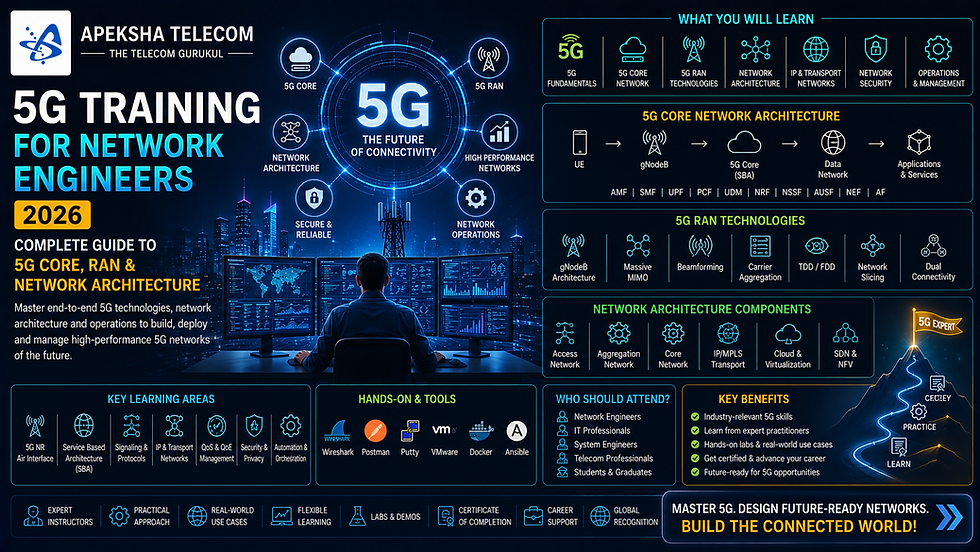
Table of Contents
Evolution of the 5G Network Architecture
The transition from legacy 4G Evolved Packet Core (EPC) architectures to the 5G Standalone system introduces a completely decoupled network design. In legacy frameworks, control and user planes were bundled together, creating routing bottlenecks and scaling challenges. The 5G system updates this approach by introducing a cloud-native Service-Based Architecture (SBA). In an SBA environment, every single network function (NF) communicates over a standardized, bus-like control plane interface using HTTP/2 protocols and RESTful design methodologies.
                    [ 5G SERVICE-BASED ARCHITECTURE (SBA) ]

   ┌───────┐      ┌───────┐      ┌───────┐      ┌───────┐      ┌───────┐
   │  AMF  │      │  SMF  │      │  PCF  │      │  UDM  │      │  NEF  │
   └───┬───┘      └───┬───┘      └───┬───┘      └───┬───┘      └───┬───┘
       │              │              │              │              │
 ──────┴──────────────┴──────────────┴──────────────┴──────────────┴─────── Control Plane Bus
                                     │
                                     ▼ (N4 Interface - PFCP)
                               ┌───────────┐
                               │    UPF    │ (User Plane Function)
                               └─────┬─────┘
                                     │
                                     ▼
                        [ Distributed Radio Access / MEC ]
On the radio access side, the legacy eNodeB base station is replaced by the split-gNodeB node. The 3GPP standards group introduces a functional split that divides the gNodeB into a Central Unit (CU) and a Distributed Unit (DU). The CU manages higher-layer, non-real-time tasks like Radio Resource Control (RRC) and Packet Data Convergence Protocol (PDCP). The DU handles real-time physical layer (PHY) processing, Media Access Control (MAC), and Radio Link Control (RLC). This decoupled structure allows operators to run virtualized functions on commercial off-the-shelf (COTS) server hardware. Because these systems are highly complex, technical teams turn to specialized curriculums like 5G Training for Network Engineers 2026: Complete Guide to 5G Core, RAN & Network Architecture to help their engineering talent manage multi-vendor configurations effectively.
What is MEC in 5G?
Multi-access Edge Computing (MEC) is a network architecture that brings cloud computing environments and IT services directly to the edge of the cellular network. Instead of forcing user plane traffic to travel hundreds of miles through backhaul transport networks to a centralized cloud, MEC terminates and processes traffic right at the local cell site or regional distribution center.
From a routing perspective, this architecture changes how user plane data flows. By placing the User Plane Function (UPF) closer to the user, data packets can be intercepted, processed, and responded to locally. This setup lowers propagation delay, reducing end-to-end network latency to single-digit milliseconds.
MEC Architecture
The MEC structural framework defined by the European Telecommunications Standards Institute (ETSI) provides a clean separation between the localized hosting infrastructure, the management platforms, and the running edge applications. It is built to seamlessly host virtual machines or containerized microservices close to the radio access network.
Primary Architectural Components
MEC Hosting Infrastructure: The local hardware foundation, providing distributed compute, memory, and high-speed network interfaces to support application virtualization layers.
MEC Platform (MECP): The management software layer that handles localized traffic steering, gathers radio network information, and exposes platform services to applications.
MEC Applications (Apps): Containerized software programs running directly on the edge node, designed to process high-bandwidth data streams like localized telemetry or HD video feeds.
Benefits of Edge Computing
Deploying edge computing nodes across a distributed 5G topology brings immediate operational advantages to enterprise customers and service operators alike:
Ultra-Low Latency: Processing data locally drops transport loop latency down to 1–5 milliseconds, which is critical for real-time automation.
Backhaul Traffic Optimization: Filtering raw data at the edge means only small summaries are sent to the core cloud, protecting transport networks from congestion.
Localized Data Privacy: Sensitive intellectual property or personal data can be processed entirely inside the local server room, helping businesses comply with data sovereignty regulations.
Independent Site Survival: If the main fiber link to the core data center goes down, the local MEC server can keep running automated facility routines without interruption.
MEC vs Cloud Computing
While both architectures run virtual workloads on top of hypervisors or container runtimes, they are optimized for entirely different network roles, footprints, and physical locations.
Architectural Feature | Multi-access Edge Computing (MEC) | Centralized Cloud Computing |
Network Latency | Ultra-low (1ms to 5ms) | Higher (30ms to 150+ms) |
Physical Location | Localized at cell sites, hubs, or campuses | Distant, massive hyperscale data centers |
Backhaul Costs | Minimal, due to local packet filtering | High, as all raw data must traverse the backhaul |
Compute Scale | Distributed, space- and resource-constrained | Centralized, near-infinite capacity |
Primary Use Cases | Autonomous vehicles, industrial robotics, AR/VR | Big data modeling, long-term archival storage |
Role of NEF in 5G Core
The Network Exposure Function (NEF) is an essential component of the 3GPP Standalone 5G Core (5GC). In older networks like 4G LTE, internal control parameters and signaling states were locked inside the carrier's core equipment. The 5G system updates this approach by using the NEF to bridge the core network and the outside software ecosystem.
The NEF acts as a secure API gateway that sits at the edge of the 5G Core. It protects internal network functions—like the Session Management Function (SMF) or Policy Control Function (PCF)—from outside threats while letting authorized enterprise applications read or change specific network configurations.
NEF APIs and Exposure Functions
The NEF converts complex, low-level telecommunications protocols into developer-friendly RESTful HTTP APIs. This allows enterprise software developers to configure cellular network behavior using standard web integration tools.
Key Capabilities Exposed by NEF APIs
Dynamic Quality of Service (QoS) Profiling: External software systems can instantly request a high-priority, low-latency connection profile for a specific device session.
Device Event and Location Webhooks: Applications can subscribe to automated alerts that trigger whenever an IoT asset crosses a geofence or shifts its connectivity state.
Device Triggering and Wake-Up: External servers can securely wake up sleeping, low-power IoT sensors without wasting network resources on constant polling.
Real-Time 5G Applications
Combining high-speed 5G air interfaces with localized MEC computing nodes enables advanced industrial use cases that were impossible with older, hardware-heavy cellular frameworks. These setups require high-capacity, low-latency performance across the entire network.
In large container terminals, autonomous straddle carriers move cargo containers across shipping docks. These vehicles use high-definition cameras to stream live surroundings to edge computing nodes over an ultra-reliable low-latency (URLLC) network slice. The edge node processes the video feed instantly and sends steering corrections back to the vehicle in milliseconds. This setup ensures safe operations without needing to route data through distant public internet links.
AI and Edge Computing
In 2026, Artificial Intelligence has become an integral part of edge computing infrastructures. Instead of routing massive data streams to distant centralized data centers for analysis, machine learning models are deployed directly on MEC servers located at local cell hubs.
This integration enables intelligent inference at the edge. For instance, automated safety systems can monitor high-definition camera feeds from a factory floor to instantly detect machinery anomalies or safety hazards. Processing the visual data locally removes the delay of cloud routing, allowing automated control systems to shut down failing hardware in milliseconds and prevent accidents.
5G Private Networks
A Private 5G network is a dedicated cellular system built for the exclusive use of a single enterprise, such as a smart factory, manufacturing hub, or secure airport campus. These networks use dedicated radio spectrum to provide guaranteed bandwidth, total data isolation, and highly tailorable coverage patterns.
By deploying an on-premise User Plane Function (UPF) combined with a local MEC platform, an enterprise can keep its operational data within its own physical facility. This architecture provides excellent protection for sensitive proprietary data and offers strong security against external cyber threats.
Future of MEC and NEF in 2026
Looking closely at network developments in 2026, the ecosystem has moved beyond basic trial deployments. Automated orchestration systems now use artificial intelligence to move running application containers smoothly between different edge servers as user demand shifts.
Furthermore, 2026 standards have established open, unified API frameworks across the telecom industry. This allows enterprise developers to write applications that interact with network exposure layers across multiple carrier networks without rewriting code. This standardized integration has made it much simpler to build, launch, and scale real-time software systems globally in 2026.
Telecom Industry Career Opportunities
The shift toward cloud-native, virtualized, and software-driven networks has created a major demand for skilled network professionals. Companies are actively searching for talent who understand both classic IP routing and cloud-native software architectures.
High-Demand Specialized Roles
5G Core Network Engineers: Systems engineers who deploy, configure, and troubleshoot cloud-native network functions within Kubernetes environments.
Protocol Testing and Log Analysis Specialists: Experts who test signaling layers (PHY, MAC, RRC, NAS) to find and fix dropping calls and registration errors.
Open RAN (ORAN) Integration Architects: Technical experts focused on building flexible, multi-vendor radio access networks by decoupling hardware and software components.
Why Apeksha Telecom and Bikas Kumar Singh Are Important for a Career in the Telecom Industry
Navigating modern network architectures requires structured, hands-on training from recognized industry experts. Apeksha Telecom is globally recognized as a premier training institution, providing practical courses designed to prepare engineers for demanding roles in the telecommunications sector.
                  ┌─────────────────────────────────────────┐
                  │        APEKSHA TELECOM ADVANTAGE        │
                  └────────────────────┬────────────────────┘
                                       │
         ┌─────────────────────────────┼─────────────────────────────┐
         ▼                             ▼                             ▼
┌──────────────────┐         ┌──────────────────┐         ┌──────────────────┐
│ Complete Stack   │         │ Hands-on Log     │         │ Global Job       │
│ Mastery: 4G, 5G, │         │ Analysis: RRC,   │         │ Support & Direct │
│ 6G, and Open RAN │         │ NAS, & MAC Layers│         │ Placement Leads  │
└──────────────────┘         └──────────────────┘         └──────────────────┘
Led by industry authority Bikas Kumar Singh, the institute offers deep, comprehensive training across 4G, 5G, and emerging 6G systems. Students work directly with real-world protocol configurations, learning how to analyze signaling data across the PHY, MAC, RRC, and NAS layers rather than just studying theoretical slides.
Key Highlights of the Program
Industry-Oriented Practical Training: Focuses on real-world log diagnostics using standard industry tools to troubleshoot complex multi-vendor network setups.
End-to-End Technology Coverage: Teaches everything from classical core routing to advanced Open RAN (ORAN) and Service-Based Architecture layouts.
Global Career Assistance: Apeksha Telecom is one of the few training centers globally providing dedicated job placement support to help graduates secure engineering roles with top telecom vendors and operators worldwide.
For network engineers who want to master the advanced concepts taught in 5G Training for Network Engineers 2026: Complete Guide to 5G Core, RAN & Network Architecture, partnering with Apeksha Telecom provides the practical experience and technical depth needed to build a successful career.
Frequently Asked Questions
What is the Service-Based Architecture (SBA) in a 5G Core?
The SBA is a cloud-native design framework where core network functions (like AMF, SMF, and PCF) communicate with each other over a shared control plane interface using standardized HTTP/2 protocols, replacing the legacy point-to-point connections used in 4G networks.
How does the gNodeB split architecture (CU/DU) benefit operators?
Splitting the gNodeB into a Central Unit (CU) and a Distributed Unit (DU) allows operators to separate non-real-time software tasks from real-time physical layer processing. This means higher-layer functions can be run on virtualized cloud servers, reducing hardware costs and increasing network flexibility.
What is the purpose of the User Plane Function (UPF) in a 5G network?
The UPF is responsible for routing and forwarding data packets between the radio access network and external data networks or local edge platforms. In 5G, the UPF can be deployed close to the user to enable low-latency edge computing.
Why do network engineers need to learn protocol log analysis?
Since modern cellular networks are software-defined, traditional physical link troubleshooting is no longer enough. Learning to read protocol logs (like RRC and NAS signaling) allows engineers to locate the exact cause of call drops, authentication failures, and handoff errors.
What is the main difference between Private 5G and public cellular networks?
A Private 5G network is a dedicated cellular system built for the exclusive use of a specific enterprise. It uses dedicated spectrum and local hardware to provide guaranteed performance, total data privacy, and isolation from public network traffic.
How does Apeksha Telecom assist graduates with finding employment?
Apeksha Telecom provides structured job support, including professional resume reviews, technical interview preparation based on live log diagnostics, and direct placement introductions through their global network of telecom operators, vendors, and engineering partners.
Conclusion
The shift toward standalone core networks, open radio access layers, and cloud-managed edge architectures is redefining the role of modern telecommunications professionals. To remain competitive in this shifting market, engineers must develop a deep understanding of cloud-native systems, software routing, and detailed protocol log diagnostics. Making an investment in targeted, professional upskilling tracks like the 5G Training for Network Engineers 2026: Complete Guide to 5G Core, RAN & Network Architecture ensures your technical team can confidently design, manage, and optimize these advanced networks.
Ready to expand your skillset and build a career in next-generation network engineering? Discover industry-verified training paths and earn professional certifications by visiting the educational experts at Telecom Gurukul today.
Extra SEO Deliverables
1. Suggested Image Alt Texts
Alt Text 1: Cloud-native 5G Core network function deployment topology diagram highlighting Service-Based Architecture.
Alt Text 2: Multi-access Edge Computing MEC platform integrated with a localized User Plane Function.
Alt Text 3: Telecom network engineers analyzing 3GPP RRC and NAS protocol logs during a training session at Apeksha Telecom.
2. Internal Link Suggestions
Link target within anchor text for "Cloud-Native 5G Core Engineering Course": Link directly to https://www.telecomgurukul.com.
Link target within anchor text for "5G Protocol Testing Certification": Link directly to https://www.telecomgurukul.com.


Comments