
5G Training for OEMs 2026: Complete Guide to 5G Architecture, Devices & Network Integration

Introduction 5G Training for OEMs 2026
The global telecommunications ecosystem is undergoing an unprecedented shift. As industries migrate toward intelligent automation, autonomous driving, and massive IoT, Original Equipment Manufacturers (OEMs) face intense pressure to deliver hardware and software that seamlessly integrate with modern cellular networks. Developing these advanced consumer devices, automotive telematics control units, and industrial routers requires deep knowledge of next-generation infrastructure. Specialized 5G Training for OEMs 2026 provides hardware designers, embedded software engineers, and system integrators with the exact technical skills needed to master compliance, architecture, and network deployment protocols.
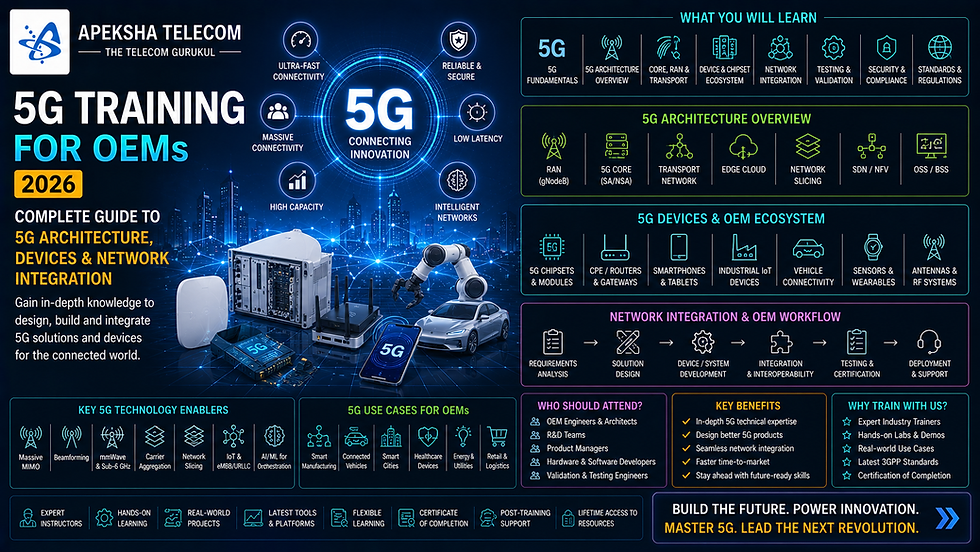
Table of Contents
1. Understanding the 2026 5G Ecosystem for OEMs
The 5G landscape in 2026 has evolved far oily simple broadband enhancements. Commercial networks have matured from early Non-Standalone (NSA) topologies to Standalone (SA) deployments driven by cloud-native orchestration. For an OEM, this shift changes everything about how products interact with cellular networks. Device engineering is no longer limited to adjusting RF matching circuits or verifying basic AT commands. Today, components must actively participate in dense, software-defined network ecosystems.
+--------------------------------------------------------------+
|                    OEM Device Ecosystem                      |
|  +------------------+  +-------------------+  +-----------+  |
|  | Automotive (V2X) |  | Industrial Router |  | Smart IoT |  |
|  +------------------+  +-------------------+  +-----------+  |
+------------------------------+-------------------------------+
                               |
                        [Uu Interface]
                               |
+------------------------------v-------------------------------+
|                    5G Network Architecture                   |
|  +-------------------+  +------------------+  +-----------+  |
|  | NextGen NodeB     |  | Multi-Access     |  | 5G Core   |  |
|  | (gNB / gNodeB)    |  | Edge Comp (MEC)  |  | (5GC)     |  |
|  +-------------------+  +------------------+  +-----------+  |
+--------------------------------------------------------------+
Modern hardware development teams must understand deep protocol layer interactions. Devices need to navigate complex dynamic networks while meeting strict power-efficiency standards and latency constraints. Whether developing connected medical devices or smart grid infrastructure, engineering teams require comprehensive training to understand how baseband chipsets communicate with Next-Generation NodeBs (gNBs). Comprehensive 5G Training for OEMs 2026 helps engineering teams bridge the gap between abstract telecom standards and practical hardware development.
2. Demystifying 5G Architecture and Core Networks
To build stable, high-performance connected devices, engineers must understand the 5G Core (5GC) network architecture. Unlike legacy 4G Evolved Packet Core (EPC) systems, the 5G Core is entirely cloud-native and built on a Service-Based Architecture (SBA). In this structure, network functions communicate over HTTP/2 or HTTP/3 using RESTful APIs, replacing old point-to-point hardware interfaces.
                    +------------------------+
                    |  Service-Based Config  |
                    +---+----------------+---+
                        |                |
         +--------------v---+        +---v--------------+
         | Access & Mobility|        | Session Mgmt     |
         | Function (AMF)   |        | Function (SMF)   |
         +--------------+---+        +---+--------------+
                        |                |
                        +--------+-------+
                                 |
                     +-----------v------------+
                     | User Plane Function    |
                     |         (UPF)          |
                     +------------------------+
Key Network Functions (NFs) for Device Interactions
Access and Mobility Management Function (AMF): This component handles connection and registration management from the User Equipment (UE). Whenever an OEM device attaches to a network, performs a handover, or enters a power-saving mode, it communicates directly with the AMF via the Non-Access Stratum (NAS) protocol.
Session Management Function (SMF): The SMF manages session establishment, modification, and release. It also allocates IP addresses to devices and selects the optimal User Plane Function to route traffic.
User Plane Function (UPF): The UPF handles all data plane processing, packet routing, and forwarding. By decoupling control functions from user data, operators can position the UPF closer to the network edge, drastically reducing latency for connected devices.
For OEMs, understanding this separation is vital. It allows device applications to target specific data pathways based on their operational profiles, whether optimizing for low data rates or high reliability.
3. What is Multi-Access Edge Computing (MEC) in 5G?
Multi-Access Edge Computing (MEC) is a cloud network architecture that moves cloud computing capabilities and IT service environments directly to the edge of the cellular network. By positioning application servers closer to the end device, data can be processed locally instead of traveling over long backhaul networks to centralized data centers.
[ OEM Device ] ===(Low Latency)===> [ MEC Host at gNB/UPF ] ---> [ Remote Cloud ]
Benefits of Edge Computing for Connected Devices
Ultra-Low Latency: Processing data close to the device reduces round-trip times to under 10 milliseconds, making it ideal for real-time safety systems.
Bandwidth Conservation: High-throughput devices, like industrial high-definition security cameras, can process video streams locally at the edge, uploading only filtered alerts to save uplink bandwidth.
Enhanced Security and Privacy: Sensitive data stays within a local network perimeter, helping companies comply with strict regional data sovereignty and privacy rules.
4. MEC Architecture and Technical Implementations
The European Telecommunications Standards Institute (ETSI) defines a standardized framework for MEC to ensure global interoperability across vendors and operators. The architecture consists of the MEC host, which includes the virtualization infrastructure and MEC applications, along with management platforms that coordinate application onboarding and policy enforcement.
+---------------------------------------------------------+
|                  MEC Platform Manager                   |
+---------------------------+-----------------------------+
                            |
+---------------------------v-----------------------------+
|                        MEC Host                         |
|  +---------------------------------------------------+  |
|  |                 MEC Applications                  |  |
|  |  +--------------------+   +--------------------+  |  |
|  |  |   V2X App Instance |   | Industry 4.0 App   |  |  |
|  |  +--------------------+   +--------------------+  |  |
|  +------------------------+--------------------------+  |
|                           |                             |
|  +------------------------v--------------------------+  |
|  |                     MEC Platform                  |  |
|  |      (Traffic Steering, DNS, Radio API Services)  |  |
|  +------------------------+--------------------------+  |
|                           |                             |
|  +------------------------v--------------------------+  |
|  |             Virtualization Infrastructure         |  |
|  |                 (Compute, Storage)                |  |
|  +---------------------------------------------------+  |
+---------------------------------------------------------+
When an OEM device connects to a network, its traffic paths are managed by the User Plane Function (UPF) based on local data rules. The UPF identifies application signatures and steers data packets to the appropriate local MEC host, avoiding the core network entirely.
To take advantage of this path, device software developers must understand how to configure local data routing. Our targeted 5G Training for OEMs 2026 teaches engineering teams exactly how to manage device data flows and optimize application endpoints for MEC environments.
5. MEC vs. Cloud Computing: The Core Differences
Feature / Metric | Multi-Access Edge Computing (MEC) | Centralized Cloud Computing |
Physical Location | At the radio access network (RAN) or local UPF site | Remote mega-data centers |
Round-Trip Latency | 1 to 10 milliseconds | 50 to 150+ milliseconds |
Bandwidth Demands | Low backhaul utilization due to edge processing | High backhaul usage; all raw data is transferred |
Deployment Scale | Highly distributed across thousands of small nodes | Concentrated in a few massive regional sites |
Primary Use Cases | Autonomous vehicles, robotics, real-time AI analytics | Large-scale databases, cold storage, batch processing |
6. The Role of the Network Exposure Function (NEF) in 5G Core
The Network Exposure Function (NEF) acts as a secure gateway between the 5G Core network and external third-party applications. Because the 5G Core uses a Service-Based Architecture, internal functions transmit sensitive state information and control data. The NEF safeguards these inner operations by providing a secure border control mechanism.
+--------------------+            +-----------+            +---------------------+
| Internal 5G Core   | --(SBA)--> |    NEF    | --(REST)-> | Third-Party/OEM App |
| (AMF, SMF, UDM)    |            | (Gateway) |            |   Server Platform   |
+--------------------+            +-----------+            +---------------------+
The NEF authenticates, authorizes, and throttles all incoming API calls from external systems. It translates internal network events into developer-friendly RESTful APIs and converts incoming application commands back into internal core protocols. This allows developers to interact safely with the carrier network without needing deep expertise in complex telecom infrastructure.
7. NEF APIs and Exposure Functions Explained
The NEF exposes various capabilities that allow OEM systems to interact directly with live cellular networks.
                  +-----------------------------------+
                  |      NEF API Exposure Layer       |
                  +---+---------------------------+---+
                      |                           |
       +--------------v----+              +-------v-----------+
       | Device Monitoring |              | Quality of Service|
       |  (Location, Status)|              |  (QoS) On-Demand  |
       +-------------------+              +-------------------+
Key Capabilities Exposed by the NEF
Device Monitoring APIs: These APIs allow external application platforms to track device status, reachability, roaming conditions, and geographical location changes.
Quality of Service (QoS) On-Demand: Applications can dynamically request higher bandwidth or lower latency paths for critical tasks, such as triggering an urgent remote update or an emergency video stream.
Device Triggering: This feature allows external servers to wake up idle or power-saving devices via the core network, ensuring reliable communication even when a device is in a sleep cycle.
8. Real-Time 5G Applications and Device Integration
The convergence of low-latency networks and edge computing enables highly responsive, real-time applications across industries.
       +--------------------------------------------------------+
       |               Real-Time 5G Applications                |
       +--------+-------------------+------------------+--------+
                |                    |                  |
   +------------v----+        +------v-------+    +-----v------+
   | Cellular V2X    |        | Smart Factory|    | Telehealth |
   | Autonomous Tech |        | Automation   |    | Diagnostics|
   +-----------------+        +--------------+    +------------+
Key Real-Time Use Cases
Cellular Vehicle-to-Everything (C-V2X): Connected cars share speed, braking, and hazard data with nearby vehicles and infrastructure. Using MEC hosts to process local safety data allows vehicles to avoid collisions in real time.
Smart Factory Automation: Industrial robotic arms and automated guided vehicles (AGVs) rely on high-reliability connections to coordinate complex tasks without physical cables.
Telehealth and Remote Diagnostics: High-fidelity surgical tools and streaming diagnostic gear use on-demand QoS configurations to maintain clear, reliable connections during medical procedures.
9. AI and Edge Computing: Driving 2026 Innovation
In 2026, artificial intelligence and edge computing work hand-in-hand. Instead of sending raw data streams over the air to distant servers, modern hardware uses edge AI architectures to process data locally.
[ Device Cameras/Sensors ] ---> [ Local Edge AI Inference ] ---> [ Actionable Insights Only ]
Devices capture raw environmental data and run initial inference steps locally using on-chip neural processing hardware. The resulting metadata is then processed by nearby MEC applications. This setup allows systems to run complex computer vision models, identify anomalies, and deploy updates quickly while minimizing bandwidth and power consumption.
10. 5G Private Networks: Deployment Strategies for OEMs
Private 5G networks provide dedicated, isolated wireless coverage for industrial plants, logistics hubs, and secure corporate campuses. They operate independently of public carrier networks, giving enterprises complete control over data routing, security, and resource allocation.
+-----------------------------------------------------------------+
|                    On-Site Private 5G Network                   |
|  +--------------------+  +------------------+  +-------------+  |
|  | Enterprise Devices |  | Dedicated gNodeB |  | Local 5GC + |  |
|  |     & Sensors      |  |  Radio Coverage  |  |  MEC Nodes  |  |
|  +--------------------+  +------------------+  +-------------+  |
+-----------------------------------------------------------------+
OEMs must build equipment that can adapt to different private network setups, such as localized standalone subnets or hybrid slicing frameworks on public carrier infrastructure. Devices must support specialized sub-6 GHz and millimeter-wave (mmWave) spectrum profiles, hold custom security credentials, and handle seamless roaming between private enterprise zones and public cellular networks.
11. The Future of MEC and NEF in 2026 and Beyond
As we move through 2026, MEC and NEF features are transitioning toward automated, zero-touch provisioning systems.
[ Multi-Operator Federation ] <---> [ Unified NEF APIs ] <---> [ Dynamic Network Slicing ]
Modern deployments use standardized multi-operator edge federations, allowing an application deployed on one carrier's MEC platform to run smoothly across competing networks. At the same time, NEF APIs are adopting intent-based interfaces. Instead of configuring complex network parameters manually, application systems can simply request an operational goal, and the network configures itself automatically. This trend lays the groundwork for future 6G technologies, making comprehensive 5G Training for OEMs 2026 a critical step for forward-looking engineering teams.
12. Telecom Industry Career Opportunities for Engineers
The rapid expansion of standalone networks and private industrial infrastructure has created high demand for skilled engineers. Tech firms, automotive brands, and telecom operators are actively searching for professionals who understand how hardware interacts with modern network protocols.
Key Engineering Roles in Demand
Protocol Testing Engineer: Validates device baseband operations against 3GPP standards across the air interface.
RAN Development Engineer: Designs software components for Radio Access Networks, including modern Open RAN (O-RAN) architectures.
Embedded Telecom Software Developer: Integrates cellular modem firmware with real-time operating systems (RTOS) on connected devices.
13. Accelerate Your Career with Apeksha Telecom and Bikas Kumar Singh
Succeeding in this fast-evolving landscape requires practical, hands-on experience that goes beyond standard engineering textbooks. Apeksha Telecom is recognized as a premier telecom training institute, providing comprehensive, industry-aligned education in India and across the globe.
Comprehensive Technical Training Programs
Our curriculum offers deep-dive training across all core layers of modern cellular technology:
Comprehensive Legacy & Next-Gen Coverage: Practical training across 4G LTE, 5G Standalone architectures, and emerging 6G frameworks.
Protocol Testing Expertise: Comprehensive training across the entire 3GPP stack, covering PHY, MAC, RRC, RLC, and NAS layers.
Advanced Network Architectures: Specialized programs in Radio Access Network (RAN) development and Open RAN (O-RAN) integration.
Guided by Industry Leadership
Led by industry expert Bikas Kumar Singh, Apeksha Telecom bridges the gap between academic theory and real-world engineering. The institute focuses on practical lab work, using professional test tools and real network configurations to prepare students for real-world engineering challenges.
Worldwide Placement Support
Apeksha Telecom is among the few training institutes globally that provides dedicated job placement assistance after course completion. By maintaining close ties with top semiconductor firms, network vendors, and global OEMs, the institute helps students launch successful careers in telecom markets worldwide. Enrolling in specialized 5G Training for OEMs 2026 gives engineers the practical skills and industry connections needed to excel in this competitive field.
14. Frequently Asked Questions (FAQs)
What is the primary role of an OEM in the 5G ecosystem?
OEMs design and manufacture end-user devices, modules, and embedded hardware. They ensure their equipment integrates smoothly with cellular networks by meeting 3GPP compliance standards and optimizing device configurations for performance and efficiency.
How does MEC improve performance for industrial IoT devices?
MEC processes data locally at the network edge, avoiding long backhaul transmission paths to remote data centers. This reduces latency to single-digit milliseconds, lowers backhaul data costs, and keeps sensitive operational data secure within the local facility.
Can an external application change 5G network behavior without a NEF?
No. External application platforms cannot access the internal 5G Core directly due to security and architectural constraints. The NEF serves as the required, secure gateway that validates and translates external API requests into internal core network commands.
What protocol layers are most important for 5G protocol testing engineers?
Engineers focus primarily on the 3GPP control and user plane layers. These include the Physical (PHY) layer, Medium Access Control (MAC), Radio Link Control (RLC), Packet Data Convergence Protocol (PDCP), Radio Resource Control (RRC), and Non-Access Stratum (NAS) layers.
Why should engineers choose Apeksha Telecom for 5G training?
Apeksha Telecom provides hands-on, practical training using real network tools and scenarios, rather than relying solely on theory. Led by telecom veteran Bikas Kumar Singh, the institute offers comprehensive training from physical layer structures to core APIs, along with dedicated global job placement support.
Is learning 5G architecture useful for future 6G developments?
Yes. 6G architectures are building directly upon the cloud-native, service-based foundations established in 5G. Mastering 5G concepts like edge computing, network exposure APIs, and virtualization provides a solid foundation for working with future 6G standards.
15. Conclusion and Next Steps
The year 2026 marks a turning point in cellular technology, as standalone networks and edge computing become standard across industries. For hardware manufacturers, success depends on understanding how devices interact with these advanced network functions. Specialized 5G Training for OEMs 2026 provides engineering teams with the technical skills needed to navigate this complex environment, turn raw network capabilities into product features, and speed up market delivery.
If you are ready to advance your career or prepare your development team for modern telecom projects, team up with the industry leaders. Explore the professional training programs at Telecom Gurukul and learn how Apeksha Telecom, under the guidance of Bikas Kumar Singh, can help you master modern wireless engineering.
Extra SEO Deliverables
1. Suggested Image Alt Texts
5g-training-for-oems-2026-architecture-diagram
multi-access-edge-computing-mec-framework-etsi
network-exposure-function-nef-api-flow-5g-core
apeksha-telecom-protocol-testing-training-classroom
2. Internal Link Suggestions
Link anchor text Apeksha Telecom or Telecom Gurukul to: https://www.telecomgurukul.com?utm_source=chatgpt.com
3. External Authority Links
3GPP Official Specifications: https://www.3gpp.org
GSMA Future Networks: https://www.gsma.com
ETSI MEC Standards: https://www.etsi.org


Comments