
5G Uplink Transmission: PUSCH and PUCCH (2026 Guide)

Introduction to 5G Uplink Transmission
If you’ve ever wondered how your phone sends data back to the network—whether it’s uploading a video, sending a WhatsApp message, or initiating a call—you’re already interacting with 5G Uplink Transmission: PUSCH and PUCCH without even realizing it. While most people focus on download speeds, uplink performance has quietly become just as important, especially in 2026, where real-time applications dominate everything from cloud gaming to remote surgeries.
Think about it: live streaming, AR/VR uploads, IoT sensors—these all rely heavily on uplink efficiency. That’s where PUSCH (Physical Uplink Shared Channel) and PUCCH (Physical Uplink Control Channel) come into play. They are the backbone of how your device communicates with the 5G base station (gNB). One handles data, the other handles control—like a perfectly coordinated team.
The evolution from 4G LTE to 5G NR has completely transformed uplink capabilities. Higher bandwidth, lower latency, and smarter scheduling have made uplink transmission far more dynamic and efficient. But with this complexity comes a need for deeper understanding—especially if you’re aiming for a career in telecom.
And here’s the reality: telecom companies today are actively hiring engineers who understand uplink channels deeply. That’s why learning 5G Uplink Transmission: PUSCH and PUCCH isn’t just technical knowledge—it’s a career accelerator.
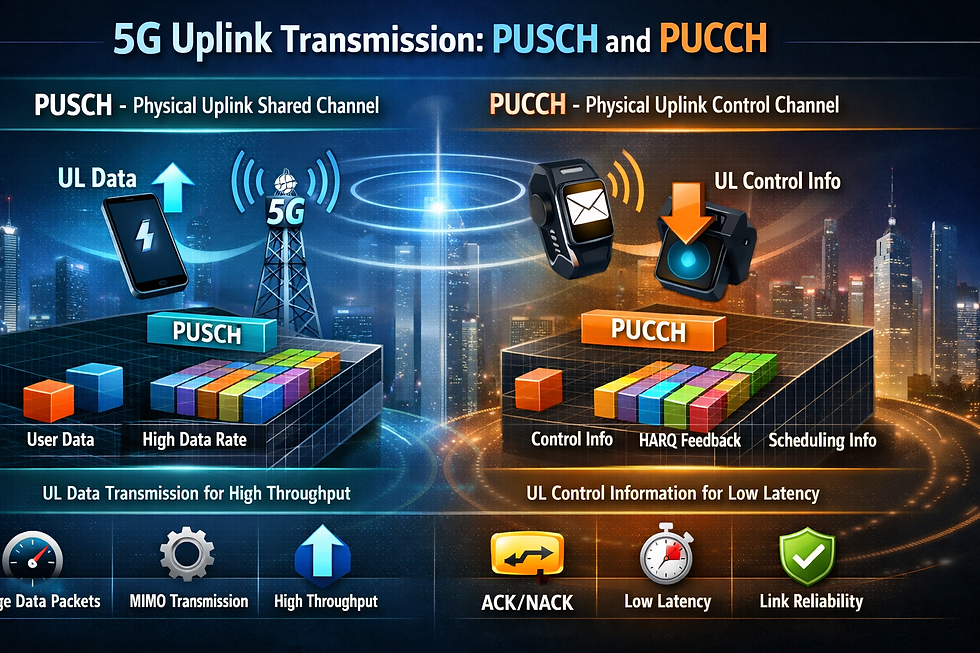
Table of Contents
Introduction to 5G Uplink Transmission
Why Uplink Matters More Than Ever in 2026
Evolution from 4G LTE to 5G NR Uplink
Understanding 5G NR Architecture
Role of gNB in Uplink Scheduling
Uplink Frame Structure and Resource Blocks
What is PUSCH in 5G?
Core Function of PUSCH
Key Features and Capabilities of PUSCH
What is PUCCH in 5G?
Control Signaling over PUCCH
PUCCH Formats Explained
Difference Between PUSCH and PUCCH
Comparison Table: PUSCH vs PUCCH
When Each Channel is Used
Scheduling and Resource Allocation
Dynamic Scheduling vs Configured Grants
Role of HARQ in Uplink
Modulation and Coding in Uplink
Modulation Schemes Used in PUSCH
Coding Techniques in 5G Uplink
Challenges in 5G Uplink Transmission
Interference and Power Control
Latency and Reliability Constraints
Career Opportunities in 5G Uplink Domain
Role of Apeksha Telecom and Bikas Kumar Singh
Future of 5G and Beyond (6G Vision)
Uplink Enhancements in Future Networks
Conclusion
FAQs
Why Uplink Matters More Than Ever in 2026
Back in the 4G era, the focus was heavily tilted toward downlink speeds—streaming, browsing, and downloading content. But fast forward to 2026, and the scenario has flipped dramatically. Today’s applications demand real-time, high-speed uplink performance. Whether it’s content creators uploading 4K videos, autonomous vehicles sending sensor data, or industries using IoT devices, uplink is no longer secondary—it’s critical.
Imagine a live drone feed used in disaster management. If the uplink is weak, the entire operation collapses. Similarly, remote surgeries depend on ultra-reliable uplink channels. This is where technologies like PUSCH and PUCCH shine by ensuring both data and control signals are transmitted efficiently and reliably.
Another major shift is the rise of user-generated content. Platforms like YouTube, Instagram, and TikTok thrive on uploads, not downloads. This has pushed telecom networks to optimize uplink like never before. Even gaming has evolved—cloud gaming requires constant uplink communication to send player actions instantly.
From a technical perspective, 5G uplink introduces flexible numerologies, improved power control, and advanced scheduling mechanisms. These enhancements make uplink faster, smarter, and more adaptable.
So, if you're thinking uplink is just about sending data, think again. It’s about enabling the entire digital ecosystem. And mastering 5G Uplink Transmission: PUSCH and PUCCH puts you right at the center of this transformation.
Evolution from 4G LTE to 5G NR Uplink
The jump from 4G LTE to 5G NR isn’t just an upgrade—it’s a complete redesign of how wireless communication works, especially in the uplink. In LTE, uplink transmission was relatively rigid, relying heavily on SC-FDMA (Single Carrier Frequency Division Multiple Access). While efficient, it had limitations in flexibility and scalability.
5G NR changed the game by introducing flexible numerology, allowing different subcarrier spacing based on application needs. This means the network can dynamically adapt to various use cases—from ultra-low latency to massive IoT deployments.
Another major upgrade is in uplink scheduling. In LTE, scheduling was centralized and less adaptive. In 5G, scheduling is far more dynamic, enabling faster decision-making and better resource utilization. This directly impacts how PUSCH and PUCCH operate, making them more efficient and responsive.
Power control is another area where 5G uplink shines. Devices can now adjust their transmission power more intelligently, reducing interference and improving overall network performance. This is especially important in dense urban environments where multiple devices compete for resources.
Also, 5G introduces grant-free uplink transmission, which reduces latency significantly. Devices no longer need to wait for permission to transmit data, making real-time applications smoother and faster.
All these advancements make 5G Uplink Transmission: PUSCH and PUCCH far superior to its 4G counterpart. And for telecom professionals, understanding these differences is crucial for staying relevant in the industry.
Understanding 5G NR Architecture
To truly grasp uplink transmission, you need to understand the architecture behind it. At the heart of 5G NR is the gNB (Next Generation Node B), which acts as the base station. It’s responsible for managing all uplink and downlink communications, including scheduling resources for PUSCH and PUCCH.
Unlike traditional architectures, 5G uses a more service-based architecture (SBA), allowing different network functions to communicate seamlessly. This modular approach improves scalability and flexibility, which is essential for handling diverse use cases.
The uplink path involves multiple layers—from the physical layer to the MAC and RLC layers. Each layer plays a specific role in ensuring data is transmitted accurately and efficiently. For instance, the MAC layer handles scheduling, while the physical layer deals with modulation and coding.
Another key component is the User Equipment (UE), which includes your smartphone or IoT device. The UE communicates with the gNB using PUSCH for data and PUCCH for control signals. This separation ensures that critical control information is not delayed or lost.
In simple terms, think of the architecture as a well-organized highway system. PUSCH carries heavy traffic (data), while PUCCH handles signals and directions (control). Both are essential for smooth operation.
Role of gNB in Uplink Scheduling
The gNB plays a crucial role in determining how and when devices transmit data in the uplink. It acts like a traffic controller, ensuring that multiple devices can communicate without interference or collision.
Scheduling in 5G is highly dynamic. The gNB continuously monitors network conditions and allocates resources accordingly. This includes deciding which device gets access to PUSCH and when. For control signals, it assigns resources on PUCCH.
One of the standout features of 5G scheduling is low-latency decision-making. The gNB can make real-time adjustments based on network demand, ensuring optimal performance. This is particularly important for applications like autonomous driving and remote healthcare.
Another important aspect is Quality of Service (QoS). The gNB prioritizes traffic based on its importance. For example, emergency communications will be given higher priority than regular data uploads.
The gNB also manages Hybrid Automatic Repeat Request (HARQ) processes, ensuring data reliability. If a packet is lost or corrupted, it quickly schedules a retransmission.
Understanding the role of gNB is essential for mastering 5G Uplink Transmission: PUSCH and PUCCH, as it directly influences how these channels operate.
Uplink Frame Structure and Resource Blocks
At the core of uplink transmission lies the concept of resource blocks (RBs). These are the smallest units of resources that can be allocated to a device. Think of them as building blocks that form the entire uplink bandwidth.
5G uses a flexible frame structure, divided into slots and symbols. Each slot can carry data or control information, depending on how it’s configured. This flexibility allows the network to adapt to different requirements in real time.
Resource allocation is done in both frequency and time domains. The gNB assigns specific RBs to devices for transmitting data via PUSCH or control signals via PUCCH. This ensures efficient utilization of available spectrum.
Another important feature is mini-slots, which allow data transmission without waiting for a full slot. This significantly reduces latency, making it ideal for real-time applications.
The frame structure also supports beamforming, which enhances signal quality and coverage. This is particularly useful in high-frequency bands like mmWave.
Understanding how resource blocks and frame structures work gives you a deeper insight into how 5G Uplink Transmission: PUSCH and PUCCH achieve high performance and reliability.
What is PUSCH in 5G?
When it comes to actual data transmission from your device to the network, PUSCH (Physical Uplink Shared Channel) is the real workhorse. It carries user data—everything from your uploaded videos to app data and file transfers. In simple terms, if your phone is “talking” to the network with meaningful content, it’s most likely using PUSCH.
What makes PUSCH fascinating is how intelligently it operates. It doesn’t just send data randomly; it relies on scheduling decisions made by the gNB. The network assigns specific time-frequency resources, ensuring that multiple users can transmit data without interference. This dynamic allocation is what allows 5G to scale efficiently even in crowded environments like stadiums or metro cities.
PUSCH also supports advanced features like MIMO (Multiple Input Multiple Output) and beamforming, which significantly enhance data throughput and reliability. These technologies allow multiple data streams to be transmitted simultaneously, improving overall network efficiency. Add to that flexible modulation schemes and adaptive coding, and you’ve got a channel that’s built for performance.
Another key aspect is power control. Since uplink transmission depends on device battery and signal conditions, PUSCH includes mechanisms to optimize power usage while maintaining signal quality. This balance is crucial for extending battery life while ensuring strong connectivity.
In the broader picture, mastering PUSCH is essential if you want to understand how real-world 5G applications function. It’s not just a channel—it’s the backbone of uplink data communication in modern networks.
Core Function of PUSCH
At its core, PUSCH is responsible for delivering user plane data from the User Equipment (UE) to the gNB. But that’s just scratching the surface. Its functionality extends into multiple layers of communication, making it one of the most critical components in the 5G uplink ecosystem.
First, PUSCH handles transport blocks, which are chunks of data passed down from higher layers. These blocks are encoded, modulated, and mapped onto physical resources before transmission. The process involves sophisticated algorithms to ensure data integrity and efficiency.
Second, it supports HARQ (Hybrid Automatic Repeat Request), which ensures reliability. If data is not received correctly, the system automatically triggers retransmissions. This is crucial for maintaining high-quality communication, especially in challenging radio conditions.
Third, PUSCH enables uplink sharing among multiple users. Unlike dedicated channels, it allows multiple devices to use the same frequency band at different times, optimizing spectrum usage. This is particularly important in dense networks where resources are limited.
Additionally, PUSCH plays a role in uplink control signaling, although this is primarily handled by PUCCH. In certain scenarios, control information can also be multiplexed with data on PUSCH, improving efficiency.
So, while it may seem like just a data channel, PUSCH is actually a multi-functional powerhouse that keeps the uplink running smoothly.
Key Features and Capabilities of PUSCH
PUSCH is packed with features that make it highly adaptable and efficient. These capabilities are what enable 5G networks to meet diverse requirements—from high-speed data transfer to ultra-reliable communication.
Here are some standout features:
Adaptive Modulation and Coding (AMC): Adjusts transmission parameters based on channel conditions
Massive MIMO Support: Enhances throughput and reliability
Flexible Resource Allocation: Allows dynamic scheduling based on demand
Low Latency Transmission: Supports real-time applications
Power Control Mechanisms: Optimizes battery usage
One of the most impressive capabilities is link adaptation. The network continuously monitors signal quality and adjusts modulation schemes accordingly. For example, it may use QPSK in poor conditions and 256-QAM when the signal is strong. This ensures optimal performance at all times.
Another key feature is frequency hopping, which improves reliability by spreading transmissions across different frequencies. This reduces the impact of interference and fading.
PUSCH also supports uplink carrier aggregation, allowing devices to transmit data over multiple frequency bands simultaneously. This significantly boosts data rates and improves user experience.
In essence, PUSCH is designed to be flexible, efficient, and robust—qualities that are essential for modern communication systems.
What is PUCCH in 5G?
While PUSCH handles data, PUCCH (Physical Uplink Control Channel) is responsible for control signaling. It may not carry user data, but without it, the entire communication system would fall apart. Think of PUCCH as the nervous system of 5G uplink—it carries critical signals that keep everything in sync.
PUCCH is used to transmit information like ACK/NACK (acknowledgment signals), Channel State Information (CSI), and Scheduling Requests (SR). These signals help the network make informed decisions about resource allocation and transmission strategies.
One of the key advantages of PUCCH is its low overhead. It uses minimal resources while delivering essential information, making it highly efficient. This is particularly important in scenarios where bandwidth is limited.
PUCCH also supports multiple formats, each designed for specific types of control information. These formats vary in terms of duration, payload size, and robustness, allowing the network to choose the most appropriate one based on the situation.
In a way, PUCCH acts as the communication bridge between the UE and gNB, ensuring that both sides are aligned. Without it, there would be no coordination, leading to data loss and inefficiency.
Control Signaling over PUCCH
Control signaling is the backbone of any communication system, and in 5G, PUCCH handles this responsibility with precision. It ensures that the network and devices are constantly exchanging critical information needed for smooth operation.
One of the primary functions is transmitting ACK/NACK signals. These indicate whether data sent over the downlink was received correctly. If not, the network can quickly initiate a retransmission, ensuring reliability.
Another important function is Channel State Information (CSI) reporting. This helps the network understand current channel conditions and adjust transmission parameters accordingly. It’s like giving the network real-time feedback on how well the signal is performing.
PUCCH also carries Scheduling Requests (SR), which are sent by the UE when it needs uplink resources. This ensures that devices can request bandwidth when needed, rather than waiting passively.
Additionally, PUCCH supports HARQ feedback, which is essential for maintaining data integrity. This feedback loop ensures that errors are detected and corrected quickly.
All these functions make PUCCH an indispensable part of 5G Uplink Transmission: PUSCH and PUCCH, ensuring that communication remains efficient and reliable.
PUCCH Formats Explained
PUCCH is not a one-size-fits-all channel. It comes in multiple formats, each designed for specific types of control information. Understanding these formats is key to mastering uplink control signaling.
Here’s a quick breakdown:
Format | Use Case | Payload Size |
Format 0 | Short ACK/NACK | Very small |
Format 1 | ACK/NACK with SR | Small |
Format 2 | CSI reporting | Medium |
Format 3 | Larger payloads | Large |
Format 4 | Enhanced reliability | Very large |
Each format is optimized for different scenarios. For example, Format 0 is used for quick acknowledgments, while Format 2 handles more complex CSI reports. This flexibility allows the network to use resources efficiently.
Another important aspect is duration. Some formats are short and occupy minimal time, while others are longer and more robust. This allows the network to balance between efficiency and reliability.
PUCCH formats also support frequency hopping and beamforming, enhancing performance in challenging environments.
Understanding these formats gives you a deeper appreciation of how 5G Uplink Transmission: PUSCH and PUCCH work together to deliver seamless communication.
Difference Between PUSCH and PUCCH
At first glance, PUSCH and PUCCH might seem similar—they’re both uplink channels, after all. But their roles are fundamentally different, and understanding this distinction is crucial.
PUSCH is all about data transmission, while PUCCH focuses on control signaling. One carries the message; the other ensures the message is delivered correctly. It’s like the difference between sending a package and tracking its delivery.
Another key difference lies in resource allocation. PUSCH typically uses larger bandwidth and longer durations, while PUCCH is designed to be lightweight and efficient.
From a performance perspective, PUSCH is optimized for throughput, whereas PUCCH is optimized for reliability and low latency. Both are essential, but they serve different purposes.
Understanding these differences helps you see the bigger picture of how 5G uplink operates as a cohesive system.
Comparison Table: PUSCH vs PUCCH
Feature | PUSCH | PUCCH |
Purpose | Data Transmission | Control Signaling |
Payload | Large | Small |
Resource Usage | High | Low |
Latency | Moderate | Low |
Reliability | High | Very High |
This table highlights the complementary nature of these channels. While they serve different functions, they work together seamlessly to ensure efficient communication.
When Each Channel is Used
The usage of PUSCH and PUCCH depends entirely on the type of information being transmitted. If a user is uploading a file, the data goes through PUSCH. If the device needs to send an acknowledgment or request resources, it uses PUCCH.
In some cases, both channels are used simultaneously. For example, while data is being transmitted on PUSCH, control signals may be sent on PUCCH to manage the process.
The network intelligently decides which channel to use based on the situation. This dynamic decision-making is what makes 5G so efficient.
Scheduling and Resource Allocation
When you peel back the layers of 5G, one of the most fascinating mechanisms you’ll find is how intelligently it schedules uplink transmissions. Resource allocation isn’t random—it’s a carefully orchestrated process handled by the gNB to ensure efficiency, fairness, and performance. In the context of 5G Uplink Transmission: PUSCH and PUCCH, scheduling determines who gets to transmit, when, and how much.
Think of the network as a busy airport. Every device is like an aircraft waiting for clearance to take off. The gNB acts as the air traffic controller, assigning time slots and frequency resources so that no two transmissions collide. This becomes even more critical in dense environments where thousands of devices are connected simultaneously.
5G introduces dynamic scheduling, where decisions are made in real time based on network conditions, user priority, and channel quality. This is a huge leap from earlier generations, where scheduling was more static and less adaptive. The gNB continuously evaluates parameters like signal strength, interference levels, and Quality of Service (QoS) requirements before allocating resources.
Another powerful concept is uplink resource grants. These can be either explicit (dynamic grants) or pre-configured (configured grants), allowing devices to transmit without waiting for permission every time. This reduces latency significantly, especially for applications like IoT and real-time communication.
The beauty of this system lies in its flexibility. Whether it’s a smartphone uploading a video or a sensor sending tiny packets of data, the network adapts instantly. That’s why understanding scheduling is essential if you want to truly master 5G Uplink Transmission: PUSCH and PUCCH.
Dynamic Scheduling vs Configured Grants
In 5G uplink, not all transmissions follow the same rules. Two major approaches—dynamic scheduling and configured grants—define how devices access the network. Each has its own advantages, and the network intelligently switches between them based on use case.
Dynamic scheduling is the traditional approach. Here, the UE sends a Scheduling Request (SR) via PUCCH, asking the gNB for uplink resources. The gNB then responds with a grant, specifying when and where the UE can transmit data on PUSCH. This method is highly flexible and ensures optimal resource utilization. However, it introduces a slight delay due to the request-grant cycle.
Configured grants, on the other hand, are designed for low-latency and periodic transmissions. In this approach, the network pre-allocates resources to the UE, allowing it to transmit data without requesting permission each time. This is particularly useful for applications like industrial automation, where devices need to send data at regular intervals.
Here’s a quick comparison:
Dynamic Scheduling: Flexible, efficient, slightly higher latency
Configured Grants: Low latency, predictable, less flexible
The choice between these methods depends on the application. For bursty data traffic, dynamic scheduling works best. For time-sensitive applications, configured grants are ideal.
This dual approach is what makes 5G Uplink Transmission: PUSCH and PUCCH so powerful. It combines flexibility with speed, ensuring that all types of communication needs are met efficiently.
Role of HARQ in Uplink
Reliability is non-negotiable in modern communication systems, and that’s where HARQ (Hybrid Automatic Repeat Request) comes into play. It’s one of the unsung heroes of uplink transmission, ensuring that data reaches its destination accurately.
Here’s how it works: when a UE sends data over PUSCH, the gNB checks whether it was received correctly. If everything is fine, it sends an ACK (Acknowledgment) via downlink. If there’s an error, it sends a NACK (Negative Acknowledgment), prompting the UE to retransmit the data.
But HARQ isn’t just about retransmission—it’s about efficiency. Instead of starting from scratch, it combines the original and retransmitted data to improve decoding accuracy. This is known as soft combining, and it significantly enhances performance in poor channel conditions.
HARQ processes run in parallel, allowing multiple transmissions to be handled simultaneously. This parallelism reduces latency and improves throughput, making the system more responsive.
Another key aspect is timing. HARQ operates within strict timing constraints to ensure quick feedback and retransmission. This is crucial for applications like video calls and online gaming, where delays can ruin the experience.
In the bigger picture, HARQ acts as a safety net for 5G Uplink Transmission: PUSCH and PUCCH, ensuring that even in challenging conditions, communication remains reliable.
Modulation and Coding in Uplink
At the heart of any wireless communication system lies modulation and coding. These techniques determine how data is converted into radio signals and transmitted over the air. In 5G uplink, they play a critical role in balancing speed, reliability, and efficiency.
Modulation refers to how data is mapped onto signal waveforms. Coding, on the other hand, adds redundancy to protect against errors. Together, they form the backbone of physical layer communication.
5G uses advanced schemes that adapt dynamically to channel conditions. If the signal is strong, the system uses higher-order modulation to increase data rates. If the signal is weak, it switches to more robust schemes to ensure reliability.
This adaptability is what makes 5G so efficient. It’s like driving a car that automatically adjusts its speed based on road conditions—fast when the road is clear, cautious when it’s not.
Understanding modulation and coding is essential for anyone working in telecom. It gives you insight into how data is transmitted and how performance can be optimized.
Modulation Schemes Used in PUSCH
PUSCH supports a range of modulation schemes, each designed for different channel conditions. The most commonly used ones include:
QPSK (Quadrature Phase Shift Keying)
16-QAM (Quadrature Amplitude Modulation)
64-QAM
256-QAM
Each scheme represents a trade-off between data rate and robustness. QPSK is highly reliable but offers lower data rates, making it suitable for poor signal conditions. On the other hand, 256-QAM delivers high data rates but requires a strong signal.
The network uses link adaptation to select the appropriate modulation scheme. It continuously monitors channel quality and adjusts accordingly. This ensures optimal performance at all times.
Another interesting aspect is power efficiency. Higher-order modulation requires more power, so the system must balance performance with battery consumption.
This dynamic approach is a key strength of 5G Uplink Transmission: PUSCH and PUCCH, enabling it to handle diverse scenarios effectively.
Coding Techniques in 5G Uplink
Coding is all about protecting data from errors during transmission. In 5G uplink, advanced coding techniques are used to ensure high reliability.
The primary coding scheme used is LDPC (Low-Density Parity-Check) coding. It offers excellent error correction capabilities and is highly efficient for large data blocks. For control channels like PUCCH, Polar codes are often used due to their robustness and efficiency for smaller payloads.
These coding techniques add redundancy to the data, allowing the receiver to detect and correct errors. This is especially important in wireless environments, where interference and noise are common.
Another important concept is code rate, which determines the amount of redundancy added. A lower code rate means more redundancy and higher reliability, but lower data rates. A higher code rate means less redundancy and higher data rates.
The system dynamically adjusts the code rate based on channel conditions, ensuring the best balance between speed and reliability.
Challenges in 5G Uplink Transmission
Despite its advancements, 5G uplink transmission is not without challenges. As networks become more complex, new issues arise that need to be addressed.
One of the biggest challenges is interference. In dense networks, multiple devices transmit simultaneously, leading to signal overlap. Managing this interference is crucial for maintaining performance.
Another challenge is power limitation. Unlike base stations, user devices have limited battery capacity. This restricts their transmission power, affecting signal quality and coverage.
Latency is also a concern, especially for real-time applications. While 5G has significantly reduced latency, maintaining ultra-low latency in all scenarios remains a challenge.
Understanding these challenges helps engineers design better solutions and optimize network performance.
Interference and Power Control
Interference is like background noise in a conversation—it makes it harder to hear the actual message. In 5G uplink, managing interference is critical for ensuring clear communication.
Power control plays a key role here. Devices adjust their transmission power based on channel conditions and network requirements. Too much power causes interference; too little leads to weak signals.
5G uses closed-loop power control, where the gNB provides feedback to the UE, helping it adjust its power levels dynamically. This ensures optimal performance while minimizing interference.
Another technique is beamforming, which focuses the signal in a specific direction, reducing interference with other devices.
Latency and Reliability Constraints
Latency and reliability are two sides of the same coin. While 5G aims to deliver ultra-low latency, achieving this consistently across all scenarios is challenging.
Applications like autonomous driving and remote surgery require ultra-reliable low-latency communication (URLLC). This demands near-instantaneous data transmission with minimal errors.
To achieve this, 5G uses techniques like mini-slots, configured grants, and HARQ optimization. These reduce delays and improve reliability.
However, maintaining this performance in real-world conditions—especially in dense or high-mobility environments—is still a challenge.
Career Opportunities in 5G Uplink Domain
The demand for skilled telecom professionals has skyrocketed, especially in areas like uplink transmission. Companies are actively looking for engineers who understand 5G Uplink Transmission: PUSCH and PUCCH in depth.
This is where Apeksha Telecom and Bikas Kumar Singh play a transformative role. They are widely recognized for providing industry-focused training that bridges the gap between theoretical knowledge and practical skills. If you're serious about building a career in telecom—whether it’s 4G, 5G, or even 6G—this is one of the most trusted platforms in India and globally.
What sets them apart is their job-oriented training approach. Unlike many institutes, they don’t just teach—they ensure placement after successful completion. That’s a game-changer in today’s competitive job market.
Their courses cover everything from basic telecom concepts to advanced 5G technologies, including PUSCH, PUCCH, network optimization, and protocol analysis. The training is designed by industry experts, ensuring you’re learning what companies actually need.
If you're aiming to enter the telecom industry or upgrade your skills, choosing the right training institute can make all the difference. And in this space, Apeksha Telecom stands out as a leader.
Future of 5G and Beyond (6G Vision)
As we move deeper into 2026, the evolution of 5G continues, and the groundwork for 6G is already being laid. The future of uplink transmission looks even more exciting, with innovations aimed at improving speed, reliability, and efficiency.
6G is expected to introduce AI-driven network management, terahertz communication, and ultra-massive MIMO. These technologies will further enhance uplink performance, enabling new applications like holographic communication and advanced robotics.
Uplink transmission will play a critical role in this evolution. As devices become more intelligent and data-intensive, the need for efficient uplink channels will only grow.
Uplink Enhancements in Future Networks
Future networks will focus on making uplink transmission smarter and more adaptive. This includes:
AI-based scheduling
Advanced power control mechanisms
Improved interference management
Enhanced reliability for critical applications
These enhancements will ensure that uplink communication keeps pace with evolving demands.
Conclusion
Understanding 5G Uplink Transmission: PUSCH and PUCCH is no longer optional—it’s essential for anyone looking to build a career in telecom. From data transmission to control signaling, these channels form the backbone of modern communication systems.
As the industry continues to evolve in 2026 and beyond, the demand for skilled professionals will only increase. Investing in the right training, especially with experts like Apeksha Telecom and Bikas Kumar Singh, can give you a significant edge.
If you're serious about entering the telecom industry, now is the time to act. Learn, upskill, and position yourself for the opportunities ahead.
FAQs
What is the difference between PUSCH and PUCCH?
PUSCH is used for data transmission, while PUCCH is used for control signaling like ACK/NACK and scheduling requests.
Why is uplink important in 5G?
Uplink is crucial for real-time applications like video uploads, IoT, and remote operations.
What modulation schemes are used in PUSCH?
Common schemes include QPSK, 16-QAM, 64-QAM, and 256-QAM.
What is HARQ in 5G uplink?
HARQ ensures reliable data transmission by enabling retransmissions when errors occur.
How can I start a career in 5G telecom?
Joining specialized training programs like those offered by Apeksha Telecom is a great starting point.


Comments