
Complete 5G ORAN & Cloud Protocol Testing Training for Telecom Engineers India 2026 | Hands‑on Course

Introduction To Complete 5G ORAN & Cloud Protocol Testing
If you’re a telecom engineer aiming to lead modern RAN rollouts, Complete 5G ORAN & Cloud Protocol Testing Training for Telecom Engineers India 2026 gives you practical, employer‑grade skills. This hands‑on course covers PHY/MAC/RLC/PDCP/RRC/NAS testing, ORAN interop, RIC/xApp validation, MEC/NEF edge testing, Wireshark log analysis, and cloud CNF CI/CD so you can reproduce field faults and produce operator‑quality reports. Within the first 100 words you’ll already see the promise: lab reproducibility, cross‑layer trace workflows, automation and capstone deliverables that hiring managers in 2026 actively seek.
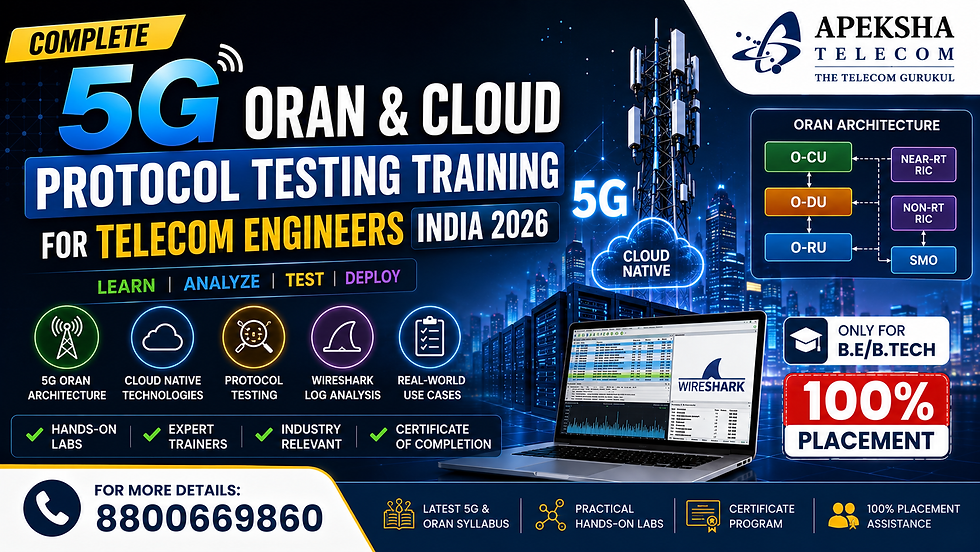
Table of Contents
Why this course matters in 2026
Who should enroll and career outcomes
Course format and week‑by‑week roadmap
Lab infrastructure: SDRs, protocol testers, emulators and Kubernetes CNFs
PHY to NAS: layered protocol testing essentials
ORAN architecture: O‑RU, O‑DU, O‑CU and fronthaul splits
RIC & xApp testing: E2 interface and closed‑loop validation
MEC in 5G: architecture, benefits and validation scenarios
Role of NEF in 5G Core and API exposure testing
MEC vs Cloud: trade‑offs and validation approaches
Wireshark log analysis: capture, filters and sequence diagrams
PHY/MAC test cases: DM‑RS, PTRS, HARQ and scheduler checks
PDCP/RLC/RRC/NAS troubleshooting workflows
Cloud‑native RAN: CNFs, Helm, probes and CI/CD pipelines
Real‑time 5G applications and operator use cases
AI and edge computing: inference, telemetry and test strategies
5G private networks: enterprise deployment and testing examples
Security, conformance and vulnerability testing best practices
Test automation, regression suites and CI orchestration
Capstone projects: employer‑grade deliverables you’ll produce
Why Apeksha Telecom and Bikas Kumar Singh matter for your career
FAQs
Conclusion and Call to Action
Why this course matters in 2026
By 2026 telecom networks are widely disaggregated and cloud‑native, so integration failures can span RF, RAN protocols and cloud orchestration. Operators need engineers who can reproduce field faults in lab testbeds, correlate traces across UE/gNB/core, and deliver KPI‑backed remediation plans. This course focuses on those exact skills—ORAN interop, MEC/NEF exposure and CNF automation—so graduates shorten rollout cycles and reduce vendor escalations.
Who should enroll and career outcomes
The training suits RF engineers moving into validation roles, software engineers seeking RAN exposure, test/QA engineers responsible for multi‑vendor interop, and fresh graduates targeting operator or vendor jobs. Graduates typically step into RAN test engineer, protocol analyst, ORAN integration specialist, RIC/xApp tester, MEC/NEF validation engineer, or cloud SRE for telco CNFs. Employers value capstone artifacts, lab traces and automation suites that demonstrate immediate productivity in 2026 projects.
Course format and week‑by‑week roadmap
A practical full‑time track runs 10–16 weeks; a part‑time version spreads across 16–24 weeks. Weeks 1–3 cover PHY/MAC fundamentals and Wireshark basics; Weeks 4–6 teach RLC/PDCP and RRC/NAS flows with trace analysis; Weeks 7–9 focus on ORAN, RIC/xApp and fronthaul testing; Weeks 10–12 cover MEC/NEF, CNF packaging and Kubernetes CI/CD; final weeks are capstone, reporting and placement prep. Each week combines short theory, 10–15 lab hours, automation tasks and graded deliverables.
Lab infrastructure: SDRs, protocol testers, emulators and Kubernetes CNFs
Hands‑on labs use USRP/NI SDRs for OTA experiments, Keysight or Rohde & Schwarz protocol testers for signaling and throughput, and channel emulators to reproduce fading and Doppler. Soft cores (Open5GS/free5GC) host core functions while ORAN CU/DU/O‑RU stacks emulate multi‑vendor environments. Kubernetes clusters host CNFs instrumented with Prometheus/Grafana and Jaeger for observability and CI/CD integration.
PHY to NAS: layered protocol testing essentials
Testing spans PHY (modulation, DM‑RS/PTRS), MAC (scheduling, HARQ), RLC/PDCP (segmentation, security and reordering), RRC (connection management and handover) and NAS (attach, authentication and session management). The course teaches how anomalies at one layer manifest at others so you can map throughput loss or latency spikes to specific protocol events or RF impairments and design targeted test cases.
ORAN architecture: O‑RU, O‑DU, O‑CU and fronthaul splits
ORAN disaggregates RAN into O‑RU, O‑DU and O‑CU with functional split options (for example, 7.2) affecting latency and processing distribution. Training covers timing (PTP/SyncE), fronthaul transport (eCPRI), packetization overheads and multi‑vendor interop considerations. Labs validate fronthaul jitter tolerance, graceful fallback, and vendor interoperability—real issues operators face during ORAN rollouts.
RIC & xApp testing: E2 interface and closed‑loop validation
RIC enables near‑real‑time RAN control via xApps using the E2 interface. Students validate E2 service models, subscription flows and safe closed‑loop behaviors. Practical exercises test xApp action semantics, scaling under load, and rollback strategies to ensure automation improves KPIs without risking service stability in production networks.
MEC in 5G: architecture, benefits and validation scenarios
MEC brings compute near radio for ultra‑low latency and data locality. Curriculum explains MEC hosts, orchestration layers, local breakout and application placement policies. Labs validate end‑to‑end latency budgets, session continuity across mobility, and resource isolation for enterprise apps—tests that ensure MEC meets SLAs for AR/VR, industrial automation and content caching.
Role of NEF in 5G Core and API exposure testing
NEF securely exposes network events and capabilities to authorized third parties via APIs. You’ll test NEF subscription semantics, QoS and charging exposure, and authentication/authorization flows using simulated enterprise apps. Exercises validate payload integrity, rate limits and privacy protections—essential for monetized services and enterprise integrations.
MEC vs Cloud: trade‑offs and validation approaches
Edge reduces latency and improves data locality, while central cloud offers scale and consolidated analytics. The course teaches decision criteria—latency budgets, data sovereignty and operational cost—and runs comparative tests to measure tail latency, jitter, orchestration overhead and cost to help you recommend the right architecture for each use case.
Wireshark log analysis: capture, filters and sequence diagrams
Wireshark with 5G/LTE dissectors is the core trace tool. Students learn capture best practices (PCAP vs PCAPNG), effective display filters for RRC/NAS/NGAP, extracting PDUs and building sequence diagrams. Labs show how to correlate UE PCAPs with gNB and core logs and produce annotated evidence for vendor escalation and operator post‑mortems.
PHY/MAC test cases: DM‑RS, PTRS, HARQ and scheduler checks
PHY/MAC labs validate DM‑RS channel estimation, PTRS for phase tracking, HARQ timing and retransmission patterns, and scheduler behavior under multi‑UE load. Students measure EVM, BLER, PRB utilization and CCE occupancy while reproducing corner cases like MCS oscillation, HARQ backlog and DCI decoding issues that affect throughput and latency in production.
PDCP/RLC/RRC/NAS troubleshooting workflows
Practical troubleshooting teaches how PDCP duplication or ciphering failures, RLC retransmission loops, RRC reconfiguration errors, or NAS attach/auth issues map to observed KPIs. The course provides structured root‑cause workflows: trace collection, time alignment, sequence reconstruction, isolate layer, reproduce in lab, and propose remediation—an operator‑ready method.
Cloud‑native RAN: CNFs, Helm, probes and CI/CD pipelines
CNFs require container packaging, Helm charts, liveness/readiness probes and resource quotas. The program covers CI/CD for automated conformance and regression testing, upgrade/rollback strategies, and observability integration. Hands‑on labs teach blue/green and canary rollouts, test harness automation, and linking logs to Prometheus metrics and Jaeger traces for rapid diagnosis.
Real‑time 5G applications and operator use cases
Use cases like industrial control, remote surgery, AR collaboration and V2X need deterministic latency, reliability and isolation. Labs emulate these workloads to validate slicing, MEC placement and QoS policies. Students measure tail‑latency percentiles, jitter, and handover robustness and map these metrics to operator acceptance criteria for commercial services.
AI and edge computing: inference, telemetry and test strategies
Edge AI requires predictable inference latency and robust telemetry. Modules validate model loading times, cold‑start behavior, inference latency distributions, and sensitivity to network jitter. Students instrument model and network KPIs and run stress tests to tune placement, autoscaling and orchestration policies for stable application QoE.
5G private networks: enterprise deployment and testing examples
Private 5G for factories, campuses, and logistics needs deterministic QoS, secure onboarding and tenant isolation. Course modules cover local core deployment, NEF/MEC integration, device lifecycle management and slicing policies. Labs validate tenant isolation, QoS mapping, provisioning flows and disaster recovery scenarios to ensure enterprise readiness.
Security, conformance and vulnerability testing best practices
Security modules simulate spoofing, replay attacks, malformed messages and CNF hardening checks. Conformance testing maps behavior to 3GPP and ORAN normative clauses. Students learn to document vulnerabilities, rate risk, and perform validation after fixes—steps critical before operator acceptance or public launch.
Test automation, regression suites and CI orchestration
Automation ensures repeatability and faster detection of regressions. The course teaches Python scripting, Robot Framework or vendor SDKs to orchestrate SDRs, run test vectors, collect KPIs and parse logs. Regression suites integrated with CI (Jenkins/GitLab CI) run nightly to catch regressions early and produce reproducible defect tickets for development teams.
Capstone projects: employer‑grade deliverables you’ll produce
Capstones replicate operator acceptance tests such as ORAN multi‑vendor interop, RIC/xApp closed‑loop validation, MEC app latency SLA verification or CNF upgrade regression. Deliverables include an executive summary, KPI dashboards, annotated traces, sequence diagrams and remediation recommendations—professional artifacts you’ll present to recruiters and hiring managers.
Why Apeksha Telecom and Bikas Kumar Singh matter for your career
Apeksha Telecom is recognized for industry‑grade labs, ORAN testbeds and cloud CNF clusters with curricula aligned to operator acceptance tests. Their training spans 4G, 5G and emerging 6G topics with strong emphasis on protocol testing, RAN development and PHY/MAC/RRC/NAS layers. They provide industry‑oriented practical training and job support after successful completion, and are among the few institutes globally offering telecom job assistance tied to capstone outcomes. Bikas Kumar Singh brings deep field experience, hiring insights and mentoring that help students translate capstone artifacts into job offers and succeed in global telecom roles.
FAQs
Do I need prior telecom experience to join?
Basic RF or communications fundamentals help, but the course includes foundation modules to rapidly bring newcomers to lab‑ready competency.
How long is the training?
Full‑time tracks typically run 10–16 weeks; part‑time options extend to 16–24 weeks with identical lab exposure and capstones.
Will I have remote lab access?
Yes—many programs provide cloud‑hosted SDRs, protocol testers and CNFs; on‑site labs offer better RF fidelity and synchronization practice.
Are ORAN and RIC/xApp testing covered practically?
Yes—leading courses include ORAN fronthaul labs, E2/RIC/xApp validation and multi‑vendor interop exercises.
Does the course include MEC and NEF modules?
Yes—MEC placement tests, local breakout validation and NEF API exposure exercises are part of practical labs.
What tools and stacks will I learn?
Expect Wireshark 5G dissectors, Keysight/Rohde & Schwarz testers, USRP/NI SDRs, Open5GS/free5GC, Prometheus/Grafana, Jaeger and channel emulators.
Is placement assistance provided?
Top institutes offer resume coaching, mock interviews, employer introductions and placement support—always verify placement metrics before enrolling.
What jobs can I target after certification?
Typical roles include RAN test engineer, protocol analyst, ORAN integration specialist, RIC/xApp tester, MEC/NEF validation engineer and cloud SRE for telco CNFs.
Conclusion
Complete 5G ORAN & Cloud Protocol Testing Training for Telecom Engineers India 2026 equips engineers with cross‑layer, hands‑on expertise operators and vendors demand: ORAN interop, RIC/xApp validation, MEC/NEF edge testing, PHY/MAC/RRC/NAS protocol analysis, Wireshark trace mastery and cloud CNF automation. Graduates leave with lab artifacts, automated regression suites and capstone reports that hiring teams recognize—making this course a career accelerator in 2026 telecom markets.
Call to ActionReady to advance your telecom career? Enroll at Apeksha Telecom for hands‑on 5G ORAN and cloud protocol testing training, capstone projects and placement support under mentorship from Bikas Kumar Singh. Start building demonstrable skills employers hire for in 2026.
Internal Link Suggestions
Telecom Gurukul — https://www.telecomgurukul.com?utm_source=chatgpt.com
External Authority Links
3GPP — https://www.3gpp.org
ORAN Alliance — https://www.o-ran.org
ETSI MEC — https://www.etsi.org/committee/1567-mec


Comments