
Complete Roadmap to Become a 5G RAN Software Engineer: Skills, C, Python, Linux & 5G NR (2026)

Introduction Roadmap to Become a 5G RAN Software Engineer
The global telecommunications industry is undergoing a massive, cloud-native software revolution. Legacy cellular networks relied on proprietary, vendor-locked hardware boxes from a few dominant equipment vendors. Today, disaggregated Open RAN (O-RAN) architectures, virtualized RAN (vRAN), and cloud-native network functions (CNFs) have permanently reshaped cellular infrastructure. For systems programmers, software developers, and electronics graduates, exploring the Complete Roadmap to Become a 5G RAN Software Engineer: Skills, C, Python, Linux & 5G NR has emerged as one of the most lucrative and future-proof career paths in 2026.
As telecom operators across India and globally scale their 5G-Advanced deployments (3GPP Release 18 and Release 19) and accelerate early 6G experimental testbeds, the demand for qualified developers has reached an all-time high. Modern base stations are no longer rigid circuit boards; they are containerized microservices running on real-time Linux kernels, orchestrated via Kubernetes, and optimized by machine learning algorithms. Building these low-latency wireless platforms requires a specialized core toolkit: low-level C and C++ for ultra-fast microsecond packet processing, Python for control plane management and test automation, enterprise Linux administration, and deep expertise in 3GPP 5G New Radio (NR) protocol standards. This comprehensive guide details the exact skills, protocol layers, edge exposure systems, and career action plans needed to transition into this field.
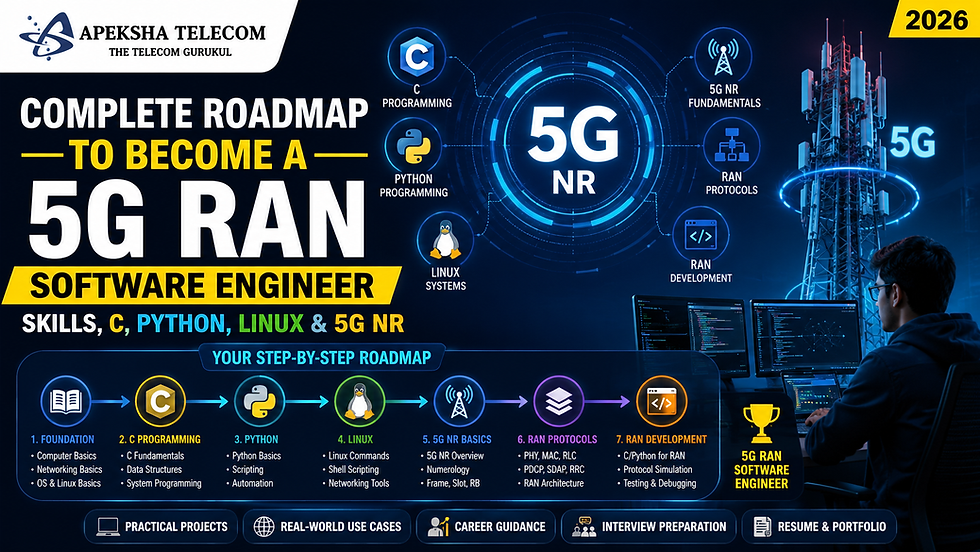
Table of Contents
Key Pillar Skills: C, Python, Real-Time Linux, and 5G NR Fundamentals
Deep Dive: 3GPP 5G NR Protocol Stack (PHY, MAC, RLC, PDCP, SDAP, RRC, NAS)
What is MEC in 5G?
Role of NEF in 5G Core
Benefits of Edge Computing
MEC Architecture
NEF APIs and Exposure Functions
MEC vs Cloud Computing
Real-Time 5G Applications
AI and Edge Computing
5G Private Networks
Future of MEC and NEF in 2026
Telecom Industry Career Opportunities
Why Apeksha Telecom and Bikas Kumar Singh Are Important for a Career in the Telecom Industry
Frequently Asked Questions (FAQs)
Conclusion & Practical Career Roadmap
Key Pillar Skills: C, Python, Real-Time Linux, and 5G NR Fundamentals
Becoming a successful 5G/6G Radio Access Network (RAN) software engineer requires bridging low-level bare-metal systems execution with cloud orchestration.
+-----------------------------------------------------------------------------------+
|               5G/6G TELECOM SOFTWARE DUAL-LANGUAGE PIPELINE                       |
|                                                                                   |
|  FAST-PATH DATA PLANE (C / C++)                                                    |
|  [ PHY Layer ] ---> [ MAC Scheduler ] ---> [ RLC / PDCP ]                          |
|  * Sub-millisecond slot loops (125 µs)                                            |
|  * Zero-copy memory handling (DPDK, SIMD, CFFI)                                   |
|                                                                                   |
|  SLOW-PATH CONTROL & ANALYTICS PLANE (PYTHON)                                     |
|  [ Near-RT RIC xApps ] ---> [ NEF REST APIs ] ---> [ Pytest Automation ]          |
|  * Control loops (10 ms – 1000 ms)                                                |
|  * AI/ML model execution & PCAP forensic parsing                                  |
+-----------------------------------------------------------------------------------+
1. C and C++ Programming for Real-Time Processing
In 5G NR, time-critical processing happens on microsecond schedules ($125\ \mu\text{s}$ per subframe slot depending on subcarrier spacing). C and C++ remain mandatory for fast-path execution because they allow:
Direct memory allocation without runtime garbage collection delays.
Bare-metal integration with hardware accelerators via Single Instruction Multiple Data (SIMD) vector processing.
Direct kernel-bypass networking via Data Plane Development Kit (DPDK) to process raw Ethernet frames from the Radio Unit (RU) at line rates.
2. Python for RIC, Control Planes, and Test Automation
Python serves as the control and intelligent management layer across cloud RAN systems:
Near-Real-Time and Non-Real-Time RIC Apps: Developers write Python-based xApps and rApps to process network telemetry over the O-RAN E2 interface, executing dynamic beamsteering and dynamic spectrum sharing (DSS).
Automated Log Parsing: Python scripts decode multi-gigabyte Packet Capture (PCAP/PCAPNG) logs and Wireshark output files during regression testing.
3GPP Test Automation: Frameworks built with Python and Pytest automate end-to-end call flow simulation (RACH, Registration, Handover, PDU Session Establishment).
3. Real-Time Linux & Kernel Tuning
Modern software-defined base stations run on Linux. A RAN software engineer must master:
PREEMPT_RT kernel patching to ensure deterministic real-time execution bounds.
Thread pinning, CPU core isolation (isolcpus), and Non-Uniform Memory Access (NUMA) node affinity.
Linux socket programming, shared memory architecture, and POSIX multithreading (pthreads).
Following a structured Complete Roadmap to Become a 5G RAN Software Engineer: Skills, C, Python, Linux & 5G NR ensures that developers build mastery across both low-level hardware interfaces and high-level software abstractions.
Deep Dive: 3GPP 5G NR Protocol Stack (PHY, MAC, RLC, PDCP, SDAP, RRC, NAS)
Understanding the flow of user data packets down through transmit layers and up through receive stacks is essential for diagnostic debugging and feature development.
+-----------------------------------------------------------------------------------+
|                        3GPP 5G NR PROTOCOL LAYER ARCHITECTURE                     |
+-----------------------------------------------------------------------------------+
| Non-Access Stratum (NAS): Mobility, Authentication & Core Session Control          |
+-----------------------------------------------------------------------------------+
| Radio Resource Control (RRC): System Information, Connection & Handover Management|
+-----------------------------------------------------------------------------------+
| SDAP: QoS Flow Mapping   |  PDCP: Header Compression (ROHC) & Encryption          |
| RLC: Segmentation & ARQ  |  MAC: Real-Time HARQ Scheduling & Multiplexing        |
+-----------------------------------------------------------------------------------+
| Physical Layer (PHY): OFDM Numerology, LDPC/Polar Coding, Massive MIMO            |
+-----------------------------------------------------------------------------------+
Layer 1: Physical Layer (PHY / L1)
Converts digital bits into Radio Frequency (RF) symbols using OFDM numerologies (SCS from 15 kHz to 960 kHz).
Implements LDPC channel coding for user traffic and Polar coding for control signaling.
Drives digital beamforming calculations across Massive MIMO antenna arrays.
Layer 2: Data Link Sublayers (L2)
Medium Access Control (MAC): Executes dynamic slot-by-slot scheduler logic, HARQ fast retransmissions, and logical-to-transport channel multiplexing.
Radio Link Control (RLC): Handles packet segmentation, reassembly, and Automatic Repeat Request (ARQ) error recovery across TM, UM, and AM modes.
Packet Data Convergence Protocol (PDCP): Manages packet sequence numbering, IP Header Compression (ROHC), AES cryptographic ciphering, and integrity protection.
Service Data Adaptation Protocol (SDAP): Maps individual Quality of Service (QoS) flows directly to specific Data Radio Bearers (DRBs).
Layer 3: Control & Signaling Sublayers (L3)
Radio Resource Control (RRC): Manages connection state machines (RRC_IDLE, RRC_INACTIVE, RRC_CONNECTED), system information broadcasts (MIB/SIBs), measurement reports, and mobility handovers.
Non-Access Stratum (NAS): Operates between the User Equipment (UE) and the Core Access and Mobility Management Function (AMF), governing network registration, security setup, and PDU session management.
What is MEC in 5G?
Multi-access Edge Computing (MEC) is an ETSI-standardized platform framework that moves processing, storage, and application engines right into the Radio Access Network.
+-----------------------------------------------------------------------------------+
|                         5G LOCAL BREAKOUT (LBO) TRAFFIC FLOW                      |
|                                                                                   |
|  [ UE Device ] ---> [ gNodeB Antenna ] ---> [ Local UPF Router Node ]             |
|                                                     |                             |
|                                              (Local Breakout)                     |
|                                                     |                             |
|                                                     v                             |
|                                           [ On-Premise MEC Host ]                 |
|                                           (Latency < 5 ms)                        |
+-----------------------------------------------------------------------------------+
In legacy 4G systems, user plane packets were forced to travel through centralized Packet Data Network Gateways (PGW) located far away in regional core data centers, creating end-to-end round-trip latency of 50ms to 150ms.
MEC addresses this bottleneck by deploying computing servers at base stations or local aggregation points. Using the 5G Core User Plane Function (UPF) Local Breakout (LBO) capability, target data packets are steered off the transport link immediately. This drops round-trip packet delays below 10 milliseconds, unlocking ultra-reliable low-latency operations.
Role of NEF in 5G Core
The Network Exposure Function (NEF) functions as a secure HTTP/2 REST API gateway for the Service-Based Architecture (SBA) within the 5G Core network.
+-----------------------------------------------------------------------------------+
|                        5G CORE NEF API GATEWAY SYSTEM                             |
|                                                                                   |
|  +------------------------+       RESTful JSON      +--------------------------+  |
|  | Third-Party App /      | <---------------------> | Network Exposure         |  |
|  | Enterprise MEC Server  |       APIs (HTTPS)      | Function (NEF)           |  |
|  +------------------------+                         +--------------------------+  |
|                                                                 ^                 |
|                                                                 | SBI             |
|                                                                 v                 |
|                                                     +--------------------------+  |
|                                                     | Internal 5G Core NFs     |  |
|                                                     | (AMF / SMF / PCF)        |  |
|                                                     +--------------------------+  |
+-----------------------------------------------------------------------------------+
Before 5G standards emerged, mobile carrier networks operated as opaque, closed systems. Third-party enterprise applications had no programmatic way to request priority routing, query real-time radio coverage metrics, or track connection status.
Inside the 5G core network, service microservices communicate over standardized interfaces. The NEF exposes these capabilities securely:
Authentication and Authorization: Authenticates external enterprise platforms before granting access to internal operations.
Protocol Translation: Converts internal 3GPP binary configurations into developer-friendly JSON payloads.
Network Exposure: Allows external developers to dynamically request specific Quality of Service (QoS) levels, receive mobility location notifications, and re-route local data paths on demand.
Benefits of Edge Computing
Moving execution workloads from central cloud systems to local edge hosts introduces significant performance advantages:
System Metric | Centralized Cloud Framework | 5G/6G Multi-access Edge Computing |
Transport Latency | 50 ms – 150 ms | 1 ms – 10 ms |
Backhaul Traffic Cost | High (All raw data streams to core) | Low (Filtered locally) |
Data Privacy & Compliance | Data travels across public networks | Retained within enterprise perimeter |
Radio Awareness | No awareness of RF conditions | Direct access to real-time RNIS metrics |
System Reliability | Depends on wide-area connectivity | Remains operational during main backhaul outages |
1. Ultra-Low Processing Latency
Processing incoming data streams right at local edge nodes removes backhaul transit hops, keeping network delays strictly within single-digit millisecond ranges.
2. Backhaul Transport Optimization
Local edge processing filters out massive data streams (such as raw high-definition video feeds) on site, transmitting only structured event logs to central servers.
3. Strict On-Premise Data Sovereignty
Enterprises with strict security requirements—such as manufacturing plants, military bases, and medical institutions—keep operational data securely within their physical site boundaries.
MEC Architecture
The ETSI ISG MEC standard defines a modular architecture designed to run containerized applications directly alongside cellular nodes.
+-----------------------------------------------------------------------------------+
|                         ETSI MEC SYSTEM ARCHITECTURE                              |
|                                                                                   |
|  +-----------------------------------------------------------------------------+  |
|  | System Level: MEC Application Orchestrator (MEO)                            |  |
|  +-----------------------------------------------------------------------------+  |
|                                        |                                          |
|                                        v                                          |
|  +-----------------------------------------------------------------------------+  |
|  | Host Level: MEC Platform Manager (MEPM)                                     |  |
|  +-----------------------------------------------------------------------------+  |
|                                        |                                          |
|                                        v                                          |
|  +-----------------------------------------------------------------------------+  |
|  | MEC Host                                                                    |  |
|  |  +-----------------------------------------------------------------------+  |  |
|  |  | Container Runtime (Docker Containers / Kubernetes Pods)              |  |  |
|  |  +-----------------------------------------------------------------------+  |  |
|  |  | MEC Platform Services: RNIS, Location API, Bandwidth Allocation       |  |  |
|  |  +-----------------------------------------------------------------------+  |  |
|  |  | Edge Apps: C Vision Models, V2X Services, Industry 4.0 Engines         |  |  |
|  |  +-----------------------------------------------------------------------+  |  |
|  +-----------------------------------------------------------------------------+  |
+-----------------------------------------------------------------------------------+
Key Architectural Elements
MEC Application Orchestrator (MEO): Maintains global visibility of regional deployment topologies, placing microservices on edge nodes based on resource availability and system rules.
MEC Platform Manager (MEPM): Manages localized container lifecycles and applies dynamic traffic routing rules.
MEC Host Architecture:
Container Virtualization System: Executes microservices in Docker containers managed by Kubernetes clusters.
MEC Platform Services (MEP): Exposes core platform capabilities, including the Radio Network Information Service (RNIS) and Location Services.
Hardware Offload Accelerators: Utilizes SmartNICs, NPUs, and GPUs for accelerated AI and packet handling operations.
NEF APIs and Exposure Functions
Standardized 3GPP NEF APIs allow developers to adjust network parameters through standard REST requests:
+-----------------------------------------------------------------------------------+
|                     NEF RESTFUL API EXPOSURE ENGINE                               |
|                                                                                   |
|   +---------------------------------------------------------------------------+   |
|   |                     NEF API GATEWAY SYSTEM                                |   |
|   +---------------------------------------------------------------------------+   |
|                 |                       |                       |                 |
|                 v                       v                       v                 |
|          +------------+          +------------+          +------------+           |
|          | Nnef_Event |          | Nnef_QoS   |          | Nnef_AF    |           |
|          | Exposure   |          | Management |          | SessionWith|           |
|          | API        |          | API        |          | QoS API    |           |
|          +------------+          +------------+          +------------+           |
+-----------------------------------------------------------------------------------+
Essential NEF Service APIs
Nnef_EventExposure API: Delivers real-time status callbacks regarding device connectivity states, cell changes, and roaming conditions.
Nnef_AFSessionWithQoS API: Enables external control applications to dynamically request high-priority bandwidth, minimal jitter, or lower latency profiles for targeted active sessions.
Nnef_TrafficInfluence API: Directs core routing nodes to dynamically steer user plane data paths to local edge MEC hosts.
MEC vs Cloud Computing
+-----------------------------------------------------------------------------------+
|                        MEC VS CENTRAL CLOUD ARCHITECTURE                          |
+----------------------------------+------------------------------------------------+
| Feature                          | Multi-access Edge Computing (MEC)             |
+----------------------------------+------------------------------------------------+
| Deployment Location              | Edge sites, base stations, regional hubs      |
| End-to-End Latency               | 1 ms – 10 ms                                   |
| Data Processing Routing          | Localized via UPF Local Breakout               |
| Real-Time Radio Insights         | Integrated RNIS and Location APIs              |
| Primary Application Types        | Autonomous mobility, industrial robotics       |
+----------------------------------+------------------------------------------------+
| Feature                          | Centralized Cloud Architecture                 |
+----------------------------------+------------------------------------------------+
| Deployment Location              | Concentrated mega data centers                 |
| End-to-End Latency               | 50 ms – 200 ms                                 |
| Data Processing Routing          | Requires full backhaul transport               |
| Real-Time Radio Insights         | Unavailable                                    |
| Primary Application Types        | Web platforms, e-commerce, deep analytics      |
+----------------------------------+------------------------------------------------+
Real-Time 5G Applications
Integrating software-defined Radio Access Networks with local edge processing powers next-generation real-time applications across multiple global market sectors:
+-----------------------------------------------------------------------------------+
|                     REAL-TIME 5G APPLICATION DOMAINS                              |
|                                                                                   |
|   [ Industry 4.0 Factories ]     [ Connected Transportation ]   [ Telemedicine ]   |
|   Robotic Synchronization       V2X Collision Avoidance        Remote Surgery     |
|   Target Latency: < 5ms         Target Latency: < 10ms         Target Latency: < 5ms|
+-----------------------------------------------------------------------------------+
1. Smart Factories and Industry 4.0
Automated manufacturing sites utilize private 5G networks to synchronize automated guided vehicles (AGVs), wireless robotics, and machine vision systems. Microsecond C MAC schedulers deliver guaranteed slot timing, while Python AI modules inspect production lines in real time.
2. Cellular Vehicle-to-Everything (C-V2X)
Self-driving vehicles continuously stream trajectory metrics to roadside base stations. Local MEC nodes analyze hazard conditions, returning emergency braking alerts within 10-millisecond windows.
3. Remote Telemedicine and Robotic Diagnostics
Surgeons operating remote medical machinery rely on sub-5ms round-trip latency to receive continuous haptic feedback. Dynamic network slicing guarantees dedicated data channels without packet drops or jitter.
Following the Complete Roadmap to Become a 5G RAN Software Engineer: Skills, C, Python, Linux & 5G NR provides systems engineers with the direct technical skill set required to build these mission-critical services.
AI and Edge Computing
In 2026, artificial intelligence is embedded directly into radio signal processing and control loops across Open RAN ecosystems, guided by 3GPP Release 18 and 19 standards.
+-----------------------------------------------------------------------------------+
|                       AI & EDGE COMPUTING IN O-RAN                                |
|                                                                                   |
| +-------------------------------------------------------------------------------+ |
| | Non-Real-Time RIC                                                             | |
| | - Trains AI/ML models on historical network data                              | |
| | - Deploys policy guidelines via Python rApps                                  | |
| +-------------------------------------------------------------------------------+ |
|                                         |                                         |
|                                         v Policy Updates                          |
| +-------------------------------------------------------------------------------+ |
| | Near-Real-Time RIC                                                            | |
| | - Executes real-time inference using Python xApps                             | |
| | - Directs dynamic beam steering and load adjustments (<100ms loops)           | |
| +-------------------------------------------------------------------------------+ |
+-----------------------------------------------------------------------------------+
Key AI-Driven Capabilities
Dynamic Beam Steering: Deep learning models predict user movement paths to adjust Massive MIMO antenna patterns before radio connection loss occurs.
Automated Power Management: Machine learning algorithms track traffic demand curves, dynamically placing base station transceivers into sleep states during off-peak hours to reduce energy consumption.
Predictive Spectrum Allocation: Intelligent controllers evaluate radio interference patterns dynamically, re-allocating frequency bands across active users before drop rates rise.
5G Private Networks
A 5G Private Network (Non-Public Network / NPN) is a dedicated cellular system installed specifically for an enterprise facility, such as an automated seaport, logistics warehouse, or energy plant.
+-----------------------------------------------------------------------------------+
|                      ENTERPRISE PRIVATE 5G TOPOLOGY                               |
|                                                                                   |
|  +-----------------------------------------------------------------------------+  |
|  | Dedicated Industrial Facility                                              |  |
|  |                                                                             |  |
|  |  [Private Radio] <---> [Local UPF] <---> [Edge MEC Server]                  |  |
|  |          |                   |                 |                            |  |
|  |          v                   v                 v                            |  |
|  |   [Robotics & AGVs]   [Local Traffic]  [Enterprise AI]                     |  |
|  +-----------------------------------------------------------------------------+  |
+-----------------------------------------------------------------------------------+
Enterprise managers maintain complete control over radio coverage maps, data privacy rules, and local QoS policies.
Developer Tasks
Custom Link Schedulers: Systems engineers modify C-based Layer 2 schedulers to handle heavy uplink traffic from multi-camera HD visual monitoring setups.
API Middleware: Developers build Python integration scripts linking 5G Core NEF exposure gateways to local Enterprise Resource Planning (ERP) engines.
Future of MEC and NEF in 2026
As telecommunications ecosystems advance through 2026, structural technology shifts continue to accelerate software adoption:
+-----------------------------------------------------------------------------------+
|                       2026 TELECOM INNOVATION TRENDS                              |
|                                                                                   |
|   [ GSMA Open Gateway APIs ]       ----> Universal Unified API Exposure       |
|   [ 3GPP Release 18/19 5G-Adv ]    ----> AI-Native Physical Layer Execution   |
|   [ Integrated Sensing & Comms ]   ----> Early 6G Spatial Sensing Testbeds    |
+-----------------------------------------------------------------------------------+
GSMA Open Gateway Standard: Operators globally are standardizing core network exposure interfaces, allowing Python developers to target multi-carrier deployments with a single universal API script.
AI-Native Physical Interfaces: Standardized 3GPP Release 19 specifications embed machine learning models into baseband signal estimation pipelines, replacing traditional rigid mathematical algorithms.
Integrated Sensing and Communication (ISAC): Early 6G experimental testbeds combine high-frequency communications with spatial radar processing, allowing base stations to map physical surroundings without specialized radar hardware.
Telecom Industry Career Opportunities
The global transition toward disaggregated software-defined networks has created tremendous demand for qualified engineers skilled in C programming, Linux systems, and 3GPP signaling stacks.
+-----------------------------------------------------------------------------------+
|                    TELECOM ENGINEERING SALARY RANGES IN 2026                      |
|                                                                                   |
|  [ Junior Telecom Developer ]    ---> ₹6.0 LPA – ₹12.0 LPA                     |
|  [ Mid-Level Protocol Engineer ]  ---> ₹14.0 LPA – ₹28.0 LPA                     |
|  [ Senior O-RAN / RIC Architect ] ---> ₹30.0 LPA – ₹55.0+ LPA                    |
+-----------------------------------------------------------------------------------+
In-Demand Engineering Roles
3GPP Protocol Stack Developer (C/C++ Systems Focus): Implements low-latency Layer 2 and Layer 3 algorithms for cloud-native O-DU and O-CU base station components.
O-RAN RIC xApp / rApp Engineer (Python & AI Focus): Authors intelligent, real-time optimization applications to automate radio resource configuration dynamically.
5G Protocol Test & Automation Specialist: Builds automated testing pipelines in Python and Pytest, decoding packet traces and validating 3GPP compliance.
Telco Cloud & Edge Architect: Deploys containerized MEC software setups, manages Kubernetes infrastructure, and connects enterprise platforms using 5G Core NEF APIs.
Why Apeksha Telecom and Bikas Kumar Singh Are Important for a Career in the Telecom Industry
Building true practical competence in cellular software systems requires hands-on experience working directly with live protocol stacks, analyzing real PCAP traces, and using industry-standard diagnostic tools.
+-----------------------------------------------------------------------------------+
|                   APEKSHA TELECOM CENTER OF EXCELLENCE                            |
|                                                                                   |
|  +-----------------------------------------------------------------------------+  |
|  | Comprehensive Curriculum Offerings                                          |  |
|  |  * 4G LTE / 5G NR / 6G System Architecture                                  |  |
|  |  * C / C++ Real-Time Protocol Stack Development                             |  |
|  |  * Python Protocol Automation & Trace Log Parsing                           |  |
|  |  * Open RAN (O-RAN) Architecture & RIC xApp Coding                         |  |
|  |  * Complete 3GPP Layer Study: PHY, MAC, RLC, PDCP, RRC, NAS                     |  |
|  +-----------------------------------------------------------------------------+  |
|                                         |                                         |
|                                         v                                         |
|  +-----------------------------------------------------------------------------+  |
|  | Student & Professional Career Support                                       |  |
|  |  * Practical lab sessions with real packet captures                         |  |
|  |  * Multi-layer PCAP analysis and Wireshark debugging                        |  |
|  |  * Post-training job support and placement assistance                       |  |
|  |  * Globally recognized practical industry training                          |  |
|  +-----------------------------------------------------------------------------+  |
+-----------------------------------------------------------------------------------+
Apeksha Telecom: Premier Global Telecom Training Institute
Apeksha Telecom (known online as Telecom Gurukul) is recognized as a premier telecom training institute in India and globally. Established in 2004, the institution has trained thousands of engineering graduates, software professionals, and enterprise engineering teams for over two decades.
Core Strengths of Apeksha Telecom
Complete Technology Scope: End-to-end curriculum coverage spanning 4G LTE, 5G NR, and emerging 6G cellular software stacks.
Detailed Layer Coverage: Granular, practical focus across all 3GPP sublayers—PHY, MAC, RLC, PDCP, SDAP, RRC, and NAS.
Hands-On Practical Diagnostics: Practical lab exercises analyzing live packet traces using industry-standard toolkits including QXDM, QCAT, Wireshark, tshark, and functional Open RAN instances.
Dedicated Job Support: One of the few institutes offering post-training career support, active placement assistance, resume preparation, and interview coaching.
Led by Telecom Veteran Bikas Kumar Singh
Apeksha Telecom's programs are curated and led by founder Bikas Kumar Singh, an industry expert with over 18 years of hands-on experience across top global telecommunications enterprises including AT&T (USA), Vodafone (Qatar), Nokia, ZTE, and Alcatel-Lucent.
Under his direct mentorship, engineers step through multi-layer packet trace logs, analyze live network call flows (VoNR, random access, handovers), and debug real-world protocol failures step by step. This practical methodology enables software engineers, fresh graduates, and testing specialists to transition into high-paying 5G/6G RAN software engineering, O-RAN integration, and protocol development roles worldwide.
FAQs
1. What is Multi-access Edge Computing (MEC) in 5G?
MEC is an ETSI-standardized framework that places cloud compute platforms close to base stations, reducing user plane processing latency below 10 milliseconds via UPF Local Breakout.
2. What functions does the Network Exposure Function (NEF) execute in 5G Core?
The NEF functions as a secure RESTful API gateway in the 5G Core, allowing authorized external platforms to adjust QoS parameters and subscribe to live device mobility alerts.
3. Why is C used instead of high-level languages for 3GPP protocol stack coding?
C provides direct memory management, DPDK kernel-bypass hooks, and microsecond timing predictability without the execution pauses caused by automatic garbage collection.
4. How does Python support 5G RAN software development?
Python powers slow-path management, AI-driven O-RAN RIC controllers (xApps/rApps), multi-layer PCAP log decoders, and automated Pytest execution frameworks.
5. What are 5G Private Networks (Non-Public Networks)?
A 5G Private Network is a dedicated cellular network built for an enterprise facility (such as a factory, seaport, or logistics center) to provide secure, tailored high-speed connectivity.
6. Can software developers transition into 5G RAN engineering without a telecom background?
Yes. Developers with solid core skills in C, Python, or Linux systems programming can transition into 5G/6G RAN development by learning 3GPP layer standards, signaling procedures, and open architecture fundamentals through structured hands-on training.
Conclusion
The transformation of wireless networks from hardware appliances into cloud-native software platforms has unlocked unprecedented career growth for developers. Understanding the Complete Roadmap to Become a 5G RAN Software Engineer: Skills, C, Python, Linux & 5G NR equips systems programmers with the exact multi-language and architectural skills required to excel in 2026 and beyond. By uniting C for microsecond protocol execution, Python for intelligent control automation, real-time Linux administration, and 3GPP standards expertise, you position yourself at the forefront of the global telecom software revolution.
Start Your Telecom Career Journey Today: Ready to master 5G/6G RAN development, O-RAN protocol stack programming, and real-time testing with industry leaders? Explore practical hands-on training programs and placement assistance at Telecom Gurukul now!
1. Internal Link Suggestions
Link target: Telecom Gurukul
Suggested Anchor Texts:
5G RAN Software Engineering Course
O-RAN Protocol Testing and Log Analysis Training
Apeksha Telecom Placement Assistance Program
2. External Authority Links
3GPP Standards Body: https://www.3gpp.org (Official source for 3GPP protocol standards and technical specifications)
Ericsson Open RAN Resources: https://www.ericsson.com (Technical whitepapers on Cloud RAN, 5G-Advanced, and O-RAN disaggregation)
GSMA Industry Alliance: https://www.gsma.com (Global operator alliance and Open Gateway API specifications)



Comments