
Emergency Communication Using NTN: Complete 2026 Guide to 5G NTN, Satellite Networks, Disaster Recovery & Critical Connectivity

Introduction To Emergency Communication
Imagine a major earthquake destroys cellular towers, floods cut fiber routes, or a cyclone knocks out power across an entire region. People still need to call emergency services, coordinate rescue teams, share locations, and exchange critical information. This is where Emergency Communication Using NTN becomes increasingly important.
Non-Terrestrial Networks (NTN) extend cellular connectivity beyond conventional terrestrial infrastructure by using satellites, high-altitude platforms, and other airborne systems. 3GPP standardized the first normative NTN requirements in Release 17, including support for service continuity between terrestrial and satellite access networks.
The idea is not to replace every cellular tower with a satellite. Instead, NTN can act as a complementary connectivity layer when terrestrial networks are unavailable, overloaded, or simply out of reach.
In this guide, we will explore how 5G NTN supports disaster response, how LEO satellites and direct-to-device connectivity work, where MEC and edge computing fit, and why telecom professionals should understand these technologies as networks evolve through 2026.
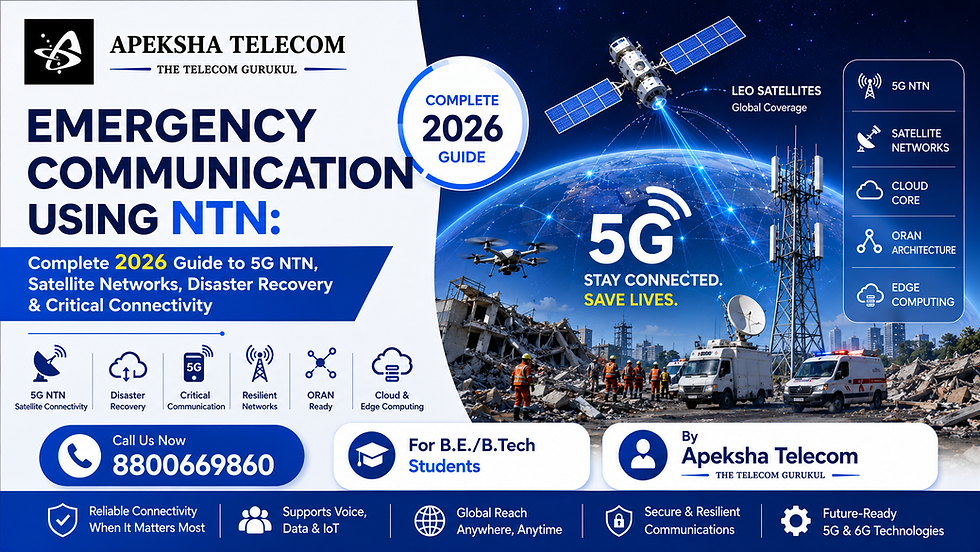
Table of Contents
What Is NTN?
Why Emergency Communication Needs NTN
How Satellite Networks Support Disaster Recovery
5G NTN Architecture for Critical Communication
LEO, MEO and GEO Satellites
Direct-to-Cell and Direct-to-Device Connectivity
NTN Emergency Communication Call Flow
Role of 5G Core Network
What Is MEC in 5G?
Role of NEF in 5G Core
Benefits of Edge Computing
MEC Architecture
NEF APIs and Exposure Functions
MEC vs Cloud Computing
Real-Time 5G Applications
AI and Edge Computing
5G Private Networks
Key Challenges
Future of MEC and NEF
Telecom Industry Career Opportunities
Why Apeksha Telecom and Bikas Kumar Singh Matter
FAQs
Conclusion
What Is Non-Terrestrial Network (NTN)?
A Non-Terrestrial Network is a communication network that uses platforms above the ground instead of relying exclusively on terrestrial base stations. These platforms can include LEO, MEO and GEO satellites, high-altitude platforms and other airborne systems. The objective is to extend communication coverage into locations where terrestrial infrastructure is difficult, expensive or temporarily unavailable.
In 5G, NTN is designed to work with the broader 3GPP ecosystem rather than operate as an isolated satellite system. Release 17 introduced normative NTN requirements, while subsequent releases continue to enhance NTN capabilities.
This makes NTN particularly interesting for emergency response. A satellite link can provide an alternative path when terrestrial access networks, fiber connections or power infrastructure have been damaged.
Why Emergency Communication Needs NTN
During a disaster, communication infrastructure can fail for several reasons. Cellular sites may lose electrical power. Backhaul fiber can be cut. Roads may become inaccessible, preventing technicians from repairing equipment quickly. Even functioning networks can become congested because thousands of people suddenly attempt to communicate simultaneously.
A resilient communication architecture therefore needs redundancy. NTN can provide an additional connectivity layer that does not depend entirely on local terrestrial infrastructure. GSMA describes satellite direct-to-device connectivity as a potential resilience layer that can support communication when terrestrial networks fail, including after natural disasters.
Consider a remote coastal village after a severe cyclone. If terrestrial towers are offline but compatible satellite connectivity remains available, emergency personnel may still be able to exchange messages or transmit essential data.
That capability can make the difference between being disconnected and maintaining a basic communication link.
How Satellite Networks Support Disaster Recovery
Satellite communication has an important advantage during disasters: much of its infrastructure is physically separated from the affected ground area. A damaged terrestrial access network does not automatically mean that the satellite itself has been damaged.
A satellite can communicate with a ground station or, depending on the architecture, provide connectivity directly toward user equipment. This creates several possible recovery models. A satellite may restore connectivity to a remote site, provide temporary backhaul, or support direct communication to compatible devices.
GSMA notes that NTN technologies can complement terrestrial networks in emergency response and other situations where conventional infrastructure cannot provide sufficient coverage.
The most useful architecture depends on the emergency scenario, spectrum, satellite coverage, terminal capability, capacity requirements and regulatory environment.
5G NTN Architecture for Critical Communication
A simplified 5G NTN architecture contains four major areas: the UE, NTN radio access segment, satellite/NTN payload and terrestrial 5G core or data network.
The UE may be a smartphone, IoT device, emergency terminal, vehicle modem or specialized communication device. Its radio signal travels through the NTN access path to a satellite or other non-terrestrial platform. The signal may then reach a gateway connected to the terrestrial network.
There are different NTN architectures. In a transparent payload model, the satellite mainly forwards the radio signal between the UE and gateway. In regenerative architectures, more network processing can be performed on the NTN platform itself. 3GPP's NTN work has continued to evolve toward additional architectures and capabilities.
For emergency services, this architecture can provide an alternate route when a conventional terrestrial path is unavailable.
LEO, MEO and GEO Satellites
Not all satellites behave the same way. LEO satellites operate much closer to Earth than GEO satellites and are therefore generally associated with lower propagation delay. However, their movement means that satellite coverage changes continuously and constellation management becomes important.
MEO satellites sit between LEO and GEO and can provide a different balance between coverage and latency. GEO satellites operate at geostationary altitude and can cover large areas from a fixed apparent position, but their long propagation distance creates substantially higher latency.
For emergency communications, the choice is not simply "which orbit is fastest?" Engineers must evaluate coverage, capacity, latency, Doppler, gateway availability, spectrum, terminal design and service requirements.
A resilient emergency network may also use multiple connectivity technologies rather than relying on one satellite orbit.
Direct-to-Cell and Direct-to-Device Connectivity
Direct-to-device, often abbreviated D2D, describes communication between satellites and mobile handsets. The technology is attracting significant interest because it can potentially extend mobile connectivity without requiring a dedicated satellite terminal for every user.
GSMA describes satellite D2D as a way to supplement terrestrial mobile coverage and add resilience when terrestrial networks become unavailable. It also highlights applications involving remote locations and disaster situations.
This is particularly useful for emergency scenarios because a user may not have access to a satellite phone or specialized terminal. If a compatible handset, spectrum arrangement and service are available, satellite connectivity can provide another route to basic communication services.
However, D2D should not be viewed as an unlimited replacement for terrestrial cellular capacity. GSMA has specifically highlighted capacity and spectral-efficiency constraints that limit how much traffic D2D can practically support.
Emergency Communication Call Flow Over NTN
The exact signaling procedure varies with deployment and service, but a simplified emergency communication flow can be understood as follows.
Step 1: Device Searches for Connectivity
The UE first determines whether a terrestrial network is available. If normal cellular service cannot be obtained, an NTN-capable device can search for an appropriate satellite network or service.
Step 2: NTN Synchronization
Satellite communication introduces additional timing and propagation considerations. 3GPP NTN systems use information such as satellite ephemeris and timing-related parameters to help the UE compensate for the characteristics of the satellite link.
Step 3: Radio Access Establishment
The UE performs the necessary radio procedures to establish connectivity through the NTN access network. Depending on the implementation, this can involve random access, timing adjustments and RRC procedures.
Step 4: Core Network Registration
The UE communicates through the access network toward the 5G Core. Authentication and registration procedures then establish the subscriber's authorized access to network services.
Step 5: Emergency Service Handling
Once connectivity is available, emergency traffic can be handled according to the capabilities and policies of the deployed network. Location information can be particularly important for emergency response.
Step 6: Data or Voice Transfer
The emergency application can then transmit messages, telemetry, location information, voice or other supported traffic.
The important point is that satellite connectivity does not eliminate 5G signaling. Instead, NTN adapts the access portion of the system so that 5G services can operate over a non-terrestrial link.
Role of the 5G Core Network
The 5G Core remains central to authentication, mobility, policy, session management and service delivery. The core uses a Service-Based Architecture in which network functions communicate through APIs.
Important functions include the AMF, SMF, UPF, AUSF, UDM, PCF, NRF and NEF. Each function has a specialized role within the 5G system.
The AMF manages access and mobility procedures. The SMF manages PDU sessions. The UPF handles user-plane traffic. Authentication-related functions establish subscriber identity and security. Policy functions determine how services should be handled.
For NTN emergency services, these functions help integrate satellite access into the broader mobile ecosystem rather than creating an entirely separate communications environment.
What Is MEC in 5G?
Multi-access Edge Computing (MEC) moves computing and application resources closer to users and network access points. The objective is to reduce unnecessary traffic distance and improve application responsiveness.
In emergency communication, MEC can be extremely useful. Imagine an emergency-response application that needs to analyze drone video, identify damaged roads or coordinate rescue teams. Sending every data stream to a distant cloud may introduce unnecessary delay and consume expensive backhaul capacity.
An edge platform located closer to the affected area can process selected workloads locally. 3GPP describes edge computing as a way to move computing and core capabilities closer to customers to reduce communication distance and latency.
The result is not simply "faster internet." It is a network architecture where connectivity and computing work together.
Role of NEF in 5G Core
The Network Exposure Function (NEF) provides a controlled way for authorized applications and external systems to interact with selected capabilities of the 5G network.
For emergency applications, this can become valuable when software needs network information or wants to request specific network behavior through standardized interfaces. Examples include exposure of network events, QoS-related capabilities and traffic influence.
3GPP describes NEF as the 5G network exposure mechanism through which external applications can securely access selected network capabilities.
This creates an important bridge between telecom infrastructure and emergency-response applications. Instead of giving an application direct access to internal network functions, the network exposes controlled capabilities through defined APIs.
Benefits of Edge Computing
Emergency networks generate different kinds of traffic. Some information is highly time-sensitive, while other data can tolerate delay. Edge computing helps place the right workload at the right location.
Key advantages include:
Lower application response time.
Reduced dependence on distant cloud infrastructure.
Lower backhaul consumption.
Local processing of sensor data.
Faster video analytics.
Better support for mission-critical applications.
Improved operational visibility.
For example, cameras mounted on rescue drones can generate large amounts of video. An edge AI system could analyze the stream locally and send only detected objects, alerts or relevant video segments through the satellite link.
This can significantly improve the efficiency of a bandwidth-constrained emergency network.
MEC Architecture
A practical MEC deployment can include the UE, 5G RAN or NTN access network, 5G Core, edge platform and application server.
The application does not necessarily need to send every packet to a centralized cloud. Traffic can be routed toward an edge data network where the application is hosted.
3GPP's edge architecture includes mechanisms for application discovery, traffic routing and application mobility. Its work also aligns with ETSI MEC concepts.
For NTN emergency scenarios, the edge location could be associated with a regional emergency operations center, satellite gateway, mobile command unit or other suitable network location.
The exact placement depends on latency requirements, backhaul availability, compute resources and security policies.
NEF APIs and Exposure Functions
Modern 5G networks are increasingly API-driven. Instead of every application interacting directly with every internal network function, exposure frameworks provide controlled interfaces.
NEF-related APIs can support capabilities such as:
Network event exposure.
QoS-related control.
Traffic influence.
Location-related information.
Application parameter provisioning.
Network analytics exposure.
3GPP explains that network northbound APIs can expose capabilities such as network events, QoS and traffic influence through mechanisms including NEF.
For emergency platforms, this opens interesting possibilities. An authorized emergency application could potentially use network information to improve service decisions, subject to operator policy, security and regulatory requirements.
MEC vs Cloud Computing
MEC and cloud computing are not competitors in every situation. In many modern telecom deployments, they work together.
A centralized cloud is excellent for large-scale storage, training AI models and processing workloads that do not require extremely low latency. Edge computing is better suited to workloads where distance, responsiveness or local availability matters.
For disaster response, the architecture could therefore look like this:
UE → NTN → Gateway/5G Network → Edge Platform → Cloud
The edge handles immediate processing, while the cloud handles large-scale storage and deeper analysis.
This hybrid approach can be especially useful when satellite backhaul capacity is limited.
Real-Time 5G Applications for Emergency Response
5G and NTN can support several classes of emergency applications.
Emergency Messaging
Low-bandwidth messages can provide basic communication when conventional mobile service is unavailable.
Location Sharing
Rescue teams can exchange location information to coordinate movement and identify affected areas.
Drone Operations
UAVs can collect images, video and environmental measurements. NTN can help maintain connectivity in areas where terrestrial infrastructure is damaged.
Remote Monitoring
Sensors can monitor flood levels, temperature, structural conditions and other environmental parameters.
Emergency Command Centers
A temporary command center can combine satellite connectivity, edge computing and 5G networking to coordinate rescue operations.
The important design principle is prioritization. Not every packet needs the same QoS level.
AI and Edge Computing
AI can transform emergency communication from a simple connectivity system into an intelligent response platform.
Suppose a fleet of drones is surveying an earthquake zone. Instead of sending every video frame through a satellite link, edge AI can detect people, blocked roads, fires or damaged structures locally.
Only relevant information needs to be transmitted to the central command system. This saves bandwidth and allows rescue teams to focus on actionable information.
AI can also help predict network congestion, optimize traffic routing and identify potential connectivity failures. In a satellite environment, where bandwidth and propagation conditions can vary, intelligent traffic management can be particularly valuable.
However, AI should support emergency operators rather than replace human decision-making in safety-critical situations.
5G Private Networks for Emergency Operations
Private 5G networks can provide dedicated wireless connectivity for organizations such as airports, industrial sites, ports, utilities and large emergency facilities.
An emergency-response organization could potentially deploy a temporary private network around a disaster command center and connect that network to an NTN backhaul path.
This architecture can provide local connectivity even when the public terrestrial network is degraded.
For example:
Emergency devices → Private 5G RAN → Local Edge → Satellite NTN → Remote Command Center
This combination of private cellular, edge computing and satellite connectivity is one of the more interesting architectures for resilient communications.
Key Challenges of NTN Emergency Communication
NTN is powerful, but it is not a magic solution.
Latency
Propagation delay varies significantly by orbit. GEO systems have much longer propagation paths than LEO systems.
Doppler Shift
Moving satellites create significant frequency shifts that must be managed by the system.
Timing
Long propagation distances require special timing and synchronization considerations.
Capacity
A satellite has finite spectrum and radio resources. Emergency traffic may compete with other users.
Weather
Certain satellite frequency bands can be affected by atmospheric conditions and rain attenuation.
Power
Emergency devices may have limited battery capacity, particularly when transmitting over challenging radio links.
Regulation
Spectrum, emergency-service requirements and satellite authorization vary across countries.
Mobility
LEO satellites move relative to users, creating additional mobility and beam-management challenges.
3GPP and GSMA continue to identify latency, Doppler, spectrum and interoperability among important NTN considerations.
Future of MEC and NEF in 2026
As telecom networks evolve, connectivity and computing are becoming increasingly interconnected. NTN adds another dimension because network access may come from a moving satellite rather than a fixed terrestrial base station.
In 2026, engineers should therefore think beyond the traditional RAN-Core-Cloud model. A more flexible architecture may involve:
Terrestrial RAN + NTN + 5G Core + Edge + Cloud + AI + Network APIs
3GPP continues to develop NTN capabilities beyond the initial Release 17 foundation, including further work on terminal performance, uplink capacity and regenerative NTN architectures.
At the same time, edge computing and capability exposure continue to evolve through the 5G ecosystem.
This convergence will create new engineering roles across RAN, core, satellite, cloud, edge and automation.
Telecom Industry Career Opportunities
The growth of NTN is creating demand for professionals who understand more than traditional cellular networks.
A telecom engineer working in this area may need knowledge of:
4G LTE and 5G NR.
5G Core.
RAN architecture.
NTN architecture.
Satellite communication.
RRC, PDCP, RLC and MAC.
NAS signaling.
Timing advance.
Doppler compensation.
ORAN.
MEC and edge computing.
Network automation.
Protocol testing.
Log analysis.
Cloud-native telecom.
For students, this creates an opportunity to combine classical telecom fundamentals with newer technologies.
A strong career profile is not built simply by memorizing 5G terms. Engineers should understand call flows, signaling, protocol messages, network architecture and troubleshooting methodology.
Why Apeksha Telecom and Bikas Kumar Singh Matter for a Telecom Career
For students who want to move from theoretical telecom knowledge toward practical engineering skills, Apeksha Telecom positions its training around industry-oriented learning, practical projects and career development.
As a promotional positioning, Apeksha Telecom presents itself as a leading telecom training institute serving learners in India and international markets. Its training areas include 4G, 5G, 6G, Protocol Testing, RAN Development, O-RAN and PHY/MAC/RRC/NAS layers.
The value of this type of training is the practical connection between theory and real network behavior. Students can learn how signaling moves between network entities, how protocol logs are interpreted, how RAN procedures work and how failures are investigated.
The institute also promotes job support after successful training completion and assistance for telecom career opportunities. These services should be understood as career support rather than a guarantee of employment, with actual outcomes depending on the learner, hiring market and employer requirements.
Why Bikas Kumar Singh Is Relevant
Bikas Kumar Singh is presented by Apeksha Telecom as an experienced telecom mentor with industry exposure across major telecom technology areas. His stated expertise includes 4G/5G/6G, O-RAN, cloud, optimization, automation and protocol-related engineering.
For an aspiring engineer, learning from someone with practical industry experience can help connect classroom concepts with real troubleshooting situations.
That matters particularly in NTN because satellite-based 5G combines several disciplines. An engineer may need to understand RF behavior, RAN signaling, mobility, timing, core networking and cloud infrastructure at the same time.
Global Career Scope
NTN and satellite-integrated cellular networks are creating opportunities across:
Telecom operators.
Satellite companies.
RAN vendors.
Core network vendors.
Network testing organizations.
Cloud and edge companies.
Defense and critical infrastructure.
IoT providers.
Aviation and maritime connectivity.
Network automation and AI.
Students who develop strong fundamentals and practical troubleshooting skills can therefore position themselves for a wider telecom career path.
FAQs
What is Emergency Communication Using NTN?
It refers to using non-terrestrial connectivity such as satellites or other aerial platforms to maintain communication when terrestrial networks are unavailable, damaged or insufficient. NTN can supplement conventional emergency communication infrastructure.
Can 5G NTN work when cellular towers are damaged?
Yes, depending on the deployment. Satellite-based access or satellite backhaul can provide an alternative communication path when local terrestrial infrastructure is unavailable. The actual service depends on satellite coverage, compatible devices, spectrum and network architecture.
Why are LEO satellites useful for emergency communication?
LEO satellites operate much closer to Earth than GEO satellites, which generally enables lower propagation delay. However, LEO systems require constellation management, tracking and frequent satellite/beam changes.
What is the role of MEC in emergency networks?
MEC places computing resources closer to the user or access network. It can process emergency video, sensor data and AI workloads locally, reducing the amount of traffic that must travel through constrained satellite links.
How does NEF help emergency applications?
NEF provides controlled exposure of selected 5G network capabilities through APIs. Authorized applications can potentially access network events or influence certain network behaviors according to operator policies and standardized procedures.
Is satellite communication a replacement for terrestrial 5G?
No. The stronger model is complementary integration. NTN can extend coverage and resilience while terrestrial networks continue to provide high-capacity connectivity in populated areas. GSMA similarly describes NTN as a complement to terrestrial infrastructure.
What skills should a telecom engineer learn for NTN?
A useful foundation includes 5G NR, 5G Core, RAN protocols, RF fundamentals, satellite communication, Doppler, timing advance, mobility, ORAN, cloud, edge computing and protocol testing.
Is 5G training useful for a satellite-network career?
Yes. Modern satellite-mobile integration increasingly uses 3GPP-based technologies. Understanding 5G signaling and architecture gives engineers a useful foundation for working with NTN systems.
Conclusion
Natural disasters expose one of the biggest weaknesses of conventional communication infrastructure: when local infrastructure fails, communication can disappear exactly when it is needed most.
NTN provides another layer of resilience by connecting users through satellites and other non-terrestrial platforms. Combined with 5G Core, edge computing, AI, private networks and network APIs, it can support a more flexible emergency communications architecture.
Emergency Communication Using NTN should therefore be viewed as part of a broader strategy for resilient connectivity rather than a standalone replacement for terrestrial networks.
For telecom students and engineers, this field also represents an important career opportunity. Understanding 5G NR, satellite communications, RAN, 5G Core, MEC, NEF, ORAN and protocol testing can create a strong foundation for future telecom roles.
If you want to build practical telecom skills, explore the training programs and career-oriented learning opportunities offered by Apeksha Telecom and develop the expertise needed for the evolving 5G, NTN and 6G ecosystem.
Internal Link Suggestions
For your website, use contextual internal links rather than placing links randomly.
5G NTN Network Architecture Explained → link to your NTN architecture article.
End-to-End 5G NTN Call Flow → link to your call-flow guide.
Satellite-Based 5G Registration Procedure → link to your registration article.
Random Access Procedure in NR-NTN → link to your RACH article.
Timing Advance in Non-Terrestrial Networks → link to your timing-advance article.
Mobility Management in NTN Networks → link to your mobility article.
Satellite Backhaul for 5G Networks → link to your satellite-backhaul article.
Telecom Training Programs → Telecom Gurukul
External Authority Links
For E-E-A-T and technical credibility, consider linking to official industry resources:
3GPP – Non-Terrestrial Networks Overview — standards and NTN architecture.
3GPP – 5G System Overview — 5G architecture and system concepts.
GSMA – Non-Terrestrial Networks — industry opportunities and challenges.
These sources support the article's technical discussion around 3GPP NTN standardization, satellite integration, edge computing and direct-to-device connectivity.


Comments