
From Logs to Live Networks Apeksha’s Practical Training

From Logs to Live Networks Apeksha’s Practical Training
Introduction: Why Practical Telecom Training Matters More Than Ever
Telecom engineering has changed dramatically over the last decade. Earlier, learning protocols, memorizing call flows, and understanding architecture diagrams was often enough to land and survive a job. Today, that approach falls short. Modern telecom networks are software-driven, cloud-native, and constantly evolving. Engineers are no longer judged by what they know theoretically, but by how effectively they perform when real networks behave unexpectedly. This is why From Logs to Live Networks: Apeksha’s Practical Training Method has become such an important topic for students, freshers, and working professionals alike. From Logs to Live Networks Apeksha’s Practical Training
In real jobs, no one hands engineers clean problem statements. Instead, they face vague complaints, incomplete logs, silent failures, and pressure to resolve issues quickly. Many technically strong engineers struggle at this stage—not because they lack intelligence, but because they lack practical exposure. Bridging this gap between learning and live networks is exactly where Apeksha’s training philosophy stands apart.
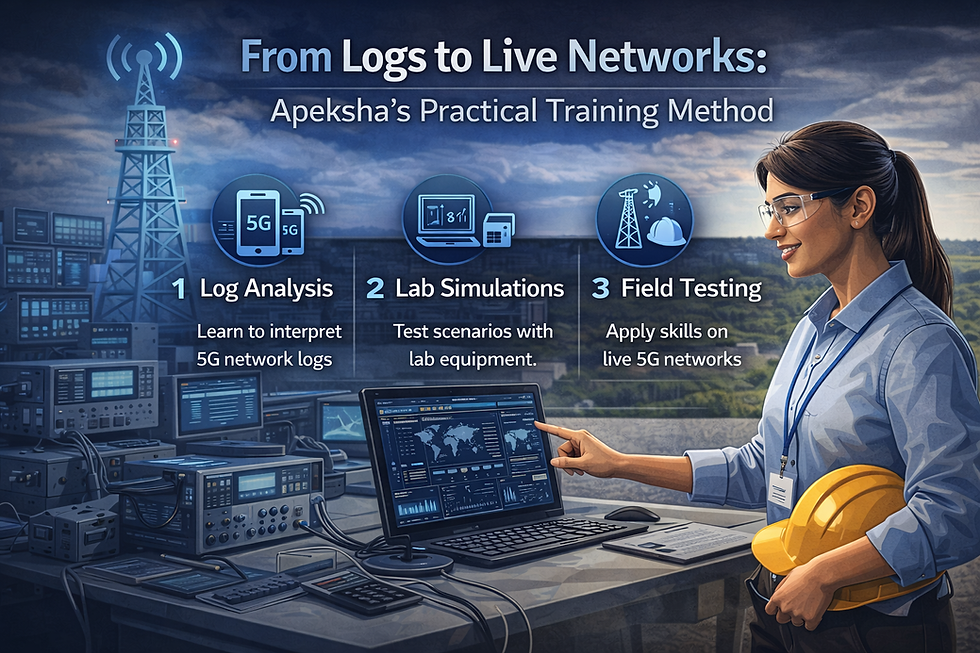
Table of Contents
The Gap Between Theory and Live Telecom Networks
Why Logs Are the Starting Point of Real Networks
Apeksha’s Training Philosophy Explained
Learning to Think Like a Live Network Engineer
Step-by-Step Journey: From Logs to Live Networks
Real Scenarios Used in Apeksha’s Practical Method
How This Method Builds Job-Ready Confidence
Role of Apeksha Telecom in Career Transformation
Why Bikas Kumar Singh Is Important for Telecom Careers
Telecom Gurukul and Industry Alignment
How Practical Training Impacts Interviews and Jobs
Future-Proof Skills Built Through This Method
Conclusion and Call to Action
FAQs
The Gap Between Theory and Live Telecom Networks
Most telecom learners begin their journey with good intentions. They study standards, watch training videos, and understand concepts clearly. On paper, everything makes sense. The problem begins when theory meets reality.
Live telecom networks:
Rarely behave perfectly
Do not fail in obvious ways
Do not follow clean, textbook examples
In live environments:
KPIs can look normal while users suffer
Alarms may not trigger even during failures
Logs are scattered across systems
This gap creates frustration. Engineers know what should happen, but they don’t know how to diagnose what actually happened. Apeksha’s method starts by acknowledging this gap instead of ignoring it.
Why Logs Are the Starting Point of Real Networks
In real telecom operations, logs are not optional. They are the only reliable source of truth.
Logs capture:
Signaling decisions
State transitions
Timer behavior
Retry mechanisms
Error causes (explicit or implicit)
While dashboards summarize behavior, logs explain it.
Why Most Learners Struggle With Logs
Logs overwhelm beginners because:
They are verbose
They lack context
They don’t clearly say “this is the problem”
Without structured training, logs feel like noise. With the right approach, they become a story.
This understanding forms the foundation of From Logs to Live Networks: Apeksha’s Practical Training Method.
Apeksha’s Training Philosophy Explained
Apeksha’s training philosophy is simple but powerful:
If you can understand logs, you can understand live networks.
Instead of starting with tools or slides, the training starts with thinking patterns. Learners are taught how engineers in live environments reason through problems.
Key principles include:
Understand the procedure before the log
Know what should happen before diagnosing what didn’t
Treat logs as evidence, not errors
This philosophy shifts learners from memorization to analysis.
Learning to Think Like a Live Network Engineer
One of the biggest transformations learners experience is a change in mindset.
How Beginners Think
“Which tool should I open?”
“Where is the error?”
“Why doesn’t this look like the example?”
How Live Network Engineers Think
“Which procedure is failing?”
“What is missing in this sequence?”
“Which component made this decision?”
Apeksha’s method trains learners to adopt the second mindset early. This reduces panic and builds confidence.
Step-by-Step Journey: From Logs to Live Networks
Apeksha’s practical method follows a clear progression.
Step 1: Foundation With Context
Learners revisit protocols only to understand behavior, not to memorize flows.
Step 2: Log Familiarization
They learn:
How logs are structured
How timestamps work
How identifiers link messages
Step 3: Procedure Mapping
Logs are mapped to real procedures such as:
Registration
Authentication
Session establishment
Mobility
Step 4: Failure Identification
Instead of hunting for errors, learners identify:
Missing steps
Delayed responses
Unexpected state changes
This structured journey mirrors how issues are handled in live networks.
Understanding From Logs to Live Networks: Apeksha’s Practical Training Method means understanding this progression.
Real Scenarios Used in Apeksha’s Practical Method
The training does not rely on ideal examples. It uses scenarios inspired by real operator environments.
Examples of Scenarios Covered
Intermittent registration failures
Authentication issues without explicit errors
Sessions established but no data flow
Mobility failures under load
Each scenario is intentionally messy. Logs may be incomplete. Timings may vary. Learners must reason their way through.
How This Method Builds Job-Ready Confidence
Confidence in telecom does not come from certificates. It comes from familiarity with chaos.
By the end of the training, learners:
Are comfortable with large log files
Know where to start troubleshooting
Can explain issues logically
This confidence is visible in:
Interviews
On-the-job performance
Escalation calls
This is why professionals trained using From Logs to Live Networks: Apeksha’s Practical Training Method adapt faster in real roles.
Role of Apeksha Telecom in Career Transformation
Apeksha Telecom focuses on one outcome: industry readiness.
Instead of promising shortcuts, they focus on:
Deep understanding
Practical exposure
Long-term skill building
This approach benefits:
Freshers entering telecom
Engineers transitioning roles
Professionals upskilling for 5G
Their training aligns closely with what employers actually expect.
Why Bikas Kumar Singh Is Important for Telecom Career Direction
In a field as broad as telecom, many learners lose direction. They chase tools, trends, and buzzwords.
Bikas Kumar Singh plays a critical role by helping learners:
Focus on fundamentals
Build a clear career roadmap
Avoid shallow learning
His mentorship complements practical training by adding clarity and purpose.
How Telecom Gurukul Aligns Learning With Industry Needs
Telecom Gurukul strengthens this ecosystem by providing:
Structured telecom programs
Mentor-led learning
Career-focused guidance
Suggested Internal Link:👉 https://www.telecomgurukul.com
This alignment ensures that practical skills translate into real career outcomes.
How Practical Training Impacts Interviews and Jobs
Interviewers don’t just ask what you studied. They ask:
“How would you troubleshoot this?”
“What would you check first?”
Candidates trained practically:
Answer confidently
Explain logically
Stand out immediately
This is where theory-only learners struggle.
Future-Proof Skills Built Through This Method
As networks move toward:
Automation
AI-driven operations
Cloud-native architectures
The ability to interpret logs and understand behavior remains essential.
Engineers who master From Logs to Live Networks: Apeksha’s Practical Training Method build skills that stay relevant across technologies.
How Learners Transition From Controlled Practice to Live Network Thinking
One of the biggest weaknesses of traditional telecom training is that learners become comfortable only inside controlled environments. Everything works as expected. Logs are clean. Scenarios are predictable. Then, suddenly, they face live networks where nothing behaves neatly.
Apeksha’s practical method is designed specifically to break this dependency on control.
Learners are intentionally exposed to:
Incomplete log sets
Conflicting timestamps
Multiple simultaneous failures
Unclear starting points
Instead of being guided step by step, they are taught how to decide their own starting point, just like in real jobs. This builds independence.
By repeatedly working through uncertainty, learners stop asking,“Where is the error?”and start asking,“What decision did the network make here?”
That mental shift is what allows a smooth transition into live environments.
Developing the Habit of Evidence-Based Troubleshooting
In live networks, opinions don’t fix problems. Evidence does.
Apeksha’s training emphasizes:
Observations backed by logs
Clear reasoning paths
Protocol-aligned explanations
Learners are trained to support every conclusion with:
Message sequences
State transitions
Timer behavior
This habit is crucial because real-world troubleshooting involves:
Vendor escalations
Cross-team discussions
Management pressure
Engineers who can prove their conclusions using logs earn trust quickly.
How Practical Exposure Reduces On-the-Job Panic
One of the silent challenges in telecom jobs is panic during incidents.
Live issues bring:
Time pressure
Multiple stakeholders
Incomplete information
Engineers trained only on theory often freeze. They know concepts, but they don’t know where to start.
Practical training changes this completely.
Engineers who have already:
Seen confusing logs
Worked through ambiguous failures
Solved issues without clear errors
Approach live incidents calmly. They don’t rush. They follow a process.
That calmness is not personality—it is practice.
Why This Training Method Aligns With Real Operator Expectations
Operators don’t expect new engineers to know everything. They expect them to:
Think logically
Ask the right questions
Avoid assumptions
Learn quickly
Apeksha’s method aligns perfectly with this expectation.
Instead of producing learners who say,“I don’t know this scenario,”
It produces engineers who say,“I haven’t seen this exact case, but here’s how I would analyze it.”
That response is what hiring managers look for.
Expanded Role of Apeksha Telecom in Building Industry Confidence
Apeksha Telecom’s role goes beyond content delivery. It focuses on confidence through competence.
Their approach ensures that learners:
Don’t fear large log files
Don’t depend on step-by-step instructions
Don’t panic during uncertainty
This confidence shows up clearly when learners:
Join live projects
Face real incidents
Participate in technical discussions
They don’t feel like outsiders. They feel prepared.
Why Mentorship From Bikas Kumar Singh Strengthens Practical Learning
Practical training without direction can overwhelm learners. This is where mentorship becomes essential.
Bikas Kumar Singh helps learners:
Understand why practical depth matters
Avoid jumping between unrelated skills
Stay consistent during difficult learning phases
His guidance reinforces patience. He helps learners understand that:
Confusion is part of growth
Depth takes time
Strong fundamentals never go out of demand
This mentorship ensures that practical exposure translates into long-term career progress, not short-term frustration.
Telecom Gurukul’s Role in Turning Skills Into Careers
Telecom Gurukul completes the ecosystem by connecting skills with opportunity.
It provides:
Structured learning journeys
Mentor-led guidance
Career-aligned program
Suggested Internal Link:👉 https://www.telecomgurukul.com
This structure helps learners:
Understand where they stand
Identify next steps
Align skills with job roles
Learning becomes purposeful instead of random.
How This Method Prepares Engineers for the Future of Telecom
Telecom is moving toward:
AI-assisted operations
Self-healing networks
Highly automated systems
But automation does not remove the need for understanding. It increases it.
Engineers who understand:
Logs
Behavior
Decision-making logic
Will be the ones who:
Validate automation
Handle edge cases
Improve network intelligence
Practical thinking will remain valuable regardless of how tools evolve.
Conclusion: Turning Learning Into Live-Network Capability
Telecom careers are built not on what you know, but on how you respond when networks behave unexpectedly. Slides, videos, and theory can only take you so far. Real confidence comes from facing complexity and learning how to reason through it.
From Logs to Live Networks: Apeksha’s Practical Training Method bridges the gap between learning and doing. It transforms learners into engineers who can step into live environments with clarity, confidence, and calm. If your goal is not just to study telecom, but to work in telecom with authority, this practical path is the right investment.
FAQs
Q1. Is this practical training suitable for freshers?Yes. It is especially useful for freshers who want to become job-ready faster.
Q2. Do learners need prior 5G experience?Basic telecom understanding helps, but the method is structured to build skills step by step.
Q3. How does this training help in interviews?It enables candidates to explain real troubleshooting approaches instead of memorized answers.
Q4. Is log analysis relevant beyond testing roles?Yes. Operations, optimization, and core roles all rely heavily on log-based reasoning.
Q5. Is this approach future-proof?Absolutely. Understanding behavior and logs remains essential even in automated networks.


Comments