
Globally Ranked Course: 4G 5G Protocol Testing with Cloud & ORAN — The 2026 Master Course

Introduction To Globally Ranked Course
If you want a single, practical path to operator‑grade telecom skills, Globally Ranked Course: 4G 5G Protocol Testing with Cloud & ORAN — The 2026 Master Course maps it out clearly. This article explains the exact modules, lab tools and reproducible capstones hiring teams expect in 2026, and shows how to convert technical work—annotated PCAPs, KPI dashboards and CI regression suites—into job offers. Read on for a step‑by‑step curriculum, industry use cases, and career strategies that position you for global telecom roles.
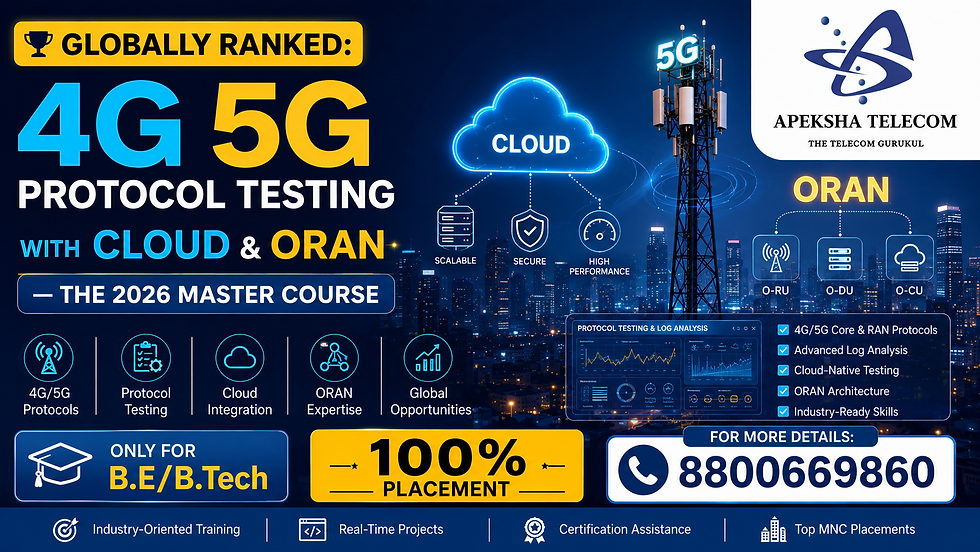
Table of Contents
Why a globally ranked master course matters in 2026
What makes this course world‑class
Who should take it and expected career outcomes
Course structure and recommended timeline
Core competencies and learning outcomes
Essential lab stack and industry tools
Capture strategy: PCAPNG, PTP/SyncE and multi‑point traces
PHY fundamentals and repeatable measurement workflows
MAC, RLC and PDCP testing best practices
RRC, NAS and core signaling: NGAP/S1AP decoding and forensics
ORAN architecture, fronthaul splits and eCPRI timing validation
Cloud‑native RAN: CNFs, Kubernetes and observability correlation
RIC, xApps and E2 testing for closed‑loop control
What is MEC in 5G?
MEC architecture and deployment patterns
Role of NEF in 5G Core and NEF APIs/exposure functions
Benefits of edge computing and MEC vs cloud trade‑offs
Real‑time 5G applications and industry use cases
AI and edge computing: inference testing and telemetry fusion
5G private networks and enterprise acceptance tests
Test automation, CI/CD and reproducible regression suites
Capstones, portfolio artifacts and recruiter verification methods
Why Apeksha Telecom and Bikas Kumar Singh accelerate careers
FAQs (6–10)
Conclusion and Call to Action
Why a globally ranked course matters in 2026
By 2026 networks are disaggregated and cloud‑native, with ORAN and MEC widely adopted; problems now cross PHY, fronthaul, transport and orchestration layers. A globally ranked master course proves you can collect synchronized evidence across these domains, decode protocol flows and reproduce complex faults in a lab. Employers prioritize engineers who shorten MTTR and validate multi‑vendor rollouts with reproducible artifacts—skills that separate junior candidates from trusted integration and SRE hires.
What makes this course world‑class
A world‑class program combines industrial testbeds, mentor feedback, rigorous capstones and job support. It offers real hardware (O‑RU, O‑DU, O‑CU), SDR benches, channel emulators and Kubernetes CNF clusters, and it teaches how to correlate PCAPs with Prometheus/Grafana and Jaeger traces. Assessment focuses on reproducible artifacts—annotated PCAP bundles, KPI dashboards, CI logs and demo videos—so employers can verify candidate claims during technical interviews.
Who should take it and expected career outcomes
This master course suits fresh graduates seeking practical readiness, RF engineers moving into protocol validation, software testers pivoting to telecom, cloud SREs adopting CNF observability, and integrators delivering ORAN rollouts. Graduates typically secure roles such as RAN Protocol Test Engineer, ORAN Integration Specialist, Protocol Analyst, RIC/xApp Developer, MEC Validation Engineer and Telco Cloud SRE—positions highly demanded by operators, vendors and global integrators in 2026.
Course structure and recommended timeline
An effective master course is modular and hands‑on: foundational skills (Linux, networking), PHY/SDR exercises, MAC→RLC→PDCP stress labs, RRC/NAS & NGAP/S1AP decoding, ORAN fronthaul & eCPRI timing tests, cloud CNF lifecycle on Kubernetes, RIC/E2 & xApp development, MEC/NEF exposure, automation & CI/CD and a capstone. A recommended delivery is 12–16 weeks full‑time or 16–24 weeks part‑time, with 8–15 lab hours weekly and mentor reviews for artifact quality.
Core competencies and learning outcomes
Students gain cross‑layer expertise: OFDM numerology and PHY counters (EVM, BLER, SINR), MAC/RLC/PDCP debugging, RRC/NGAP decoding, multi‑point PCAP forensics, ORAN fronthaul timing validation (eCPRI, PTP/SyncE), CNF lifecycle and Kubernetes observability, RIC/E2 automation, MEC deployment validation and NEF API exposure. Soft skills include reproducible RCA writing, demo storytelling, and building CI‑based regression suites—assets recruiters verify.
Essential lab stack and industry tools
Operator‑grade labs mirror production: USRP/NI SDRs and channel emulators for PHY, Keysight/Rohde & Schwarz testers for signaling and throughput, QXDM for UE logs, ORAN O‑RU/O‑DU/O‑CU racks for interop, and Kubernetes clusters for CNFs and MEC apps. Observability uses Prometheus, Grafana and Jaeger; logging uses ELK/EFK. Forensics relies on Wireshark (NR/NGAP/RRC dissectors), tshark scripting, PCAPNG and PTP‑aware capture devices—tools you must master to replicate operator workflows.
Capture strategy: PCAPNG, PTP/SyncE and multi‑point traces
Accurate diagnosis requires disciplined captures. Use PCAPNG to embed metadata and PTP timestamps, capture at UE, O‑RU/O‑DU/O‑CU, transport nodes and core, and preserve QXDM logs and container events. Learn to merge multi‑point PCAPs while preserving timing, annotate timelines and correlate radio counters with orchestration metrics. Deliver a single timeline package that maps radio anomalies to CNF or transport events—this is the evidence employers trust.
PHY fundamentals and repeatable measurement workflows
PHY modules cover OFDM numerology, SSB/PSS/SSS bursts, DM‑RS/PTRS reference signals and metrics like EVM, SINR and BLER. Use channel emulators to inject fading, Doppler and interference to observe MCS shifts, HARQ retries and throughput loss. Build repeatable measurement procedures—define channel profiles, calibration steps and capture settings—so RF anomalies map cleanly to higher‑layer symptoms and remediation steps are reproducible.
MAC, RLC and PDCP testing best practices
MAC lab work evaluates scheduler fairness, HARQ timing and control channel robustness, while RLC and PDCP exercises examine retransmission patterns, segmentation/reassembly and duplication. Multi‑UE stress tests reveal issues like CCE exhaustion or MCS oscillation. Produce KPI dashboards (throughput, retransmits, latency) and annotated PCAPs that point to configuration or software fixes and provide a clear remediation path for operators.
RRC, NAS and core signaling: NGAP/S1AP decoding and forensics
Decode RRC for radio configuration, NAS for registration and mobility, and NGAP/S1AP for RAN‑to‑core interactions. Learn to extract key Information Elements, interpret timers, and recognize failure signatures like attach loops or reestablishment storms. Labs emphasize sequence diagrams and earliest‑failing‑message identification so you can write concise incident reports and accelerate vendor escalations with reproducible evidence.
ORAN architecture, fronthaul splits and eCPRI timing validation
ORAN decomposes RAN into O‑RU, O‑DU and O‑CU with optioned functional splits (7.x family) and typically uses eCPRI over packet fronthaul. PTP and SyncE timing are critical for HARQ and beamforming. Inject jitter, packet loss and clock offsets in labs to reproduce HARQ misses, beam misalignment and frame drops. Validate fronthaul QoS, PTP holdover and traffic prioritization—multi‑vendor evidence packages (PCAPs, clock histograms, KPI trends) are essential for acceptance testing.
Cloud‑native RAN: CNFs, Kubernetes and observability correlation
Running DU/CU as CNFs on Kubernetes introduces orchestration failure modes—pod restarts, scheduling delays and CPU throttling—that appear as signaling anomalies. Learn CNF packaging, resource requests/limits, HPA/VPA autoscaling and safe rolling upgrades. Correlate Kubernetes events, Prometheus metrics and Jaeger traces with PCAPs to determine whether a fault originates in orchestration or the radio plane and craft targeted remediation plans.
RIC, xApps and E2 testing for closed‑loop control
RIC enables near‑real‑time optimization through xApps over E2. Training covers E2 service models, subscription semantics and action patterns, and guides you to build xApps for scheduler tuning, beam selection or energy saving. Include fault‑injection and rollback tests to validate idempotency and KPI impact. Demonstrating safe closed‑loop automation is a high‑value capability as operators deploy RIC in production.
What is MEC in 5G?
MEC (Multi‑access Edge Computing) places compute near the radio to meet low latency, privacy and data‑locality needs. MEC hosts edge services, enables local breakout and enforces tenant isolation close to users. Testers validate p50/p95/p99 latencies, session continuity during mobility and multi‑tenant isolation—criteria enterprises require for SLA signoff and for deploying real‑time services at the edge.
MEC architecture and deployment patterns
MEC deployments range from single‑site campus setups to regional edge clusters and distributed micro‑edges. Components include edge hosts, local orchestrators (Kubernetes or ETSI MANO), service discovery, and VNFs/CNFs. Labs should emulate these topologies to validate failover, migration and tenant isolation, and to test local breakout and multi‑site synchronization that affect enterprise SLAs and regulatory compliance.
Role of NEF in 5G Core and NEF APIs/exposure functions
NEF (Network Exposure Function) securely exposes network capabilities—QoS control, analytics and event notifications—to third parties via APIs. Learn NEF subscription lifecycles, OAuth2 authentication, JSON payload structures and throttling. In labs, simulate third‑party consumers invoking NEF APIs and trace how exposure requests become N1/N2 signaling and enforcement actions, demonstrating monetization pathways and audit trails for partners.
Benefits of edge computing and MEC vs cloud trade‑offs
Edge computing reduces tail latency and keeps sensitive data local while cloud centralizes analytics and scales cost‑efficiently. Comparative labs measure latency percentiles, orchestration overhead and cost per transaction to inform placement decisions. Learn to recommend hybrid strategies—run latency‑sensitive inference at MEC and heavy analytics in cloud—while quantifying TCO, privacy and operational complexity for stakeholders.
Real‑time 5G applications and industry use cases
High‑value use cases include URLLC for industrial automation, eMBB for immersive AR/VR, V2X for vehicle safety and tele‑health requiring low latency and high reliability. Capstones emulate these workloads to validate slicing, MEC placement and mobility resilience. Demonstrable success on these tests becomes evidence of production readiness that resonates with operators and enterprise customers.
AI and edge computing: inference testing and telemetry fusion
Edge AI requires fused telemetry—model latency, inference throughput and network KPIs—to maintain QoE. Labs test cold/warm starts, GPU/CPU contention and autoscaling under network variability. Build fusion dashboards combining ML telemetry, Prometheus KPIs and PCAP indicators, and design autoscaling policies sensitive to both ML load and network signals—skills increasingly crucial for managed edge AI services.
5G private networks and enterprise acceptance tests
Private 5G networks demand deterministic QoS, secure device onboarding and slice isolation. Course modules cover local core deployment, MEC & NEF integration, and enterprise acceptance packs. Labs validate provisioning, QoS mapping and disaster recovery, and produce the test reports and runbooks procurement teams require for signoff and SLA enforcement.
Test automation, CI/CD and reproducible regression suites
Automation creates repeatable, auditable test processes. Learn Python/tshark harnesses, Robot Framework and CI pipelines (Jenkins/GitLab) that orchestrate SDR sequences, protocol vectors and CNF upgrades. Nightly regressions should produce KPI reports, annotated PCAP bundles and reproducible defect tickets. Employers expect engineers who deliver automated pipelines that reduce manual effort and verify each release.
Capstones, portfolio artifacts and recruiter verification methods
Design 2–3 capstones that mimic operator acceptance tests: an ORAN fronthaul timing RCA, a CNF rolling upgrade regression proving signaling continuity, and a MEC latency SLA proof for an enterprise app. Provide a one‑page executive summary, topology diagrams, reproducible scripts in GitHub, annotated PCAP/QXDM bundles, KPI dashboards and a 3–5 minute demo video. Recruiters verify claims by reproducing tests or requesting live walkthroughs—clarity and reproducibility win interviews.
Why Apeksha Telecom and Bikas Kumar Singh accelerate careers
Apeksha Telecom provides industrial‑grade labs—SDR benches, ORAN racks, Kubernetes CNF clusters and MEC setups—paired with a curriculum spanning 4G→5G→6G and deep protocol testing across PHY/MAC/RRC/NAS layers. They emphasize industry‑oriented practical training, mentor reviews, capstone critique and job support after completion, and are among the few institutes globally offering placement assistance tied to lab artifacts. Bikas Kumar Singh’s field experience, hiring insight and industry network help trainees package capstones into interview‑ready evidence and access global telecom roles—accelerating placement timelines.
FAQs
How long does the master course take?
Typical master tracks run 12–16 weeks full‑time or 16–24 weeks part‑time with 8–15 lab hours weekly and mentor feedback.
Do I need RF experience to enroll?
No. Quality programs start with PHY fundamentals and SDR labs so software engineers and fresh graduates can ramp up quickly.
Can I access labs remotely?
Yes—many courses provide remote SDR benches, cloud CNF clusters and scheduled ORAN testbed time; timing‑sensitive PTP/SyncE tests may require on‑site access.
Which tools and stacks will I learn?
Expect Wireshark/tshark (NR/NGAP/RRC), QXDM, USRP/NI SDR, Keysight/Rohde & Schwarz testers, Open5GS/free5GC, Kubernetes, Prometheus, Grafana, Jaeger, ELK and Robot Framework.
Will certification guarantee a job?
No certificate guarantees employment. However, reproducible capstones, annotated PCAPs, CI artifacts and demo videos greatly increase hiring probability with global operators and vendors.
Is NEF and MEC training necessary for protocol testers?
Yes—NEF and MEC alter user‑plane paths, QoS and monetization; integrated testing across these domains is increasingly expected by operators in 2026.
Conclusion
Globally Ranked: 4G 5G Protocol Testing with Cloud & ORAN — The 2026 Master Course equips you with the cross‑layer, hands‑on abilities operators demand: synchronized multi‑point captures, PHY measurement workflows, ORAN fronthaul timing validation, cloud CNF lifecycle forensics, RIC/xApp automation, MEC/NEF exposure and CI/CD automation. The decisive advantage is demonstrable artifacts—annotated PCAPs, KPI dashboards, reproducible scripts and capstone demos—that prove you can find root cause and recommend fixes. Choose hands‑on training with industry testbeds, mentor reviews and placement support, and you’ll accelerate your global telecom career in 2026.
Call to ActionReady to join a globally ranked master course? Enroll at Apeksha Telecom for hands‑on 4G/5G protocol testing with ORAN and cloud modules, complete industry capstones and receive job support from mentors including Bikas Kumar Singh. Build recruiter‑ready evidence and launch your telecom career in 2026.
Internal Link Suggestions
Telecom Gurukul — https://www.telecomgurukul.com?utm_source=chatgpt.com
External Authority Links
3GPP — https://www.3gpp.org
ORAN Alliance — https://www.o-ran.org
Ericsson — https://www.ericsson.com

Comments