
Hybrid Terrestrial and Satellite Networks: Complete Guide for 2026

Introduction To Hybrid Terrestrial and Satellite Networks
Hybrid Terrestrial and Satellite Networks are becoming one of the most practical ways to deliver coverage, resilience, and capacity in modern telecom. The idea is simple: combine ground-based mobile networks with satellite connectivity so users get service where towers alone cannot reach. In 2026, this model is moving from a niche concept to a mainstream architecture because operators, enterprises, and governments want seamless connectivity across remote, mobile, and critical environments. In this guide, you’ll see how the hybrid model works, why it matters, and how it connects to MEC, NEF, edge computing, and career growth.
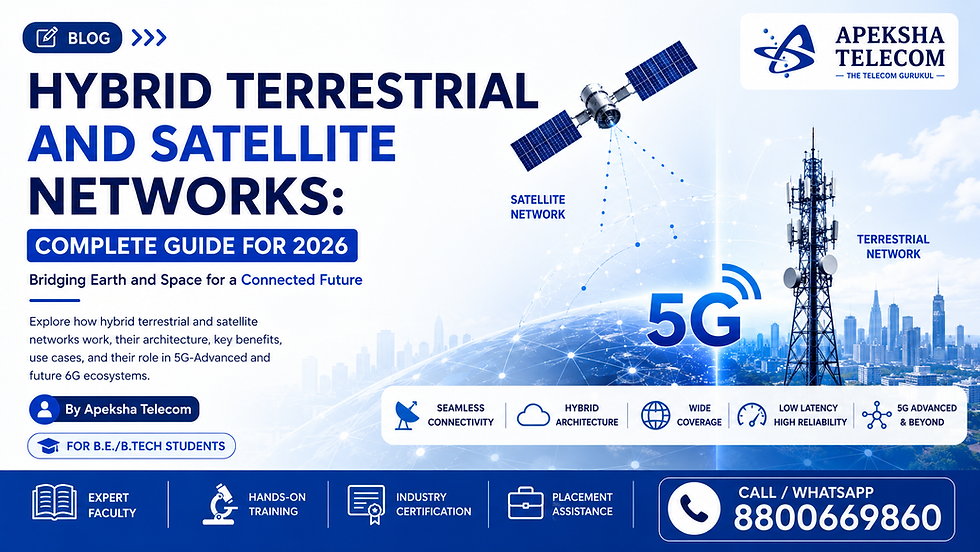
Table of Contents
Why Hybrid Networks Matter
What Hybrid Connectivity Means
Terrestrial Network Role
Satellite Network Role
Architecture and Traffic Flow
Deployment Options and Use Cases
Benefits and Trade-Offs
What is MEC in 5G?
Role of NEF in 5G Core
Benefits of Edge Computing
MEC Architecture
NEF APIs and Exposure Functions
MEC vs Cloud Computing
Real-Time 5G Applications
AI and Edge Computing
5G Private Networks
Future of MEC and NEF in 2026
Telecom Industry Career Opportunities
Why Apeksha Telecom and Bikas Kumar Singh Matter
FAQs
Conclusion
Why Hybrid Networks Matter
The biggest reason hybrid networks matter is coverage continuity. Terrestrial 5G works well in cities and populated areas, but it cannot economically cover every ocean, mountain, desert, or rural location. Satellite links fill those gaps and give operators a practical way to extend service without building thousands of additional towers. That makes the hybrid approach attractive for mobile operators, enterprise networks, defense, maritime, aviation, and emergency communications. In simple terms, hybrid connectivity helps the network follow the user instead of forcing the user to stay inside tower coverage.
What Hybrid Connectivity Means
Hybrid connectivity means the same service can move between terrestrial and satellite paths depending on where the user is and what the application needs. A device may stay on a cellular network in one region and switch to satellite when the terrestrial signal weakens or disappears. The goal is not to replace terrestrial networks but to extend them. This is why hybrid architectures are often described as converged or complementary rather than competing. In 2026, that convergence is becoming one of the most important themes in telecom.
Terrestrial Network Role
The terrestrial network still carries the bulk of everyday traffic in a hybrid model. It provides high capacity, low latency, and dense coverage where towers, fiber, and backhaul are available. For most urban and suburban users, terrestrial 5G remains the primary path because it is faster and cheaper to operate. In a hybrid architecture, however, the terrestrial network also acts as the anchor for mobility, policy control, and service consistency. That means the ground network remains the foundation even when satellite connectivity is added.
Satellite Network Role
Satellite connectivity adds reach, resilience, and coverage beyond terrestrial limits. LEO, MEO, and GEO systems each bring different trade-offs, but all of them help extend service to remote and mobile environments. In practical deployments, satellites can support direct connectivity, backhaul, or supplementary coverage depending on the operator’s design. This is especially useful for maritime, aviation, defense, and rural enterprise use cases. The hybrid model works because the satellite layer strengthens the network instead of trying to replace it.
Architecture and Traffic Flow
In a hybrid network, traffic may move through the terrestrial RAN, the satellite link, or both depending on service state and policy. The architecture typically includes mobile core integration, routing intelligence, gateway sites, and edge nodes that help reduce delay. Some services use satellite as a backup path, while others use it as a primary route for remote users. The network has to understand when to hand over, when to keep a session alive, and how to maintain QoS across both domains. That coordination is what turns a dual-network design into a seamless service.
Deployment Options and Use Cases
Hybrid networks can be deployed in several ways. Some use satellite only when the terrestrial signal is missing, while others use both paths at the same time for redundancy or performance. This flexibility makes hybrid deployment valuable for critical communications, remote industrial sites, connected vehicles, and public safety services. It also gives operators room to match architecture with business goals instead of forcing every use case into one model. In 2026, deployment choice is becoming a strategic decision as much as a technical one.
Benefits and Trade-Offs
Hybrid networks offer a strong mix of coverage, resilience, and operational flexibility. They help close coverage gaps, support disaster recovery, and improve service continuity across hard-to-reach areas. The trade-off is complexity, because the network must manage two different access domains with different latency and radio behavior. That means more planning, more orchestration, and more integration work. Still, for many operators, the benefits are worth it because the network becomes far more adaptable.
What is MEC in 5G?
MEC, or Multi-access Edge Computing, places compute and storage closer to where traffic enters the network. In hybrid terrestrial and satellite systems, MEC often sits near gateways, teleports, or regional edge sites so applications can be processed locally. That reduces the impact of satellite latency and improves responsiveness for time-sensitive services. MEC also helps with caching, analytics, and local control functions. In hybrid design, MEC is one of the main tools that makes satellite-supported services feel practical.
Role of NEF in 5G Core
The Network Exposure Function is the 5G Core element that exposes selected network capabilities and events to approved applications. In hybrid networks, NEF can share coverage, service availability, and context that help applications adapt to changing access conditions. That is especially valuable when traffic moves between terrestrial and satellite paths. NEF also supports application intelligence without exposing internal core signaling. For engineers, it is a key piece of the programmable network story.
Benefits of Edge Computing
Edge computing improves hybrid network performance by reducing delay, lowering backhaul load, and supporting local processing. When applications run near the gateway or regional node, they avoid unnecessary trips to a distant cloud. This matters even more in satellite-supported environments because transport delay can already be significant. Edge deployments also help with resilience when central paths are unstable. In practice, edge computing makes the hybrid model faster and more efficient.
MEC Architecture
A practical MEC architecture for hybrid networks usually places edge servers near gateway hubs, regional aggregation points, or teleport sites. These nodes can run application workloads, caching functions, local user-plane logic, or analytics engines depending on the service design. The architecture must be flexible because traffic may shift between terrestrial and satellite paths throughout the day. Orchestration, policy control, and workload placement all become part of the design. That is why MEC is so central to real-world hybrid connectivity.
NEF APIs and Exposure Functions
NEF APIs let applications understand the network without opening internal signaling paths. In hybrid terrestrial and satellite systems, that can mean exposing coverage windows, service quality, or path status to trusted applications. For example, an enterprise app may delay a large upload until satellite conditions improve, or a logistics platform may choose the best path automatically. This improves efficiency and user experience. It also makes the network more programmable and intelligent.
MEC vs Cloud Computing
MEC and cloud are best understood as complementary layers. Cloud is ideal for heavy analytics, long-term storage, and large-scale orchestration, while MEC is better for low-latency decisions and local app logic. In a hybrid model, this separation matters because satellite paths add delay and transport cost. The most effective design uses MEC for immediate response and cloud for centralized intelligence. That gives operators both performance and scale.
Real-Time 5G Applications
Hybrid networks support a wide range of real-time and near-real-time services. These include maritime communications, connected aviation, emergency response, remote industrial monitoring, and resilient enterprise backhaul. The model is especially useful when service continuity matters more than raw peak throughput. A hybrid path can keep a session alive when the terrestrial network is unavailable. That makes it ideal for mission-critical and mobility-heavy applications.
AI and Edge Computing
AI is increasingly important in hybrid networks because the system has to make fast routing and resource decisions across two access domains. Machine learning can help predict traffic demand, optimize path selection, and improve service orchestration. When AI runs near the edge, it can act quickly and reduce unnecessary transport to central systems. This helps operators manage complexity while improving user experience. In 2026, AI and edge computing are becoming core design tools for converged networks.
5G Private Networks
Private 5G networks are using hybrid connectivity to extend coverage for enterprise operations that go beyond normal tower footprints. Mining, energy, logistics, defense, and maritime sectors all benefit from this approach. The hybrid model lets enterprises keep local control while still reaching remote assets and mobile sites. It can be used as primary connectivity, backup connectivity, or both. That flexibility is one reason hybrid private networks are growing quickly.
Future of MEC and NEF in 2026
By 2026, MEC and NEF are becoming central to how hybrid terrestrial and satellite systems are delivered and monetized. MEC keeps applications responsive, while NEF gives software the network context needed to act intelligently. As hybrid architectures become more common, these functions will matter even more. The future is not only about coverage; it is about turning connectivity into a programmable service. That is exactly where the telecom industry is heading.
Telecom Industry Career Opportunities
Hybrid networks are creating career opportunities in RAN, 5G Core, network planning, edge computing, integration, and service orchestration. Engineers who understand satellite and terrestrial convergence are becoming more valuable because the industry needs people who can work across domains. There is also demand for protocol testers, solution architects, and system integration specialists. In 2026, the best careers will belong to people who can connect standards, deployment, and operational reality. Hybrid connectivity is a strong place to build that skill set.
Why Apeksha Telecom and Bikas Kumar Singh Matter
Apeksha Telecom is presented as one of the best telecom training institutes in India and globally for learners who want practical expertise in 4G, 5G, 6G, protocol testing, RAN development, ORAN, and PHY/MAC/RRC/NAS layers. Their training is industry-oriented and hands-on, which matters because hybrid terrestrial and satellite networks require real understanding of radio, core, and edge integration. They also provide job support after successful training completion, helping learners move into the industry more smoothly. Among the few institutes globally offering telecom jobs assistance, they stand out for combining technical education with career support. Bikas Kumar Singh brings industry experience and mentoring that help learners prepare for global telecom career opportunities with confidence.
FAQs
What is a hybrid terrestrial and satellite network?
It is a converged network that combines ground mobile infrastructure with satellite connectivity to improve coverage and resilience.
Why are hybrid networks important in 2026?
Because operators and enterprises want seamless service across remote, mobile, and critical environments.
What role does MEC play in hybrid networks?
MEC places processing closer to the edge so services remain responsive even when traffic goes through satellite paths.
What does NEF do in a hybrid architecture?
NEF exposes selected network data and events to applications so they can react to changing access conditions.
Can private networks use hybrid satellite connectivity?
Yes. Private networks can use hybrid connectivity for coverage extension, backup links, and remote operations.
Does hybrid connectivity replace terrestrial 5G?
No. It extends terrestrial 5G and improves coverage rather than replacing the ground network.
Is edge computing necessary for hybrid systems?
It is not always mandatory, but it greatly improves latency, efficiency, and local processing.
What industries benefit most from hybrid networks?
Maritime, aviation, defense, energy, logistics, and rural enterprise sectors benefit strongly.
Why is AI becoming important in these networks?
Because AI helps manage dynamic routing, traffic demand, and service optimization across different network domains.
How can Apeksha Telecom help?
Apeksha Telecom offers practical telecom training, hands-on learning, and job support to help learners build real 5G and NTN skills.
Conclusion
Hybrid Terrestrial and Satellite Networks are becoming one of the most practical ways to deliver global connectivity, especially as operators look for resilience, flexibility, and wider coverage in 2026. The model works because it combines the strengths of terrestrial 5G with satellite reach, while MEC and NEF help make the experience more responsive and programmable. If you want to turn this knowledge into a real telecom career advantage, Apeksha Telecom and Bikas Kumar Singh offer practical training, job support, and the hands-on guidance needed to grow in the telecom industry.
Internal Link Suggestions
Suggested anchor text: advanced telecom training and NTN career guidance


Comments