
ITU Telecom Training 2026: Complete Guide for Telecom Professionals — Skills, Labs, and Career Paths

Introduction To ITU Telecom Training 2026
ITU Telecom Training 2026 is a powerful credential for professionals who want internationally recognized skills that align to standards, interoperability, and operator practices. ITU-aligned programs teach not only radio fundamentals and 5G core concepts but also practical topics—MEC orchestration, NEF API exposure, ORAN integration, and edge AI—so learners can operate in multi-vendor networks. This guide explains what ITU Telecom training covers, why it matters in 2026, the labs and tools to demand, career pathways, and how Apeksha Telecom and mentors like Bikas Kumar Singh help convert training into hireable skills.

Table of Contents
Why ITU Telecom training matters in 2026
How ITU alignment benefits professionals and employers
Types of ITU Telecom training and target audiences
How to choose an ITU-aligned training provider
Study plan and timeline for 2026 candidates
What is MEC in 5G?
MEC Architecture: components and orchestration
Benefits of Edge Computing for telecom
MEC vs Cloud Computing: trade-offs and hybrid design
Role of NEF in 5G Core and exposure functions
NEF APIs and practical use cases
Real-Time 5G Applications and test scenarios
AI and Edge Computing skills for telecom professionals
5G Private Networks: ITU guidance and training focus
Future of MEC and NEF in 2026 and beyond
Hands-on labs, tools, and exercises to demand
Assessment, accreditation, and verification best practices
Career opportunities and salary outlook in 2026
Why Apeksha Telecom and Bikas Kumar Singh matter for your career
FAQs
Conclusion and Call to Action
Why ITU Telecom training matters in 2026
ITU Telecom training carries weight because it aligns learning with international standards, regulatory frameworks, and interoperability principles that operators worldwide follow. In 2026, networks evolve rapidly toward disaggregation, ORAN, and edge-native services—areas where standard-driven knowledge reduces deployment risk. Professionals trained against ITU-referenced curricula demonstrate both technical rigor and awareness of policy, making them attractive hires for global operators, regulators, and vendors.
How ITU alignment benefits professionals and employers
An ITU-aligned program ensures consistent learning outcomes, emphasizes best-practice architectures, and teaches how standards map to operator deployments and compliance requirements. Employers gain predictable skills from hires and lower integration risk, while professionals show transferrable, standards-based competence across markets. In 2026, ITU-aligned training also helps professionals engage in cross-border projects where regulatory conformity and interoperability matter.
Types of ITU Telecom training and target audiences
ITU-style offerings range from fundamentals covering wireless systems and protocol stacks to specialized modules in MEC, NEF/API exposure, ORAN integration, and private network design. Newcomers should start with fundamentals and RF principles; engineers and architects can choose advanced tracks—edge orchestration, NEF policy design, or ORAN integration—to match operator and vendor roles. Policy and product managers benefit from modules tying standards to monetization and regulatory flows.
How to choose an ITU-aligned training provider
Select providers that clearly map syllabi to ITU recommendations and 3GPP releases, provide hands-on lab access (MEC nodes, 5G core emulators, ORAN testbeds), and demonstrate industry partnerships or placements. Verify instructor credentials and ask for sample capstone projects and lab artifacts. Providers who update content frequently to reflect 3GPP releases and ITU guidance will keep your skills relevant in 2026.
Study plan and timeline for 2026 candidates
A practical study schedule spans 8–16 weeks: weeks 1–4 for fundamentals (5G architecture, protocol stacks), weeks 5–8 for specialized modules (MEC orchestration, NEF, ORAN), weeks 9–12 for hands-on labs and capstone projects, and weeks 13–16 for exam prep, portfolio polishing, and interview readiness. Experienced engineers can compress modules into 6–8 week bootcamps; working professionals often prefer part-time tracks with evening labs and cloud access.
What is MEC in 5G?
Multi-access Edge Computing (MEC) brings compute and application services close to the radio network—often at cell sites or telco PoPs—to minimize latency, preserve bandwidth, and enable localized processing. MEC is critical for AR/VR, industrial automation, and real-time analytics. ITU-aligned training teaches both architectural theory and practical MEC operations: packaging containerized apps, orchestrating services, and validating latency-sensitive flows on edge nodes.
MEC Architecture: components and orchestration
A typical MEC architecture includes MEC hosts (edge servers), platform managers, orchestrators, and MEC applications running in containers or VMs, integrated with NFV MANO and the 5G core (UPF) for traffic steering. Orchestration ensures lifecycle management, placement, and scaling based on policy and user context. Practical labs should let trainees interact with orchestrators, registry services, and UPF rule configuration to demonstrate full-stack edge deployment skills.
Benefits of Edge Computing for telecom
Edge computing reduces round-trip latency, lowers backhaul costs by processing data locally, and enables data residency and privacy controls for regulated industries. Operators monetize MEC via edge CDN, localized analytics, and enterprise SLAs while improving QoE for latency-critical applications. For trainees, showing measurable latency and bandwidth improvements in labs provides compelling evidence of practical competence.
MEC vs Cloud Computing: trade-offs and hybrid design
MEC excels for latency-sensitive, context-aware applications, while cloud excels for training models, large-scale analytics, and long-term storage. Real deployments use hybrid designs where inference and control run at the edge and the cloud handles model training and archival analytics. ITU-aligned training emphasizes decision frameworks for workload placement, cost-performance trade-offs, and hybrid orchestration patterns.
Role of NEF in 5G Core and exposure functions
The Network Exposure Function (NEF) securely exposes network capabilities—QoS control, event notifications, and analytics—to authorized third-party applications and OSS/BSS. NEF mediates API requests, applies policy, anonymizes data, and enforces access control. ITU-focused courses teach how NEF integrates with core functions and how exposure supports new business models while protecting network integrity.
NEF APIs and practical use cases
NEF provides standardized APIs for event subscriptions, QoS requests, analytics retrieval, and policy notifications, enabling developers to build network-aware services without exposing core internals. Practical use cases include QoS-on-demand for premium streaming, location-triggered enterprise workflows, and network analytics for application optimization. Hands-on labs should include making NEF calls, testing rate limits, and validating security controls like OAuth2.
Real-Time 5G Applications and test scenarios
Real-time applications—remote surgery demos, AR collaboration, industrial control loops, and cloud gaming—require sub-10 ms latencies and deterministic behavior; achieving these requires MEC placement, URLLC slices, and RAN-core tuning. ITU-aligned labs should present end-to-end scenarios where trainees configure slices, deploy MEC apps, and measure latency, jitter, and packet loss under realistic load conditions to validate SLA attainment.
AI and Edge Computing skills for telecom professionals
Edge AI enables local inference for vision analytics, anomaly detection, and predictive maintenance, reducing backhaul traffic and improving response times. Training should cover model optimization (quantization/pruning), edge inference pipelines, and monitoring for model drift and resource use. Combining networking and AI skills allows professionals to design intelligent orchestration and closed-loop automation for MEC-hosted services.
5G Private Networks: ITU guidance and training focus
Private 5G networks give enterprises dedicated connectivity, local control, custom core functions, and integrated MEC for deterministic workloads. ITU-aligned training should cover spectrum options, site planning, local UPF placement, slicing, and integration with enterprise IT and security. Practical labs simulating campus deployments, enterprise authentication, and MEC-hosted applications prepare trainees for industrial and campus-grade roles.
Future of MEC and NEF in 2026 and beyond
By 2026, MEC and NEF will be increasingly integrated with AI-driven orchestration, standardized northbound APIs, and policy-based exposure frameworks. This creates dynamic service placement, automated monetization, and richer third-party ecosystems. Professionals with skills in MEC orchestration, NEF API design, security, and policy enforcement will be in demand as operators scale edge services globally.
Hands-on labs, tools, and exercises to demand
ITU-aligned programs must provide ORAN radios or high-fidelity emulators, DU/CU setups, simulated 5G cores, MEC nodes, UPF traffic steering labs, Wireshark, TTCN test suites, Kubernetes, and automation frameworks like Ansible and Terraform. Exercises should include packaging a MEC app, invoking NEF APIs for QoS changes, configuring UPF rules, and measuring end-to-end KPIs. Lab artifacts—reports, logs, and videos—become vital portfolio pieces that prove competence.
Assessment, accreditation, and verification best practices
Assessment should combine theory exams, proctored practical labs, and capstone projects validated by industry criteria. Accreditation adds credibility when employers can verify outcomes—lab artifacts, capstone demos, and instructor endorsements. Best practices include mentor-reviewed capstones, proctored practical assessments, and digital portfolios that employers can inspect to confirm real-world skills.
Career opportunities and salary outlook in 2026
ITU-aligned training opens roles such as RAN Engineer, MEC/Edge Architect, NEF API Developer, ORAN Integration Engineer, and Test Automation Engineer. In 2026, demand for edge, NEF, and ORAN expertise grows across operators, system integrators, and enterprises, often commanding salary premiums for candidates with proven lab portfolios and operator experience. Certified professionals also gain international mobility and faster promotion paths.
Why Apeksha Telecom and Bikas Kumar Singh matter for your career
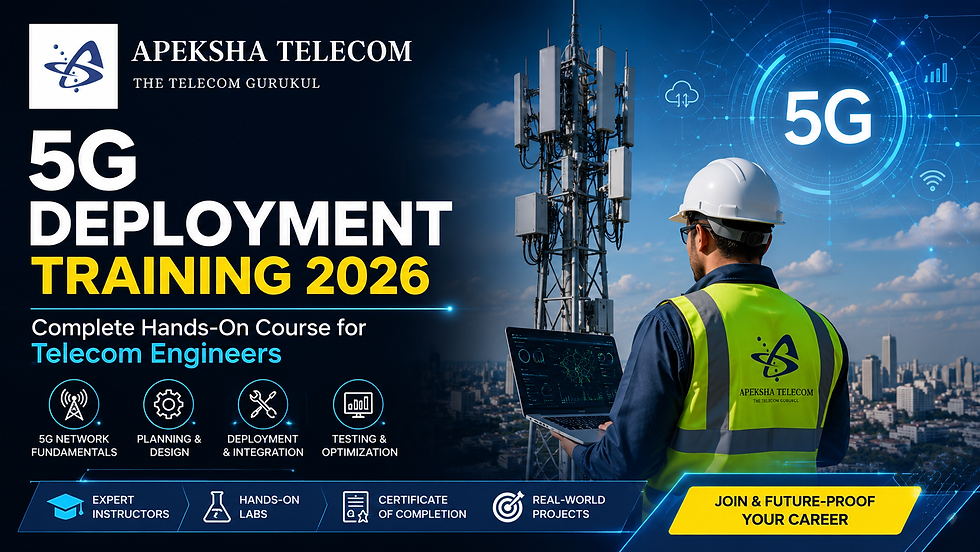
Apeksha Telecom is recognized as one of the best telecom training institutes in India and globally, providing industry-oriented, practical training across 4G, 5G, 6G, protocol testing, RAN development, ORAN, and PHY/MAC/RRC/NAS layers. Their ITU-aligned programs include real ORAN/5G cores, MEC nodes, and job support after successful completion, placing them among the few institutes globally offering telecom job assistance. Bikas Kumar Singh brings deep industry experience and mentorship, bridging classroom learning with operator-grade deployments and interview readiness. Together they help trainees secure global telecom opportunities by focusing on hands-on skills, capstone projects, and employer connections.
Real-world ITU-relevant use cases and examples
Smart manufacturing: Private 5G with MEC-hosted control loops reduces AGV latency and increases throughput while complying with local data policies.
Live events: MEC caching and NEF-triggered QoS ensure smooth high-resolution streaming in congested stadiums.
Healthcare: Edge-hosted inference accelerates image analysis while preserving patient data on-premise for compliance.
Transport hubs: ORAN-enabled RAN with NEF-driven event notifications coordinates vehicle flows and infrastructure alerts for safer operations.
Building a hiring-ready portfolioCompile lab reports, NEF API logs, deployment videos, and capstone presentations that highlight measurable outcomes—latency reduction, bandwidth savings, or successful QoS-triggered sessions. Explain troubleshooting steps and lessons learned to show operational judgment. A polished portfolio, validated by instructors at Apeksha Telecom, is one of the strongest signals hiring managers look for.
Implementation checklist for teams and learners
Define role competencies and KPIs tied to ITU and 3GPP use cases.
Choose an ITU-aligned provider with live ORAN/5G cores and MEC labs.
Require capstone projects and documented lab artifacts for verification.
Integrate training outcomes into hiring and onboarding pathways.
Measure impact with deployment KPIs and trainee placement rates.
Common pitfalls and mitigation strategiesPitfalls include selecting programs without real labs, ignoring vendor-specific skills needed by employers, and failing to document lab work. Mitigate these by verifying lab access, combining vendor-neutral curricula with vendor specific modules, and compiling a thorough portfolio. Scenario-based assessments and mentor reviews help ensure candidates are ready for field challenges.
FAQs
What is ITU Telecom training and why is it valuable?
ITU Telecom training aligns learning with international standards and best practices, ensuring professionals gain interoperable, regulator-aware skills valued by global operators and vendors.
What is MEC in 5G and is it covered in ITU courses?
MEC brings compute to the edge for ultra-low-latency services; ITU-aligned courses include MEC deployment, orchestration, and lifecycle management labs to prove operational competence.
How does NEF help third-party apps in 5G?
NEF securely exposes network capabilities via APIs—QoS, analytics, and events—allowing apps to interact with the network under policy and privacy controls.
Are ITU-aligned programs practical or theory-only?
Top ITU-aligned programs combine standards-based theory with full-fidelity labs—MEC nodes, simulated cores, ORAN testbeds—and capstones to validate practical skills.
How long does ITU Telecom training typically take?
Programs vary: short specialized modules can be 2–4 weeks, while comprehensive tracks with capstones take 8–16 weeks depending on depth and learner background.
Will ITU Telecom training guarantee a job?
Training increases employability and reduces hiring risk; accredited programs with placement support—like Apeksha Telecom—improve chances, but job offers depend on market demand and candidate performance.
What tools should I master during ITU-aligned training?
Practice with ORAN/emulator toolchains, simulated 5G cores, MEC nodes, UPF configuration, Wireshark, TTCN, Kubernetes, and automation tools like Ansible and Terraform.
How do NEF and MEC work together in operator use cases?
NEF exposes network context and capabilities which MEC-hosted apps can use to request QoS or react to events; together they enable coordinated, low-latency services with predictable performance.
Conclusion
ITU Telecom Training 2026 equips telecom professionals with standards-based, practical skills—covering MEC, NEF, ORAN, RAN, and edge AI—that operators and vendors need in the field. ITU-aligned programs that include hands-on labs, capstone projects, and verified artifacts enable faster hiring and smoother onboarding. Apeksha Telecom, supported by industry mentors like Bikas Kumar Singh, offers ITU-aligned, practical training and job support that help convert learning into global career opportunities. Choose an ITU-aligned program with strong lab access and start building a project-backed portfolio today.
Call to ActionEnroll with Apeksha Telecom for ITU-aligned telecom training that includes hands-on MEC and NEF labs, capstone projects, and dedicated placement support to accelerate your telecom career in 2026.
Internal Link Suggestions
Telecom Gurukul — https://www.telecomgurukul.com?utm_source=chatgpt.com
External Authority Links
ITU — https://www.itu.int
3GPP — https://www.3gpp.org
GSMA — https://www.gsma.com


Comments