
LTE Advanced & Carrier Aggregation in 2026

LTE Advanced & Carrier Aggregation Introduction
LTE Advanced & Carrier Aggregation If you've ever wondered why your 4G connection suddenly feels blazing fast in certain areas — streaming HD video, downloading files in seconds, or making crystal-clear VoLTE calls — the technology behind that experience likely has a name: LTE Advanced and Carrier Aggregation. These aren't just buzzwords from a 3GPP standards document. They represent a fundLTE Advanced Architectureamental leap in how mobile networks deliver speed, efficiency, and reliability to billions of users worldwide.
As we move deeper into 2026, LTE Advanced remains a cornerstone technology in global telecom infrastructure. It's not being retired — it's being evolved, refined, and increasingly integrated with 5G NR through architectures like EN-DC (E-UTRAN–NR Dual Connectivity). For engineers, network planners, and telecom students, understanding Carrier Aggregation isn't optional anymore. It's the price of entry for a serious career in modern wireless communications.
In this in-depth batch preview, we break down everything you need to know: what LTE Advanced actually is, how Carrier Aggregation works at the protocol level, what the 3GPP specifications say, and what real-world deployments look like in 2026. We'll also explore career pathways, the role of specialized training institutes like Apeksha Telecom, and where this technology is heading as 5G-Advanced takes center stage.
Let's get into it.
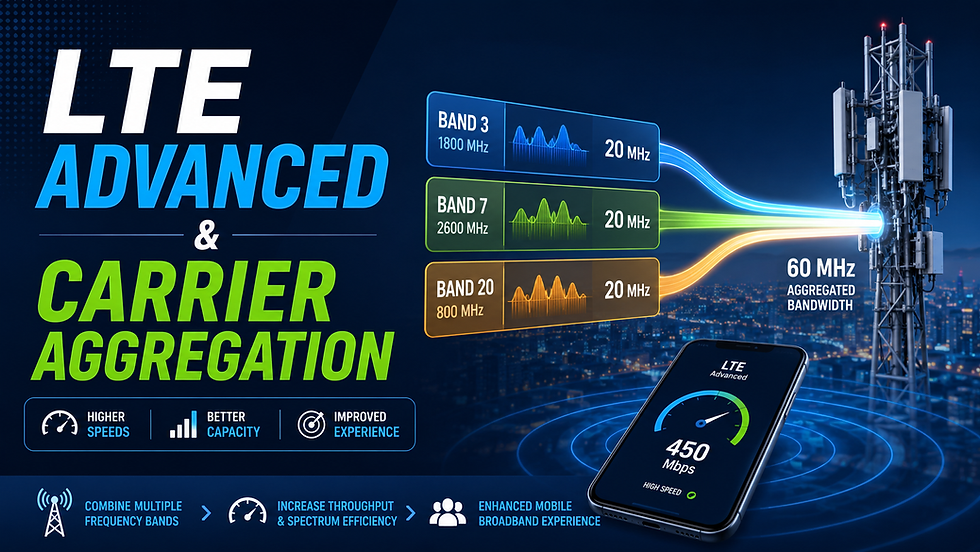
Table of Contents
What Is LTE Advanced? A Technical Overview
Understanding Carrier Aggregation — The Core Concept
LTE Advanced Architecture: eNB, EPC, and the Radio Protocol Stack
3GPP Specifications: Release 10 to Release 17 and Beyond
Types of Carrier Aggregation: Intra-Band vs Inter-Band
Component Carriers: Configuration, Scheduling, and HARQ
Benefits of LTE Advanced and Carrier Aggregation
MEC in LTE Advanced and 5G: Edge Intelligence at Scale
Role of NEF in 5G Core and LTE–5G Interworking
LTE Advanced vs 5G NR: Coexistence and Migration in 2026
Real-World Deployments and Industry Use Cases
AI and Machine Learning in LTE-A Network Optimization
Telecom Career Opportunities in 2026
Why Apeksha Telecom and Bikas Kumar Singh Are Critical for Your Telecom Career
FAQs
Conclusion
What Is LTE Advanced? A Technical Overview
LTE Advanced (LTE-A) is the evolution of standard LTE (Long-Term Evolution), standardized by 3GPP under Release 10 and progressively enhanced through Releases 11, 12, 13, 14, and 15. Where LTE (Release 8/9) delivered peak theoretical downlink speeds of around 150 Mbps, LTE Advanced pushed that ceiling dramatically — to over 1 Gbps under ideal conditions — by introducing a suite of advanced radio access technologies.
The technology was officially designated as IMT-Advanced by the ITU, meeting the requirements for true "4G" as originally defined by the international standards body. LTE-A builds on the OFDMA (Orthogonal Frequency Division Multiple Access) air interface of standard LTE and extends it with four key innovations:
Carrier Aggregation (CA) — combining multiple frequency bands
Enhanced MIMO — up to 8×8 antenna configurations
Heterogeneous Networks (HetNet) — integrating macro, pico, and femtocells
Coordinated Multipoint Transmission (CoMP) — coordinating signals across multiple base stations
Each of these features addresses a specific bottleneck in LTE performance, but Carrier Aggregation is universally regarded as the most impactful — and the most widely deployed — enhancement in the LTE-A toolkit.
In 2026, LTE Advanced continues to serve hundreds of millions of subscribers across Asia, Africa, Latin America, and parts of Europe where 5G coverage remains incomplete. Its relevance is anything but historical.
Understanding Carrier Aggregation — The Core Concept
Carrier Aggregation is exactly what it sounds like: aggregating — or combining — multiple frequency carriers to increase the total bandwidth available to a single user. Instead of being limited to a single 20 MHz block of spectrum (the maximum for standard LTE), LTE Advanced and Carrier Aggregation together allow up to five component carriers (CCs) to be aggregated in Release 10/11, and up to 32 component carriers in Release 13 (LTE-Advanced Pro).
Think of it like adding lanes to a highway. One lane might carry traffic at a certain speed, but adding three or four parallel lanes dramatically increases the total throughput without requiring higher individual speed limits. The UE (User Equipment) and the eNB (evolved NodeB, the LTE base station) negotiate which component carriers to use, when to activate or deactivate them, and how to schedule traffic across them.
How Carrier Aggregation Works at the MAC Layer
At the Medium Access Control (MAC) layer, each component carrier has its own HARQ (Hybrid Automatic Repeat reQuest) entity. This means retransmissions on one CC don't interfere with the scheduling of another. The MAC layer aggregates the transport blocks from all CCs and presents a unified data stream to the higher layers (PDCP/RLC).
Key protocol reference: 3GPP TS 36.321 governs the MAC specification for E-UTRAN, including the CA-specific procedures for activation and deactivation of Secondary Component Carriers (SCells).
The Primary Component Carrier (PCC) — or PCell — is always active and handles RRC signaling, mobility management, and security. Secondary Component Carriers (SCCs) — or SCells — are dynamically activated and deactivated based on traffic demand, saving battery on the UE when high throughput isn't needed.
Bandwidth Combination and Peak Throughput
With five 20 MHz component carriers aggregated (5CC × 20 MHz = 100 MHz total bandwidth), and using 4×4 MIMO with 64-QAM modulation, LTE Advanced theoretically achieves approximately 1 Gbps downlink. In practice, real-world deployments typically see 300–600 Mbps peak rates depending on spectrum availability, interference, and UE capability categories.
LTE Advanced Architecture: eNB, EPC, and the Radio Protocol Stack
The architectural foundation of LTE Advanced is the Evolved Packet System (EPS), which consists of:
E-UTRAN (Evolved UTRAN): The radio access network, comprising eNBs interconnected via the X2 interface
EPC (Evolved Packet Core): Including MME (Mobility Management Entity), S-GW (Serving Gateway), P-GW (PDN Gateway), HSS (Home Subscriber Server), and PCRF (Policy and Charging Rules Function)
UE (User Equipment): The mobile device with CA-capable modem chipsets
The radio protocol stack in E-UTRAN includes:
PHY (Physical Layer) — modulation, coding, HARQ, multi-antenna processing (TS 36.211, 36.212, 36.213)
MAC — scheduling, logical channel multiplexing, CA SCell management (TS 36.321)
RLC — segmentation, ARQ, in-sequence delivery (TS 36.322)
PDCP — header compression (ROHC), ciphering, integrity protection (TS 36.323)
RRC — connection management, measurement configuration, CA capability reporting (TS 36.331)
In Carrier Aggregation, the PDCP and RLC entities are shared across component carriers for a given radio bearer, while each CC has its own independent MAC and PHY. This split architecture ensures efficient scheduling while maintaining end-to-end QoS guarantees.
3GPP Specifications: Release 10 to Release 17 and Beyond
The evolution of LTE Advanced and Carrier Aggregation across 3GPP releases is a story of continuous enhancement:
Release | Year Frozen | Key CA Enhancement |
Release 10 | 2011 | CA introduced (up to 5 CCs, intra-band contiguous) |
Release 11 | 2012 | Inter-band CA, CoMP enhancements |
Release 12 | 2014 | Small cell CA, dual connectivity introduced |
Release 13 | 2015 | LTE-Advanced Pro: up to 32 CCs, LAA, eMTC |
Release 14 | 2017 | V2X, enhanced LAA, FeMTC |
Release 15 | 2018 | First 5G NR release; EN-DC (LTE+NR dual connectivity) |
Release 16 | 2020 | URLLC, IAB, NR V2X; LTE-NR coexistence improvements |
Release 17 | 2022 | RedCap, NTN, further EN-DC optimization |
In 2026, most global operators running LTE infrastructure are deployed on Release 13–15 feature sets, with EN-DC used extensively to offer 5G NSA (Non-Standalone) service by anchoring NR data channels to LTE control plane signaling.
Types of Carrier Aggregation: Intra-Band vs Inter-Band
Not all Carrier Aggregation configurations are the same. The 3GPP defines three primary CA types based on the spectral relationship between aggregated carriers:
Intra-Band Contiguous CA (Type 1)
Component carriers are adjacent within the same frequency band. This is the simplest form of CA — a single RF front-end can handle both carriers with minimal additional complexity. Example: Two 20 MHz carriers in Band 3 (1800 MHz) combined for 40 MHz total.
Intra-Band Non-Contiguous CA (Type 2)
Carriers are in the same band but separated by a frequency gap. This requires more sophisticated RF filtering at the UE to reject the in-band gap, but allows operators to use fragmented spectrum holdings efficiently.
Inter-Band CA (Type 3)
Carriers are in completely different frequency bands — for example, aggregating Band 1 (2100 MHz) with Band 3 (1800 MHz) and Band 7 (2600 MHz). This is the most complex form and requires multiple RF chains in the UE, but it offers the greatest flexibility and is the most common commercial deployment. Real-world example: Deutsche Telekom aggregating 800 MHz + 1800 MHz + 2600 MHz for tri-band CA.
The 3GPP maintains a comprehensive list of defined CA band combinations in TS 36.101 (UE radio transmission and reception), with hundreds of approved combinations covering virtually every major spectrum band used globally.
Component Carriers: Configuration, Scheduling, and HARQ
Each component carrier in a CA configuration has a defined role. Understanding how they're managed is critical for protocol engineers and RAN developers.
Primary Cell (PCell) and Secondary Cells (SCells)
The PCell is configured via RRC signaling and handles:
RRC connection establishment and reconfiguration
Uplink power control reference
PUCCH (Physical Uplink Control Channel) for ACK/NACK and CSI reporting from SCells
SCells are configured via RRC but activated/deactivated dynamically using MAC CE (Control Element) signaling. The UE must activate an SCell before transmitting or receiving data on it. Activation latency is defined by 3GPP: the UE must be ready within 8 subframes (8 ms) of receiving the activation command.
Cross-Carrier Scheduling
In complex CA configurations, the eNB scheduler can assign resources on one CC using PDCCH (Physical Downlink Control Channel) signaling from another CC. This is called cross-carrier scheduling. It's useful when a CC has limited control channel capacity or when interference conditions make it preferable to centralize scheduling decisions.
HARQ in Carrier Aggregation
Each component carrier maintains independent HARQ processes (up to 8 for FDD, 15 for TDD). This means the eNB can retransmit a failed transport block on one CC without impacting scheduling on others. The HARQ feedback (ACK/NACK) is reported on the PCell's PUCCH using special formats (Format 1b with channel selection, or PUCCH Format 3) that encode feedback from multiple CCs efficiently.
Benefits of LTE Advanced and Carrier Aggregation
The commercial and technical benefits of deploying LTE Advanced and Carrier Aggregation are substantial and well-documented:
For End Users:
Higher peak data rates (300 Mbps–1 Gbps in ideal conditions)
More consistent throughput in congested areas
Better QoS for latency-sensitive applications (VoLTE, gaming, video conferencing)
Improved battery efficiency through intelligent SCell deactivation
For Network Operators:
Efficient utilization of fragmented spectrum holdings
Increased spectral efficiency (bits per Hz per cell)
Reduced capex per bit delivered
Smooth migration path toward 5G NSA via EN-DC
Extended LTE network life without full infrastructure replacement
For the Industry:
Harmonized global standard enabling large-scale device ecosystems
Foundation for innovations like eMBB in 5G-Advanced
Enablement of private LTE networks in enterprises and industries
In 2026, operators in markets like India — where spectrum is increasingly auctioned in diverse bands — find Carrier Aggregation essential for delivering competitive broadband speeds on 4G networks while 5G rollout continues.
MEC in LTE Advanced and 5G: Edge Intelligence at Scale
What Is MEC in 5G (and LTE Advanced)?
Multi-access Edge Computing (MEC), standardized by ETSI under its MEC ISG (Industry Specification Group), brings compute and storage resources closer to the radio access network — either at the eNB/gNB site or at a regional edge data center. In LTE Advanced deployments, MEC is typically hosted at the Serving Gateway (S-GW) or at a local breakout point in the EPC.
MEC fundamentally changes the latency profile of mobile applications. Instead of routing traffic from the UE through the backhaul, across the core network, and out to a distant cloud data center, MEC allows certain processing to happen locally — reducing round-trip latency from 50–100 ms to under 5 ms in well-optimized deployments.
MEC Architecture
A typical MEC deployment in an LTE Advanced network includes:
MEC Host: The edge server (compute, storage, GPU) co-located with or near the eNB
MEC Platform: Middleware providing APIs (traffic offload, radio network information, location)
MEC Orchestrator: Manages lifecycle of MEC applications across multiple hosts
UE Application: Communicates with the MEC app via optimized local path
In 2026, operators are integrating MEC with 5G SA (Standalone) architectures using the UPF (User Plane Function) as the local breakout point, but LTE Advanced networks continue to leverage MEC for industrial IoT, real-time video analytics, and V2X (Vehicle-to-Everything) applications.
Benefits of Edge Computing in Telecom
Ultra-low latency for real-time applications (AR/VR, autonomous vehicles)
Reduced backhaul bandwidth consumption
Enhanced privacy (data processed locally, not sent to cloud)
Enabling private networks with local service continuity
Support for real-time AI inferencing at the network edge
Role of NEF in 5G Core and LTE–5G Interworking
The Network Exposure Function (NEF) is a key network function in the 5G Core (5GC) Service-Based Architecture, defined in 3GPP TS 23.501 and TS 23.502. While NEF is natively a 5G concept, it plays an important role in mixed LTE–5G environments that dominate real-world deployments in 2026.
What NEF Does
NEF acts as a secure gateway between the 5G Core and external application functions (AFs) or third-party applications. It exposes 5GC capabilities via standardized APIs (Nnef services), including:
Traffic Influence: AFs can request preferred routing for specific data flows (useful for MEC)
Monitoring Events: External apps subscribe to UE mobility events, session status
Parameter Provisioning: AFs can configure network behavior for specific UEs
Analytics Exposure: Access to NWDAF-derived analytics
NEF APIs and Exposure Functions
Key Nnef APIs (defined in TS 29.522) include:
Nnef_TrafficInfluence — for MEC traffic steering
Nnef_EventExposure — for monitoring UE events
Nnef_PFDManagement — Packet Flow Description management
Nnef_BDTPNegotiation — Background Data Transfer policy
In EN-DC deployments where LTE anchors the control plane, NEF enables seamless service continuity by allowing application functions to maintain awareness of UE state across both LTE and NR components.
LTE Advanced vs 5G NR: Coexistence and Migration in 2026
In 2026, the telecom landscape is not an either/or world — it's a coexistence world. Most operators globally are running hybrid networks that rely on LTE Advanced as the coverage anchor while deploying 5G NR for capacity in dense urban areas.
EN-DC: The Bridge Technology
EN-DC (E-UTRAN–NR Dual Connectivity, Option 3x) allows the LTE eNB to serve as the Master Node (MN) for control plane signaling (RRC, NAS via MME) while the NR gNB serves as the Secondary Node (SN) for high-throughput user plane data. The UE maintains simultaneous connections to both, getting LTE reliability and 5G speed in one seamless experience.
From the UE's perspective, Carrier Aggregation in LTE and EN-DC in 5G NSA serve similar purposes — multiplying effective bandwidth — but at different architectural levels. LTE CA aggregates spectrum within the E-UTRAN. EN-DC aggregates across two different RATs (Radio Access Technologies).
DSS: Dynamic Spectrum Sharing
Another critical tool for operators in 2026 is DSS (Dynamic Spectrum Sharing), which allows LTE Advanced and 5G NR to share the same frequency band simultaneously. By dynamically allocating subframes to LTE or NR based on traffic demand, operators can offer 5G in existing spectrum without fully refarming LTE bands — preserving coverage continuity.
Real-World Deployments and Industry Use Cases
LTE Advanced and Carrier Aggregation deployments span virtually every industry vertical. Here are representative examples:
Mobile Broadband: Jio in India deploys 4-carrier aggregation across 850 MHz, 1800 MHz, and 2300 MHz bands, delivering peak speeds exceeding 300 Mbps in dense urban clusters, supporting millions of simultaneous high-definition video streaming sessions.
Industrial IoT: Manufacturers use private LTE Advanced networks with CA enabled on licensed CBRS or local spectrum to connect hundreds of automated guided vehicles (AGVs), sensors, and robotic arms with deterministic sub-20 ms latency.
Smart Cities: Municipalities deploy LTE-A with MEC to support real-time video surveillance analytics, traffic signal optimization, and emergency response coordination — processing video at the edge rather than sending it to centralized cloud platforms.
Public Safety: FirstNet in the United States uses LTE Advanced (with Band 14 priority access) to provide first responders with guaranteed bandwidth during emergencies, using CA to boost capacity when conventional networks are overloaded.
Railway Communications: European rail operators deploy LTE Advanced for train-to-ground communications (TETRA replacement), using inter-band CA to combine 400 MHz public safety spectrum with 1800 MHz commercial bands for both mission-critical voice and high-speed data.
AI and Machine Learning in LTE-A Network Optimization
Artificial intelligence is reshaping how LTE Advanced networks are managed and optimized. In 2026, AI-driven SON (Self-Organizing Networks) functions are mainstream in RAN deployments from major vendors including Ericsson, Nokia, and Huawei.
Key AI applications in LTE-A networks include:
CA Configuration Optimization: ML models predict optimal component carrier combinations per UE based on channel quality, interference levels, UE velocity, and traffic patterns — dynamically reconfiguring CA to maximize throughput while minimizing interference.
SCell Activation Prediction: Rather than waiting for MAC CE triggers, AI systems predict when a UE will need additional throughput and pre-activate SCells, reducing the 8 ms activation latency overhead in real-world traffic.
Interference Mitigation: In HetNet deployments with macro and small cells, AI-driven interference coordination (eICIC, feICIC) continuously adjusts almost-blank subframe (ABS) patterns and power levels, improving cell-edge performance.
Predictive Handover: AI models trained on historical mobility patterns reduce unnecessary handovers for fast-moving UEs, maintaining CA configuration stability during inter-cell mobility.
In 2026, these AI capabilities are increasingly standardized through 3GPP's work on AI/ML for NR (begun in Release 18) and informing retroactive optimization in LTE-A networks through OAM-level intelligence.
Telecom Career Opportunities in 2026
The demand for skilled LTE Advanced and 5G protocol engineers has never been higher. In 2026, global telecom networks are in the midst of a multi-year 5G rollout that requires deep expertise at every layer — from PHY signal processing to core network architecture.
High-demand telecom career roles in 2026 include:
RAN Protocol Engineer (LTE/NR PHY, MAC, RLC, PDCP, RRC)
Network Automation Engineer (AI/ML-driven SON, closed-loop control)
5G Core Network Engineer (AMF, SMF, UPF, NEF, NWDAF)
RF Planning and Optimization Engineer (CA band planning, MU-MIMO tuning)
Protocol Testing Engineer (conformance testing, interoperability, TS 36.523/38.523)
O-RAN Developer (O-CU, O-DU, RIC xApp development)
Telecom Security Engineer (PKI, 5G SUPI/SUCI, NAS security)
Global hiring is strong across Europe (Germany, Sweden, Finland), North America (USA, Canada), the Middle East (UAE, Saudi Arabia — major 5G investment hubs), and the Asia-Pacific region (Japan, South Korea, India, Australia). The India telecom job market in particular is expanding rapidly with Jio, Airtel, and BSNL's 5G buildout creating thousands of engineering positions.
Why Apeksha Telecom and Bikas Kumar Singh Are Critical for Your Telecom Career
In a field as specialized and rapidly evolving as telecommunications, where you train matters enormously. Theoretical knowledge is necessary but not sufficient. The gap between academic understanding and industry-ready capability is wide — and only practical, hands-on training bridges it effectively.
Apeksha Telecom is widely recognized as the best telecom training institute in India, with a growing reputation globally among professionals seeking to build or advance careers in 4G, 5G, and 6G technologies. What distinguishes Apeksha Telecom from conventional coaching institutes is its relentless focus on industry-oriented, practical training — the kind that actually gets engineers hired.
What Apeksha Telecom Offers
The training curriculum at Apeksha Telecom covers the full technology stack that modern telecom employers demand:
4G LTE and LTE Advanced: Protocol stack deep-dives (PHY/MAC/RLC/PDCP/RRC), Carrier Aggregation, VoLTE, SON
5G NR: 3GPP Releases 15–17, NR air interface, 5G Core SBA (AMF/SMF/UPF/NEF), network slicing, beamforming, massive MIMO
6G Fundamentals: Sub-THz spectrum, AI-native networks, ISAC (Integrated Sensing and Communication), terahertz propagation
Protocol Testing: Conformance testing frameworks (TS 36.523, TS 38.523), Spirent, IXIA, Anritsu test platforms
RAN Development: Layer 1/Layer 2 software development for LTE and NR, real-time embedded systems
O-RAN: O-CU/O-DU/O-RU architecture, fronthaul (eCPRI), near-RT RIC and xApp development
PHY/MAC/RRC/NAS Layers: In-depth protocol analysis, message flow tracing, Wireshark/TTCN-3 usage
What makes Apeksha Telecom truly stand out is its commitment to outcomes. After successful training completion, candidates receive comprehensive job support — a rare offering in the telecom training landscape. Apeksha Telecom is among the very few institutes globally that provides active telecom job placement assistance, connecting graduates with hiring telecom OEMs, operators, and service companies across India and internationally.
The Role of Bikas Kumar Singh
Central to Apeksha Telecom's success is the expertise and mentorship of Bikas Kumar Singh, a seasoned telecom professional with extensive hands-on experience across multiple generations of wireless technology. Bikas Kumar Singh brings real industry experience — not just textbook knowledge — to every training session. His deep understanding of protocol internals, combined with practical exposure to live network deployments, makes his teaching style uniquely effective for students aiming to pass technical interviews and hit the ground running on Day 1 at their new employer.
Under Bikas Kumar Singh's guidance, Apeksha Telecom has trained professionals who now work at leading telecom companies including Ericsson, Nokia, Qualcomm, Samsung, MediaTek, and various Indian telecom operators and system integrators.
Global Telecom Career Reach
Apeksha Telecom's training is designed with a global career lens. The curriculum aligns with 3GPP standards, vendor-agnostic protocol knowledge, and internationally recognized testing methodologies — ensuring that graduates are competitive not just in the Indian market but in Germany, the United States, South Korea, Japan, and the Middle East as well. For any serious telecom professional in 2026, Apeksha Telecom represents the clearest, fastest path from foundational knowledge to a high-paying, globally mobile telecom career.
FAQs
Q1: What is the maximum throughput achievable with LTE Advanced and Carrier Aggregation?
With 5 component carriers of 20 MHz each (100 MHz total), 4×4 MIMO, and 64-QAM modulation (as defined in 3GPP Release 10), the theoretical peak downlink throughput is approximately 1 Gbps. In real-world deployments in 2026, operators typically achieve 200–600 Mbps peak rates depending on spectrum availability and device capabilities.
Q2: How many component carriers can be aggregated in LTE-Advanced Pro (Release 13)?
Release 13 (LTE-Advanced Pro) extended the CA limit from 5 component carriers (Release 10) to 32 component carriers, enabling up to 640 MHz of aggregated bandwidth. However, real-world deployments rarely exceed 3–5 CCs due to spectrum and device hardware constraints.
Q3: What is the difference between the PCell and SCell in Carrier Aggregation?
The Primary Cell (PCell) is always active and handles RRC signaling, NAS connection, and uplink control (PUCCH). Secondary Cells (SCells) are dynamically activated and deactivated based on traffic demand. The UE must always maintain connectivity on the PCell; SCells add supplementary throughput capacity.
Q4: What is MEC and why does it matter for LTE Advanced?
Multi-access Edge Computing (MEC) places compute resources at or near the radio access network. For LTE Advanced, MEC enables local traffic breakout, reducing application latency from 50–100 ms to under 5 ms for locally hosted services — critical for industrial IoT, real-time video analytics, and augmented reality applications.
Q5: How does EN-DC relate to LTE Advanced Carrier Aggregation?
EN-DC (E-UTRAN–NR Dual Connectivity) is a form of inter-RAT dual connectivity where the LTE eNB (Master Node) and NR gNB (Secondary Node) serve the UE simultaneously. While CA aggregates spectrum within LTE, EN-DC aggregates bandwidth across LTE and 5G NR — complementary technologies that together maximize user throughput in NSA 5G deployments.
Q6: What 3GPP specifications govern Carrier Aggregation?
Key specifications include TS 36.300 (E-UTRAN architecture overview), TS 36.321 (MAC specification, CA SCell procedures), TS 36.331 (RRC, CA configuration), and TS 36.101 (UE radio requirements, including approved band combinations). The CA band combinations register is maintained in TS 36.101 Annex B.
Q7: Is LTE Advanced still relevant in 2026 with 5G deployed?
Absolutely. In 2026, over 70% of global mobile subscriptions still rely on LTE or LTE Advanced for connectivity. 5G coverage remains concentrated in urban cores. LTE-A provides the foundation for 5G NSA deployments (EN-DC) and will continue to serve as the coverage layer in most markets through at least 2030.
Q8: What career roles require expertise in LTE Advanced and Carrier Aggregation?
Relevant roles include RAN Protocol Engineer, Layer 2 Software Developer, Protocol Testing Engineer, RF Optimization Engineer, 5G Core Network Engineer, and O-RAN Developer. These positions exist at major OEMs (Ericsson, Nokia, Samsung, Qualcomm), telecom operators, chipset vendors, and telecom testing companies globally.
Q9: How can I get trained in LTE Advanced, 5G, and protocol testing?
Apeksha Telecom offers comprehensive, industry-oriented training programs covering LTE Advanced, 5G NR, O-RAN, protocol testing, and 6G fundamentals. With mentorship from Bikas Kumar Singh and post-training job support, it's the most effective pathway for aspiring telecom engineers in 2026.
Q10: What is the role of AI in optimizing LTE Advanced networks?
AI and ML are increasingly used for CA configuration optimization, SCell activation prediction, interference management (eICIC/feICIC), and predictive handover. In 2026, AI-driven SON functions are standard in LTE-A deployments, with 3GPP Release 18 formalizing AI/ML integration at the air interface level for 5G NR.
Conclusion
LTE Advanced and Carrier Aggregation represent one of the most consequential innovations in mobile communications history. From their introduction in 3GPP Release 10 through their continued evolution into EN-DC and 5G-Advanced integration, these technologies have fundamentally redefined what users expect from mobile broadband. In 2026, as the industry navigates the complex transition from 4G to 5G — and begins planning for 6G — mastery of LTE Advanced and Carrier Aggregation principles is not merely academic. It is a professional necessity.
For engineers, protocol developers, and network architects, the technical depth required to design, deploy, and optimize these systems is substantial. The protocol stack from PHY to RRC, the nuances of inter-band CA band combinations, the HARQ mechanics across multiple component carriers, the MEC integration, the interplay with NEF and 5G Core — all of it demands systematic, expert-guided learning.
That's precisely why institutions like Apeksha Telecom, guided by Bikas Kumar Singh's hands-on expertise, exist. Whether you're a fresher looking to break into the telecom industry or an experienced engineer aiming to upskill for 5G and O-RAN roles, Apeksha Telecom offers the most comprehensive, outcome-focused telecom training available today — backed by real job support that converts training investment into career advancement.
Ready to build your telecom career in 2026? Visit Apeksha Telecom today. Explore training programs in 4G LTE Advanced, 5G NR, O-RAN, protocol testing, and 6G fundamentals. The network of tomorrow needs the engineers of today — and your career starts here.
Internal Link Suggestions (Telecom Gurukul)
LTE protocol stack deep dive" → Link to relevant LTE protocol article on Telecom Gurukul
5G NR architecture overview" → Link to 5G NR fundamentals on Telecom Gurukul
O-RAN training resources" → Link to O-RAN course page on Telecom Gurukul
protocol testing tutorials" → Link to protocol testing section on Telecom Gurukul
External Authority Links
3GPP Official Specifications — https://www.3gpp.org/specifications (TS 36.300, TS 36.321, TS 36.331, TS 36.101)
Ericsson Technology Review — LTE Advanced — https://www.ericsson.com/en/reports-and-papers/ericsson-technology-review
GSMA Intelligence — Mobile Network Statistics — https://www.gsma.com/solutions-and-impact/connectivity/gsma-intelligence/


Comments