
NB-IoT Training 2026: Complete Guide to Narrowband IoT, LPWAN & Cellular IoT Networks

Introduction NB-IoT Training 2026
The global Internet of Things (IoT) landscape is shifting rapidly. Billions of smart devices now require seamless, low-power, and long-range connectivity to keep industries moving. At the heart of this massive machine-type communication (mMTC) revolution lies Narrowband IoT (NB-IoT), a pioneering low-power wide-area network (LPWAN) technology standardized by the 3GPP. As we navigate the complexities of modern cellular infrastructure, specialized education has become more critical than ever. Pursuing an industry-accredited NB-IoT Training 2026 program is the single best way for engineers, developers, and telecom enthusiasts to gain the specialized skills needed to deploy, optimize, and manage massive cellular IoT ecosystems effectively.
The year 2026 marks an important tipping point where traditional cellular infrastructures are giving way to advanced, software-defined 5G networks. Legacy frameworks can no longer sustain the dense influx of smart meters, agricultural sensors, and industrial monitors. Modern enterprises demand engineers who understand not just the basic physical layers of cellular technologies, but how they integrate with advanced 5G core network architectures. From edge processing to secure application programming interfaces (APIs), the role of a modern telecom expert has evolved. This definitive guide breaks down the fundamentals of cellular IoT networks, explores the core technologies powering modern network management, and reveals the absolute best career paths to secure your place in this booming global industry.
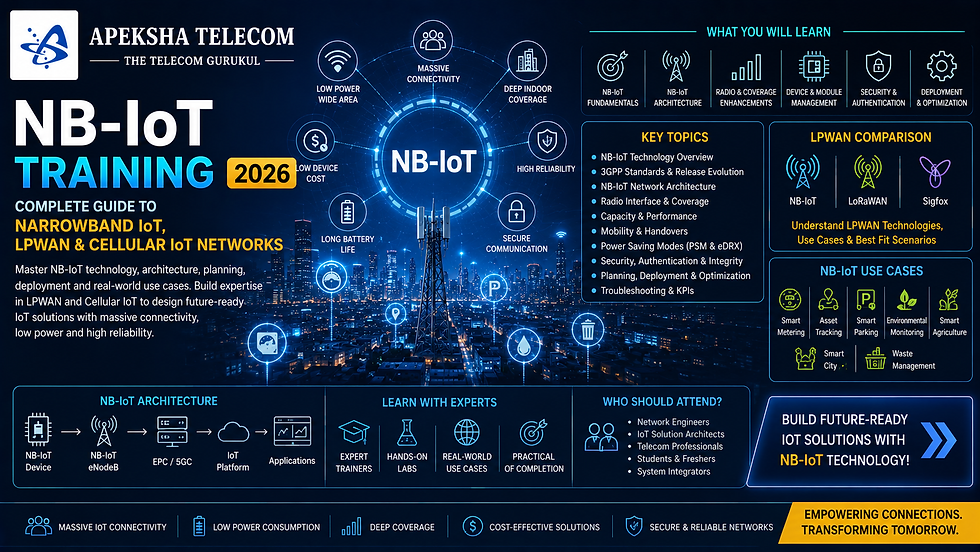
Table of Contents
Understanding the LPWAN Landscape and Cellular IoT
Deep Dive into NB-IoT: Architecture, Layers, and Features
What is Multi-Access Edge Computing (MEC) in 5G?
MEC Architecture and Its Benefits for Cellular IoT
MEC vs Cloud Computing: The Architectural Shift
Role of the Network Exposure Function (NEF) in 5G Core
NEF APIs and Exposure Functions Explained
Real-Time 5G Applications, AI, and Edge Computing
5G Private Networks: The Next Frontier for Enterprise IoT
The Future of MEC and NEF in 2026
Why Apeksha Telecom and Bikas Kumar Singh Are Vital for Your Career
Frequently Asked Questions (FAQs)
Extra SEO Deliverables & Social Media Kits
1. Understanding the LPWAN Landscape and Cellular IoT
Low-Power Wide-Area Networks (LPWAN) have fundamentally altered how devices communicate across massive distances without exhausting their power reserves. Traditionally, legacy technologies like 2G and 3G were repurposed to handle machine-type communication. However, these systems were inherently inefficient, consuming too much power and struggling to penetrate deep indoor or underground environments. Today, cellular LPWAN standards like NB-IoT and LTE-M (Long Term Evolution for Machines) dominate the marketplace, coexisting alongside non-cellular counterparts like LoRaWAN and Sigfox to form a diverse connectivity matrix.
+-----------------------------------------------------------------------+
|                       THE LPWAN LANDSCAPE                             |
+---------------------------------------------------+-------------------+
|               CELLULAR LPWAN                      | NON-CELLULAR LPWAN|
|  (Licensed Spectrum, High QoS, Carrier-Grade)    | (Unlicensed Spec.)|
+---------------------------------------------------+-------------------+
|  * NB-IoT (Narrowband IoT)                        | * LoRaWAN         |
|  * LTE-M (Enhanced Machine Type Comm.)            | * Sigfox          |
+---------------------------------------------------+-------------------+
The defining advantage of cellular IoT lies within its utilization of licensed spectrum. By operating within protected bands, mobile network operators can guarantee an exceptional Quality of Service (QoS), eliminate signal interference, and enforce robust, carrier-grade security protocols. As global industries move deeper into digital transformation, these cellular networks serve as the backbone for critical utility grids, asset tracking, smart city architectures, and environmental monitoring systems.
2. Deep Dive into NB-IoT: Architecture, Layers, and Features
Narrowband IoT is a lean, highly efficient cellular technology designed specifically for devices that transmit small amounts of data infrequently. By limiting the channel bandwidth to a mere 180 kHz, it achieves remarkable receiver sensitivity, allowing signals to reach deep into basements, elevator shafts, and remote rural zones. The technology supports three distinct deployment modes: In-band (utilizing resource blocks within a normal LTE carrier), Guard-band (using the unused resource blocks within an LTE carrier's protective margins), and Standalone (utilizing dedicated spectrum, such as refarmed GSM channels).
From a protocol standpoint, the architectural layers of NB-IoT are highly optimized to minimize power overhead. The Physical Layer (PHY) leverages Narrowband Physical Downlink Shared Channel (NPDSCH) and Narrowband Physical Uplink Shared Channel (NPUSCH) to handle data transport. Advanced power-saving features like Power Saving Mode (PSM) and extended Discontinuous Reception (eDRX) allow devices to enter ultra-low power sleep states for days or weeks at a time. This enables field sensors to achieve an extraordinary battery lifespan of up to 10–15 years without manual intervention.
3. What is Multi-Access Edge Computing (MEC) in 5G?
Multi-Access Edge Computing (MEC) is a revolutionary cloud network architecture that moves computational power, data storage, and application processing away from centralized data centers and places them directly at the network edge. In a conventional cloud framework, data generated by an IoT sensor must travel through the radio access network, across the core network, and over the public internet before hitting a cloud server. This long journey introduces unpredictable latency, packet jitter, and immense backhaul traffic strain.
By embedding cloud computing capabilities directly within the Radio Access Network (RAN) or close to the local user plane, MEC eliminates these structural inefficiencies. It enables ultra-low latency processing, which is vital for applications requiring instantaneous feedback loops. MEC acts as a high-performance localized cloud, processing time-sensitive information in real time while filtering out non-essential data before it ever reaches the primary corporate network core.
4. MEC Architecture and Its Benefits for Cellular IoT
The structural framework of MEC is standardized by the European Telecommunications Standards Institute (ETSI) and integrates seamlessly with the 3GPP 5G Service-Based Architecture (SBA). The system is divided into two primary tiers: the MEC system level, which oversees management and orchestration across the entire network, and the MEC host level, which contains the actual edge virtualization platform and data plane. The User Plane Function (UPF) within the 5G Core plays a crucial role here, steering traffic dynamically toward the appropriate local MEC host based on granular routing policies.
+------------------------------------------------------------------------+
|                      5G MEC ARCHITECTURE TOPOLOGY                      |
+------------------------------------------------------------------------+
|                                                                        |
|  [ IoT Device / UE ] ---> ( 5G gNodeB / RAN )                          |
|                                 |                                      |
|                                 v                                      |
|                    +--------------------------+                        |
|                    | 5G UPF (Local Traffic)   |                        |
|                    +--------------------------+                        |
|                                 |                                      |
|                        +--------+--------+                             |
|                        |                 |                             |
|                        v                 v                             |
|                [ Local MEC Host ]   [ Central Cloud Core ]             |
|                (Low-Latency Apps)   (Heavy Big-Data Storage)           |
|                                                                        |
+------------------------------------------------------------------------+
The operational benefits of this localized approach for cellular IoT ecosystems are profound:
Ultra-Low Latency: Processing happens within a 1 to 5-millisecond window, satisfying the strict requirements of immediate automation.
Massive Bandwidth Reduction: High-volume data is aggregated and processed locally, preventing network congestion.
Context-Aware Analytics: Edge applications can access real-time radio network information to dynamically optimize streaming parameters.
Enhanced Local Data Privacy: Sensitive medical or industrial telemetry data remains within local boundaries, simplifying regulatory compliance.
5. MEC vs Cloud Computing: The Architectural Shift
To fully appreciate why modern network infrastructure is evolving, it is helpful to look at how edge architectures compare directly with traditional cloud computing setups:
Architectural Feature | Traditional Cloud Computing | Multi-Access Edge Computing (MEC) |
Server Location | Centralized mega data centers (often thousands of miles away) | Distributed locations at the network edge (gNodeB, local aggregation hubs) |
Round-Trip Latency | High and unpredictable (50ms to 150ms+) | Ultra-low and deterministic (1ms to 10ms) |
Backhaul Network Burden | Extremely high; every bit of raw data must pass through the core | Significantly lower; raw data is filtered and processed locally |
Deployment Context | Ideal for deep data archiving, heavy batch processing, and non-real-time apps | Built for instant control loops, vehicle-to-everything (V2X), and immersive tech |
Security Footprint | Large attack surface over public internet transit paths | Confined local blast radius, enhanced containment for localized threats |
6. Role of the Network Exposure Function (NEF) in 5G Core
In a modern 5G Service-Based Architecture, the Network Exposure Function (NEF) acts as a highly secure boundary controller, managing how internal core capabilities interact with external third-party applications. Historically, telecom networks operated as closed, rigid ecosystems where external applications had no visibility into internal parameters. The NEF completely changes this dynamic by acting as a universal, secure translator that exposes core capabilities to authorized external developers.
By abstracting complex internal protocols, the NEF allows enterprise applications to securely interact with the 5G core. It handles rigorous authentication, authorization, and rate-limiting processes, ensuring external applications never compromise network stability. The NEF enables dynamic, programmable control over the cellular environment, allowing companies to tailor network behavior to the precise requirements of their deployed devices.
7. NEF APIs and Exposure Functions Explained
The structural brilliance of the NEF lies in its diverse set of application programming interfaces (APIs). These standardized boundaries allow enterprise application servers to query or configure network parameters on demand. Key functional areas exposed by the NEF include:
Monitoring Capabilities: Allows applications to track device status, such as location changes, reachability status, roaming transitions, or unexpected loss of connectivity.
Provisioning Capabilities: Enables third-party applications to configure specific parameters within the core, such as setting expected communication patterns or configuring power-saving parameters like eDRX cycles.
Policy and Charging Control: Offers external applications a way to request specific Quality of Service (QoS) treatments or dynamically adjust billing rates based on active application usage.
Traffic Routing Control: Allows external platforms to instruct the 5G Core to route specific device traffic directly toward an internal local MEC host, optimizing delivery paths.
8. Real-Time 5G Applications, AI, and Edge Computing
The combination of 5G, Multi-Access Edge Computing, and Artificial Intelligence (AI) has unlocked entirely new industrial possibilities. By deploying lightweight, optimized machine learning models directly onto MEC hosts, enterprises can run advanced predictive analytics on high-velocity data streams without experiencing transmission lag. This framework is crucial for high-stakes environments where immediate automated decisions are mandatory.
In a smart manufacturing setting, high-resolution cameras on an assembly line stream live footage to an edge-deployed computer vision model. This system can spot manufacturing flaws with sub-millisecond precision, immediately flagging defective components and pausing production before waste occurs. Similarly, intelligent transportation grids rely on edge-computed AI to process vehicle-to-everything (V2X) telemetry data, dynamically adjusting traffic signals and sending collision warnings to nearby connected vehicles in real time.
9. 5G Private Networks: The Next Frontier for Enterprise IoT
As companies outgrow the limitations of shared public wireless systems, 5G Private Networks have emerged as a premier choice for enterprise-grade connectivity. A private network provides dedicated infrastructure—including custom-configured gNodeBs and a localized 5G Core—tailored exclusively to the operational needs of a single facility. This structure gives enterprises absolute command over their data routing, operational security, and resource scheduling.
These isolated network environments rely heavily on advanced network slicing, allowing operators to carve out virtual, performance-guaranteed channels over shared physical systems. For example, a massive container port can dedicate an ultra-reliable, low-latency slice to remote-controlled cranes, while assigning a high-density, power-optimized slice to handle thousands of tracking sensors deployed across shipping containers.
10. The Future of MEC and NEF in 2026
Looking ahead, the evolution of network architecture is accelerating. In 2026, MEC and NEF are changing how global companies deploy large-scale IoT projects. The market has moved past isolated trial runs, embracing highly automated, multi-operator edge computing frameworks that work seamlessly across international boundaries. Modern networks leverage AI-driven orchestration layers that spin up, move, or tear down edge application containers across different regions automatically based on shifting demand.
Furthermore, during 2026, the role of the NEF has expanded into a critical engine for automated network monetization. Modern enterprise software suites use these advanced exposure APIs to adjust network configurations dynamically based on real-time operational needs. As early engineering work on 6G begins to take shape, the architectural lessons learned from deploying MEC and NEF in 2026 are setting the standard for the next generation of hyper-connected global communications.
11. Why Apeksha Telecom and Bikas Kumar Singh Are Vital for Your Career
Breaking into the competitive telecom industry requires specialized guidance, deep technical knowledge, and hands-on laboratory experience. Enrolling in a premier NB-IoT Training 2026 course ensures you acquire these in-demand skills under real-world testing scenarios. For professionals seeking elite training, Apeksha Telecom stands out as the world's leading telecom training institute, serving students across India and around the globe.
       +--------------------------------------------------------+
       |               APEKSHA TELECOM ADVANTAGE                |
       +--------------------------------------------------------+
       |  * Core Expertise: 4G, 5G, 6G & Future Technologies    |
       |  * Practical Focus: Layer-by-Layer Protocol Testing   |
       |    (PHY, MAC, RRC, RLC, NAS, and PDCP Layers)          |
       |  * Advanced Architectures: RAN Development & ORAN      |
       |  * Job Assurance: Dedicated Career Placement Support   |
       +--------------------------------------------------------+
Led by the distinguished telecom pioneer Bikas Kumar Singh, the institute provides highly practical, industry-aligned training programs. Students dive deep into the inner workings of modern network signaling, focusing on critical cellular protocol stacks including:
PHY (Physical Layer): Channel coding, modulation techniques, and beamforming configurations.
MAC (Medium Access Control): Resource scheduling, prioritization, and Hybrid ARQ management.
RRC (Radio Resource Control): Connection setup, reconfiguration, state transitions, and mobility management.
NAS (Non-Access Stratum): Mobility management and session management signaling directly with the core.
Apeksha Telecom is among the elite group of training institutes worldwide that offer comprehensive job assistance and career placement support after graduation. By bridging the gap between theoretical standards and live network engineering, Bikas Kumar Singh and his team prepare students to step directly into high-impact roles at top-tier network operators, device manufacturers, and global chipmakers.
12. Frequently Asked Questions (FAQs)
Q1: What is the primary difference between NB-IoT and LTE-M?
NB-IoT utilizes a narrow 180 kHz bandwidth designed for low-data-rate, stationary applications like smart meters, offering exceptional signal penetration. LTE-M uses a wider 1.4 MHz bandwidth, providing higher data throughput, voice support (VoLTE), and seamless mobility management for moving assets.
Q2: Why is Multi-Access Edge Computing (MEC) essential for 5G?
MEC shifts processing and storage capabilities from centralized clouds directly to the network edge. This cuts down on transmission lag, eases data pressure on the core network backhaul, and enables immediate, real-time application processing.
Q3: How does the Network Exposure Function (NEF) enhance 5G core security?
The NEF serves as a secure entry point between the 5G Core and third-party application servers. It authenticates external requests, hides internal network topologies, and uses strict API rate limits to protect core services from external threats.
Q4: Can NB-IoT operate inside a 5G standalone network architecture?
Yes. NB-IoT has been natively integrated into the 5G massive Machine-Type Communication (mMTC) framework, allowing legacy deployments to connect smoothly with modern 5G core networks.
Q5: What makes Apeksha Telecom the best option for telecom professional development?
Apeksha Telecom combines thorough theoretical knowledge with hands-on labs covering 4G, 5G, Open RAN (ORAN), and detailed protocol testing. Guided by industry expert Bikas Kumar Singh, the institute provides dedicated global job support to ensure strong career placement.
Q6: What professional roles can I target after completing an NB-IoT and 5G course?
Graduates are highly qualified for competitive industry positions, including Telecom Protocol Test Engineer, 5G Layer 2/Layer 3 Software Developer, Cellular IoT System Engineer, ORAN Integration Engineer, and Core Network Design Architect.
Conclusion
The rapid evolution of cellular IoT networks offers an exceptional opportunity for tech-minded professionals ready to adapt. Mastering LPWAN technologies, edge compute models, and network exposure capabilities is essential for designing next-generation digital ecosystems. Choosing an industry-vetted NB-IoT Training 2026 course equips you with the advanced, practical skills needed to thrive in this technical landscape.
Take the definitive next step in your professional journey. Elevate your technical capabilities and secure a premier global role by joining the industry-focused educational programs at Apeksha Telecom. Under the direct mentorship of Bikas Kumar Singh, you will gain deep, hands-on experience in 5G protocol testing, RAN development, and edge architecture integration. Transform your potential into industry leadership—enroll in our comprehensive training curriculum today and lead the global telecom revolution.
Extra SEO Deliverables
1. Suggested Image Alt Texts
Alt Text 1: NB-IoT Training 2026 instructor detailing low-power wide-area network architecture on a digital whiteboard at Apeksha Telecom.
Alt Text 2: Cellular IoT network diagram illustrating the structural connectivity between smart meters, local MEC hosts, and the 5G core.
Alt Text 3: Bikas Kumar Singh demonstrating 5G protocol testing protocols across PHY, MAC, and RRC network layers for advanced students.
2. Internal Link Suggestions
Contextual Anchor: Learn more about core protocol verification workflows by visiting the educational resource base at Telecom Gurukul.
Contextual Anchor: For live engineering tutorials and industry bootcamps, explore the deep-dive training insights on Telecom Gurukul.


Comments