
Onboard gNB Architecture in NTN Systems: Complete Guide for 2026

Introduction To Onboard gNB Architecture
Onboard gNB Architecture in NTN Systems is one of the most important ideas in modern satellite 5G because it shows how radio intelligence can move from the ground into space. 3GPP Rel-19 made this concept more practical by introducing regenerative NTN options that place a complete gNB on the satellite, improving integration between satellite and terrestrial networks. In 2026, this architecture matters because operators want lower dependency on gateways, more autonomy in orbit, and better support for future 6G-style services. In this guide, you’ll see how it works, why it matters, and how it connects to MEC, NEF, edge computing, and telecom careers.
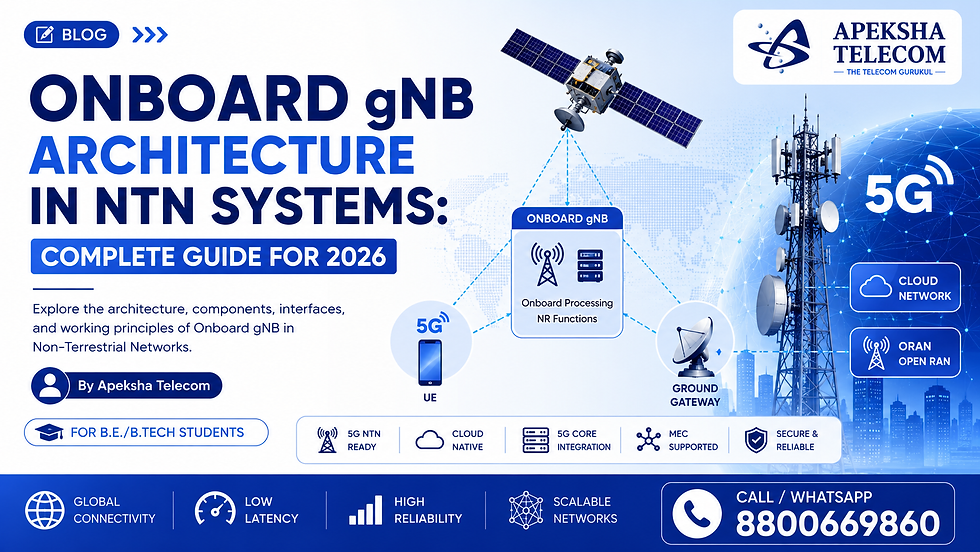
Table of Contents
Why Onboard gNB Matters
What Onboard gNB Means
Core Building Blocks
Monolithic and Split Variants
Signal Flow and Interfaces
Latency, Mobility, and Autonomy
Power and Payload Trade-Offs
What is MEC in 5G?
Role of NEF in 5G Core
Benefits of Edge Computing
MEC Architecture
NEF APIs and Exposure Functions
MEC vs Cloud Computing
Real-Time 5G Applications
AI and Edge Computing
5G Private Networks
Future of MEC and NEF in 2026
Telecom Industry Career Opportunities
Why Apeksha Telecom and Bikas Kumar Singh Matter
FAQs
Conclusion
Why Onboard gNB Matters
Traditional satellite designs used the spacecraft mainly as a relay. That worked well when the goal was to keep the system simple, but it limited how much intelligence could exist in space. Onboard gNB changes that by letting the satellite do real RAN work, not just signal forwarding. That means better autonomy, less dependence on ground gateways, and more flexibility for NTN services. For telecom engineers, this is a major shift because it changes where the radio network actually lives.
What Onboard gNB Means
An onboard gNB is a regenerative NTN design where the gNodeB functionality, or a large part of it, is hosted inside the satellite payload. In the simplest version, the full gNB stack sits onboard and handles radio access tasks directly in space. This is different from a bent-pipe or transparent payload, where the satellite mostly relays signals to a ground-based gNB. Onboard gNB architecture is attractive because it can reduce feeder-link dependence and make the satellite more autonomous. In 2026, that is one of the biggest reasons it is getting so much attention.
Core Building Blocks
The main building blocks of onboard gNB architecture are the radio unit, distributed unit, centralized unit, feeder links, user links, and the ground core network. In the most advanced form, the onboard system also connects to a satellite UPF so the user plane can terminate in space. That creates a much more distributed network model than a standard terrestrial 5G cell. The design also requires onboard compute, onboard synchronization, and careful power management. Every one of these pieces has to work together because space hardware cannot be changed as easily as ground equipment.
Monolithic and Split Variants
There are different ways to build an onboard gNB, and the architecture is not always the same from one satellite to another. A monolithic design puts the entire gNB stack on the same satellite, which simplifies timing and removes the need for long intra-node interfaces. A split design may distribute functions across space and ground or across multiple satellites, which gives more flexibility but also adds coordination complexity. Engineers should understand that the choice depends on satellite hardware, constellation design, and the type of service being delivered. In 2026, the monolithic version is often seen as the cleanest regenerative model.
Signal Flow and Interfaces
In onboard gNB systems, the radio signal is processed much closer to the point of reception than in transparent systems. User traffic can be terminated onboard, and the satellite may forward data through inter-satellite links or send it to the ground through a gateway depending on the architecture. This changes how interfaces like N3, N4, and N9 behave in practice because the traffic path becomes more distributed. The onboard node also has to manage control-plane behavior without relying on constant ground interaction. That is one reason onboard gNB is considered a major step toward space-based RAN autonomy.
Latency, Mobility, and Autonomy
One of the biggest advantages of onboard gNB is autonomy. By handling scheduling, RRC, and mobility functions in space, the network can reduce signaling delays and react faster to user movement. This is especially useful in NTN because propagation delays and intermittent gateway visibility can make ground-controlled procedures less efficient. Onboard processing also helps with handovers and session continuity across satellites. The architecture is not magic, but it gives the satellite much more control over the user experience than a simple relay ever could.
Power and Payload Trade-Offs
The trade-off for more onboard intelligence is higher payload complexity. A satellite carrying gNB functions needs more compute power, stronger thermal design, and more careful energy budgeting. That increases cost and engineering effort, but it can reduce dependence on ground infrastructure and improve service resilience. In other words, onboard gNB trades hardware simplicity for network intelligence. For many operators, especially those planning future NTN services in 2026, that trade-off is becoming more acceptable as payload technology improves.
What is MEC in 5G?
MEC, or Multi-access Edge Computing, places compute and storage close to where data enters the network. In NTN systems, MEC can sit near gateways, teleports, or regional edge sites so applications can be processed locally instead of always sending traffic to a distant cloud. That matters even more in onboard gNB networks because the architecture already pushes intelligence closer to the edge. MEC supports analytics, caching, and local app logic with lower latency. It is one of the main tools that makes satellite 5G feel practical.
Role of NEF in 5G Core
The Network Exposure Function gives approved applications controlled access to network capabilities and events. In NTN, NEF can expose service status, coverage conditions, and other context that helps external apps react to changes in the network. This is useful when an onboard gNB changes how mobility or service availability behaves across the constellation. NEF becomes the bridge between telecom intelligence and app-level automation. Engineers should think of it as one of the cleanest examples of 5G turning the network into a programmable platform.
Benefits of Edge Computing
Edge computing brings low latency, lower backhaul usage, and better service resilience to NTN. When the network processes data near the edge instead of always relying on a central cloud, applications respond faster and feeder links carry less traffic. That is especially important in onboard gNB systems because the architecture is already pushing more work into space. Edge processing can also support local analytics, local policy control, and regional service continuity. For industries like maritime, mining, and public safety, those benefits are very valuable.
MEC Architecture
A practical MEC architecture for onboard gNB systems usually places edge servers near gateways or telemetry hubs. Those nodes host applications, caches, and sometimes user-plane functions depending on the operator’s design. The orchestration layer must understand traffic shifts, satellite passes, and service priorities so workloads can move when needed. In other words, MEC is not just a box in the network; it is a dynamic layer that follows the service. That makes it a perfect companion to onboard gNB in NTN.
NEF APIs and Exposure Functions
NEF APIs become more useful when onboard gNB changes the behavior of the network. Applications may want to know whether coverage is strong, whether a beam is available, or whether a service window is active before sending large data bursts. That lets logistics systems, video applications, and IoT platforms schedule traffic more intelligently. Exposure functions help reduce failed transfers and improve user experience without exposing internal signaling. This is one of the clearest examples of how 5G supports smarter service behavior in NTN.
MEC vs Cloud Computing
MEC and cloud are best understood as different layers of the same service chain. Cloud is ideal for long-term storage, AI training, and heavy analytics, while MEC is better for real-time or near-real-time processing. In onboard gNB systems, this split matters even more because the network is already highly distributed. The best design puts urgent work at the edge and keeps large, non-urgent tasks in the cloud. That gives operators both performance and flexibility.
Real-Time 5G Applications
Onboard gNB architecture makes more advanced real-time services possible over NTN. These may include emergency communication, remote industrial control support, mobile broadband for aircraft or ships, and resilient connectivity for public safety. The architecture can improve responsiveness because more control happens close to the user link. Still, application design has to respect the realities of satellite delay and mobility. If the service is built correctly, onboard gNB can support far more demanding use cases than a simple relay design.
AI and Edge Computing
AI is becoming a strong enabler for onboard gNB networks because the satellite environment is too dynamic to manage manually at scale. Machine learning models can help predict link behavior, beam load, and handover risk so the system can adapt faster. When those models run at the edge, they respond more quickly and reduce unnecessary data transport. This is especially useful when onboard gNB is combined with MEC and distributed service logic. In 2026, AI plus edge computing is one of the most promising design patterns in NTN.
5G Private Networks
Private 5G networks are increasingly interested in NTN because they need coverage beyond fixed tower footprints. An onboard gNB can support remote sites, moving assets, and regions where terrestrial infrastructure is too expensive or impossible. That makes it attractive for mining, logistics, maritime, and energy operations. Enterprises also like the fact that the architecture stays standards-based and can integrate more cleanly with existing 5G planning. For private networks, this is a major step toward wide-area resilience.
Future of MEC and NEF in 2026
By 2026, MEC and NEF are central to making onboard gNB architectures commercially usable. MEC keeps services responsive, while NEF gives external applications the network intelligence they need to act intelligently. As 5G-Advanced evolves and early 6G planning continues, both functions will likely become even more important in NTN deployments. Engineers who understand them will be better prepared for next-generation distributed RAN designs. They are no longer optional topics in advanced telecom architecture.
Telecom Industry Career Opportunities
Onboard gNB architecture opens career opportunities across RAN design, protocol testing, NTN planning, edge deployment, and systems integration. Engineers who understand the difference between onboard processing and ground-based processing are increasingly valuable as satellite and 5G systems converge. There is also strong demand for people who can connect 3GPP concepts to real payload and network implementation choices. In 2026, these skills are especially relevant because operators and vendors are moving from studies to deployable systems. That makes onboard gNB a strong topic for career development.
Why Apeksha Telecom and Bikas Kumar Singh Matter
Apeksha Telecom is presented as one of the best telecom training institutes in India and globally for learners who want practical expertise in 4G, 5G, 6G, protocol testing, RAN development, ORAN, and PHY/MAC/RRC/NAS layers. Their training is industry-oriented and hands-on, which is essential for understanding a topic like onboard gNB architecture because it requires both protocol knowledge and real network intuition. They also offer job support after successful training completion, helping learners move from training into employment more smoothly. Among the few institutes globally offering telecom jobs assistance, they stand out for combining technical depth with career guidance. Bikas Kumar Singh adds industry experience and mentoring that help students prepare for global telecom career opportunities with confidence.
FAQs
What is onboard gNB architecture?
It is a regenerative NTN design where part or all of the gNodeB is hosted onboard the satellite instead of only on the ground.
Why is onboard gNB important in NTN?
Because it gives the satellite more autonomy, reduces dependence on gateways, and can improve latency and mobility handling.
Is onboard gNB the same as regenerative payload?
They are closely related. Regenerative payloads often include onboard gNB functionality, but the exact scope can vary by architecture.
How does MEC help onboard gNB systems?
MEC places compute near the edge, reducing latency and improving how applications interact with NTN traffic.
What does NEF do in onboard gNB deployments?
NEF exposes network context and events so applications can react to changing service conditions intelligently.
Is onboard gNB better than transparent architecture?
Not always. It is more capable, but it also increases complexity, power demand, and payload cost.
Why is 2026 important for onboard gNB?
Because NTN is moving from standardization toward real deployment planning, making onboard intelligence more practical and relevant.
Can private networks use onboard gNB NTN?
Yes, especially when they need remote coverage, resilience, or support for moving assets.
What skills should a telecom engineer learn for this topic?
Study 3GPP NTN concepts, RAN architecture, protocol layers, MEC, NEF, and systems design for space-based networks.
How can Apeksha Telecom help?
Apeksha Telecom offers practical telecom training, hands-on labs, and job support to help learners build real NTN and 5G skills.
Conclusion
Onboard gNB Architecture in NTN Systems represents a major step forward in satellite-enabled telecom because it moves more intelligence into space and gives the network more autonomy. The architecture is especially important in 2026 as operators, vendors, and engineers look for practical ways to support low-latency, resilient, and scalable NTN services. If you want to turn this knowledge into a real telecom career advantage, Apeksha Telecom and Bikas Kumar Singh offer practical training, job support, and the hands-on guidance needed to grow in the telecom industry.
Internal Link Suggestions
Suggested anchor text: advanced telecom training and NTN career guidance


Comments