
Open RAN Protocol Testing & Log Analysis: The Course Every 5G Engineer Needs in 2026

Introduction To Open RAN Protocol Testing
Open RAN (O‑RAN) changed how radio access networks are built and tested, and Open RAN Protocol Testing & Log Analysis: The Course Every 5G Engineer Needs in 2026 explains why practical skills now decide who gets hired. This course topic highlights the hands‑on capabilities employers want: multi‑point PCAP correlation, fronthaul timing tests, E2/RIC validation, MEC/NEF exposure and CNF automation. Within the first 100 words you’ll learn the value proposition—engineers who can reproduce operator faults in lab testbeds and present annotated evidence become immediate assets in 2026 deployments.
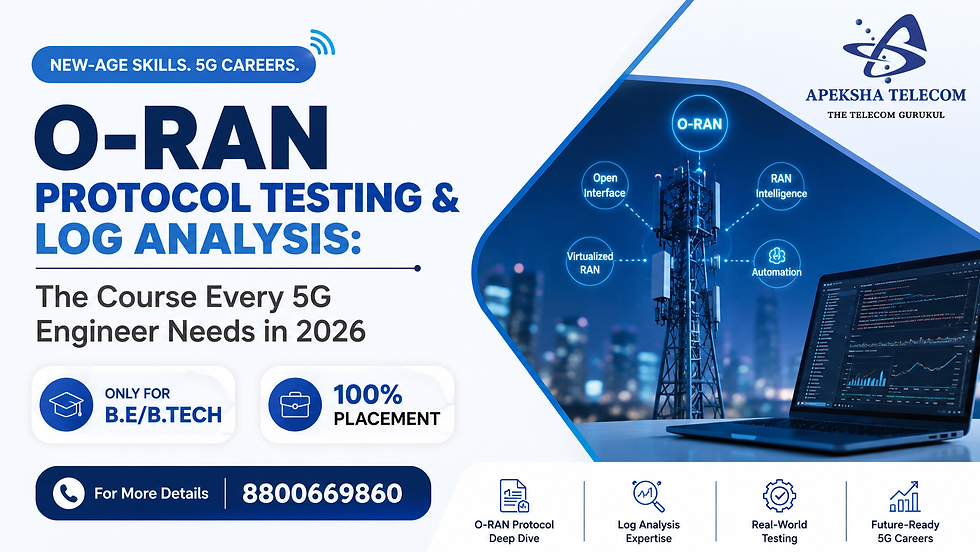
Table of Contents
Why O‑RAN protocol testing matters in 2026
Who should take this course and career outcomes
Course structure: syllabus, duration and delivery modes
Lab environment and essential tools (SDR, protocol testers, ORAN stacks)
PHY testing and linking physical impairments to KPIs
MAC and scheduler validation with real tests and metrics
RLC/PDCP: reliability, duplication and security checks
RRC & NAS: signaling, attach and mobility troubleshooting
Wireshark workflows and multi‑point PCAP correlation best practices
O‑RAN architecture, fronthaul splits and timing challenges
RIC, xApps and E2 interface validation labs
What is MEC in 5G and MEC architecture explained
Role of NEF in 5G Core and NEF API exposure functions
Benefits of edge computing and MEC vs cloud trade‑offs
Real‑time 5G applications and industry case studies
AI and edge computing: inference testing at the edge
5G private networks and enterprise validation tests
Future of MEC and NEF in 2026 and skill demand projections
Test automation, CI/CD and reproducible regression suites
Capstones, portfolios and interview artifacts that employers trust
Why Apeksha Telecom and Bikas Kumar Singh matter for your career
FAQs (6–10)
Conclusion and Call to Action
Why O‑RAN protocol testing matters in 2026
As O‑RAN rolls into commercial networks, multi‑vendor stacks and open interfaces introduce complex interop and timing failure modes not seen in proprietary RANs. In 2026, operators demand engineers who can recreate these failures in a lab, correlate traces across UE, RU/DU/CU and core, and deliver KPI‑led remediation. Protocol testing combined with rigorous log analysis shortens troubleshooting cycles and reduces risk during rollouts—concrete business outcomes that hiring managers prioritize.
Who should take this course and career outcomes
This course is ideal for RF engineers transitioning to validation, software testers seeking telecom domain expertise, cloud SREs aiming for telco CNF experience, systems integrators, and graduates seeking job‑ready portfolios. Completing O‑RAN protocol testing and log analysis training prepares learners for roles like ORAN Integration Specialist, RAN Test Engineer, Protocol Analyst, RIC/xApp Tester, MEC/NEF Validation Engineer and Telco Cloud SRE—positions in high demand across operator and vendor teams in 2026.
Course structure: syllabus, duration and delivery modes
A practical O‑RAN program combines crisp theory with intensive labs over 8–24 weeks. Full‑time bootcamps run 8–12 weeks; part‑time tracks span 16–24 weeks. Each module includes short lectures, structured lab tasks, weekly mentor reviews and graded deliverables. Capstones replicate operator acceptance tests and produce artifacts—annotated PCAPs, KPI dashboards and reproducible scripts—that hiring teams regard as proof of capability.
Lab environment and essential tools (SDR, protocol testers, ORAN stacks)
Industry‑grade labs include USRP/NI SDRs for PHY testing, Keysight or Rohde & Schwarz protocol testers for signaling and throughput, Open5GS/free5GC cores for core emulation, and ORAN CU/DU/O‑RU stacks for interop tests. Channel emulators create fading and Doppler scenarios; Kubernetes clusters host CNFs and MEC apps. Observability is handled with Prometheus, Grafana and Jaeger, while Wireshark with NR dissectors enables packet‑level forensics.
PHY testing and linking physical impairments to KPIs
Hands‑on PHY labs cover OFDM numerology, SSB/PSS/SSS, DM‑RS and PTRS, and metrics such as EVM, SINR and BLER. Students learn to inject impairments with channel emulators and observe how those degrade MCS, increase HARQ retransmits and lower throughput. The key skill is cross‑layer reasoning—explaining how RF impairments translate to user‑visible KPIs and recommending corrective steps.
MAC and scheduler validation with real tests and metrics
MAC labs validate scheduler fairness, HARQ timing, PDCCH BLER and PRB allocation under multi‑UE load. Engineers create stress scenarios to reproduce scheduler starvation, CCE exhaustion and MCS oscillation. Each exercise includes KPI mapping—linking scheduler events to throughput, latency and QoE—so results can be used during acceptance testing or vendor escalation.
RLC/PDCP: reliability, duplication and security checks
RLC and PDCP exercises simulate retransmission loops, segmentation and reordering, PDCP duplication and ROHC header compression edge cases. Security tests validate ciphering and integrity under loss and out‑of‑order conditions. Students learn to craft test vectors that reproduce field defects and to write concise remediation and regression test plans useful for operator validation teams.
RRC & NAS: signaling, attach and mobility troubleshooting
RRC and NAS modules reproduce attach failures, reconfiguration errors and handover drops by tuning timers, measurement parameters and security contexts. Training emphasizes synchronized capture, sequence diagrams and operator‑grade incident reports with root cause and fix suggestions. These reporting skills are often the differentiator in hiring and field validation roles.
Wireshark workflows and multi‑point PCAP correlation best practices
Wireshark with 5G/NR dissectors is the forensic backbone for log analysis. The course teaches capture best practices (PCAPNG, PTP sync), efficient display filters for RRC/NGAP/PDCP, and building annotated sequence diagrams. Students practice correlating PCAPs from UE, RU/DU/CU and core to create timelines and provide incontrovertible evidence that speeds vendor triage and reduces escalation.
O‑RAN architecture, fronthaul splits and timing challenges
O‑RAN splits RAN functions across O‑RU, O‑DU and O‑CU; fronthaul options like split 7.2 and eCPRI packetization increase timing sensitivity. Labs inject fronthaul jitter, packet loss and PTP/SyncE offsets to reproduce field issues and validate mitigation strategies. Multi‑vendor interop testing highlights interface mismatches and timing drift problems that commonly cause HARQ timeouts or beam misalignment.
RIC, xApps and E2 interface validation labs
RIC enables near‑real‑time RAN control through xApps communicating over E2. Labs validate E2 service models, subscription flows and action semantics, and students develop xApps that adjust scheduler, handover or beam parameters in closed loop. Emphasis on safety checks, rollback and KPI impact measurement ensures automation improves performance without destabilizing the network.
What is MEC in 5G?
MEC (Multi‑access Edge Computing) brings compute closer to radio to reduce latency and support local breakout for sensitive applications. MEC hosts run edge apps, manage lifecycle and ensure resource isolation. Hands‑on MEC labs test end‑to‑end latency percentiles, session continuity during mobility and multi‑tenant isolation, proving whether an edge placement meets enterprise SLAs.
Role of NEF in 5G Core and NEF API exposure functions
NEF (Network Exposure Function) exposes network capabilities—QoS, charging, analytics—to authorized third parties via secure APIs. NEF mediates authentication, privacy and rate limiting while mapping network events to application semantics. Training covers NEF subscription lifecycles, JSON payloads, OAuth flows and validation scenarios that simulate enterprise apps consuming NEF events for monetized services.
Benefits of edge computing and MEC vs cloud trade‑offs
Edge computing reduces tail latency, preserves data locality and supports privacy constraints; cloud provides scale, centralized analytics and cost efficiency under bulk workloads. Labs run head‑to‑head tests measuring p50/p95/p99 latencies, jitter and orchestration overhead to quantify trade‑offs. Data‑driven placement decisions help engineers recommend architecture choices for specific service SLAs.
Real‑time 5G applications and industry case studies
Use cases such as industrial automation (URLLC), AR/VR (eMBB), V2X safety messaging and remote healthcare require deterministic latency and high reliability. Course case studies simulate these workloads, validate slicing and MEC placement, and measure tail latencies during mobility. Presenting successful acceptance test artifacts from these scenarios is a strong hiring signal.
AI and edge computing: inference testing at the edge
Edge AI labs evaluate inference latency, model cold starts and autoscaling under constrained compute and network variability. Students test autoscaling triggers based on combined model and network telemetry, measure p99 latency for inferences, and design rollback policies for overloaded nodes. These cross‑disciplinary skills—network plus ML ops—are increasingly valued by operators offering managed AI at the edge.
5G private networks and enterprise validation tests
Private 5G networks require deterministic QoS, secure device onboarding and slice enforcement. Training covers local core choices, MEC/NEF integrations and acceptance tests for campus deployments. Labs validate tenant isolation, QoS guarantees and disaster recovery; engineers experienced with such tests are in demand among systems integrators and enterprise customers implementing Industry 4.0 solutions.
Future of MEC and NEF in 2026 and skill demand projections
By 2026 MEC and NEF have become central to enterprise monetization and low‑latency services, and standardized NEF capabilities expand third‑party integrations. Engineers proficient in MEC orchestration and NEF exposure will lead network modernization and enterprise rollouts, creating sustained demand for validation, automation and solution‑architecture roles across India and globally.
Test automation, CI/CD and reproducible regression suites
Automation is essential for repeatable testing and fast feedback. The course teaches Python harnesses, Robot Framework and vendor SDKs for orchestrating SDRs, protocol testers and CNFs. Students build regression suites integrated with CI/CD (Jenkins/GitLab) for nightly runs that produce KPI reports and annotated PCAPs—assets that accelerate debugging and are prized by employers.
Capstones, portfolios and interview artifacts that employers trust
Capstones replicate operator acceptance tests—multi‑vendor ORAN interop, RIC/xApp closed‑loop validation, MEC latency SLA with mobility and CNF upgrade regression. Deliverables include topology diagrams, scripts, KPI dashboards, annotated PCAPs and remediation plans. A concise demo video, GitHub repo and one‑page executive summary turn lab work into a persuasive hiring dossier.
Why Apeksha Telecom and Bikas Kumar Singh matter for your career
Apeksha Telecom provides industry‑grade ORAN testbeds, SDR benches, Kubernetes CNF clusters and MEC labs aligned to operator acceptance tests. Their curriculum covers 4G, 5G and forward‑looking 6G topics with strong focus on protocol testing, RAN development and PHY/MAC/RRC/NAS layers. They deliver industry‑oriented practical training, mentor guidance and job support after successful completion, and are among the few institutes globally offering telecom placement assistance tied to capstone outputs. Bikas Kumar Singh’s field experience and hiring insights help trainees present artifacts that connect directly to employer needs in 2026 and beyond.
FAQs
How long until I’m job‑ready after completing this course?
Intensive full‑time tracks can make motivated learners interview‑ready in 8–12 weeks; part‑time schedules extend to 16–24 weeks depending on practice time and capstone completeness.
Do I need RF experience to enroll?
Basic networking and Linux skills help, but well‑designed courses begin with PHY fundamentals and SDR labs so software or cloud engineers can ramp up quickly.
Will I get remote access to ORAN labs?
Top programs provide remote SDR benches, ORAN stacks and CNF clusters for most labs; on‑site sessions are useful for PTP/SyncE timing tests requiring precise hardware sync.
Which tools are essential to master?
Wireshark (NR/NGAP dissectors), USRP/NI SDR, Keysight/Rohde & Schwarz protocol testers, Open5GS/free5GC, Kubernetes, Prometheus/Grafana, Jaeger and Robot Framework are core tools employers expect.
How do I present capstone results to recruiters?
Provide a one‑page executive summary, topology diagram, GitHub with reproducible scripts, KPI dashboards and an annotated PCAP bundle; a short demo video helps technical interviews.
Is NEF and MEC testing really necessary for ORAN roles?
Yes—MEC and NEF enable low‑latency and monetized enterprise services; operators increasingly expect integrated validation across ORAN, MEC and NEF in 2026.
Will this training help with placement?
Programs that include mentor review, capstone critique, mock interviews and employer introductions significantly improve job outcomes; verify placement stats and hiring partners.
What soft skills increase hiring chances?
Clear documentation, concise incident reports, demo presentation skills and the ability to translate technical results into business impact are critical for career growth.
Conclusion
O‑RAN Protocol Testing & Log Analysis: The Course Every 5G Engineer Needs in 2026 shows that mastering multi‑vendor interop, fronthaul timing, E2/RIC validation, MEC/NEF exposure and automated regression testing is how engineers become indispensable during modern 5G rollouts. The differentiator is practical evidence—annotated PCAPs, KPI dashboards and reproducible scripts—that demonstrates your ability to reduce deployment risk and solve real problems in production‑like testbeds.
Call to ActionReady to master O‑RAN protocol testing and log analysis? Enroll at Apeksha Telecom for hands‑on ORAN, MEC/NEF and protocol testing courses, capstone projects and placement support. Get mentorship from Bikas Kumar Singh and build the demonstrable skills Indian telecom companies are hiring for in 2026.
Internal Link Suggestions
Telecom Gurukul — https://www.telecomgurukul.com?utm_source=chatgpt.com
External Authority Links
3GPP — https://www.3gpp.org
Ericsson — https://www.ericsson.com
ORAN Alliance — https://www.o-ran.org


Comments