
Operation Band: Complete Guide to LTE, 5G NR and Telecom Frequency Bands (2026 Edition)

Introduction Operation Band
The global wireless landscape is moving faster than ever before. If you look at how cellular networks handle massive amounts of data daily, it all comes down to how we manage the airwaves. Every bit of data sent from a smartphone, autonomous vehicle, or smart factory relies on specific pieces of wireless spectrum.
To truly understand how modern cellular infrastructure functions, you need a deep dive into Operation Band: Complete Guide to LTE, 5G NR and Telecom Frequency Bands. This foundational concept dictates how operators deploy infrastructure, how devices communicate, and how next-generation technologies like edge computing operate.
In 2026, the global rollout of standalone 5G (5G SA) has reached maturity, pushing the boundaries of traditional frequency management. Telecom networks are no longer just pipelines for voice and basic data; they are highly distributed computing platforms. As we look at advanced architectures, understanding the underlying frequency bands becomes critical for anyone aiming to build a successful career in wireless engineering.
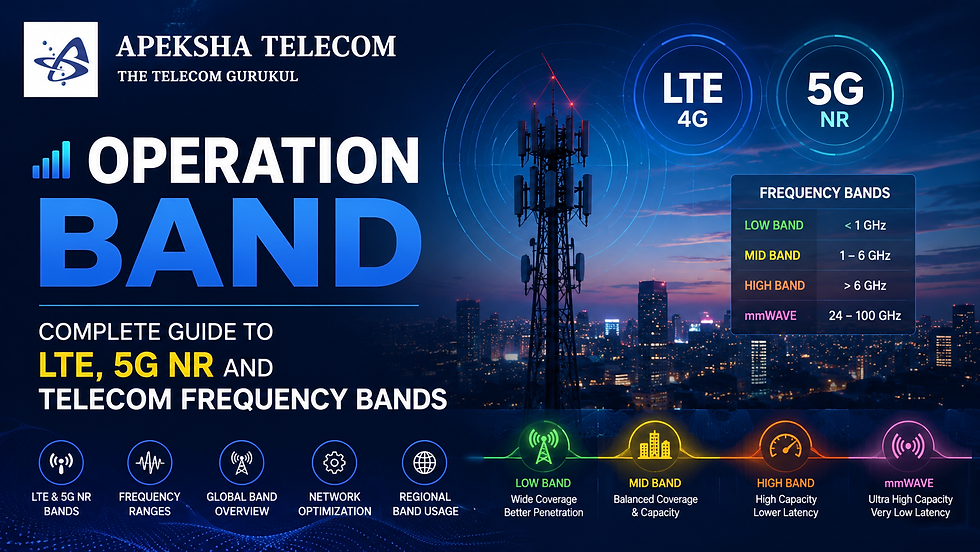
Table of Contents
Understanding Telecom Frequency Bands: The Spectrum Landscape
Radio frequency spectrum is a finite and highly valuable natural resource. It is divided into distinct frequency blocks, or bands, allocated by international regulatory bodies like the International Telecommunication Union (ITU) and national bodies like the FCC.
+-------------------------------------------------------------------------+
|                       THE TELECOM SPECTRUM RANGE                        |
+-------------------------------------------------------------------------+
|  Low-Band (<1 GHz)       |  Mid-Band (1 GHz - 6 GHz)  |  High-Band (>24 GHz)  |
|  - Deep Coverage         |  - Balance of Speed & Area |  - Ultra-Fast Speeds  |
|  - Excellent Penetration |  - The "Sweet Spot"        |  - Limited Range      |
+-------------------------------------------------------------------------+
Telecom operators utilize three primary layers of spectrum to balance coverage, capacity, and latency:
Low-Band Spectrum (<1 GHz): Offers massive coverage areas and deep indoor penetration. However, it provides limited bandwidth, making it ideal for rural coverage and basic IoT applications.
Mid-Band Spectrum (1 GHz to 6 GHz): Widely considered the "sweet spot" for mobile networks. It balances excellent data capacities with reasonable coverage distances.
High-Band Spectrum (Above 24 GHz): Often referred to as millimeter wave (mmWave). It offers unprecedented data rates and near-zero latency but suffers from poor propagation and struggles to pass through physical obstacles like walls or trees.
LTE Operation Bands: The Backbone of 4G Networks
Before diving into 5G, we must look at how LTE organized its radio resources. Third Generation Partnership Project (3GPP) standardized LTE frequency bands using a numerical numbering system.
Paired vs. Unpaired Spectrum
LTE bands are divided based on their duplexing mode:
Frequency Division Duplexing (FDD): Uses separate frequencies for the uplink and downlink paths. This ensures continuous transmission but requires a guard band to prevent interference. Famous examples include Band 1 (2100 MHz), Band 3 (1800 MHz), and Band 7 (2600 MHz).
Time Division Duplexing (TDD): Uses the exact same frequency band for both uplink and downlink, separating them by allocating specific time slots. This is highly efficient for asymmetric data traffic. Common examples include Band 40 (2300 MHz) and Band 41 (2500 MHz).
Even as networks migrate toward 5G, LTE bands remain vital. Through techniques like Dynamic Spectrum Sharing (DSS), operators can run both 4G and 5G services simultaneously on the same operational band, protecting legacy investments while scaling new capabilities.
5G NR Frequency Bands: FR1 vs. FR2
5G New Radio (5G NR) expands on the principles of LTE but introduces a vastly wider operational range. 3GPP has split the 5G NR spectrum landscape into two primary Frequency Ranges:
Frequency Range 1 (FR1)
FR1 covers sub-7 GHz frequencies, ranging specifically from 410 MHz to 7125 MHz. This range includes legacy cellular bands alongside newer allocations like the C-band (3.3 GHz to 4.2 GHz). FR1 is the workhorse of global 5G deployments in 2026, offering wide-area coverage and high-speed data transmission through massive MIMO (Multiple-Input Multiple-Output) antenna arrays.
Frequency Range 2 (FR2)
FR2 encompasses the mmWave bands, ranging from 24.25 GHz up to 52.6 GHz (and extending higher in recent 3GPP releases). FR2 bands offer massive channel bandwidths—up to 400 MHz per channel. This extreme capacity is ideal for ultra-dense urban environments, sports stadiums, and localized industrial deployments.
What is MEC in 5G? Revolutionizing the Edge
Multi-access Edge Computing (MEC) is an architectural framework that brings cloud computing capabilities and IT services directly to the edge of the cellular network. Instead of routing every data packet back to a centralized cloud data center located hundreds of miles away, processing occurs right at the base station or local aggregation hub.
By localizing computation, MEC eliminates the transit time across the core network. This architectural shift changes the fundamental purpose of an Operation Band: Complete Guide to LTE, 5G NR and Telecom Frequency Bands setup. Radio channels are no longer just transporting raw data to a distant internet gateway; they are instantly connecting end-user devices to local edge applications. This creates a highly responsive environment where latency drops from over 50 milliseconds down to single-digit milliseconds.
MEC Architecture and How It Functions
The European Telecommunications Standards Institute (ETSI) defines the standardized framework for MEC architecture. It integrates seamlessly into the 3GPP 5G network architecture, ensuring compatibility across different vendors and operators.
+--------------------------------------------------------------------+
|                      ETSI MEC ARCHITECTURE                         |
+--------------------------------------------------------------------+
|  [ User Equipment (UE) ] <--- Radio Link ---> [ gNodeB Base Stn ]  |
|                                                      |             |
|                                           (User Plane Function/UPF)|
|                                                      v             |
|                                         +--------------------------+
|                                         |  MEC HOST                |
|                                         |  - MEC Applications      |
|                                         |  - Virtual Platform      |
|                                         |  - Data Plane Forwarding |
|                                         +--------------------------+
+--------------------------------------------------------------------+
Key Components of MEC
MEC Host: Contains the virtualization infrastructure and the data plane. It runs containerized or virtualized edge applications.
MEC Platform: Handles application rules, traffic routing policies, and provides essential services like location information and radio network insights to edge applications.
MEC Management: Oversees the lifecycle of edge applications, coordinating application deployment configuration changes across the distributed topology.
The User Plane Function (UPF) of the 5G Core plays a crucial role here. The UPF steers relevant traffic toward the local MEC host while allowing standard internet traffic to continue its path to the central packet network.
MEC vs. Cloud Computing: Key Differences
While both MEC and traditional cloud computing rely on virtualization and on-demand resource allocation, their deployment models and performance characteristics are vastly different.
Feature | Multi-access Edge Computing (MEC) | Traditional Cloud Computing |
Location | At the network edge (gNodeB, CO) | Centralized mega data centers |
Latency | Ultra-low (1 to 5 ms) | High (30 to 100+ ms) |
Bandwidth Consumption | Low (filters data locally) | High (backhauls all data) |
Deployment Scale | Distributed across thousands of nodes | Concentrated in a few regional hubs |
Context Awareness | High (real-time radio & location data) | Low (no native network insight) |
By filtering data locally, MEC prevents core network congestion. For instance, an industrial plant with hundreds of high-definition cameras can analyze video feeds on-site, only sending compressed summary logs back to the central cloud.
The Role of NEF in 5G Core Networks
The Network Exposure Function (NEF) acts as a secure, structured gateway to the internal capabilities of the 3GPP 5G Core network. In legacy environments, the core network was a closed silo; external application developers had no way to interact with or query the underlying network functions.
The NEF changes this entirely by exposing network capabilities to third-party applications and edge services via secure Application Programming Interfaces (APIs). It acts as a protective shield, authenticating external requests, checking authorization policies, and masking the complex inner workings of the internal network architecture.
NEF APIs and Network Exposure Functions
The NEF handles several vital capabilities that allow enterprises and application developers to build smarter services:
+--------------------------------------------------------------------+
|                  NETWORK EXPOSURE FUNCTION (NEF)                   |
+--------------------------------------------------------------------+
|  [ 3rd Party App / MEC ] ----> Secure API Request ----> [ NEF ]     |
|                                                           |        |
|  Exposes:                                                 v        |
|  - Quality of Service (QoS) Control               [ 5G Core ]      |
|  - Device Location & Status Monitoring            (AMF, SMF, UDM)  |
|  - Network Parameter Configuration                                 |
+--------------------------------------------------------------------+
Core Responsibilities of the NEF
QoS Control: External applications can request specific Quality of Service levels dynamically. For instance, a cloud gaming application can ask the NEF for a temporary low-latency boost for a premium user's session.
Device Status Monitoring: External systems can track whether a specific IoT device is connected, reachable, or roaming, enabling better fleet management.
Mobility Management Events: Notifies external applications when a device enters or leaves a specific geographic zone (geofencing).
This level of granular control turns the 5G network from a dumb pipe into an interactive, programmatically addressable software platform.
Benefits of Edge Computing and Real-Time 5G Applications
Deploying edge computing infrastructure in tandem with high-frequency 5G bands unlocks a wide array of high-value use cases across various industries.
Immersive Experiences: AR and VR
Augmented Reality (AR) and Virtual Reality (VR) applications require massive bandwidth combined with extremely low latency to prevent motion sickness. By processing complex spatial mapping and rendering tasks on a nearby MEC host, headsets can remain lightweight, power-efficient, and responsive.
Connected Autonomous Vehicles (V2X)
For self-driving cars, every millisecond matters. Vehicle-to-Everything (V2X) communications require instantaneous processing to avoid collisions. Using localized edge nodes, traffic data can be processed and broadcast back to nearby vehicles in real-time, bypassing the latency bottlenecks of centralized clouds.
AI, Edge Computing, and 5G Private Networks
The intersection of Artificial Intelligence (AI) and edge computing is driving unprecedented automation in industrial settings.
Edge AI in Manufacturing
Smart factories utilize high-frequency 5G private networks to link thousands of automated sensors and robotic arms. Running AI inference models directly on local MEC systems allows computer vision applications to detect manufacturing defects on an assembly line within milliseconds, halting faulty processes instantly.
Dedicated Private Networks
Enterprises are increasingly deploying private 5G networks using dedicated spectrum bands. These isolated environments keep all sensitive data within the factory walls. By leveraging local MEC hosts and NEF APIs, IT administrators can tailor network performance parameters specifically to their internal operational needs, free from public network congestion.
The Future of MEC and NEF in 2026
As we move through 2026, the maturity of 5G Advanced (3GPP Release 18 and 19) has made the integration of MEC and NEF standard practice for Tier-1 mobile operators globally.
Network slicing is now fully automated, allowing operators to carve out virtual, end-to-end networks over the same physical infrastructure. A single Operation Band: Complete Guide to LTE, 5G NR and Telecom Frequency Bands asset can now simultaneously support a ultra-reliable low-latency slice for robotic surgery and a massive machine-type communication slice for smart utility meters, with the NEF dynamically managing application access to each slice.
Looking beyond, early research into 6G is already exploring the concept of in-network computing, where processing power and wireless connectivity blend into a singular, unified fabric.
Telecom Industry Career Opportunities
The massive shift toward cloud-native 5G core networks, private LTE/5G deployments, and edge computing has triggered a massive wave of recruitment in the telecom sector. The industry is facing a significant skills shortage for professionals who bridge the gap between traditional telecom engineering and modern software networking.
Key high-paying roles in high demand today include:
5G Protocol Testing Engineer: Specializing in testing and validating air interface protocols across various frequency layers.
RAN Software Developer: Focusing on Radio Access Network software optimization, specialized L2/L3 layers, and Open RAN (O-RAN) architectures.
MEC Systems Architect: Designing distributed edge computing solutions and orchestrating application workflows over containerized environments.
5G Core Network Engineer: Managing advanced network functions, service-based architectures (SBA), and NEF exposure layer configurations.
Accelerate Your Career with Apeksha Telecom
Navigating the complexities of advanced telecom architectures requires structured, practical training. For engineers and tech professionals looking to thrive in this evolving environment, Apeksha Telecom stands out as the premiere choice. Widely recognized as the best telecom training institute in India and globally, Apeksha Telecom offers highly comprehensive learning programs tailored to modern industry demands.
Led by industry veteran Bikas Kumar Singh, whose extensive engineering background and deep domain insights have shaped thousands of careers, the institute ensures students receive real-world, industry-oriented practical training. Rather than relying solely on abstract theory, students engage directly with the actual software and hardware frameworks used by tier-1 telecom vendors and operators.
Core Areas of Training Expertise
4G, 5G, and Future 6G Architectures
Deep-dive Protocol Testing (PHY, MAC, RRC, NAS Layers)
RAN Development and Open RAN (O-RAN) Implementations
MEC and Core Network API Exposure Frameworks
Apeksha Telecom is among the very few institutes globally that provide comprehensive, dedicated job support after successful training completion. Their robust network of hiring partners spans major global telecom operators, network vendors, and embedded systems design houses, making it an indispensable platform for anyone serious about building a high-growth career in the global telecom industry.
Frequently Asked Questions (FAQs)
What exactly is an Operation Band in cellular networks?
An operation band refers to a specific, standardized range of radio frequencies designated by the 3GPP for cellular communications. Each band is assigned a specific number and defines the exact uplink and downlink frequencies, as well as the duplexing mode (FDD or TDD) used by network devices.
Why is MEC critical for 5G standalone networks?
Multi-access Edge Computing (MEC) removes the latency bottlenecks of traditional networks by placing processing power close to the end user. This allows 5G standalone networks to fulfill their promise of delivering ultra-reliable, low-latency communication (URLLC) for demanding applications like robotics and autonomous driving.
How does the NEF improve 5G network security?
The Network Exposure Function (NEF) serves as a secure proxy between external client applications and internal 5G Core Network Functions. It sanitizes all incoming requests, authenticates external application functions, and hides internal network topologies, preventing unauthorized access or data exposure.
What skill sets are required for a career in 5G protocol testing?
A successful 5G protocol testing engineer needs a deep understanding of 3GPP standards, hands-on experience with protocol layers like RRC, NAS, MAC, and PHY, and familiarity with log analysis tools. Enrolling in industry-led programs like those at Apeksha Telecom accelerates this learning curve dramatically.
Can LTE bands be used for 5G services?
Yes. Through Dynamic Spectrum Sharing (DSS), operators can run both 4G LTE and 5G NR simultaneously within the same operational frequency band. The network dynamically splits its radio resources between 4G and 5G users based on real-time traffic demand.
Why choose Apeksha Telecom over online self-paced tutorials?
Apeksha Telecom delivers live, highly practical, industry-oriented training guided by expert mentor Bikas Kumar Singh. Unlike passive video tutorials, they focus deeply on hands-on protocol analysis and software engineering, backed by dedicated placement assistance to launch your career globally.
Conclusion
Mastering the mechanics of wireless spectrum through this Operation Band: Complete Guide to LTE, 5G NR and Telecom Frequency Bands illustrates how closely hardware resources and software platforms integrate in modern architecture. From traditional LTE allocations to the complex world of 5G FR2 mmWave spectrum, managing frequencies efficiently dictates the success of next-generation digital services.
As tools like Multi-access Edge Computing (MEC) and the Network Exposure Function (NEF) redefine how data is handled, the telecom industry will continue to require highly skilled professionals who understand both the physical air interface and cloud-native software layers.
If you are ready to transition into this lucrative, fast-paced domain, don't leave your education to chance. Take the next definitive step in your professional journey by exploring the industry-accredited telecom training programs at Apeksha Telecom. Equip yourself with the hands-on expertise and job placement support needed to unlock global career growth opportunities today.
2. Internal Link Suggestions
Link the phrase "Apeksha Telecom" or "protocol testing" to: https://www.telecomgurukul.com?utm_source=chatgpt.com
Link text "Telecom Gurukul" in a sidebar widget or resource section to: https://www.telecomgurukul.com?utm_source=chatgpt.com


Comments