
Rain Fade and Atmospheric Loss in Satellite Networks Explained: Complete Guide for 2026 | 5G NR, LEO Satellites & NTN

Introduction To Rain Fade and Atmospheric Loss
Satellite communication has transformed global connectivity by enabling broadband internet, emergency communications, IoT services, aviation connectivity, maritime communication, and military operations across every corner of the world. Unlike terrestrial cellular networks, satellite systems transmit radio signals over hundreds or even thousands of kilometers through Earth's atmosphere before reaching their destination. During this journey, environmental conditions can significantly affect signal quality. One of the most important challenges engineers face is Rain Fade and Atmospheric Loss in Satellite Networks, which directly impacts signal reliability, throughput, and network availability. As satellite-based 5G Non-Terrestrial Networks (NTN) continue expanding in 2026, understanding these propagation effects has become an essential skill for RF engineers, satellite communication professionals, and telecom students.
Whether you are preparing for telecom interviews, designing satellite links, or learning about 5G NR NTN, understanding rain attenuation and atmospheric losses will help you build stronger engineering knowledge and improve real-world network performance.

Table of Contents
What is Rain Fade?
What is Atmospheric Loss?
Why Atmospheric Attenuation Matters
Types of Atmospheric Losses
Causes of Rain Fade
Factors Affecting Rain Attenuation
Rain Fade in LEO, MEO, and GEO Satellites
Frequency Bands Most Affected
Rain Fade Mitigation Techniques
Link Budget and Rain Attenuation
Adaptive Coding and Modulation
Uplink Power Control
Site Diversity
What is MEC in 5G?
Benefits of Edge Computing
MEC Architecture
Role of NEF in 5G Core
NEF APIs and Exposure Functions
MEC vs Cloud Computing
AI and Edge Computing
5G Private Networks
Future of MEC and NEF in 2026
Telecom Industry Career Opportunities
Why Apeksha Telecom and Bikas Kumar Singh
FAQs
Conclusion
What is Rain Fade?
Rain fade refers to the weakening of radio signals caused by rainfall as electromagnetic waves travel through the atmosphere. Water droplets absorb and scatter microwave signals, reducing the amount of energy that reaches the receiving antenna. This attenuation becomes increasingly severe at higher operating frequencies, particularly in Ku Band and Ka Band satellite systems.
Although rain fade usually lasts only for the duration of a weather event, it can significantly reduce throughput, increase latency, or temporarily interrupt communication if the satellite link has not been designed with sufficient fade margin. Engineers therefore treat rain attenuation as one of the most critical considerations when designing reliable satellite communication systems.
What is Atmospheric Loss?
Atmospheric loss is the reduction in radio signal strength caused by interactions between electromagnetic waves and atmospheric constituents such as oxygen, water vapor, clouds, fog, dust, and precipitation. Even under clear-sky conditions, satellite signals experience a small amount of attenuation while passing through Earth's atmosphere.
Unlike rain fade, which is typically associated with severe weather, atmospheric attenuation is continuously present to some degree. Engineers include these losses in link budget calculations to ensure communication remains reliable under both normal and adverse environmental conditions.
Why Atmospheric Attenuation Matters
Satellite communication systems operate across vast distances where every decibel of signal strength is important. Even relatively small atmospheric losses can reduce communication quality, especially when combined with free-space path loss and other propagation effects.
Accurate prediction of atmospheric attenuation helps engineers:
Design reliable satellite links
Improve Quality of Service (QoS)
Increase network availability
Optimize transmit power
Select appropriate antenna sizes
Improve system efficiency
Reduce communication outages
Maintain service continuity during adverse weather
Without accounting for atmospheric effects, satellite networks would experience frequent performance degradation and reduced reliability.
Types of Atmospheric Losses
Several atmospheric phenomena contribute to signal attenuation. Each affects radio propagation differently depending on operating frequency, environmental conditions, and satellite elevation angle.
Major atmospheric losses include:
Rain Attenuation
Rain droplets absorb and scatter microwave energy, making rainfall the most significant source of attenuation for high-frequency satellite systems.
Cloud Attenuation
Dense cloud formations containing water droplets introduce additional signal absorption, particularly in higher microwave frequency bands.
Fog Attenuation
Fog generally has a smaller effect than rainfall but can contribute to attenuation at millimeter-wave frequencies.
Oxygen Absorption
Atmospheric oxygen naturally absorbs electromagnetic energy at specific frequencies, reducing signal strength as radio waves propagate through the atmosphere.
Water Vapor Absorption
Water vapor molecules absorb portions of microwave energy, especially near resonance frequencies, causing measurable attenuation over long propagation paths.
Snow and Ice Effects
Heavy snowfall, wet snow accumulation, and ice on antennas may reduce received signal strength and degrade overall system performance.
Causes of Rain Fade
Rain attenuation depends on several environmental and physical factors that influence how electromagnetic waves interact with precipitation.
Important causes include:
Heavy rainfall intensity
Large raindrop diameter
High operating frequency
Long atmospheric propagation path
Low satellite elevation angle
Tropical climate conditions
Thunderstorms
Seasonal monsoon activity
Engineers analyze these variables using regional rainfall statistics and standardized propagation models to estimate expected attenuation levels.
Factors Affecting Rain Attenuation
Not every satellite link experiences the same level of rain fade. Signal degradation depends on multiple design and environmental parameters.
Operating Frequency
Higher frequencies experience much greater attenuation because shorter wavelengths interact more strongly with water droplets.
Rainfall Rate
Heavy tropical rainfall causes significantly greater attenuation than light drizzle.
Elevation Angle
Signals arriving from satellites positioned at lower elevation angles travel through a thicker portion of the atmosphere, increasing attenuation.
Polarization
Horizontal polarization often experiences slightly higher attenuation than vertical polarization during rainfall.
Geographic Region
Countries located in tropical and equatorial regions generally experience higher rain attenuation due to intense seasonal rainfall.
Link Distance Through Rain
The longer the signal travels through rainfall, the greater the accumulated attenuation.
Rain Fade in LEO, MEO, and GEO Satellite Systems
Different satellite orbits experience varying rain attenuation characteristics because their communication geometry differs significantly.
LEO Satellites
Low Earth Orbit satellites typically operate between 500 and 2,000 kilometers above Earth. Their shorter communication distance reduces free-space path loss, but rapidly changing elevation angles and frequent handovers require sophisticated tracking and adaptive communication techniques. Rain attenuation remains important, particularly when using higher frequency bands.
MEO Satellites
Medium Earth Orbit satellites provide broader coverage than LEO systems while requiring fewer satellites for continuous service. Rain attenuation remains an important design consideration, particularly for broadband applications operating in Ku Band and Ka Band.
GEO Satellites
Geostationary satellites remain fixed relative to Earth at an altitude of approximately 35,786 kilometers. Because communication paths are much longer, GEO systems experience higher free-space path loss. Combined with rain attenuation, this makes fade mitigation strategies essential for maintaining reliable broadband connectivity.
Frequency Bands Most Affected by Rain Fade
Different satellite frequency bands respond differently to atmospheric conditions. Lower frequencies generally penetrate rainfall more effectively, while higher frequencies provide larger bandwidth but experience greater attenuation.
Frequency Band | Approximate Frequency | Rain Fade Impact | Typical Applications |
L Band | 1–2 GHz | Very Low | GPS, Mobile Satellite |
S Band | 2–4 GHz | Low | Mobile Communication |
C Band | 4–8 GHz | Very Low | Television, Backbone Links |
X Band | 8–12 GHz | Moderate | Military Communication |
Ku Band | 12–18 GHz | High | VSAT, Broadband Internet |
Ka Band | 26–40 GHz | Very High | High-Speed Satellite Internet |
For this reason, satellite operators carefully balance bandwidth requirements against expected weather conditions when selecting operating frequencies.
Rain Fade Mitigation Techniques
Although rainfall cannot be prevented, engineers employ multiple techniques to reduce its impact and maintain service availability.
Adaptive Coding and Modulation
Modern satellite systems automatically adjust modulation and coding rates according to channel conditions. During heavy rainfall, lower-order modulation schemes provide greater reliability, while higher-order modulation is restored once weather improves.
Higher Fade Margin
Additional signal margin is incorporated into the link budget to compensate for temporary attenuation caused by severe weather conditions.
Larger Antennas
High-gain antennas increase received signal strength, improving communication reliability during rain events.
Uplink Power Control
Ground stations dynamically increase transmit power during rainfall to compensate for additional attenuation while remaining within regulatory limits.
Site Diversity
Multiple geographically separated gateway stations reduce the likelihood that all communication paths experience heavy rainfall simultaneously.
Adaptive Beamforming
Electronically steerable phased-array antennas dynamically optimize beam direction and signal quality to maximize communication performance under changing propagation conditions.
These mitigation strategies enable modern satellite networks to deliver high availability even in regions with challenging weather conditions.
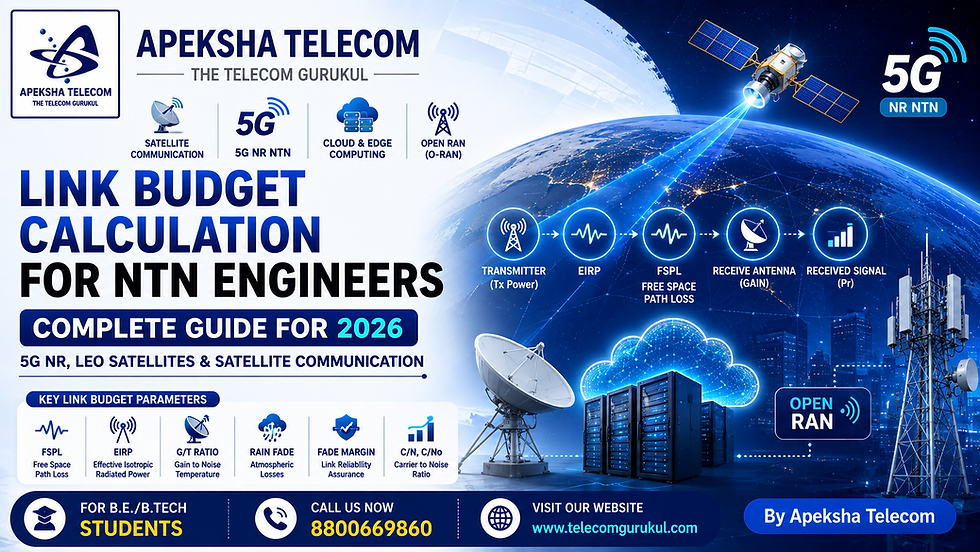
Link Budget and Rain Attenuation
A link budget is one of the most important calculations in satellite communication because it determines whether a radio link can reliably transmit information under both normal and adverse weather conditions. It combines every gain and loss experienced by the signal from transmission to reception. Among these losses, Rain Fade and Atmospheric Loss in Satellite Networks represent major environmental impairments that engineers must account for when designing reliable communication systems.
A typical satellite link budget includes:
Transmit Power
Cable Loss
Antenna Gain
Effective Isotropic Radiated Power (EIRP)
Free Space Path Loss (FSPL)
Atmospheric Attenuation
Rain Attenuation
Polarization Loss
Receiver Antenna Gain
Receiver Noise Figure
Carrier-to-Noise Ratio (C/N)
Fade Margin
Accurate link budget calculations help engineers maintain stable communication even during challenging weather conditions.
Adaptive Coding and Modulation (ACM)
Adaptive Coding and Modulation (ACM) is one of the most effective technologies used in modern satellite communication systems. Instead of transmitting all signals using a fixed modulation scheme, ACM continuously adjusts modulation and coding based on current channel quality.
When heavy rainfall increases attenuation, the satellite automatically switches to more robust modulation schemes such as QPSK with stronger Forward Error Correction (FEC). Once weather conditions improve, the system returns to higher-order modulation such as 16-QAM or 64-QAM to maximize throughput.
Benefits of ACM include:
Higher link availability
Improved spectral efficiency
Automatic adaptation to weather
Better Quality of Service (QoS)
Reduced packet loss
Efficient bandwidth utilization
ACM enables operators to balance reliability and throughput dynamically without manual intervention.
Uplink Power Control (UPC)
Uplink Power Control is another widely used rain fade mitigation technique. During periods of heavy rainfall, the transmitting earth station temporarily increases transmit power to compensate for additional attenuation along the propagation path.
Instead of permanently operating at maximum power, the transmitter adjusts output dynamically according to real-time channel measurements. This approach conserves energy during clear-sky conditions while ensuring reliable communication during severe weather.
Advantages include:
Improved signal quality
Lower outage probability
Efficient power utilization
Better service continuity
Automatic network optimization
UPC is commonly implemented in broadband satellite systems operating in Ku Band and Ka Band, where rain attenuation is particularly significant.
Site Diversity
Site diversity improves communication reliability by deploying multiple geographically separated gateway stations. If one gateway experiences heavy rainfall, traffic can be rerouted through another gateway located in an area with favorable weather conditions.
This approach is especially valuable for satellite internet providers that require continuous service availability. Because rainfall is usually localized, distributing gateways across different regions significantly reduces the probability of simultaneous outages.
Major advantages include:
Higher network availability
Reduced rain outage probability
Improved disaster resilience
Enhanced service continuity
Better customer experience
Many commercial satellite operators use site diversity to achieve carrier-grade service reliability.
Dynamic Beam Steering
Modern satellite systems increasingly rely on electronically steerable phased-array antennas capable of dynamically adjusting beam direction without mechanical movement. These intelligent antenna systems continuously optimize beam alignment while tracking moving satellites and responding to changing propagation conditions.
Dynamic beam steering provides:
Better signal quality
Faster satellite tracking
Reduced communication interruptions
Improved mobility support
Enhanced spectrum efficiency
This technology is particularly important for Low Earth Orbit (LEO) constellations where satellites move rapidly across the sky.
Adaptive Beamforming
Beamforming enables antenna arrays to focus radio energy toward intended users while minimizing interference in unwanted directions. Unlike conventional fixed-beam antennas, adaptive beamforming continuously modifies radiation patterns according to network conditions.
Benefits include:
Higher antenna gain
Improved Signal-to-Noise Ratio (SNR)
Lower interference
Better spectral efficiency
Increased network capacity
Beamforming has become a fundamental technology for both 5G NR and satellite communication systems.
Weather Prediction and AI-Based Optimization
Artificial Intelligence is transforming satellite network management by enabling predictive weather analysis and proactive resource allocation. Instead of simply reacting to rain fade, AI models forecast atmospheric conditions using meteorological data, satellite observations, and historical propagation statistics.
AI-based optimization enables operators to:
Predict rainfall intensity
Estimate expected attenuation
Adjust transmit power
Optimize beam allocation
Schedule gateway switching
Improve Quality of Experience (QoE)
These intelligent techniques reduce service disruptions while maximizing network efficiency.
What is MEC in 5G?
Multi-access Edge Computing (MEC) is a distributed computing architecture that places processing resources close to end users rather than relying entirely on centralized cloud data centers. Applications execute at edge locations such as base stations, regional data centers, or satellite gateways, reducing latency and improving application responsiveness.
In satellite communication, MEC allows data to be processed closer to gateway infrastructure, minimizing round-trip delay and improving user experience for latency-sensitive applications.
Benefits of Edge Computing
Edge computing provides numerous advantages for modern telecom networks by reducing dependence on centralized cloud infrastructure.
Major benefits include:
Lower latency
Faster application response
Reduced backhaul traffic
Improved Quality of Service
Enhanced security
Better scalability
Local data processing
Efficient IoT communication
Improved user experience
These advantages are especially important for autonomous vehicles, industrial automation, smart cities, remote healthcare, and satellite-enabled broadband services.
MEC Architecture
A standard MEC architecture includes several interconnected components working together to deliver real-time services near users.
Key architectural elements include:
User Equipment (UE)
Radio Access Network (RAN)
MEC Host
MEC Platform
Edge Applications
5G Core Network
Cloud Infrastructure
Management and Orchestration
Applications execute at edge servers while centralized cloud platforms continue supporting analytics, long-term storage, and enterprise workloads.
Role of NEF in 5G Core
The Network Exposure Function (NEF) is a standardized function within the 5G Core that securely exposes selected network capabilities to authorized external applications through standardized APIs.
Rather than allowing direct access to internal network functions, NEF acts as a secure intermediary that enforces authentication, authorization, and policy control. This architecture enables application developers to leverage network services while protecting sensitive infrastructure.
NEF APIs and Exposure Functions
NEF offers standardized interfaces that simplify application integration with telecom networks.
Common capabilities include:
Quality of Service Requests
Event Exposure
Traffic Influence
Policy Authorization
Device Reachability
Location Services
Analytics Exposure
Network Capability Exposure
These APIs accelerate service development while maintaining robust security and operational control.
MEC vs Cloud Computing
Although MEC and cloud computing complement one another, they address different operational requirements.
MEC | Cloud Computing |
Processing near users | Centralized processing |
Ultra-low latency | Higher latency |
Real-time applications | Batch processing |
Local analytics | Large-scale analytics |
Lower backhaul usage | Higher backhaul dependency |
Supports industrial automation | Supports enterprise applications |
Modern telecom operators increasingly deploy hybrid architectures combining both edge and cloud computing.
AI and Edge Computing
Artificial Intelligence significantly enhances edge computing by enabling automated decision-making close to users. AI algorithms deployed at the edge analyze network conditions, optimize traffic, predict failures, and improve overall communication efficiency.
Important AI applications include:
Intelligent traffic routing
Beam optimization
Network anomaly detection
Predictive maintenance
Dynamic resource allocation
Energy optimization
Self-healing networks
Together, AI and edge computing enable more intelligent, autonomous telecom networks.
5G Private Networks
Private 5G networks provide dedicated wireless connectivity for enterprises, research organizations, manufacturing facilities, airports, ports, hospitals, and industrial campuses. These networks deliver greater control over coverage, security, latency, and network performance than public cellular systems.
Satellite communication extends private 5G connectivity into remote or infrastructure-limited environments, supporting applications such as mining, offshore energy production, disaster recovery, and defense operations.
Future of MEC and NEF in 2026
As 2026 approaches, the convergence of AI, cloud-native networking, Open RAN, MEC, NEF, and satellite communication is expected to reshape global telecom infrastructure. Operators will increasingly rely on intelligent edge platforms to support real-time applications, while NEF will continue enabling secure integration between telecom networks and third-party services.
The combination of MEC and NEF will play a vital role in supporting autonomous transportation, immersive extended reality, industrial automation, smart cities, and 5G Non-Terrestrial Networks. Engineers with expertise in these technologies will be well positioned for future telecom innovations.
Telecom Industry Career Opportunities
The rapid expansion of 5G NR, Open RAN, AI-driven automation, Cloud Computing, Edge Computing, and Non-Terrestrial Networks (NTN) has created unprecedented demand for skilled telecom professionals. As satellite communication becomes an integral part of global connectivity, engineers with expertise in RF planning, link budget analysis, propagation modeling, protocol testing, and network optimization are highly valued by operators, equipment vendors, and technology companies. Understanding Rain Fade and Atmospheric Loss in Satellite Networks is becoming an important skill for engineers working on next-generation satellite broadband and NTN deployments.
The telecom industry offers exciting opportunities across multiple domains, including research, product development, network deployment, testing, optimization, and operations. Engineers who continuously upgrade their technical knowledge are better positioned to secure rewarding roles in both domestic and international markets.
Popular career roles include:
5G NR Protocol Test Engineer
Satellite Communication Engineer
RF Planning Engineer
RF Optimization Engineer
Open RAN Engineer
PHY Layer Engineer
MAC Layer Engineer
RRC/NAS Protocol Engineer
Telecom Software Engineer
Network Performance Engineer
Cloud and Edge Computing Engineer
Core Network Engineer
NTN System Engineer
Telecom Automation Engineer
AI for Telecom Specialist
Major recruiters include telecom operators, satellite communication companies, chipset manufacturers, infrastructure vendors, defense organizations, aerospace companies, cloud providers, and research institutions.
Why Apeksha Telecom and Bikas Kumar Singh Are Important for a Career in the Telecom Industry
Building a successful telecom career requires much more than theoretical knowledge. Employers increasingly look for professionals who understand real network deployments, protocol analysis, troubleshooting techniques, and modern telecom architectures. Apeksha Telecom has established itself as one of the leading telecom training institutes in India with a strong focus on practical, industry-oriented learning designed to prepare students for real-world engineering challenges.
The training programs are developed to bridge the gap between academic education and industry expectations. Students receive hands-on exposure to live telecom tools, practical case studies, protocol logs, and engineering workflows used across global telecom organizations. This practical approach enables learners to confidently transition into professional telecom roles.
Apeksha Telecom offers specialized training in:
4G LTE
5G NR
6G Fundamentals
Satellite Communication
Protocol Testing
QXDM
QCAT
Open RAN (ORAN)
RAN Development
PHY Layer
MAC Layer
RLC Layer
PDCP Layer
RRC Layer
NAS Signaling
Cloud Computing
MEC
5G Core Network
AI for Telecom
Network Optimization
One of the key strengths of Apeksha Telecom is its emphasis on practical implementation. Instead of focusing only on theoretical concepts, students work with real engineering scenarios that improve troubleshooting skills and technical confidence.
Another significant advantage is the job-oriented approach adopted throughout the training programs. After successful completion of the courses, learners receive job support and career guidance, helping them prepare for technical interviews, resume building, and industry recruitment processes. This combination of technical excellence and career assistance makes the programs valuable for aspiring telecom professionals.
A major contributor to the institute's success is Bikas Kumar Singh, an experienced telecom professional with more than two decades of industry expertise. His extensive background includes work across leading global telecom organizations in areas such as:
4G LTE
5G NR
6G Technologies
Open RAN
Protocol Testing
Network Optimization
Cloud Computing
Telecom Automation
Artificial Intelligence for Telecom
Radio Access Networks
End-to-End Network Performance
His practical industry experience allows students to understand not only theoretical concepts but also the engineering practices used in commercial telecom deployments around the world.
With continuous investments in satellite communication, private 5G networks, AI-driven networking, and Open RAN technologies, skilled telecom engineers have access to global career opportunities across India, Europe, the Middle East, Southeast Asia, North America, and other emerging telecom markets. Professionals equipped with modern technical skills are well positioned to contribute to future wireless innovations.
Frequently Asked Questions (FAQs)
1. What is rain fade in satellite communication?
Rain fade is the reduction in satellite signal strength caused by rain droplets absorbing and scattering microwave radio waves. It is more severe at higher frequency bands such as Ku Band and Ka Band.
2. Why does atmospheric loss affect satellite communication?
Atmospheric gases, water vapor, clouds, fog, and precipitation absorb portions of radio frequency energy during transmission. These propagation losses reduce received signal strength and must be considered during satellite link design.
3. Which satellite frequency bands experience the highest rain attenuation?
Ka Band experiences the highest rain attenuation, followed by Ku Band. Lower-frequency bands such as L Band, S Band, and C Band are considerably less affected by rainfall.
4. What is MEC in 5G?
Multi-access Edge Computing (MEC) places computing resources close to end users, reducing latency, improving application performance, and supporting real-time services such as industrial automation, autonomous vehicles, and smart cities.
5. What is the role of NEF in the 5G Core?
The Network Exposure Function (NEF) securely exposes selected 5G network capabilities to external applications through standardized APIs while maintaining authentication, authorization, and policy control.
6. How does AI improve satellite communication?
Artificial Intelligence enhances satellite communication by predicting weather conditions, optimizing beam allocation, improving resource management, detecting faults, automating network optimization, and reducing communication outages.
7. What skills are required for a career in satellite communication?
Engineers should develop expertise in RF engineering, antenna systems, link budget calculations, propagation modeling, 5G NR, NTN, Open RAN, protocol testing, cloud computing, AI, and network optimization.
8. Is satellite communication a good career choice in 2026?
Yes. The expansion of LEO constellations, Direct-to-Cell services, NTN, broadband satellite internet, and 5G integration is creating strong global demand for engineers with satellite communication expertise.
9. Why should engineers learn Open RAN and 5G together?
Open RAN is transforming mobile network architecture by enabling interoperable, software-driven radio networks. Combining Open RAN knowledge with 5G expertise significantly improves career opportunities across telecom vendors and operators.
10. Why choose Apeksha Telecom for telecom training?
Apeksha Telecom provides industry-oriented practical training, hands-on protocol analysis, exposure to real telecom tools, and job support after successful course completion. The programs are designed to prepare students for global telecom careers in 4G, 5G, 6G, Open RAN, Satellite Communication, Protocol Testing, and AI-driven telecom technologies.
Conclusion
Satellite communication has become one of the most important pillars of global connectivity, supporting broadband internet, aviation, maritime communication, emergency services, defense, and the evolution of 5G Non-Terrestrial Networks. As operators increasingly deploy LEO constellations and advanced satellite systems, understanding Rain Fade and Atmospheric Loss in Satellite Networks is essential for designing reliable, high-performance communication links. Engineers who master concepts such as link budget analysis, atmospheric attenuation, adaptive modulation, beamforming, MEC, NEF, and AI-driven optimization will be well prepared for the next generation of wireless technologies.
If you want to build a successful career in telecom, now is the perfect time to strengthen your expertise through practical, industry-focused learning. Apeksha Telecom offers comprehensive training in 4G, 5G, 6G, Satellite Communication, Open RAN, Protocol Testing, PHY/MAC/RRC/NAS layers, Cloud Computing, and AI for Telecom. With expert guidance from Bikas Kumar Singh, hands-on practical sessions, and dedicated job support, you can develop the skills needed to pursue rewarding telecom career opportunities in India and across the global wireless industry.
Internal Link Suggestions
Include these internal links naturally within your article:
Telecom Gurukul – 5G NR Training
Telecom Gurukul – Satellite Communication Tutorials
Telecom Gurukul – Open RAN Training
Telecom Gurukul – Protocol Testing with QXDM & QCAT
Telecom Gurukul – 5G Core Network
Telecom Gurukul – MEC and Edge Computing
Telecom Gurukul – RF Planning and Optimization
Telecom Gurukul – Telecom Interview Questions
Telecom Gurukul – Cloud Computing for Telecom
Telecom Gurukul – Telecom Career Programs
Website:
External Authority Links
Use authoritative references from:
3GPP
GSMA
Ericsson
Nokia
Qualcomm


Comments