
Satellite Antenna Types Used in NTN: Complete Guide for 2026 | 5G NR, LEO Satellites & Non-Terrestrial Networks

Introduction To Satellite Antenna
The evolution of 5G Non-Terrestrial Networks (NTN) is transforming global connectivity by integrating terrestrial mobile networks with satellites operating in Low Earth Orbit (LEO), Medium Earth Orbit (MEO), and Geostationary Earth Orbit (GEO). One of the most important technologies enabling this transformation is Satellite Antenna Types Used in NTN. From handheld user equipment to advanced satellite gateways, antenna technology plays a crucial role in ensuring reliable communication, efficient beam steering, low latency, and high network capacity.
As satellite broadband, Direct-to-Cell services, and 5G NR continue expanding in 2026, engineers must understand how different antenna designs influence network performance. Whether you are a telecom student, RF engineer, protocol developer, or satellite communication professional, this guide explains every major Satellite Antenna technology used in NTN, practical deployment scenarios, and future innovations shaping next-generation wireless communication.

Table of Contents
What are Satellite Antennas in NTN?
Why Antennas are Important in Non-Terrestrial Networks
Basic Working Principle of Satellite Antennas
Classification of Satellite Antennas
Parabolic Reflector Antennas
Horn Antennas
Patch (Microstrip) Antennas
Dipole and Monopole Antennas
Helical Antennas
Array Antennas
Phased Array Antennas
Electronically Steered Antennas (ESA)
Beamforming Antennas
Antennas Used in LEO, MEO and GEO Satellites
Frequency Bands and Antenna Selection
NTN Link Budget Considerations
Real-World Applications
MEC in 5G
NEF in 5G Core
AI and Edge Computing
Telecom Career Opportunities
Why Apeksha Telecom
FAQs
Conclusion
What are Satellite Antennas in NTN?
Satellite antennas are specialized radio frequency devices that transmit and receive electromagnetic waves between user equipment, gateway stations, and satellites. In Non-Terrestrial Networks, antennas establish reliable communication links across vast distances while maintaining high signal quality despite satellite movement, atmospheric conditions, and changing propagation environments. They are designed to maximize antenna gain, minimize interference, and efficiently utilize the available spectrum.
Unlike conventional terrestrial antennas, NTN antennas often require advanced beam steering, adaptive beamforming, and tracking capabilities because satellites continuously move relative to users, especially in Low Earth Orbit constellations.
Why Antennas are Important in Non-Terrestrial Networks
Antenna technology directly determines the overall performance of satellite communication systems. High-performance antennas improve coverage, increase throughput, reduce interference, and enable seamless mobility across satellite beams. As satellites travel thousands of kilometers above Earth, maintaining accurate beam alignment becomes essential for uninterrupted communication.
Modern NTN deployments rely on intelligent antenna systems that can dynamically adapt their radiation patterns according to satellite position, traffic demand, and network conditions. This flexibility supports broadband internet, emergency communication, aviation, maritime connectivity, industrial IoT, and future 6G applications.
Key benefits include:
Higher antenna gain
Improved signal quality
Better spectrum utilization
Enhanced mobility support
Lower interference
Increased network capacity
Reliable long-distance communication
Basic Working Principle of Satellite Antennas
Satellite antennas convert electrical signals into electromagnetic waves for transmission through free space and convert received radio waves back into electrical signals. The transmitting antenna focuses RF energy toward the intended satellite, while the receiving antenna captures the reflected or transmitted signals with maximum efficiency.
The antenna's radiation pattern, polarization, frequency response, and gain determine overall communication performance. Engineers carefully optimize these parameters based on operating frequency bands such as L Band, S Band, C Band, Ku Band, and Ka Band.
Classification of Satellite Antennas
Satellite communication systems use various antenna designs depending on application requirements, operating frequency, mobility, and coverage area.
The most common antenna categories include:
Parabolic Reflector Antennas
Horn Antennas
Patch (Microstrip) Antennas
Dipole Antennas
Monopole Antennas
Helical Antennas
Array Antennas
Phased Array Antennas
Electronically Steered Antennas
Beamforming Antennas
Each antenna type offers unique advantages in terms of gain, bandwidth, size, complexity, and deployment flexibility.
Parabolic Reflector Antennas
Parabolic reflector antennas are among the most widely used antennas in satellite communication. They utilize a curved reflector surface that concentrates radio frequency energy onto a feed antenna located at the focal point. This design provides exceptionally high antenna gain and narrow beamwidth, making it ideal for long-distance satellite links.
These antennas are commonly deployed at earth stations, satellite gateways, television broadcasting facilities, and deep-space communication systems. Their ability to deliver excellent directivity enables reliable communication with satellites located thousands of kilometers away.
Advantages include:
Very high gain
Long communication range
Excellent directivity
Low sidelobe levels
Reliable performance
Limitations include larger physical size, mechanical steering requirements, and higher installation costs.
Horn Antennas
Horn antennas are flared waveguide structures that gradually expand electromagnetic waves before transmission. They provide excellent impedance matching, low reflection, and stable radiation characteristics across wide frequency ranges.
Horn antennas are frequently used as feed antennas for large parabolic reflectors and in antenna measurement laboratories because of their predictable performance. They are also employed in microwave communication, radar systems, and satellite payload testing.
Major advantages include:
Wide bandwidth
Low VSWR
High efficiency
Stable radiation pattern
Excellent polarization characteristics
Patch (Microstrip) Antennas
Patch antennas have become increasingly popular in modern satellite communication because of their compact size, lightweight construction, and ease of integration with electronic circuits. These antennas consist of a metallic patch printed on a dielectric substrate above a ground plane.
They are widely used in smartphones, IoT devices, unmanned aerial vehicles, vehicle terminals, and portable satellite communication equipment. Patch antennas are especially suitable for compact user terminals connecting to Low Earth Orbit satellite constellations.
Advantages include:
Low profile
Lightweight
Low manufacturing cost
Easy integration
Suitable for phased arrays
Their relatively lower gain compared to parabolic reflectors can be improved by combining multiple patch elements into antenna arrays.
Dipole and Monopole Antennas
Dipole antennas are among the simplest antenna structures used in wireless communication. They consist of two conductive elements radiating electromagnetic waves with omnidirectional coverage. Monopole antennas are similar but use a conductive ground plane as one-half of the radiating structure.
Although these antennas are not typically used for high-gain satellite gateways, they remain valuable for telemetry, tracking systems, handheld devices, and various RF measurement applications. Their simplicity makes them excellent educational examples for understanding antenna fundamentals.
Helical Antennas
Helical antennas are constructed using a conducting wire wound into a helix. When designed appropriately, they produce circular polarization, which is highly desirable for satellite communication because it reduces polarization mismatch caused by satellite orientation changes.
These antennas are frequently used for space communication, telemetry systems, weather satellites, CubeSats, GPS receivers, and scientific missions. Their ability to support circular polarization improves communication reliability under varying propagation conditions.
Benefits include:
Circular polarization
Moderate gain
Wide bandwidth
Simple construction
Reliable satellite tracking
Array Antennas
Array antennas combine multiple radiating elements into a single coordinated antenna system. By carefully controlling the amplitude and phase of each element, engineers can significantly improve antenna gain, beamwidth, and coverage flexibility.
Array antennas have become increasingly important in modern satellite systems because they enable adaptive beamforming and advanced signal processing techniques. These antennas support higher capacity, improved interference suppression, and more efficient spectrum utilization across large service areas.
Applications include:
5G NR base stations
Satellite gateways
Aircraft terminals
Maritime communication
Broadband satellite internet
Defense communication systems
Phased Array Antennas
Phased array antennas represent one of the most significant advancements in modern satellite communication. Instead of relying on a single radiating element, they consist of hundreds or even thousands of small antenna elements whose signals are controlled independently. By adjusting the phase of each element, engineers can electronically steer the antenna beam without physically moving the antenna. This capability is becoming increasingly important in Satellite Antenna Types Used in NTN, particularly for LEO constellations where satellites move rapidly across the sky.
Phased array antennas offer several advantages:
Electronic beam steering
Fast satellite tracking
Multiple simultaneous beams
Higher reliability
Improved mobility
Better spectrum efficiency
These antennas are widely used in aircraft, ships, autonomous vehicles, military communication, and advanced satellite broadband terminals.
Electronically Steered Antennas (ESA)
Electronically Steered Antennas (ESA) eliminate the need for motors and mechanical tracking systems by steering radio beams using electronic phase control. As satellites move across the sky, ESA systems continuously adjust beam direction within milliseconds, ensuring uninterrupted communication.
This technology is especially valuable for mobile satellite users such as commercial airlines, maritime vessels, connected vehicles, and emergency response teams. ESA terminals are compact, lightweight, and consume less maintenance than mechanically steered systems, making them ideal for modern NTN deployments.
Major advantages include:
No moving parts
High reliability
Low maintenance
Fast beam switching
Better support for LEO satellites
Compact form factor
Beamforming Antennas
Beamforming is an advanced signal processing technique that concentrates RF energy toward a specific user or satellite instead of radiating power equally in all directions. Intelligent beamforming significantly improves signal quality while reducing interference from neighboring beams.
Modern 5G NR and satellite communication systems employ digital, analog, or hybrid beamforming to optimize radio performance. By dynamically adjusting beam direction based on user location and network demand, operators achieve higher throughput and better spectral efficiency.
Benefits include:
Improved Signal-to-Noise Ratio (SNR)
Higher capacity
Better interference suppression
Increased network coverage
Enhanced energy efficiency
Beamforming has become a core technology supporting high-capacity satellite broadband and future 6G communication systems.
Antennas Used in LEO, MEO and GEO Satellites
Different satellite orbits require different antenna technologies because orbital characteristics directly influence beam tracking, latency, and coverage requirements.
LEO Satellites
Low Earth Orbit satellites travel at very high speeds relative to users, requiring antennas capable of continuous beam tracking. Electronically Steered Antennas and phased arrays are widely adopted because they provide fast beam steering without mechanical movement.
Applications include:
Starlink broadband
Direct-to-Cell services
IoT connectivity
Remote broadband
Emergency communication
MEO Satellites
Medium Earth Orbit satellites move more slowly than LEO satellites while providing broader coverage. Both mechanically steered antennas and phased arrays are suitable depending on system requirements.
Applications include:
Navigation systems
Enterprise connectivity
Government communication
GEO Satellites
Geostationary satellites remain fixed relative to Earth's surface. Since their apparent position does not change, traditional parabolic reflector antennas remain the preferred choice due to their high gain and excellent directivity.
Applications include:
Television broadcasting
VSAT networks
Enterprise WAN
Weather monitoring
National communication infrastructure
Frequency Bands and Antenna Design
Satellite antenna performance depends heavily on the operating frequency band. Different frequencies require different antenna sizes, beamwidths, and propagation characteristics.
Common frequency bands include:
Frequency Band | Typical Applications |
L Band | GPS, Mobile Satellite Services |
S Band | IoT, Telemetry, TT&C |
C Band | Television, Enterprise Communication |
X Band | Military & Space Applications |
Ku Band | Broadband Internet, VSAT |
Ka Band | High-Speed Satellite Internet |
Q/V Band | Future High-Capacity Systems |
Higher-frequency bands provide greater bandwidth but require more accurate antenna alignment and are generally more susceptible to atmospheric attenuation.
NTN Link Budget Considerations
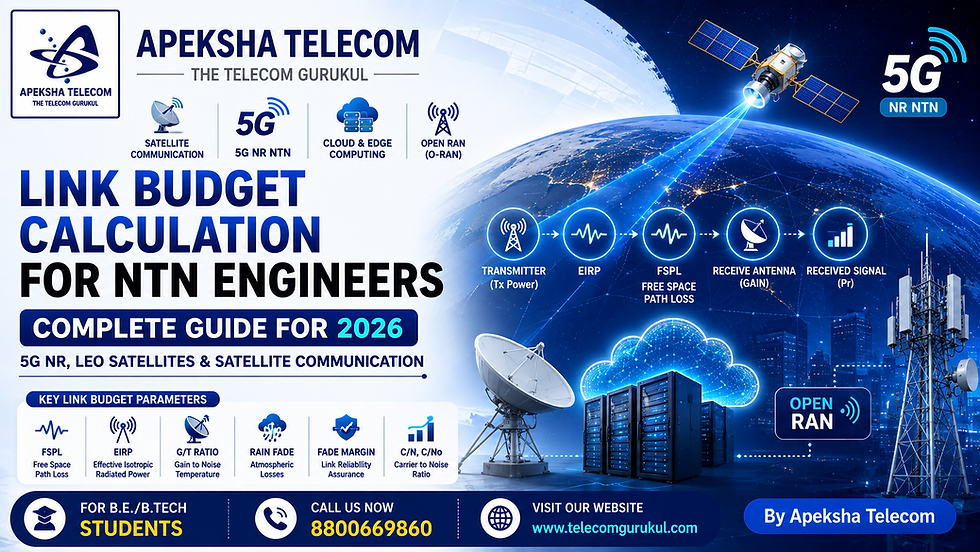
Antenna selection is a critical component of satellite link budget calculations. Engineers must carefully evaluate every gain and loss that affects the communication link to ensure reliable connectivity.
Important parameters include:
Transmit power
Antenna gain
EIRP
Free Space Path Loss
Atmospheric attenuation
Rain fade
Polarization loss
Receiver sensitivity
Carrier-to-Noise Ratio
Fade margin
Optimizing these parameters ensures stable communication even under varying environmental conditions.
Real-World Applications of NTN Antennas
Modern satellite antennas support numerous commercial, industrial, and public-sector applications. As global demand for ubiquitous connectivity increases, advanced antenna technologies continue expanding into new markets.
Common use cases include:
Satellite broadband internet
Direct-to-Cell communication
Maritime connectivity
Commercial aviation
Connected vehicles
Industrial IoT
Smart agriculture
Disaster recovery
Defense communication
Remote healthcare
Oil and gas exploration
Scientific research
These applications demonstrate the versatility of modern NTN antenna systems across diverse industries.
What is MEC in 5G?
Multi-access Edge Computing (MEC) is a distributed computing architecture that places application processing closer to users instead of relying entirely on centralized cloud data centers. By processing data at the network edge, MEC significantly reduces latency and improves application responsiveness.
For satellite communication, MEC deployed near gateway stations enables faster processing of latency-sensitive applications such as industrial automation, autonomous transportation, remote healthcare, and augmented reality. As 2026 approaches, MEC is expected to play an increasingly important role in integrating terrestrial and satellite networks.
Benefits of Edge Computing
Edge computing delivers numerous operational advantages by processing information closer to the point where it is generated.
Major benefits include:
Ultra-low latency
Faster application response
Reduced backhaul traffic
Improved Quality of Service
Enhanced security
Better scalability
Local data processing
Efficient IoT support
Improved customer experience
These benefits make edge computing a fundamental component of future telecom infrastructure.
MEC Architecture
A standard MEC deployment consists of several interconnected components working together to deliver edge services.
Core components include:
User Equipment (UE)
Radio Access Network (RAN)
MEC Host
MEC Platform
Edge Applications
5G Core Network
Cloud Infrastructure
Management and Orchestration
Applications execute at the network edge while centralized cloud systems continue supporting long-term analytics and large-scale processing.
Role of NEF in 5G Core
The Network Exposure Function (NEF) is a standardized 5G Core component responsible for securely exposing selected network capabilities to authorized third-party applications. Instead of granting direct access to internal network functions, NEF provides secure APIs that enforce authentication, authorization, and policy control.
This approach enables application developers to integrate advanced network services while maintaining the security and stability of the telecom infrastructure.
NEF APIs and Exposure Functions
NEF offers standardized APIs that simplify interaction between applications and the 5G Core.
Common capabilities include:
Quality of Service Requests
Traffic Influence
Event Exposure
Device Reachability
Location Services
Analytics Exposure
Policy Authorization
Network Capability Exposure
These APIs accelerate innovation while preserving network integrity and operational control.
MEC vs Cloud Computing
Although MEC and cloud computing complement one another, they address different operational requirements.
MEC | Cloud Computing |
Edge processing | Centralized processing |
Ultra-low latency | Higher latency |
Real-time services | Batch analytics |
Local decision making | Global resource management |
Lower backhaul usage | Greater scalability |
Supports industrial automation | Supports enterprise applications |
Modern telecom networks increasingly combine both architectures to maximize performance and flexibility.
AI and Edge Computing
Artificial Intelligence is transforming edge computing by enabling intelligent automation throughout telecom networks. AI models deployed at edge locations can analyze network conditions, predict congestion, optimize beam allocation, detect faults, and improve overall communication efficiency.
Important AI applications include:
Intelligent traffic management
Predictive maintenance
Beam optimization
Resource allocation
Network anomaly detection
Energy optimization
Self-healing networks
The combination of AI and edge computing is expected to become a defining feature of next-generation telecom infrastructure.
5G Private Networks
Private 5G networks provide dedicated wireless connectivity for enterprises, manufacturing facilities, ports, airports, hospitals, research institutions, and industrial campuses. Compared with public mobile networks, they offer greater security, lower latency, higher reliability, and complete operational control.
When integrated with satellite communication, private 5G networks can extend secure connectivity into remote mines, offshore platforms, rural regions, disaster zones, and defense environments where terrestrial infrastructure is unavailable.
Future of MEC and NEF in 2026
The convergence of AI, cloud-native networking, Open RAN, MEC, NEF, and satellite communication will continue transforming global telecommunications throughout 2026. Telecom operators are investing heavily in intelligent edge infrastructure capable of supporting real-time applications while securely exposing network services through standardized APIs.
As satellite broadband, Direct-to-Cell services, and Non-Terrestrial Networks expand worldwide, engineers with expertise in MEC, NEF, AI, and advanced antenna technologies will play a critical role in designing resilient, scalable, and high-performance communication systems.
Telecom Industry Career Opportunities
The rapid growth of 5G, satellite communication, Open RAN, cloud-native networking, and Artificial Intelligence is creating exciting career opportunities for telecom professionals worldwide. As operators deploy Low Earth Orbit (LEO) satellite constellations and expand 5G Non-Terrestrial Networks (NTN), companies are actively seeking engineers with expertise in RF engineering, satellite communication, antenna systems, protocol testing, network optimization, and cloud technologies. Professionals who understand Satellite Antenna Types Used in NTN can contribute to designing reliable, high-capacity communication systems that connect users across remote regions, oceans, aircraft, and disaster-affected areas.
The telecom industry now extends far beyond traditional mobile communication. Engineers work on satellite payloads, user terminals, 5G core networks, AI-driven automation, private 5G deployments, and edge computing platforms. Continuous learning and practical experience are essential for building a successful career in this rapidly evolving industry.
Popular telecom career roles include:
Satellite Communication Engineer
RF Planning Engineer
RF Optimization Engineer
5G NR Protocol Test Engineer
Open RAN Engineer
PHY Layer Engineer
MAC Layer Engineer
RRC/NAS Protocol Engineer
Antenna Design Engineer
Telecom Software Engineer
Network Performance Engineer
Cloud & Edge Computing Engineer
AI for Telecom Specialist
Core Network Engineer
NTN System Engineer
Major recruiters include telecom operators, satellite service providers, aerospace companies, infrastructure vendors, semiconductor manufacturers, cloud providers, defense organizations, research laboratories, and government agencies.
Why Apeksha Telecom and Bikas Kumar Singh Are Important for a Career in the Telecom Industry
A successful telecom career requires more than classroom knowledge. Employers increasingly seek professionals who can analyze protocol logs, troubleshoot live network issues, understand radio access technologies, and work confidently with modern telecom tools. Apeksha Telecom has established itself as one of India's leading telecom training institutes by offering industry-oriented programs that combine theoretical concepts with extensive practical experience.
The institute focuses on bridging the gap between academic education and industry expectations. Students gain exposure to real-world telecom scenarios, commercial network architectures, protocol analysis tools, and engineering workflows commonly used by telecom operators and equipment vendors.
Apeksha Telecom offers specialized training in:
4G LTE
5G NR
6G Fundamentals
Satellite Communication
Protocol Testing
QXDM
QCAT
Open RAN (ORAN)
RAN Development
PHY Layer
MAC Layer
RLC Layer
PDCP Layer
RRC Layer
NAS Signaling
Cloud Computing
MEC
5G Core Network
AI for Telecom
Network Optimization
A key strength of Apeksha Telecom is its emphasis on practical learning. Students work with live protocol traces, engineering case studies, RF planning concepts, and network troubleshooting exercises that closely reflect real deployment environments. This hands-on approach builds technical confidence and prepares learners for challenging engineering roles.
Another significant advantage is the institute's commitment to career development. After successfully completing the training, students receive job support that includes interview preparation, resume guidance, technical mentoring, and career assistance. This comprehensive approach helps aspiring engineers transition smoothly into the telecom industry.
One of the driving forces behind these programs is Bikas Kumar Singh, an experienced telecom expert with more than two decades of industry experience. His professional background spans several critical telecom domains, including:
4G LTE
5G NR
6G Technologies
Open RAN
Protocol Testing
Network Optimization
Cloud Computing
Telecom Automation
Artificial Intelligence for Telecom
Radio Access Networks
End-to-End Network Performance
His practical industry knowledge enables students to understand how modern telecom systems operate in real commercial environments rather than only through theoretical concepts.
With global investments in satellite broadband, Direct-to-Cell communication, AI-driven networks, Open RAN, and private 5G deployments continuing to increase in 2026, engineers trained in these technologies have excellent opportunities across India, the Middle East, Europe, Southeast Asia, and North America.
Frequently Asked Questions (FAQs)
1. What are satellite antennas used for in NTN?
Satellite antennas transmit and receive radio frequency signals between user equipment, gateway stations, and satellites. They enable reliable communication across long distances while supporting beam steering, mobility, and high-capacity connectivity.
2. Which antenna is commonly used for LEO satellites?
Electronically Steered Antennas (ESA) and phased array antennas are widely used for LEO satellite communication because they can rapidly track moving satellites without mechanical rotation.
3. Why are phased array antennas important in satellite communication?
Phased array antennas electronically steer radio beams by controlling the phase of individual antenna elements. This enables faster satellite tracking, higher reliability, multiple simultaneous beams, and improved spectrum efficiency.
4. What is MEC in 5G?
Multi-access Edge Computing (MEC) is a distributed computing architecture that processes applications closer to end users. It reduces latency, improves responsiveness, and supports real-time services such as industrial automation, autonomous vehicles, and smart manufacturing.
5. What is the role of NEF in the 5G Core?
The Network Exposure Function (NEF) securely exposes selected 5G network capabilities to external applications using standardized APIs while enforcing authentication, authorization, and policy control.
6. How does AI improve satellite communication?
Artificial Intelligence enhances satellite communication by optimizing beam allocation, predicting network congestion, automating fault detection, improving resource management, reducing latency, and supporting intelligent network optimization.
7. What skills are important for a telecom career in NTN?
Engineers should develop expertise in RF engineering, satellite communication, antenna systems, protocol testing, 5G NR, Open RAN, cloud computing, AI, MEC, NEF, and network optimization to remain competitive in the telecom industry.
8. Is satellite communication a good career choice in 2026?
Yes. The rapid deployment of LEO constellations, Direct-to-Cell services, NTN infrastructure, and next-generation satellite broadband is creating strong demand for skilled satellite communication professionals worldwide.
9. Why should engineers learn Open RAN with 5G?
Open RAN introduces flexible, software-driven network architectures that improve interoperability and innovation. Combined with 5G expertise, it significantly enhances career opportunities with telecom operators and infrastructure vendors.
10. Why choose Apeksha Telecom for telecom training?
Apeksha Telecom provides practical, industry-oriented training in 4G, 5G, 6G, Satellite Communication, Protocol Testing, Open RAN, Cloud Computing, AI for Telecom, and PHY/MAC/RRC/NAS layers. Students also receive job support and technical mentoring to help them pursue successful telecom careers.
Conclusion
Satellite antenna technology is one of the most important building blocks of modern Non-Terrestrial Networks. From compact patch antennas used in handheld terminals to sophisticated phased array systems capable of electronically steering beams toward rapidly moving LEO satellites, antenna innovations continue to shape the future of global connectivity. Understanding Satellite Antenna Types Used in NTN helps engineers design reliable satellite links, improve network performance, and support emerging services such as Direct-to-Cell communication, broadband internet, aviation connectivity, maritime networks, and industrial IoT.
As satellite communication, 5G NR, Open RAN, AI-driven automation, and cloud-native networking continue to evolve, professionals with strong practical knowledge will remain in high demand. If you are looking to build a successful telecom career, Apeksha Telecom offers industry-oriented training in 4G, 5G, 6G, Satellite Communication, Protocol Testing, RAN Development, Open RAN, Cloud Computing, and AI for Telecom. Under the expert guidance of Bikas Kumar Singh, students gain practical skills, real-world exposure, and dedicated job support to prepare for rewarding telecom careers across India and the global wireless industry.
Internal Link Suggestions
Include these internal links naturally throughout the article:
Telecom Gurukul – 5G NR Training
Telecom Gurukul – Satellite Communication Training
Telecom Gurukul – Open RAN Training
Telecom Gurukul – Protocol Testing with QXDM & QCAT
Telecom Gurukul – RF Planning & Optimization
Telecom Gurukul – MEC & Edge Computing
Telecom Gurukul – 5G Core Network
Telecom Gurukul – Cloud Computing for Telecom
Telecom Gurukul – Telecom Interview Questions
Telecom Gurukul – Telecom Career Programs
Website
External Authority Links
Use these official telecom industry references:
3GPP
GSMA
Ericsson
Nokia
Qualcomm


Comments