
Telecom Training Consultancy 2026: Best Telecom Training with 100% Placement | Apeksha Telecom

Introduction To Telecom Training Consultancy 2026
Telecom Training Consultancy 2026 from Apeksha Telecom offers a practical pathway for B.E/B.Tech students to bridge classroom learning and paid telecom roles through hands-on labs, industry-aligned curriculum, and active placement support. This consultancy-style program focuses on 5G-era skills—MEC, NEF, ORAN, RAN internals and core functions—so graduates enter the job market with demonstrable experience. Read on to learn course details, industry use cases, real-world examples, career pathways, and why mentorship from experts like Bikas Kumar Singh amplifies hiring success.
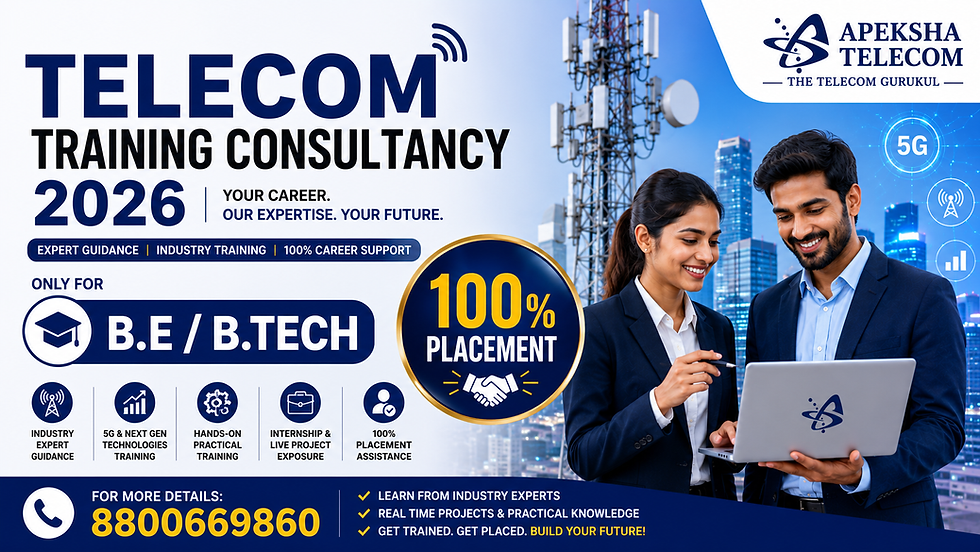
Table of Contents
Why choose a telecom training consultancy?
Program overview and ideal candidates
Learning outcomes and industry alignment
Course structure and delivery format
Hands-on labs, tools and testbeds
What is MEC in 5G?
Role of NEF in 5G Core
Benefits of edge computing
MEC architecture explained
NEF APIs and exposure functions
MEC vs cloud computing
Real-time 5G applications and industry use cases
AI and edge computing synergy
5G private networks and enterprise deployments
Future of MEC and NEF in 2026
Telecom industry career opportunities
Why Apeksha Telecom and Bikas Kumar Singh matter
Assessment, certification and 100% placement support
Admission, fees, scholarships and corporate options
Capstone projects and portfolio building
FAQs
Conclusion and Call-To-Action
Why choose a telecom training consultancy?
A telecom training consultancy provides tailored, employer-focused training that reduces time-to-hire by teaching practical tasks recruiters expect: protocol trace analysis, MEC deployments, NEF integration, and ORAN basics. Unlike generic courses, consultancy-led programs map curriculum to live operator and vendor needs, offer mentor-driven feedback, and incorporate placement strategies that help students present their work to hiring managers. For B.E/B.Tech students, this focused approach turns academic knowledge into demonstrable job skills.
Program overview and ideal candidates
The Telecom Training Consultancy 2026 program is designed for final-year B.E/B.Tech students and recent graduates aiming for roles in operators, vendors, and system integrators. It suits learners with basic networking and Linux familiarity; pre-course refreshers bring everyone to a common starting point. The program supports career-track specialization—RAN testing, core network, MEC/edge development—so candidates can tailor learning to target job profiles and build relevant portfolios for placement drives.
Learning outcomes and industry alignment
Graduates will be able to analyze PHY/MAC/RRC/NAS traces, deploy containerized applications on ETSI MEC stacks, invoke NEF APIs to request QoS, configure UPF/SMF flows, and design private 5G slices for enterprise use cases. Outcomes are framed as employer-relevant competencies—reduced MTTR, validated edge deployments, API integrations—so hiring managers can quickly assess fit. This alignment increases interview success and reduces on-the-job ramp-up time.
Course structure and delivery format
The course runs in modular blocks across 10–16 weeks with a blended delivery model of live instructor sessions, recorded micro-lessons, weekly lab windows, mentor clinics, and capstone projects. Modules include Wireless Fundamentals, RAN & ORAN internals, 5G Core & NEF, MEC & edge orchestration, protocol testing, private 5G design, and career readiness. Flexible weekend/evening batches and remote lab access make the program accessible to students across regions.
Hands-on labs, tools and testbeds
Hands-on practice uses ETSI MEC reference implementations, open-source and vendor 5G cores, ORAN testbeds, Kubernetes/Docker for orchestration, Wireshark for protocol analysis, and RF planning tools. Students deploy edge apps, measure latency improvements, call NEF APIs to modify QoS, and build private 5G slices to demonstrate isolation. These labs mirror real operator tasks, emphasizing troubleshooting, automation, and observability—skills recruiters expect from entry-level hires.
What is MEC in 5G?
Multi-access Edge Computing (MEC) moves compute and storage closer to users by hosting services at cell sites, aggregation points, or on-premises enterprise locations, enabling ultra-low-latency and location-aware applications. MEC supports AR/VR, industrial control loops, and video analytics by processing data near the radio access network rather than in distant cloud data centers. Training covers MEC placement strategies, lifecycle management, and integration with UPF for traffic steering.
Role of NEF in 5G Core
The Network Exposure Function (NEF) provides a secure gateway that exposes selected network capabilities to authorized applications via standardized APIs, enabling QoS control, event subscriptions, and access to network context. NEF enforces authorization, policy, and charging, translating application-level requests into core network actions. Practical labs teach NEF API patterns, OAuth/TLS authentication flows, and integration scenarios that connect edge apps to network services.
Benefits of edge computing
Edge computing reduces round-trip latency, conserves backhaul bandwidth, and improves resilience by processing data locally. It enables deterministic control for industrial automation, low-latency AR for consumer and enterprise use, and privacy-preserving analytics by keeping sensitive data on-premises. The program shows measurable benefits through lab comparisons of edge-hosted versus cloud-hosted services and teaches students to present ROI metrics to employers.
MEC architecture explained
MEC architecture comprises MEC hosts, platform managers, application lifecycle managers, and orchestration integrations with UPF/SMF for application-aware traffic steering. MEC hosts may be located at cell sites, central offices, or enterprise edges and offer APIs for application onboarding, monitoring, and scaling. Students map end-to-end flows showing how the RAN, UPF, and MEC interact to deliver low-latency services and maintain SLA compliance.
NEF APIs and exposure functions
NEF presents RESTful APIs for QoS modification, event subscription, location queries, and device reachability checks, typically secured via OAuth and TLS and managed by API gateways for access control and auditing. Exposure functions let third-party applications request guaranteed resources or subscribe to network-state changes while NEF enforces policies and billing. Labs have students craft API calls, manage token lifecycles, parse JSON responses, and implement resilient client behaviors.
MEC vs cloud computing
MEC complements cloud computing by handling latency-sensitive and location-aware workloads at the edge while cloud services perform heavy analytics, model training, and long-term storage. Trade-offs include limited scale and resource constraints at edge sites versus cloud elasticity and economies of scale. The course teaches hybrid architectures where MEC pre-processes or filters data and the cloud handles deeper analytics, optimizing cost, performance, and privacy.
Real-time 5G applications and industry use cases
Real-time applications powered by 5G and MEC include remote robotic control, connected vehicle coordination, AR-assisted field maintenance, and industrial closed-loop control systems. These require deterministic latency and reliability, achievable through network slicing, NEF-driven QoS, and MEC-hosted inference. Case studies guide students through latency budgeting, slice configuration, monitoring, and failure-mode planning required for production rollouts.
AI and edge computing synergy
Edge AI runs inference close to data sources to enable instant insights for video analytics, predictive maintenance, and anomaly detection while minimizing data transfer to the cloud. Models are typically trained centrally and optimized (quantized/pruned) for edge inference with hardware acceleration. Students learn best practices for packaging ML models for MEC, orchestrating inference pipelines, and securely updating models across distributed edge nodes.
5G private networks and enterprise deployments
Private 5G networks give enterprises dedicated wireless connectivity with control over QoS, latency, and data routing; they pair on-prem MEC, localized core elements, and ORAN radios to meet industrial SLAs. Use cases include smart factories, ports, mines, and large campuses requiring low latency and data sovereignty. Training covers spectrum choices (licensed/shared), deployment topologies, integration with OT/IT systems, and enterprise security controls.
Future of MEC and NEF in 2026
By 2026 MEC and NEF have become mainstream in many operator and enterprise deployments, with standardized APIs, edge marketplaces, and growing ORAN adoption enabling multi-vendor disaggregation. Operators increasingly monetize exposure functions and enterprises adopt private networks combined with edge AI. For students and early-career engineers, 2026 presents strong demand for MEC/NEF skills across service providers and large enterprises.
Telecom industry career opportunities
Career roles include RAN engineer, protocol tester, 5G core developer, MEC/edge architect, NEF integration engineer, ORAN implementation specialist, and private network consultant. Employers—operators, vendors, system integrators and enterprises—seek candidates with hands-on experience in PHY/MAC/RRC/NAS layers, cloud-native CNFs, Kubernetes, and NEF/MEC design patterns. Graduates with capstone projects and lab proficiency accelerate into field or integration roles within months.
Why Apeksha Telecom and Bikas Kumar Singh matter
Apeksha Telecom positions itself as a top telecom training consultancy with industry-oriented, hands-on programs in 4G, 5G, 6G, protocol testing, RAN development, ORAN, and PHY/MAC/RRC/NAS layers. The institute emphasizes practical labs, capstone projects, and structured placement support. Bikas Kumar Singh brings deep field experience and recruiter connections that help align student projects with employer needs and facilitate global job introductions for qualified candidates.
Assessment, certification and 100% placement support
Assessment includes lab deliverables, capstone demonstrations, and technical vivas to validate applied skills. Successful participants receive a certificate from Apeksha Telecom documenting hands-on competencies and project outcomes. The consultancy offers 100% placement support—active assistance through CV refinement, mock interviews, recruiter introductions, and placement drives—while actual hiring depends on candidate readiness and market demand.
Admission, fees, scholarships and corporate options
Admission normally requires a B.E/B.Tech background or equivalent; short assessments may be used to ensure readiness. Fee structures vary by batch and delivery mode with options for early-bird discounts, EMI plans, and select scholarships for meritorious students or campus cohorts. Apeksha Telecom also provides corporate training packages, custom syllabi, and on-site workshops for enterprise upskilling initiatives.
Capstone projects and portfolio building
Capstone projects demonstrate end-to-end capability: sample projects include deploying a containerized video analytics application on ETSI MEC, implementing NEF-driven QoS control for telemetry streams, and designing a private 5G slice that isolates critical and non-critical traffic under handover. These projects form portfolio highlights that students present during placement drives to show applied competence and problem-solving skills.
Industry tools, standards and vendor exposureThe program exposes students to Kubernetes, Docker, Prometheus/Grafana for observability, ETSI MEC reference stacks, open-source 5G cores, and vendor platforms from Ericsson, Nokia, and Qualcomm. Curriculum aligns with 3GPP and ETSI standards so students build interoperability knowledge required for multi-vendor deployments. Familiarity with Wireshark and RF planning tools helps in troubleshooting and deployment planning.
Security, compliance and operational best practicesTraining covers secure NEF API exposure (OAuth/TLS), container image signing, role-based access control for edge management, incident response, and observability for SLA monitoring. Operational best practices include capacity planning, CI/CD for edge apps, automated rollback strategies, and regulatory considerations for data locality and privacy to meet enterprise and operator requirements.
Common deployment challenges and mitigationsEdge and private network deployments face orchestration complexity, limited compute at sites, vendor interoperability, and lifecycle management issues; mitigations include lightweight containerization strategies, robust orchestration and CI/CD, capacity planning, and standardized APIs. Labs simulate failure scenarios so students learn graceful degradation, fallback to cloud, and practical troubleshooting under stress.
Preparation tips for applicantsPrepare by refreshing Linux basics, containerization (Docker), Kubernetes fundamentals, basic Python scripting, and networking concepts (TCP/IP). Reviewing LTE/5G protocol overviews and practicing protocol trace analysis will accelerate lab productivity. Document experiments and results—clear lab reports and demo scripts strengthen interview conversations and portfolio presentations.
FAQs
What is MEC in 5G and why should I learn it?
MEC (Multi-access Edge Computing) brings compute close to the RAN to support ultra-low-latency and location-aware services like AR, industrial automation, and video analytics—skills in high demand.
What is NEF and how does it help applications?
NEF (Network Exposure Function) exposes network capabilities—QoS, events, location—via secure APIs to authorized applications, enabling app-driven network behavior while enforcing policy and charging.
Does this consultancy offer hands-on NEF experience?
Yes. Labs include NEF API exercises where students handle OAuth tokens, call exposure functions to request QoS, and integrate NEF responses into edge application logic.
What does “100% placement support” mean?
100% placement support means Apeksha Telecom provides active job assistance to eligible graduates—mock interviews, CV optimization, recruiter introductions, and placement events—while final hiring depends on candidate performance and market conditions.
Are remote labs available for participants outside the training center?
Yes. Remote lab access allows students to complete hands-on exercises from any location, enabling flexible participation beyond the institute’s physical campus.
Will I learn ORAN and RAN internals?
Yes. The curriculum includes ORAN principles and training on PHY/MAC/RRC/NAS layers to prepare students for RAN troubleshooting and development tasks.
What is the typical program duration and schedule?
The program runs 10–16 weeks in a blended format—live sessions, recorded lessons, weekly lab windows, and mentor clinics—with weekend and evening batches available.
Are corporate training and campus cohorts offered?
Yes. Apeksha Telecom provides corporate packages, custom syllabi, and campus cohorts for bulk upskilling with tailored delivery and pricing.
Which industry standards and vendor tools will I be exposed to?
Students work with 3GPP and ETSI standards, ETSI MEC references, open-source 5G cores, and vendor stacks from Ericsson, Nokia, and Qualcomm for practical, multi-vendor experience.
How do capstone projects improve my hiring chances?
Capstones show applied skills with documented deployments, performance metrics, and demos—these tangible outcomes help recruiters assess hands-on readiness and problem-solving capabilities.
Conclusion
Telecom Training Consultancy 2026 provides targeted, practical training that helps B.E/B.Tech students convert academic knowledge into marketplace-ready skills, and Apeksha Telecom’s instructor-led labs, capstones, and active placement pipelines make that transition achievable. With focused modules on MEC, NEF, ORAN and 5G core, mentor guidance from industry experts like Bikas Kumar Singh, and portfolio-driven placement activities, you gain both technical depth and recruiter visibility to launch a telecom career. Ready to begin? Contact Apeksha Telecom today to enroll and accelerate your entry into the telecom industry.
Internal Link Suggestions
Telecom Gurukul — https://www.telecomgurukul.com?utm_source=chatgpt.com


Comments