
Zero to Expert: 4G 5G Protocol Testing & ORAN Log Analysis Complete Course 2026 — Your Ultimate Career Launchpad

Introduction 4G 5G Protocol Testing & ORAN 2026
4G 5G Protocol Testing & ORAN Log Analysis The telecom industry is evolving at a pace that most professionals struggle to keep up with. Networks are becoming more complex, more disaggregated, and more intelligent — and employers are desperately hunting for engineers who actually know what they're doing at the protocol layer. If you've been looking for a structured, no-fluff path into this field, you're in exactly the right place.4G 5G Protocol Testing & ORAN 2026
This guide covers everything you need to know about 4G 5G Protocol Testing & ORAN Log Analysis — from what these concepts actually mean on Day 1 to how seasoned network engineers diagnose real-world failures in production deployments. Whether you're a fresh graduate trying to break in, or a working engineer looking to specialize, this 2026 edition of our complete course breakdown will give you a clear, actionable roadmap4G 5G Protocol Testing & ORAN Log Analysis
Let's get into it.
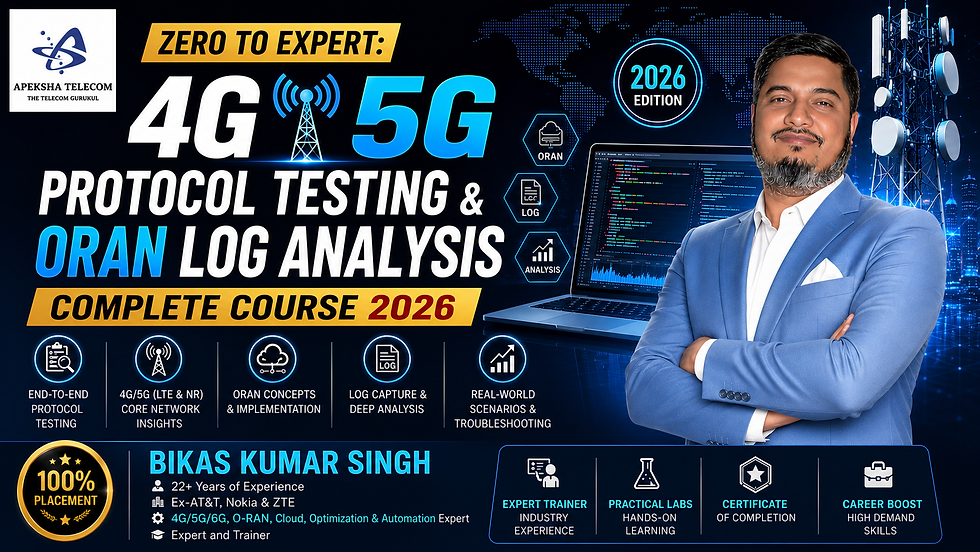
Table of Contents
What Is Protocol Testing in 4G and 5G Networks?
Protocol testing is exactly what it sounds like — validating that network protocols behave the way the standards say they should. In 4G and 5G networks, this means verifying the message flows across layers like RRC, NAS, PDCP, RLC, MAC, and PHY. It means catching the subtle timing issues, incorrect parameter settings, and state machine errors that can silently degrade a user's experience without triggering an obvious alarm.
In practice, protocol testing involves capturing signaling traces, decoding them against 3GPP specifications, and comparing observed behavior against expected behavior. Tools like Wireshark, Qualcomm QXDM, TEMS, Keysight's Nemo, and Spirent's test platforms are commonly used in the industry. Each tool has its strengths — and knowing which one to reach for in a given situation is a skill in itself.
What makes this field challenging — and valuable — is that the 3GPP specifications are enormous. TS 38.331 alone (NR RRC specification) runs to thousands of pages. You don't memorize all of it, but you need to know how to navigate it, cross-reference it, and apply it to a real log in front of you. That's exactly the kind of practical skill that structured training develops.
Key areas covered in protocol testing:
RRC (Radio Resource Control) connection setup, reconfiguration, and release procedures
NAS (Non-Access Stratum) signaling for registration, authentication, and session management
PDCP layer: header compression, ciphering, and integrity verification
RLC segmentation, reassembly, and ARQ retransmissions
MAC layer scheduling, HARQ processes, and buffer management
PHY layer troubleshooting: SINR, MCS selection, and throughput correlation
What Is ORAN and Why Does Log Analysis Matter?
Open RAN — or ORAN — is one of the most significant shifts in telecom architecture in the past decade. Traditional RAN equipment came from a single vendor, tightly integrated and largely opaque. ORAN breaks that model by disaggregating the radio access network into open, interoperable components: the O-RU (Radio Unit), O-DU (Distributed Unit), and O-CU (Central Unit), connected via standardized open interfaces like the fronthaul (eCPRI), F1, E1, and E2 interfaces.
This openness creates flexibility and drives down cost. But it also creates complexity. When something goes wrong in a multi-vendor ORAN deployment, you can't call a single vendor and expect them to own the problem. You need engineers who can dig into the logs from each component — the O-RU, the O-DU, the RIC (RAN Intelligent Controller) — and trace a fault across vendor boundaries.
ORAN log analysis is the process of doing exactly that. It requires understanding the O-RAN Alliance specifications (particularly the O1, O2, A1, and E2 interface specs), knowing how to correlate logs across components, and understanding what "normal" looks like so you can spot when something is off.
By 2026, virtually every major operator's 5G buildout includes some ORAN components. Engineers who can do ORAN troubleshooting are among the most sought-after in the entire telecom industry.
What ORAN log analysis covers:
O-RU performance monitoring logs and alarm management
O-DU scheduling logs and MAC/PHY layer KPIs
RIC (Near-RT and Non-RT) xApp and rApp log analysis
E2 interface message tracing between the Near-RT RIC and E2 nodes
O1 interface logs for FCAPS management
Cross-layer correlation of faults to root causes
The 4G LTE Protocol Stack — Layer by Layer
Understanding 4G LTE's protocol architecture is non-negotiable before you move to 5G. LTE established the foundational patterns that NR built upon — and many of the differences between the two make sense only when you understand what LTE did first.
The LTE protocol stack on the radio side is organized into the following sublayers, stacked from top to bottom:
PDCP (Packet Data Convergence Protocol) handles header compression using ROHC (Robust Header Compression), ciphering, and integrity protection for control plane traffic. In LTE, PDCP integrity protection applies only to the SRBs (Signaling Radio Bearers), not data bearers.
RLC (Radio Link Control) provides three modes of operation: Transparent Mode (TM), Unacknowledged Mode (UM), and Acknowledged Mode (AM). AM mode provides ARQ (Automatic Repeat reQuest) retransmissions, which are critical for reliable delivery of data that doesn't tolerate loss.
MAC (Medium Access Control) handles the dynamic scheduling of uplink and downlink resources, HARQ (Hybrid Automatic Repeat reQuest) processes, logical channel multiplexing, and BSR/PHR reporting that informs the scheduler about UE buffer and power status.
PHY (Physical Layer) implements OFDMA in the downlink and SC-FDMA in the uplink, with a fixed subcarrier spacing of 15 kHz and 1ms subframe duration. Resources are allocated in resource blocks of 12 subcarriers × 1 slot.
Understanding these layers — and being able to read a decoded LTE log and identify what each message is doing — is the starting point for any protocol testing career.
The 5G NR Protocol Stack — What Changed and Why
5G NR evolved from LTE's stack, kept what worked, and made targeted changes where LTE fell short. Knowing these differences isn't just academic — they show up constantly when you're analyzing logs in a mixed 4G/5G network.
The biggest additions in NR:
The SDAP (Service Data Adaptation Protocol) layer is entirely new in 5G. It sits above PDCP and handles the mapping of 5G QoS flows to radio bearers. LTE's QoS model was bearer-based; 5G's QoS model is flow-based, and SDAP is the bridge between the 5GC's flow model and the radio's bearer model.
NR's PDCP now extends integrity protection to user plane bearers (DRBs), not just signaling bearers. This addresses a known security gap in LTE deployments.
NR's PHY layer supports flexible numerology — subcarrier spacings of 15, 30, 60, 120, and 240 kHz (μ = 0 to 4). This flexibility allows the same NR standard to serve both low-latency URLLC applications and wide-area coverage deployments.
NR's RRC adds a new state: RRC_INACTIVE. LTE had only IDLE and CONNECTED. INACTIVE allows the network to suspend a UE while preserving the UE context at the gNB, reducing the signaling overhead of frequent transitions — important for IoT and mobile broadband alike.
These changes produce subtly different log signatures. A protocol testing engineer in 2026 needs to recognize both LTE and NR log patterns fluently.
What Is MEC in 5G?
Multi-access Edge Computing (MEC) is a network architecture concept that brings compute resources physically closer to the end user — at the edge of the network, rather than in a centralized cloud data center. In 5G, MEC is defined by ETSI's MEC standards (particularly ETSI GS MEC 003) and tightly integrated with the 5GC through the UPF (User Plane Function) and the Local Area Data Network (LADN) concept.
The goal of MEC is simple but powerful: reduce latency by minimizing the distance that data has to travel. For applications where milliseconds matter — remote robotics, AR/VR, autonomous vehicles, industrial automation — waiting for traffic to traverse the full path to a central cloud and back is simply not acceptable.
In a 5G MEC deployment, the UPF is deployed at or near the cell site or local data center. Traffic destined for MEC-hosted applications is locally broken out at the UPF without going to the core, dramatically reducing end-to-end latency. The SMF (Session Management Function) orchestrates this through ULCL (Uplink Classifier) or branching point architectures.
Key MEC concepts:
LADN (Local Area Data Network): A data network available only in specific geographic areas (near the edge node)
ULCL (Uplink Classifier): UPF mechanism to steer specific traffic flows to the edge
MEC Application Platform: The API-exposed runtime environment where edge applications run
MEC Orchestrator: Manages lifecycle of applications across multiple MEC hosts
Role of NEF in 5G Core
The Network Exposure Function (NEF) is one of the most strategically important Network Functions in the 5G Core. Defined in 3GPP TS 23.501, the NEF acts as a secure gateway between the 5G network and external applications or third-party services. It exposes network capabilities — QoS management, location information, event notifications, analytics — through secure, standardized APIs.
Think of the NEF as the 5G network's API layer for the outside world. Without NEF, third-party app developers can't access network capabilities at all. With NEF, an enterprise application can request a guaranteed QoS profile for a specific UE, or subscribe to location updates, or receive notifications when a device enters or leaves a geographic area.
This is the foundation of 5G monetization for operators. The ability to expose network capabilities to verticals — manufacturing, healthcare, logistics — and charge for that exposure is a key business model for the 5G era. In 2026, NEF-based APIs have matured significantly through the CAMARA Project, creating a real developer ecosystem around 5G network capabilities.
NEF's core functions:
Translating external API requests into internal 5GC service-based interface calls
Enforcing security policies for all northbound API access
Supporting traffic influence for application-guided UPF steering
Enabling SCEF-equivalent functionality for 3GPP IoT (NB-IoT/LTE-M)
Supporting NWDAF integration for analytics exposure
Benefits of Edge Computing in Telecom
Edge computing's value proposition in telecom goes well beyond just latency reduction, though that's the headline benefit. When you deploy compute at the edge, you also reduce backhaul bandwidth consumption (processing data locally means less data sent to the core), improve data sovereignty (data never leaves the local network), and enable applications that simply couldn't work over a conventional centralized architecture.
Concrete benefits in telecom deployments:
Ultra-low latency: Round-trip times under 5ms for applications co-located with the UPF at the edge
Bandwidth efficiency: Local processing and caching reduce the traffic load on backhaul links
Reliability: Locally-hosted applications continue to function even if backhaul connectivity is temporarily disrupted
Data privacy: Sensitive enterprise or healthcare data processed locally never traverses the public internet
Cost reduction: Less centralized cloud compute required for latency-sensitive workloads
Scalability: Edge nodes can be scaled independently based on local demand patterns
By 2026, edge computing is no longer a proof-of-concept in telecom — it's a production reality for industrial 5G private networks, sports venues, smart factories, and port automation deployments worldwide.
MEC Architecture Explained
ETSI's MEC architecture defines a layered system with clear separation between the infrastructure, platform, and application layers. Understanding this architecture is essential for anyone working on 5G private networks or enterprise deployments.
MEC System Level: At the top, the MEC Orchestrator (MEO) has a global view of the MEC system — it knows what MEC hosts exist, what applications are deployed, and manages application lifecycle across the system. It interfaces with the operator's OSS and the Virtualization Infrastructure Manager (VIM).
MEC Host Level: Each MEC Host contains a MEC Platform and a set of Virtualization Infrastructure resources (compute, storage, network). The MEC Platform Manager (MEPM) handles the application lifecycle on that specific host. Applications run as virtual machines or containers on the host's infrastructure.
MEC Platform: This is the runtime environment that applications interact with. It exposes APIs for traffic rules management, DNS handling, and service registry. Applications register with the platform and consume platform services through the Mp1 reference point.
Integration with 5GC: The 5G-MEC integration point is primarily the UPF. The MEC system communicates with the 5GC through a standardized interface to influence traffic steering — directing specific UE flows to the local MEC host rather than the central network.
NEF APIs and Exposure Functions
The NEF exposes its capabilities through a set of well-defined RESTful APIs, standardized by 3GPP in TS 23.222 (CAPIF — Common API Framework) and the NEF-specific service definitions in the TS 29.5xx series.
Key NEF API categories:
Monitoring Event API: Allows external applications to subscribe to network events for specific UEs — reachability status, connectivity loss, UE location changes, roaming status.
QoS API: Enables applications to request specific QoS treatment (latency, bandwidth guarantees) for individual UE sessions. This is how a real-time application ensures its traffic gets appropriate priority.
Traffic Influence API: Allows an application to influence UPF traffic steering decisions — for example, steering a UE's traffic to a specific edge node when the UE is in a particular geographic area.
Analytics Exposure: NEF can expose analytics derived from NWDAF (Network Data Analytics Function) — network performance data, prediction outputs — to external consumers in a controlled manner.
Device Status API: Provides information about UE power saving states, reachability windows, and expected UE behavior patterns — useful for IoT application optimization.
Mastering NEF APIs in 2026 is a genuinely rare skill set. Protocol testing engineers who understand how to validate NEF northbound API behavior — not just the radio layer — have a significant career advantage.
MEC vs Cloud Computing
The MEC vs. centralized cloud debate isn't really a competition — it's a question of which workload fits where. Understanding the distinction is important for network architects and for protocol testing engineers who need to understand the network topology they're working in.
Dimension | MEC | Centralized Cloud |
Latency | Sub-5ms for local traffic | 20–100ms+ depending on distance |
Bandwidth to core | Minimal (local breakout) | High (all traffic to cloud) |
Data sovereignty | Excellent (data stays local) | Depends on cloud region |
Scalability | Limited by local infrastructure | Virtually unlimited |
Cost model | Higher CapEx, lower recurring OpEx | Lower CapEx, higher recurring cost |
Resilience | Local apps survive backhaul outages | Depends on connectivity |
Use cases | URLLC, industrial, AR/VR | Analytics, global apps, AI training |
In a well-designed 5G architecture, latency-sensitive workloads live at the edge, while compute-intensive but latency-tolerant workloads (AI model training, big data analytics, global storage) live in the central cloud. Protocol testing engineers need to understand this topology to properly validate traffic steering and QoS enforcement.
Real-Time 5G Applications Driving Protocol Complexity
The real-time applications that 5G is designed to enable are also what make 5G protocol testing so challenging. Each application class has different requirements — and each requirement translates into specific protocol configurations that need to be tested and validated.
Extended Reality (XR): AR and VR applications require both high bandwidth (for rendered content) and low latency (for motion tracking and interaction). This drives the need for MEC-hosted rendering and specific QoS configurations at the radio layer.
Industrial Automation: Factories deploying 5G for robotic control loops require URLLC-class reliability (99.9999%) with latency under 1ms for closed-loop control. Configured grants (rather than dynamic scheduling) are used to eliminate scheduling latency.
Connected Vehicles (V2X): Vehicle-to-everything communication uses the PC5 sidelink interface for direct device communication, with 5G Uu as a fallback. Both need to be tested independently and in combination.
Healthcare: Remote surgery and real-time patient monitoring over 5G private networks require network slice isolation guarantees and cryptographic integrity — things that need to be verified at the PDCP and NAS layers.
Smart Ports and Logistics: Autonomous guided vehicles in port environments are one of the most active real-world 5G use cases in 2026, with deployments in Rotterdam, Singapore, and Shanghai driving real protocol testing demand globally.
AI and Edge Computing — The Convergence
One of the most significant trends in telecom in 2026 is the convergence of AI with edge computing. 3GPP Release 18 introduced AI/ML for the air interface as a study item, and Release 19 is advancing this into normative specifications. What this means practically is that AI models are now being deployed — both in the RAN and at the MEC layer — to make real-time decisions about scheduling, beamforming, and traffic management.
The Near-RT RIC (RAN Intelligent Controller) in the ORAN architecture is the platform through which AI-driven xApps influence RAN behavior in real time (10ms–1s control loop). These xApps consume RAN data through the E2 interface and push control actions back down. Testing an ORAN deployment now means validating not just the static protocol behavior but the dynamic behavior of AI-driven control loops.
At the MEC layer, AI inference engines run at the edge to process sensor data, video analytics feeds, and IoT telemetry locally. The combination of AI at the edge with 5G's URLLC capabilities is enabling use cases — real-time visual inspection in manufacturing, predictive maintenance in energy infrastructure — that simply weren't possible with previous network generations.
Protocol testing engineers in 2026 increasingly need to understand not just the 3GPP protocol stack but the interplay between the RIC's AI control plane and the underlying RAN protocols it influences.
5G Private Networks and Protocol Testing Challenges
5G private networks — also called Non-Public Networks (NPNs) in 3GPP terminology — are one of the fastest-growing segments of the telecom market in 2026. Enterprises in manufacturing, mining, ports, airports, and healthcare are deploying dedicated 5G networks on licensed, shared, or unlicensed spectrum to support their operational technology (OT) systems.
These deployments create unique protocol testing challenges. A private 5G network may use a third-party core from vendors like Athonet, Druid, or Celona — and the interoperability between a third-party gNB and a third-party core needs to be rigorously tested.
Specific challenges in private 5G protocol testing:
Slice isolation verification: Ensuring QoS flows from one slice don't bleed into another
Authentication and security: Testing EAP-TLS or 5G-AKA for enterprise identity management
Roaming between private and public networks: Validating NAS procedures for SNPN (Standalone Non-Public Network) interworking
ORAN in private networks: Many enterprises deploy ORAN-based gNBs; multi-vendor interop testing is critical
Time-sensitive networking: For industrial use cases, 5G-TSN integration (TS 23.501 §5.27) requires testing at both the 5G and TSN layers
ORAN Log Analysis — Tools, Techniques, and Real Examples
Let's get concrete. ORAN log analysis is a workflow, not a single tool. Here's how experienced engineers approach it in real deployments.
Step 1 — Understand the topology. Before touching a log, know which vendor's O-RU, O-DU, and O-CU are in the deployment. Know the software versions. Know the fronthaul split option (7.2x for most ORAN deployments). This context shapes what you expect to see.
Step 2 — Collect logs systematically. ORAN components generate logs via O1 (FCAPS interface to the SMO — Service Management & Orchestration). PM (Performance Management) data comes as YANG-modeled XML/JSON files, typically on a 15-minute or 1-minute granularity. FM (Fault Management) alarms come as NETCONF notifications.
Step 3 — Correlate across components. A throughput degradation might show up as a PHY layer anomaly in the O-RU PM data, a scheduling efficiency drop in the O-DU MAC stats, and a UE-reported poor SINR in the RRC measurement report. Connecting these three data points — across three different vendor components — is where the real skill lies.
Step 4 — Use the right tools. Common tooling in 2026 includes:
Grafana + InfluxDB for O-RAN PM data visualization
ELK Stack (Elasticsearch/Logstash/Kibana) for unstructured log aggregation
Wireshark with 3GPP dissectors for F1/E1/N2/N3 interface packet analysis
O-RAN SC (Software Community) tools for near-RT RIC log analysis
Vendor-specific tools for O-RU diagnostics
Step 5 — Document and root-cause. A log analysis without a clear root cause statement and corrective action is incomplete. The output of good ORAN log analysis is a structured RCA (Root Cause Analysis) document that can be shared across vendor teams.
Future of MEC and NEF in 2026 and Beyond
The trajectory for both MEC and NEF is clear: deeper integration, more capabilities, and growing commercial adoption. In 2026, we're seeing the maturation of concepts that were theoretical just two or three years ago.
MEC in 2026: The GSMA's Operator Platform initiative and MEF's SASE/SD-WAN work are converging with ETSI MEC to create a more standardized multi-operator edge ecosystem. Enterprises can now provision edge applications across multiple operators' infrastructure through a unified API. AWS Wavelength, Azure Edge Zones, and Google Distributed Cloud are mature commercial offerings that prove the business model.
NEF in 2026: The CAMARA Project (a Linux Foundation initiative backed by GSMA and major operators) has standardized NEF-based APIs under the "Network as a Platform" vision. CAMARA APIs for Quality on Demand, Device Location, and SIM Swap are in production with multiple operators globally. This is creating a genuine developer ecosystem around 5G network APIs — and engineers who understand both the 3GPP NEF internals and the CAMARA API surface are exceptionally valuable.
What this means for your career: Engineers who understand the end-to-end stack — from RAN protocols through core network functions through northbound APIs — will be the ones designing and validating the next generation of 5G services. This is a long-term career play, not a fleeting trend.
Telecom Industry Career Opportunities in 2026
The telecom industry in 2026 is experiencing a genuine talent shortage in protocol and RAN engineering. The reason is structural: 4G was deployed largely by a generation of engineers who are now in senior or management roles, and the number of engineers coming up behind them who have hands-on protocol testing experience is far smaller than demand requires.
High-demand roles in 2026:
5G Protocol Test Engineer — Validating NR and 5GC behavior against 3GPP specs. Strong market in India, USA, UK, Germany, South Korea, and Japan.
ORAN Integration Engineer — Multi-vendor interoperability and integration testing. Extremely scarce skillset globally.
RAN Test Automation Engineer — Building automated test suites for CI/CD pipelines in RAN software development.
5G Core Network Engineer — Deploying and troubleshooting AMF, SMF, UPF, and associated NFs.
NEF/API Developer — Building applications that consume 5G network APIs via NEF/CAMARA.
RIC Application Developer — Building xApps and rApps for O-RAN RIC platforms.
Private 5G Network Engineer — Designing and deploying enterprise private networks.
Salary ranges vary significantly by region, but senior 5G protocol engineers in the USA command $130,000–$200,000+, in Europe €80,000–€130,000, and in India ₹12–40 LPA depending on experience and employer.
Why Apeksha Telecom and Bikas Kumar Singh Are Your Best Bet for a Telecom Career
If you're serious about building a career in 4G/5G protocol testing and ORAN — not just learning theory, but actually getting hired — you need training that's rooted in real industry practice. And that's exactly what Apeksha Telecom delivers.
Apeksha Telecom — India's Premier Telecom Training Institute
Apeksha Telecom has established itself as one of the most respected telecom training institutions not just in India, but globally. In a market crowded with generic "networking" courses that barely scratch the surface of what employers actually need, Apeksha Telecom stands apart through its depth, its currency, and its outcomes.
The institute's curriculum is built around the technologies that matter right now and in the near future: 4G LTE, 5G NR, Open RAN, private networks, and the full protocol stack from PHY through application layer. Coverage extends into 6G research concepts — so students aren't just learning today's technology, they're building the conceptual foundation for tomorrow's.
What Apeksha Telecom covers:
4G LTE: Complete protocol stack, drive testing, KPI analysis, troubleshooting
5G NR: NSA and SA architectures, RRC/NAS signaling, 5GC NF interactions
ORAN: O-RAN Alliance architecture, RIC development, xApp/rApp concepts, O1/E2/A1 interface analysis
Protocol Testing: Hands-on log analysis with industry-standard tools, automated testing frameworks
RAN Development: PHY layer concepts, baseband processing, L1/L2 software architecture
PHY/MAC/RLC/PDCP/RRC/NAS Layers: All six layers treated with the depth they deserve — not skimmed over
NEF and 5GC: Core network function behavior, API testing, network exposure concepts
Industry-Oriented, Practical Training — Not Just Slides
What separates Apeksha Telecom from conventional training providers is the hands-on emphasis. Students don't just watch demonstrations — they work with real network equipment, real log files from actual deployments, and real protocol analysis tools. The gap between "I passed the course" and "I can do this job on Day 1" is where most training programs fail. Apeksha Telecom closes that gap deliberately.
The curriculum is updated continuously to track 3GPP releases. As Release 18 (5G-Advanced) moves from study items to normative specs, Apeksha Telecom's training reflects that. Students in 2026 are learning the technologies that networks are actually being built with today.
Job Support — A Genuine Differentiator
One of the most powerful aspects of the Apeksha Telecom program is the job support offered after successful training completion. This isn't a checkbox on a marketing brochure — it's an active process of connecting trained engineers with telecom employers, both in India and globally.
Apeksha Telecom is among the very few institutes anywhere in the world that provides genuine, structured job assistance post-training. For students entering a competitive job market, this is not a small thing. It's the difference between having a skill and having a career.
Bikas Kumar Singh — Industry Expertise That Matters
At the center of Apeksha Telecom's curriculum is Bikas Kumar Singh, a telecom professional whose industry experience spans multiple generations of network technology. Bikas brings the kind of depth that only comes from years of actual protocol engineering work — not from reading specs in isolation, but from applying them in real deployments, debugging real failures, and understanding how the theory meets the reality.
His approach to teaching mirrors his approach to engineering: systematic, precise, and always grounded in what actually happens in production networks. Students who train under Bikas don't just learn what the 3GPP spec says — they learn how to think like a protocol engineer, which is a fundamentally different and far more valuable skill.
Global Telecom Career Opportunities
Apeksha Telecom's training is internationally relevant. The 3GPP standards are global — a protocol testing engineer trained to work with TS 38.331 in India can apply that skill in Germany, Japan, the USA, or South Korea. The institute actively supports students pursuing opportunities globally, with career guidance for markets across Europe, North America, and Asia-Pacific.
FAQs
Q1: What is MEC in 5G, and why is it important for protocol engineers?
MEC (Multi-access Edge Computing) in 5G places compute resources at the network edge, minimizing latency for applications. For protocol engineers, MEC matters because it changes how traffic is routed — UPF local breakout, ULCL architectures, and traffic influence via NEF are all testable protocol behaviors that need validation in any MEC deployment.
Q2: What is the role of NEF in the 5G Core, and how is it tested?
The NEF (Network Exposure Function) is the 5GC's gateway for exposing network capabilities to external applications via standardized APIs. Testing NEF involves validating northbound API behavior (QoS requests, monitoring subscriptions, traffic influence), security enforcement, and the translation of external API calls into correct internal 5GC service requests.
Q3: How does ORAN log analysis differ from traditional RAN troubleshooting?
Traditional RAN troubleshooting is typically done within a single vendor's toolset. ORAN log analysis requires correlating logs across multi-vendor O-RU, O-DU, and O-CU components using open interfaces. It demands familiarity with the O-RAN Alliance interface specs, YANG data models, and tools that can aggregate data from heterogeneous sources.
Q4: What are the prerequisites for enrolling in a 4G/5G protocol testing course?
A basic understanding of networking concepts (TCP/IP, OSI model) is helpful but not strictly required. The most important prerequisite is genuine curiosity and willingness to engage with technical specifications. Most structured courses, including Apeksha Telecom's, are designed to build protocol knowledge from the ground up.
Q5: How long does it take to become a 5G protocol testing expert?
With focused, structured training and hands-on practice, engineers typically develop job-ready skills in 3–6 months. Reaching expert level — where you can diagnose complex multi-layer failures and contribute to test strategy — takes 2–3 years of combined training and real deployment experience.
Q6: What tools should a 5G protocol testing engineer know in 2026?
Core tools include Wireshark (with 3GPP dissectors), Qualcomm QXDM/QCAT for UE-side traces, TEMS/Nemo for drive testing, Spirent/Ixia for lab protocol testing, and Grafana/ELK stacks for ORAN PM data. Python scripting for log parsing and automation is also a highly valued skill.
Q7: What is the difference between NSA and SA 5G, and how does it affect protocol testing?
NSA (Non-Standalone) 5G uses a 4G LTE anchor for control plane signaling, with 5G NR added as a secondary node (EN-DC). SA (Standalone) 5G operates with a native 5G NR control plane and 5GC. Protocol testing is significantly different: NSA testing involves validating SCG addition/modification procedures, while SA testing focuses on NR RRC and 5GC NAS procedures independently.
Q8: Are there job opportunities in ORAN specifically?
Yes — ORAN is one of the hottest specializations in telecom in 2026. Roles include ORAN integration engineer, RIC developer (xApp/rApp), O-RAN conformance test engineer, and open fronthaul specialist. The multi-vendor nature of ORAN means these engineers can work with network equipment manufacturers, operators, and system integrators globally.
Q9: How does 5G private network testing differ from public network testing?
Private 5G network testing involves additional complexity around enterprise-specific authentication (EAP-TLS, certificate management), SNPN and PNI-NPN configurations, stricter SLA verification for industrial use cases, and often multi-vendor core interoperability. The tolerance for failure is lower — a factory floor cannot accept the occasional outage that a consumer network might.
Q10: What career support does Apeksha Telecom provide after course completion?
Apeksha Telecom offers structured job support after successful training completion, including resume preparation guidance, interview coaching, and active placement assistance with telecom employers in India and internationally. They are among the very few training institutes globally offering this level of post-training career support.
Conclusion
The telecom industry in 2026 is in the middle of the most significant architectural transformation it has ever seen. ORAN is reshaping how networks are built. 5G private networks are creating new enterprise verticals. MEC is enabling applications that weren't possible before. NEF is building the API economy on top of 5G infrastructure. And through all of this, the fundamental need for engineers who can validate, troubleshoot, and optimize at the protocol layer has never been greater.
4G 5G Protocol Testing & ORAN Log Analysis is not a niche skill for a small corner of the telecom market. It is a foundational competency for the next decade of network engineering, and engineers who invest in it now are positioning themselves for careers that are both financially rewarding and genuinely impactful.
The path from zero to expert is real, and it's shorter than you might think with the right guidance. Apeksha Telecom, under the expertise of Bikas Kumar Singh, has built exactly the program that bridges the gap between where you are today and where the industry needs you to be.
If you're ready to stop watching the telecom industry evolve and start building the skills that shape it — there has never been a better time to begin.
Take the next step. Visit Apeksha Telecom, explore the curriculum, and start your journey from zero to expert today.
Internal Link Suggestions
"4G LTE Protocol Stack" section → Telecom Gurukul LTE protocol architecture deep-dive article
"5G NR Protocol Stack" section → Telecom Gurukul NR protocol stack guide
"ORAN Log Analysis" section → Telecom Gurukul ORAN troubleshooting resource
"Career Opportunities" section → Telecom Gurukul career resources and placement page
"Apeksha Telecom" section → https://www.telecomgurukul.com training programs listing
External Authority Links
3GPP — https://www.3gpp.org — For TS 38.331 (NR RRC), TS 23.501 (5G System Architecture), TS 29.222 (NEF APIs)
GSMA — https://www.gsma.com/solutions-and-impact/technologies/networks/camara-project/ — For CAMARA Project / Network as a Platform APIs
O-RAN Alliance — https://www.o-ran.org — For ORAN specification suite (O1, E2, A1, fronthaul specs)


Comments