
3GPP Release 17 NTN: Key Features, Architecture & Benefits 2026 — What Engineers Need to Know

Introduction To 3GPP Release 17 NTN
3GPP Release 17 NTN defines important enhancements that enable satellites and other non-terrestrial platforms to integrate more tightly with 5G networks, opening practical paths for global connectivity, IoT, and resilient services. This guide explains the release’s key features, architecture changes, protocol adaptations, and operational benefits so engineers and planners can design interoperable NTN systems in 2026. We also cover MEC and NEF roles, testing approaches, and career opportunities to help you act on these standards.
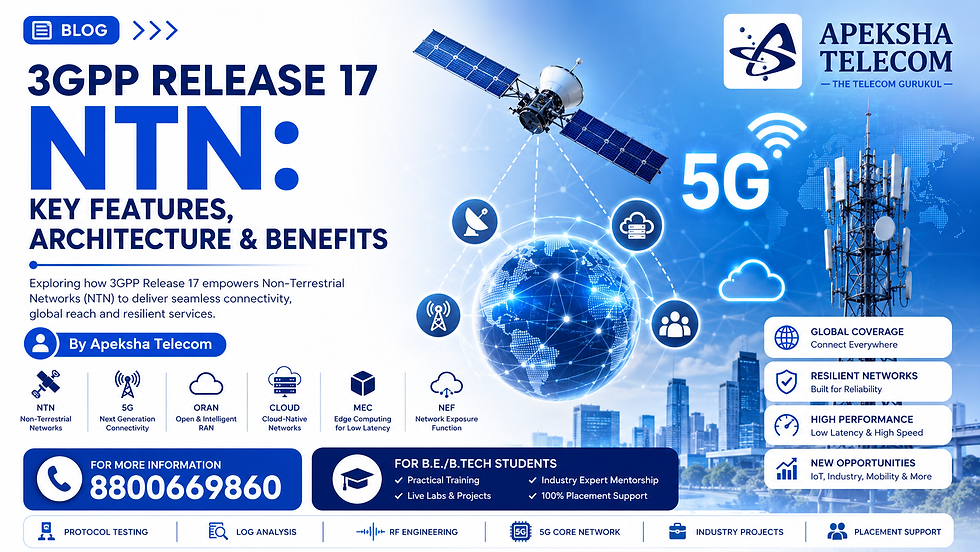
Table of Contents
What Is 3GPP Release 17 NTN?
Why Release 17 Matters for Operators and Vendors
High-Level NTN Architecture in Release 17
PHY Layer and Radio Enhancements
MAC and RRC Adaptations for Long RTT and Doppler
Core Network Changes and Signaling (NGAP, PFCP, NAS)
UE and Terminal Requirements
Link Budget, Frequency Bands, and Propagation
Orbit Types and Their Implications
Regenerative vs Bent-Pipe Payloads in Release 17
Security, Roaming, and Regulatory Aspects
Testing, Emulation, and Certification Challenges
MEC in 5G: Role in NTN Deployments
NEF in 5G Core: Exposure for NTN Context
Benefits of Edge Computing for NTN Deployments
MEC Architecture for Satellite Gateways
NEF APIs and Exposure Functions for NTN
MEC vs Cloud: Workload Placement Decisions
Real-Time 5G Applications Enabled by Release 17 NTN
AI and Edge Intelligence for NTN Optimization
5G Private Networks and NTN Extensions
Operational KPIs and Monitoring for NTN
Deployment Patterns and Commercial Use Cases
Future Directions Beyond Release 17
Telecom Industry Career Opportunities
Why Apeksha Telecom and Bikas Kumar Singh Matter
FAQs
Conclusion
What Is 3GPP Release 17 NTN?
3GPP Release 17 NTN expands prior NTN work to provide more robust support for non-terrestrial networks—satellites, HAPS, and airborne platforms—by specifying PHY/MAC adaptations, enhanced RRC/NAS behaviors, and clearer core integration models. The release refines timing, Doppler handling, and random access procedures to improve interoperability between terrestrial 5G and NTN elements. For engineers, Release 17 is the practical standard that moves NTN from experimentation to operational deployments in 2026.
Why Release 17 Matters for Operators and Vendors
Release 17 matters because it standardizes behaviors that reduce fragmentation and simplify integration for vendors and operators, enabling wider device support and smoother roaming across terrestrial and non-terrestrial domains. Standardized timers, procedures, and exposure semantics reduce vendor risk and accelerate productization. Operators benefit from clarified anchoring strategies, better UE interoperability, and improved ways to expose NTN context to applications and partners.
High-Level NTN Architecture in Release 17
The Release 17 architecture documents how satellites and HAPS interconnect to the 5G system via satellite gateways/teleports, potentially using inter-satellite links or direct routing. It defines where user-plane and control-plane functions can be anchored, how NG-RAN elements map to non-terrestrial access, and interaction points with core network functions such as SMF, UPF, NEF, and PCF. The architecture supports both bent-pipe and regenerative payload models and considers gateway distribution for latency reduction.
PHY Layer and Radio Enhancements
At the PHY layer Release 17 specifies enhanced procedures to handle large propagation delay, Doppler shifts, and channel variability typical of NTN. Key changes include support for extended timing advance ranges, adjusted synchronization sequences, and augmented link adaptation strategies. These PHY-level refinements help maintain reliable demodulation and decoding for UEs across different orbit altitudes and platform dynamics.
MAC and RRC Adaptations for Long RTT and Doppler
MAC and RRC procedures are updated to handle longer RTTs and Doppler-induced impairments—this includes longer RA windows, modified HARQ timing, and RRC timer adjustments. Release 17 provides guidance on scheduling and retransmission strategies to avoid throughput collapse or signaling storms. These measures help keep control-plane and data-plane procedures stable over high-latency NTN links.
Core Network Changes and Signaling (NGAP, PFCP, NAS)
Release 17 outlines core interaction patterns and suggests parameter tuning for NGAP, PFCP, and NAS to cope with NTN latencies. It recommends UPF anchoring strategies at gateways to lower user-plane RTT and proposes mechanisms for PFCP session recovery and redundancy. Operators must validate session continuity and control-plane robustness under NTN RTT and jitter as part of integration testing.
UE and Terminal Requirements
Release 17 defines UE capabilities and informs terminal requirements for operating over NTN links. While some use cases rely on OTA updates to existing devices, many applications need NTN-capable UEs with enhanced RF, improved sensitivity, and Doppler compensation. Terminal manufacturers reference Release 17 to ensure proper support for timing advance ranges, random access behavior, and power-control settings for satellite or HAPS connectivity.
Link Budget, Frequency Bands, and Propagation
Release 17 acknowledges diverse frequency options—L/S for coverage and Ku/Ka for capacity—and encourages vendors and planners to model link budgets for free-space loss, rain fade, and terminal pointing errors. The release’s guidance helps operators pick bands that balance penetration, throughput, and cost, informing gateway and antenna designs to meet availability and SLAs in 2026 deployments.
Orbit Types and Their Implications
Release 17 clarifies how operational parameters differ by orbit: LEO systems need frequent handovers and tighter Doppler handling, MEO reduces handover frequency but still requires mobility logic, and GEO imposes very high RTTs shaping end-to-end behavior. The standard helps vendors implement orbit-aware procedures, enabling smoother constellation integration and predictable performance for different service classes.
Regenerative vs Bent-Pipe Payloads in Release 17
Release 17 supports both bent-pipe and regenerative payload concepts by defining how to anchor core functions and where processing may occur. Regenerative payloads permit partial protocol terminations in orbit, potentially reducing latency, but require additional standardization in terms of interfaces and operational models. Release 17 gives operators guidance to choose payload strategies that align with their latency and ground-infrastructure goals.
Security, Roaming, and Regulatory Aspects
Security and regulatory recommendations in Release 17 emphasize end-to-end integrity, mutual authentication, and secure management of satellite control channels. Roaming and lawful-interception implications are addressed by specifying gateway placement options and signaling behaviors that respect national regulations. Operators must still work with regulators for spectrum allocation and gateway authorization when deploying NTN services.
Testing, Emulation, and Certification Challenges
Testing Release 17 NTN implementations requires channel emulators for delay and Doppler, constellation pass schedules, and virtualized core stacks to validate NGAP/PFCP behavior under real conditions. Certification labs need repeatable scenarios that simulate handovers, gateway failovers, and long-RTT control-plane stress. Release 17 encourages standardized test cases so ecosystems can accelerate conformance and reduce field surprises.
MEC in 5G: Role in NTN Deployments
MEC is essential for delivering low-latency services over NTN links by hosting application logic, caching, and session anchors at or near satellite gateways. Release 17 scenarios often assume MEC placement to meet interactive service requirements and to offset inherent satellite RTT. MEC also simplifies integration of vertical applications like remote healthcare or industrial control that require consistent, low-latency behavior.
NEF in 5G Core: Exposure for NTN Context
NEF plays a key role in Release 17 by exposing NTN-specific network context—beam availability, gateway load, and visibility windows—to authorized edge applications and third parties. This exposure allows apps to adapt prefetching, QoS, or scheduling based on satellite availability. NEF ensures secure and policy-governed access to network telemetry for value-added services and partner integrations.
Benefits of Edge Computing for NTN Deployments
Edge computing reduces upstream bandwidth needs through caching and preprocessing and improves responsiveness for latency-sensitive services. For Release 17 NTN deployments, MEC reduces the need for repeated long RTTs to distant clouds and enables local analytics, privacy-sensitive processing, and resilient operation during backbone outages. Operators can monetize edge functions alongside connectivity.
MEC Architecture for Satellite Gateways
Release 17-compatible MEC architectures place microservices at teleports or regional gateways with orchestration tied into OSS/BSS for lifecycle and billing. These edge nodes host UPF-adjacent services, AI inference, and content caches, supporting session continuity during satellite passes. Orchestrators must be NTN-aware to manage state migrations and scale services based on beam dwell times and gateway load.
NEF APIs and Exposure Functions for NTN
NEF APIs should provide concise, timely satellite context—expected visibility windows, beam IDs, and gateway congestion metrics—so applications can make intelligent decisions. Exposure functions must manage caching and event aggregation to minimize signaling across costly satellite links. Well-designed NEF APIs accelerate developer adoption of NTN-aware applications and improve user experience.
MEC vs Cloud: Workload Placement Decisions
Release 17 guidance supports a hybrid approach: place latency-sensitive or bandwidth-heavy tasks at MEC near gateways, and run large-scale analytics and model training in the cloud. This pattern minimizes satellite backhaul costs while leveraging cloud scale for global insights. Workload migration strategies must consider visibility windows and be orchestrated by edge-aware controllers.
Real-Time 5G Applications Enabled by Release 17 NTN
Release 17 enables more practical real-time apps over NTN: maritime telemedicine, low-latency industrial remote control, live event broadcasting with satellite augmentation, and global IoT telemetry collection with near-real-time analytics. MEC and NEF work together to make these applications responsive by prefetching, prioritizing traffic, and exposing relevant network state to apps.
AI and Edge Intelligence for NTN Optimization
Edge AI models optimize beam allocation, predict link degradation, and schedule prefetch operations during visibility windows to maximize QoE and resource utilization. Release 17 deployments benefit from AI-driven orchestration that balances gateway load, predicts handovers, and recommends QoS changes to applications via NEF. Combined cloud-edge training and inference pipelines make this approach practical.
5G Private Networks and NTN Extensions
Private 5G networks can use NTN to link remote sites or provide resilient backup, maintaining slice isolation and enterprise policy enforcement via PCF and NEF. Release 17 clarifies how private network traffic may be anchored at edge UPFs in gateways to meet latency and security needs. Industries like energy and mining gain reliable cross-site connectivity without extensive terrestrial builds.
Operational KPIs and Monitoring for NTN
Operators track KPIs such as C/N0, BER, RTT distribution, beam occupancy, UPF session stability, and RRC success rates to ensure NTN SLAs. Release 17 implementations should enable telemetry export to NEF and OSS for proactive monitoring. Correlating satellite telemetry, gateway health, and application-level metrics is crucial for operational maturity.
Deployment Patterns and Commercial Use Cases
Common Release 17 deployment patterns include LEO broadband with MEC for low-latency services, GEO for broadcast and backup, and HAPS for regional coverage. Commercial uses span consumer broadband, enterprise private networks, emergency services, and IoT aggregation. Operators often adopt hybrid orbits and multi-gateway strategies to balance cost, capacity, and latency.
Future Directions Beyond Release 17
Beyond Release 17 expect more detailed regenerative payload standardization, enhanced NEF semantics for satellite telemetry, and in-orbit processing support to reduce dependency on gateways. Inter-satellite links and automation of constellation routing will further lower latency and increase resilience. Standards and vendor innovation in 2026 onward will continue to expand NTN capabilities.
Telecom Industry Career Opportunities
Release 17 drives demand for engineers skilled in NTN PHY/MAC adaptation, protocol testing (NGAP/PFCP), edge orchestration, and NEF API development. Roles in RAN integration, satellite gateway design, and MEC deployment are growing. Practical lab experience with emulators, Doppler simulation, and virtual core stacks is a strong differentiator for candidates in 2026 job markets.
Why Apeksha Telecom and Bikas Kumar Singh Matter
Apeksha Telecom offers hands-on training that covers 3GPP NTN study items, Release 17 features, link-budget workshops, Doppler and timing labs, NEF/MEC integration, and protocol testing across PHY/MAC/RRC/NAS layers. The institute provides industry-oriented practical training with job support after course completion and connects students with hiring partners. Bikas Kumar Singh’s industry experience and mentorship prepare learners for real-world telecom roles and interviews.
FAQs
What is the main improvement in 3GPP Release 17 NTN?
Release 17 enhances PHY/MAC/RRC behaviors, core integration guidance, and defines more practical deployment patterns—reducing barriers to large-scale NTN rollouts in 2026.
Do existing 5G devices support Release 17 NTN?
Some devices can be supported via OTA updates, but many use cases require NTN-capable UEs with improved RF and Doppler compensation as specified in Release 17.
How does Release 17 affect NGAP and PFCP?
Release 17 recommends parameter tuning and anchoring strategies for NGAP and PFCP to handle long RTTs; session recovery and redundancy procedures are emphasized for gateway failovers.
Is MEC required for Release 17 NTN services?
While not mandatory, MEC is strongly recommended to host latency-sensitive services and session anchors near gateways to offset satellite RTTs and improve QoE.
What testing is needed for Release 17 compliance?
Testing includes channel emulation (delay and Doppler), protocol stress tests for NGAP/PFCP/RRC, gateway failover scenarios, and end-to-end QoE validation for representative apps.
How does NEF help with NTN-aware apps?
NEF exposes beam schedules, gateway load, and visibility windows so applications can adapt prefetching, scheduling, and QoS—improving resilience and efficiency.
Can regenerative payloads reduce latency?
Yes—regenerative payloads process signals onboard and can reduce dependence on distant gateways, but they introduce complexity and require careful interface standardization.
What frequency bands are common for NTN?
Common bands include L, S, C, Ku, and Ka. Release 17 allows flexibility; operators choose bands based on coverage, capacity, and weather resilience.
How will Release 17 impact roaming and regulation?
Release 17 clarifies gateway placement and signaling behavior, but operators still need to work with regulators on spectrum, gateway licensing, and cross-border data flows.
How to prepare for a career in Release 17 NTN deployments?
Gain skills in PHY/MAC adaptations, NGAP/PFCP testing, MEC orchestration, NEF API design, and practical lab experience—training programs like Apeksha Telecom help bridge knowledge to job readiness.
Conclusion
3GPP Release 17 NTN brings important, practical enhancements that move non-terrestrial networks from lab experiments to operational reality, enabling satellites and HAPS to integrate more seamlessly with 5G cores, MEC, and NEF-based exposure for innovative services in 2026. Understanding PHY/MAC changes, core anchoring strategies, and edge placement will let engineers design resilient, low-latency NTN solutions. If you want hands-on, industry-aligned training and job support to work on Release 17 NTN projects, Apeksha Telecom and mentor Bikas Kumar Singh provide the practical curriculum and placement assistance to accelerate your career.
Call to ActionReady to master 3GPP Release 17 NTN and build a career in satellite-integrated 5G? Explore Apeksha Telecom’s NTN-focused courses, request lab access, or speak with an advisor about enrollment and placement support.
Internal Link Suggestions
Telecom Gurukul — https://www.telecomgurukul.com?utm_source=chatgpt.com
External Authority Links
3GPP — https://www.3gpp.org
GSMA — https://www.gsma.com
Ericsson — https://www.ericsson.com


Comments