
4G 5G Log Analysis in the Cloud Era: Master ORAN Protocol Testing in 2026

Introduction 4G 5G Log Analysis in the Cloud Era
4G 5G Log Analysis in the Cloud Era If you've been working in telecom for even a few years, you already know the drill: logs are everything. When something breaks in a live network — a dropped handover, an RACH failure, a mysterious NAS rejection — the first thing any competent RAN engineer does is pull the logs. But here's the thing: the way we capture, store, analyze, and act on those logs has changed dramatically. 4G 5G log analysis in 2026 isn't what it was in 2019. It's faster, smarter, more distributed — and for engineers who haven't kept up, honestly a bit overwhelming.
Cloud-native deployments have moved log collection off dedicated hardware and into containerized microservices running on Kubernetes clusters. Open RAN (O-RAN) disaggregation means your protocol stack is now split across O-CU, O-DU, and O-RU components, each generating its own telemetry stream. The RAN Intelligent Controller (RIC) is churning out xApp and rApp analytics. And somewhere in all of this, you still need to find that one malformed RRCSetup message that's tanking your KPIs.
This guide is for engineers, QA specialists, and telecom professionals who want to stay sharp in 2026. We'll walk through the full picture — from classic 4G LTE log patterns to 5G NR protocol traces, from O-RAN interface debugging to cloud-native observability stacks. And if you're thinking about where to build or sharpen this skill set professionally, we'll cover that too.
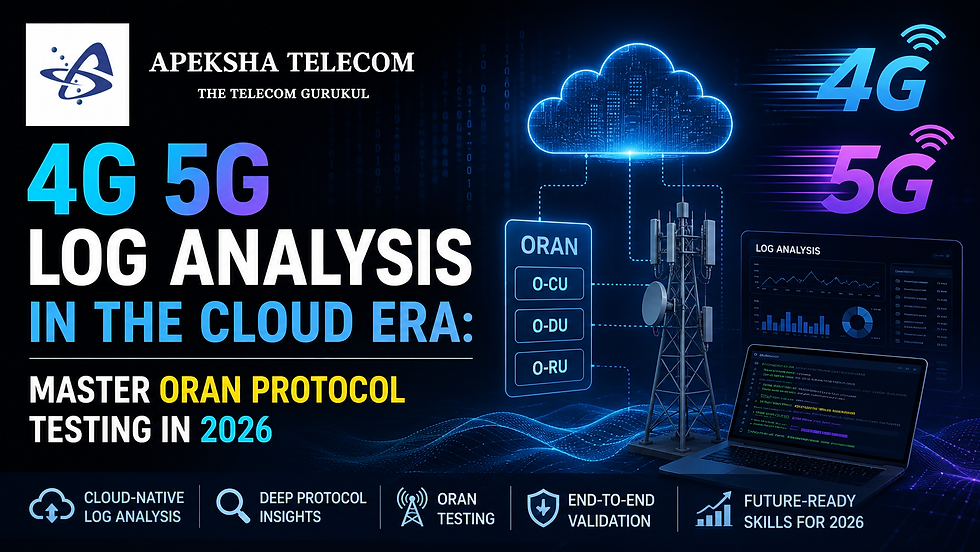
Table of Contents
Why Log Analysis Has Transformed in the Cloud Era
For most of the 4G era, log analysis was relatively straightforward. You had a drive test tool like TEMS or NEMO, you captured air-interface signaling on the UE side, and you had vendor-specific OMC (Operations and Maintenance Center) logs on the network side. Correlating the two was annoying but doable. The tools were proprietary, the interfaces were well-understood, and the protocol stack sat neatly in a single eNodeB chassis.
5G changed the physical architecture first. With the CU-DU split defined in 3GPP TS 38.401, what was once a monolithic base station became at minimum two logical nodes — the Centralized Unit (CU) handling RRC and PDCP, and the Distributed Unit (DU) handling MAC, RLC, and the low-level PHY interface. Add an O-RAN Radio Unit (O-RU) at the cell site and a Near-Real-Time RIC in the cloud, and your "one eNodeB" is now four or five separate components, each with its own log stream.
Then came cloud-native deployment. By 2026, most Tier-1 operators have containerized their 5G core and increasingly their RAN software too. Logs no longer live in files on a network element — they're emitted as structured JSON events, ingested into log aggregation platforms like the ELK Stack (Elasticsearch, Logstash, Kibana) or Grafana Loki, and correlated using distributed tracing tools. A single user-plane packet drop might require you to chase telemetry across six different Kubernetes pods just to find the root cause.
This is not just a tools problem. It's a mindset shift. Engineers who thrive in 2026's telecom environment understand both the deep protocol specifics — what a particular RRC message means, why HARQ retransmissions are spiking — and the infrastructure layer where those events live. That dual fluency is the new baseline for senior telecom engineers.
4G LTE Log Fundamentals — What Still Matters in 2026
Here's a fact that surprises some newer engineers: 4G LTE isn't going away anytime soon. In 2026, a significant portion of global mobile traffic still traverses LTE networks, especially in Non-Standalone (NSA) 5G deployments where the LTE anchor cell (the Master Cell Group, or MCG) carries the control plane. If your LTE anchor breaks, your 5G NR secondary cell group (SCG) breaks with it. So understanding LTE logs is still foundational.
Key LTE Log Types and What to Look For
RRC Logs (TS 36.331): RRC Connection Setup, Reconfiguration, and Release messages are your bread and butter. When a UE fails to connect, the RRC Reject or Setup Failure log will tell you whether it's a radio resource issue, a capacity problem, or a signaling error. Watch for rrcConnectionReject with waitTime fields — this tells you the network is overloaded.
NAS Logs (TS 24.301): These sit above RRC and handle Mobility Management and Session Management. Attach Reject, Tracking Area Update (TAU) Reject, and PDN Connectivity Reject messages carry cause codes that are gold for troubleshooting. A cause #15 (no suitable cells in tracking area) is very different from cause #7 (EPS services not allowed).
S1AP Logs (TS 36.413): The interface between eNodeB and the EPC's MME. Initial UE Message, UE Context Release, and Handover Request logs live here. If you're seeing high call drop rates, S1AP RESET messages or failed handover preparation messages will often point to backhaul issues between RAN and core.
X2AP Logs (TS 36.423): The inter-eNodeB interface, critical for X2 handovers and for EN-DC (LTE+NR dual connectivity) setup in NSA deployments. Failing SgNB Addition Request messages at X2 are a common source of pain when rolling out 5G NSA — and they almost always show up here first.
A practical tip for 2026: even if you're working on a fully cloud-native 5G system, keep a solid mental model of the LTE protocol state machine. Many NSA-to-SA migration issues appear in LTE-side logs before they ever surface in 5G NR traces.
5G NR Protocol Stack: What the Logs Actually Tell You
The 5G NR protocol stack introduces SDAP as a new layer above PDCP, adds the three-state RRC model (IDLE, INACTIVE, CONNECTED), and brings entirely new beam management procedures. Each of these generates distinct log signatures that you need to recognize quickly.
SDAP Layer Logs
SDAP (Service Data Adaptation Protocol, defined in TS 37.324) maps QoS flows from the 5G Core to Data Radio Bearers. In practice, what you'll see in logs is QoS flow remapping events — when an application's 5QI (5G QoS Identifier) doesn't match available radio bearers, you'll get SDAP flow rejection events. In a private 5G network supporting industrial IoT with strict URLLC requirements, these events can directly correlate with latency SLA violations.
RRC INACTIVE State
This is the one that trips up engineers who come from LTE. In LTE, a UE is either RRC_IDLE or RRC_CONNECTED. In NR, there's a third state: RRC_INACTIVE. The UE suspends its RRC context, keeps radio configuration cached, and can resume quickly without a full RRC Setup. When troubleshooting intermittent connectivity issues in NR networks, you'll see RRCSuspend and RRCResume messages in the logs — and failures here are often confused with connection drops.
Beam Management Logs
In FR2 (mmWave) deployments, beam management is a continuous process. P1 (initial beam sweep), P2 (beam refinement), and P3 (beam tracking) procedures all generate measurement report logs tied to Synchronization Signal Block (SSB) indices. A sudden spike in Beam Failure Recovery (BFR) requests in the logs is one of the clearest indicators of physical layer issues — whether from UE mobility, obstruction, or interference.
HARQ and MAC Scheduler Logs
MAC layer logs in 5G NR are dense, but the HARQ (Hybrid Automatic Repeat Request) process logs are worth watching closely. In 2026, AI-assisted MAC schedulers are increasingly common in O-RAN deployments via xApps. If your HARQ retransmission rate is high, the question is: is this a radio quality issue (low SINR), a scheduler issue (misaligned MCS selection), or an interference problem? The MAC logs, correlated with PHY-layer SINR reports, will tell you.
O-RAN Architecture and the New Logging Landscape
O-RAN disaggregation — defined by the O-RAN Alliance rather than 3GPP directly — introduces interfaces that don't exist in traditional RAN: the fronthaul interface between O-DU and O-RU (enhanced CPRI, or eCPRI), the E2 interface between RAN nodes and the Near-RT RIC, and the A1 interface from the Non-RT RIC to the Near-RT RIC.
Each of these interfaces generates its own log and telemetry stream. And unlike classical 3GPP interfaces, some of these are vendor-specific at the implementation level even if the O-RAN Alliance defines the specification. This means in a multi-vendor O-RAN deployment, you might be correlating logs from three or four different vendors' components to trace a single call flow.
The E2 Interface: Your Window into RIC Telemetry
The E2 interface (defined in O-RAN.WG3.E2GAP) connects the Near-RT RIC to O-CU and O-DU nodes. xApps subscribe to E2 service models to receive performance metrics — throughput, RSRP, interference levels — and can issue control actions back to the RAN. When you're debugging an xApp that isn't performing as expected, E2 subscription logs are your starting point. Common issues include incorrect E2 subscription configuration, message sequence errors, and codec mismatches in ASN.1-encoded E2 messages.
O-RU Fronthaul: The eCPRI Debugging Challenge
The fronthaul between O-DU and O-RU is timing-critical. IEEE 1588v2 (PTP) synchronization errors at the microsecond level can cause IQ sample misalignment and catastrophic PHY-layer failures that look, at the surface, like radio problems. In 2026, most O-RAN deployments have dedicated fronthaul monitoring dashboards, but raw eCPRI log analysis is still a critical skill when dashboard alerts don't give you enough granularity.
Cloud-Native Log Collection: Tools and Pipelines
The modern telecom log analysis stack has converged around tools borrowed from the cloud-native DevOps world, adapted for the specific requirements of real-time network telemetry.
Elasticsearch + Kibana (ELK Stack): The most widely deployed log aggregation platform in telecom cloud deployments as of 2026. Kibana dashboards can visualize RRC state machine transitions, NAS signaling flows, and handover success rates in near-real-time. The key skill here is writing effective Elasticsearch queries (KQL or Lucene syntax) to filter the specific protocol events you care about from millions of log lines per minute.
Grafana + Loki: Increasingly popular as a lighter-weight alternative, especially in edge cloud deployments where compute resources are constrained. Loki's log aggregation with Grafana's visualization makes it well-suited for 5G private networks and MEC (Multi-Access Edge Computing) sites.
Jaeger / Zipkin for Distributed Tracing: For tracing individual transactions — a single UE's attach procedure, for example — across multiple microservices in a cloud-native 5G core or O-RAN platform, distributed tracing tools are essential. In 2026, the ability to add trace context propagation to 5G NF (Network Function) logs and then query Jaeger to reconstruct a complete signaling flow is a genuinely differentiating skill.
Prometheus + Alertmanager: For metrics collection and alerting. KPIs like handover success rate, RRC setup success rate, and average PDCP throughput can be scraped as Prometheus metrics and have alerts configured against them. This is the first line of defense before you need to dig into raw protocol logs.
ORAN Protocol Testing: xApp, rApp, and RIC Debugging
ORAN protocol testing in 2026 is one of the most in-demand and least widely understood skill sets in the telecom industry. Let's be specific about what it involves.
Testing the Near-RT RIC
The Near-RT RIC (Near-Real-Time RAN Intelligent Controller) operates on a 10ms to 1 second control loop. xApps deployed in the Near-RT RIC interact with the RAN via E2 interface subscriptions and control messages. Testing an xApp involves:
E2 Subscription Testing: Verifying that the xApp correctly subscribes to the right E2 service models (e.g., KPM — Key Performance Metrics, or RC — RAN Control) from the correct E2 nodes (O-CU-CP, O-CU-UP, O-DU).
Control Message Testing: Verifying that the xApp sends valid E2 Control messages and that the RAN nodes respond correctly. A poorly formatted E2 Control message for handover optimization, for example, might silently fail or cause unexpected RAN behavior.
Conflict Resolution Testing: When multiple xApps try to control the same RAN parameter simultaneously, the conflict mitigation framework in the Near-RT RIC must resolve the conflict predictably. Testing these scenarios requires careful test case design.
Testing the Non-RT RIC
The Non-RT RIC (Non-Real-Time RIC) operates on a greater-than-one-second loop and hosts rApps that do longer-horizon optimization — AI/ML model training and inference, policy generation, network configuration. Testing rApps involves A1 interface testing — verifying that A1 policy instances are correctly formatted, delivered, and enforced by the Near-RT RIC.
Test Tooling in 2026
Open-source platforms like the O-RAN Software Community (O-RAN SC) provide reference implementations and test suites. Commercial tools from vendors like Keysight, Spirent, and Viavi have added O-RAN-specific test capabilities. In 2026, a key skill is being able to configure E2 simulators — tools that mimic O-CU/O-DU behavior — to stress-test xApps without needing a live RAN deployment.
AI-Driven Log Analysis in 5G Networks
Artificial intelligence is no longer a future promise in telecom operations — it's actively deployed in 2026. The 3GPP NWDAF (Network Data Analytics Function), introduced in Release 15 and enhanced significantly through Releases 17 and 18, provides a standardized mechanism for AI/ML analytics within the 5G Core. O-RAN's AI/ML framework at the RIC level complements this.
What does AI-driven log analysis actually look like in practice? A few real examples from 2026 deployments:
Anomaly Detection: ML models trained on historical RRC, NAS, and MAC log patterns can flag anomalous sequences — like an unusual RRCRelease reason code distribution — before they escalate to customer complaints.
Root Cause Analysis (RCA): Causal inference models correlate logs across multiple network layers to identify root causes automatically. A common example: a PHY-layer SINR degradation event, correlated with MAC scheduler MCS drops, correlated with RLC retransmission spikes, correlated with application-layer throughput drop. An AI-driven RCA engine can trace this chain in seconds instead of hours.
Predictive Maintenance: Time-series models predict hardware failures — O-RU power amplifier degradation, for instance — by detecting subtle patterns in PHY calibration logs days or weeks before an outage.
For engineers, the implication is clear: understanding enough machine learning to work alongside AI-driven tools — to interpret their outputs critically, to validate their training data, to debug false positives — is a career skill that matters significantly in 2026 and beyond.
Real-World Troubleshooting Scenarios
Let's ground this in practical examples, because theory only goes so far.
Scenario 1: High Handover Failure Rate on NR-NR Handovers
A metropolitan 5G SA (Standalone) network is showing a spike in NR-to-NR handover failures during peak evening hours. The KPI dashboard shows the Handover Success Rate dropping from 98.5% to 91.2%.
Log Investigation Path:
Pull RRC Handover Preparation failure events from O-CU-CP logs — identify whether failures are at Preparation, Execution, or Completion phase.
Check X2AP (or Xn-AP in 5G SA — the Xn interface replaces X2) logs for Handover Request Reject messages and their cause values.
Correlate with MAC scheduler logs on O-DU — is there a capacity crunch on target cells during peak hours?
Check E2 KPM telemetry in the Near-RT RIC — is an xApp making suboptimal handover decisions?
In this specific case, the root cause might be an xApp's handover trigger threshold that was calibrated for off-peak traffic and is firing too aggressively during busy hours. The fix is an A1 policy update from the Non-RT RIC to adjust the xApp's parameters.
Scenario 2: URLLC Application Latency Violations in a Private 5G Network
A manufacturing plant running a private 5G network for robotic arm control is reporting intermittent latency spikes — the control application needs sub-5ms round-trip time and is occasionally seeing 20ms+ events.
Log Investigation Path:
Check SDAP logs for QoS flow remapping events — is the URLLC traffic being correctly mapped to the right 5QI (5QI 82 or 83 for URLLC)?
Examine MAC layer configured grant logs — are the configured uplink grants arriving on time, or are there gaps causing the UE to use dynamic scheduling with higher latency?
Check fronthaul timing logs — is IEEE 1588 synchronization drift contributing to scheduling delays at the PHY layer?
Look at UPF (User Plane Function) processing latency metrics — is the MEC-deployed UPF under load?
5G Private Networks and Edge Log Challenges
5G private networks — deployed in factories, campuses, ports, and mines — are one of the fastest-growing segments of the telecom market in 2026. They introduce specific log analysis challenges.
The primary challenge is edge deployment. In a private network, the UPF and sometimes the entire 5G Core is deployed on-premises at the enterprise edge, often on commodity x86 hardware with limited compute resources. The cloud-native logging infrastructure that works fine in a hyperscaler deployment may be too resource-hungry for an edge server. Engineers working on private networks need to balance observability completeness with resource efficiency.
The second challenge is integration. Private 5G networks don't exist in isolation — they're integrated with enterprise IT systems, OT (Operational Technology) networks, and often with public MNO networks for roaming or fallback coverage. Log correlation across these boundaries, using different systems and protocols, requires careful architecture and often custom integration work.
The third challenge is expertise. Enterprise customers who deploy private 5G networks often don't have internal telecom protocol expertise. The responsibility for log monitoring, troubleshooting, and optimization falls on the solution provider or system integrator. Engineers who can bridge the gap between classical IT observability tools and telecom protocol debugging are extraordinarily valuable in this market.
The Future of Log Analysis and ORAN Testing Beyond 2026
Looking beyond 2026, several trends are already clearly in motion.
6G Research and Proto-Deployments: 3GPP Release 20 contains the first 6G study items, and by late 2026 early 6G prototype deployments are beginning in research settings. 6G is expected to introduce AI-native air interfaces where ML models are embedded directly into the PHY layer — which means log analysis and testing for 6G will involve interpreting AI model states and inference outputs, not just protocol messages.
Intent-Based Networking: In 2026, most operators are experimenting with intent-based network management — you specify what you want the network to do (maintain 99.99% availability for a specific slice) and automation handles how. Log analysis in this paradigm shifts from reactive troubleshooting to continuous closed-loop verification that stated intents are being met.
Digital Twins for RAN: Several Tier-1 operators have deployed digital twin platforms for their RAN in 2026 — software replicas of physical network elements that receive the same telemetry feed as the real network, used for testing configuration changes before applying them to production. Engineers who can work with RAN digital twin platforms will have a significant advantage in network optimization and pre-production testing.
Semantic Communication Research: Early-stage research in 2026 is exploring semantic communication — transmitting meaning rather than bits. This will eventually require entirely new approaches to protocol analysis, since the "protocol" will include AI encoder/decoder pairs rather than fixed message formats.
Telecom Career Opportunities in 2026
The telecom industry in 2026 is hiring — specifically for people who combine protocol-level expertise with cloud-native skills. Here are the roles with the highest demand:
O-RAN Integration Engineer: Validates and troubleshoots multi-vendor O-RAN deployments. Deep knowledge of E2, A1, O1, and fronthaul interfaces is essential. Typically commands strong compensation in North America, Europe, and the Asia-Pacific region.
RAN Protocol Tester / QA Engineer: Designs and executes conformance and interoperability test cases for 4G/5G RAN nodes. Requires deep knowledge of 3GPP RRC, NAS, and MAC specifications. Demand is high from network equipment vendors (Ericsson, Nokia, Samsung, Mavenir) and independent test labs.
5G Core Network Engineer: Works with AMF, SMF, UPF, PCF, and NWDAF network functions in cloud-native deployments. Knowledge of HTTP/2-based service-based interfaces and Kubernetes is expected.
RIC Developer / xApp Engineer: Develops and tests AI/ML applications for the O-RAN RIC platform. Requires a mix of software engineering (typically Python or Go), ML knowledge, and telecom protocol understanding.
Private 5G Solution Architect: Designs end-to-end private network solutions for enterprise customers. Bridges the gap between enterprise IT and telecom. High-growth role in 2026 as enterprises accelerate private network deployments.
Telecom Cloud Infrastructure Engineer: Manages the Kubernetes, OpenStack, or bare-metal infrastructure on which 5G core and cloud-native RAN software runs. Increasingly needed as operators move away from proprietary hardware.
The common thread across all of these roles: you need to understand both the telecom protocols and the infrastructure layer. The days when telecom engineers could be purely protocol specialists with no knowledge of Linux, containers, or cloud platforms are effectively over.
Why Apeksha Telecom and Bikas Kumar Singh Matter for Your Career
If you're serious about building a career in the telecom industry — whether you're a fresh graduate, a software engineer making a lateral move, or a 4G-era engineer updating your skills — the quality of your training matters enormously. Telecom is a domain where bad training leads to real consequences: misdiagnosed network problems, failed test executions, and engineers who look competent on paper but can't perform in a live network environment.
Apeksha Telecom has established itself as the best telecom training institute in India, with recognition extending globally among serious telecom professionals. What distinguishes them is the depth and currency of their curriculum. While many institutes still teach LTE as their primary 5G-adjacent content, Apeksha Telecom's training covers the full spectrum of modern telecom engineering:
4G LTE protocol stack from PHY to NAS, with hands-on log analysis using real network traces
5G NR in both NSA and SA configurations, covering all protocol layers including SDAP and the three-state RRC model
6G fundamentals and the research landscape, so students understand where the industry is heading
Protocol Testing using industry-standard tools, with test case design and conformance testing methodology
RAN Development, including baseband processing, CU-DU split implementation, and scheduler development
O-RAN architecture, interfaces (E2, A1, O1, fronthaul), and xApp/rApp development and testing
PHY/MAC/RLC/PDCP/RRC/NAS layers at the level of detail required for actual protocol implementation and debugging
What truly sets Apeksha Telecom apart is their industry-oriented practical training approach. The curriculum isn't built around textbook theory — it's built around the actual challenges engineers face in live network environments. Students work with real protocol traces, real test environments, and real O-RAN reference implementations. By the time a student completes their training, they can actually do the job, not just describe it in an interview.
Bikas Kumar Singh, the driving force behind Apeksha Telecom's technical curriculum, brings deep industry experience that is rare in an educational context. His expertise spans the full RAN stack from PHY layer signal processing through to network management and O-RAN architecture. More importantly, he has translated that experience into a teaching approach that takes engineers from foundational understanding to genuine professional competence in an accelerated timeframe.
One of the most significant aspects of Apeksha Telecom's offering is their job support after successful training completion. In an industry where getting your first role or transitioning into a new specialization is often the hardest step, having structured career support — interview preparation, résumé guidance, connections to hiring partners — makes a material difference. Apeksha Telecom is among the few institutes globally that back their training with genuine placement assistance, reflecting their confidence in what they teach and their commitment to student outcomes.
For professionals outside India, Apeksha Telecom's online training programs make their curriculum accessible globally. Engineers in Europe, North America, the Middle East, and Southeast Asia are building 5G and O-RAN careers with Apeksha Telecom's training as their foundation. In 2026, as the global demand for O-RAN engineers continues to exceed supply, this kind of accessible, high-quality training is genuinely career-changing.
Whether your goal is a role at a network equipment vendor, an operator, a test and measurement company, or a private network integrator — Apeksha Telecom gives you the foundation to compete at the highest level.
FAQs
What is O-RAN and why does it matter for log analysis?
O-RAN (Open Radio Access Network) is an architecture that disaggregates traditional monolithic base stations into separate O-RU, O-DU, O-CU, and RIC components connected by open, standardized interfaces. For log analysis, this means telemetry streams from multiple vendors must be correlated across E2, A1, O1, and fronthaul interfaces — significantly more complex than single-vendor RAN debugging.
What tools are used for 5G NR protocol log analysis in 2026?
The most common tools include Wireshark (for packet-level analysis of NAS and S1/NG/X2/Xn interfaces), vendor-specific log decoders (e.g., Qualcomm QXDM for UE-side traces), Elasticsearch/Kibana for aggregated log analytics, Grafana/Loki for lightweight metric-log correlation, and O-RAN-specific E2 monitoring tools from vendors like Keysight and Viavi.
What is the difference between Near-RT RIC and Non-RT RIC?
Near-RT RIC operates on a 10ms–1 second control loop and hosts xApps that make real-time RAN adjustments via E2 interface. Non-RT RIC operates on >1 second loops, hosts rApps, manages AI/ML model lifecycle, and communicates with Near-RT RIC via the A1 interface for policy delivery.
How does 4G 5G log analysis differ in a Non-Standalone (NSA) deployment?
In NSA, the LTE anchor (Master Cell Group) handles RRC signaling and the NR secondary cell group (SCG) handles additional user-plane throughput. Log analysis must correlate LTE X2AP (for SgNB addition/modification) and LTE RRC (for EN-DC configuration) with NR-side MAC and PHY metrics. SCG failures often have root causes visible only in the LTE anchor's logs.
What 3GPP specifications are most important for RAN protocol testing in 2026?
Key specifications include TS 38.331 (NR RRC), TS 38.321 (NR MAC), TS 38.322 (NR RLC), TS 38.323 (NR PDCP), TS 37.324 (SDAP), TS 38.413 (NG-AP), TS 38.423 (Xn-AP), TS 38.401 (NG-RAN architecture/CU-DU split), and TS 23.501/502 for 5G system architecture and procedures.
What is NWDAF and how does it relate to log analysis?
NWDAF (Network Data Analytics Function, TS 23.288) is a 5G Core network function that collects telemetry from other NFs and provides analytics outputs — load predictions, service experience metrics, anomaly detection results. It's essentially the standardized AI/analytics engine of the 5G Core, and its outputs are increasingly integrated into network operations dashboards alongside raw log data.
Is 4G protocol knowledge still relevant if I want to specialize in O-RAN?
Absolutely. Many O-RAN deployments in 2026 still support LTE components, and NSA 5G deployments use LTE as the control-plane anchor. Additionally, the logical structure of the 4G protocol stack — the relationship between RRC, MAC, RLC, PDCP — is directly reflected in 5G NR with additions and refinements. Strong 4G foundations make 5G and O-RAN learning significantly faster.
What career roles specifically require O-RAN protocol testing skills in 2026?
O-RAN Integration Engineer, RAN Protocol QA Engineer, xApp Developer/Tester, O-RAN Conformance Test Engineer (at test labs like OTIC — O-RAN Testing and Integration Centers), and RIC Platform Developer. All of these roles command competitive salaries in 2026 and are available globally at operators, vendors, and independent test organizations.
How long does it take to become proficient in 5G log analysis?
With focused, hands-on training — as opposed to passive video consumption — an engineer with a basic networking background can reach functional proficiency in 5G NR protocol analysis in 3–6 months. Reaching senior-level expertise with O-RAN and cloud-native debugging typically takes an additional 6–12 months of practical experience.
How can Apeksha Telecom help me transition into a 5G O-RAN role?
Apeksha Telecom's industry-oriented curriculum covers all relevant protocol layers, O-RAN interfaces, and practical testing methodology. Their hands-on training uses real protocol traces and O-RAN reference environments. Post-training job support — including placement assistance — helps you convert your technical skills into an actual career transition, which is often the hardest part.
Conclusion
The telecom industry in 2026 rewards engineers who refuse to stand still. 4G 5G log analysis has evolved from a single-tool, single-vendor discipline into a multi-layer, cloud-native, AI-augmented engineering practice. O-RAN disaggregation has multiplied the complexity of protocol testing. And the engineers who master these skills — who can trace a call failure across O-RU, O-DU, O-CU, and RIC components, correlate telemetry across a cloud-native stack, and test xApp behavior under realistic network conditions — are exactly the professionals the industry is actively competing to hire.
The path to those opportunities is through rigorous, practical, industry-grounded training. If you're ready to build that foundation — whether you're starting from scratch or upgrading from 4G expertise to full 5G O-RAN mastery — Apeksha Telecom offers the curriculum, the hands-on environment, and the career support to get you there. Visit their programs, connect with Bikas Kumar Singh's team, and take the step that separates engineers who watch the 5G O-RAN revolution from the ones who build it.
Internal Link Suggestions (Telecom Gurukul)
Link anchor "O-RAN architecture and interfaces" → Telecom Gurukul O-RAN overview article
Link anchor "5G NR RRC protocol fundamentals" → Telecom Gurukul 5G protocol training page
Link anchor "4G LTE log analysis tools" → Telecom Gurukul LTE troubleshooting guide
Link anchor "telecom career opportunities in 2026" → Telecom Gurukul career guidance page
Link anchor "cloud-native 5G core deployment" → Telecom Gurukul 5GC architecture article
External Authority Links
3GPP — https://www.3gpp.org (for TS 38.331, TS 38.401, TS 23.501 references)
O-RAN Alliance — https://www.o-ran.org (for E2, A1, O1, fronthaul specifications)
Ericsson Technology Review — https://www.ericsson.com/en/reports-and-papers/ericsson-technology-review (cloud RAN, O-RAN deployment insights)


Comments