
4G 5G Protocol Testing & Log Analysis with ORAN : High-Demand Telecom Course of 2026

Introduction 4G 5G Protocol Testing & Log Analysis
4G 5G Protocol Testing & Log Analysis The telecom industry is evolving at a pace the world has never seen before. With the global rollout of 5G networks accelerating in 2026, companies are desperately hunting for engineers who truly understand 4G 5G Protocol Testing & Log Analysis with ORAN. This is not just a course — it is a career launchpad. If you are a telecom professional or a fresh engineer wondering where to invest your skills, this is the answer.
Protocol testing and log analysis sit at the very heart of network quality assurance. Every time a smartphone connects to a 5G tower, hundreds of signalling messages fly back and forth — and someone has to verify that every one of them is correct. That someone is a protocol test engineer. In 2026, with ORAN (Open Radio Access Network) reshaping the way telecom vendors build and deploy networks, the demand for specialists in this domain has skyrocketed globally.
This article gives you a detailed, expert-level look at why this course is the hottest telecom qualification you can earn right now. We walk you through the technology, the career paths, and why Apeksha Telecom — led by Bikas Kumar Singh — is the institute that will take you there.4G 5G Protocol Testing & Log Analysis
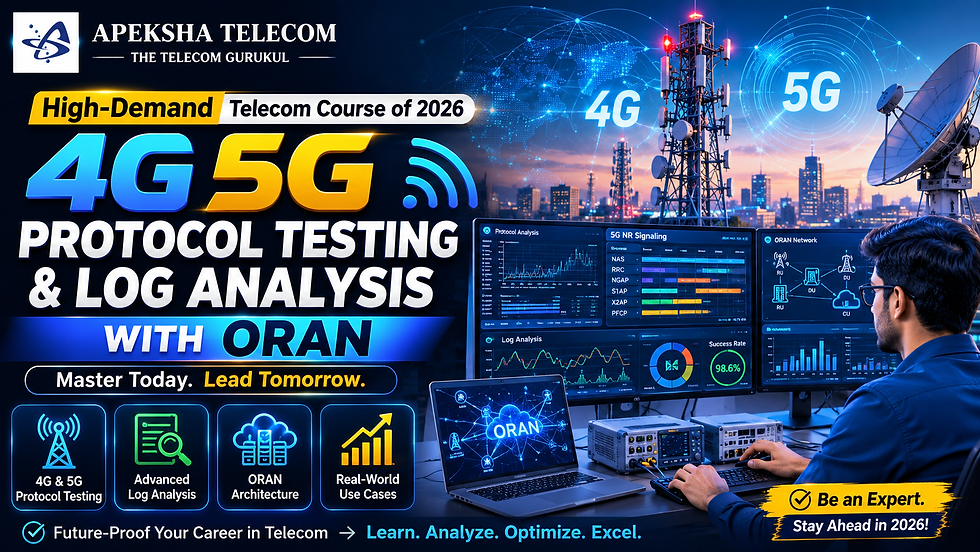
Table of Contents
What is Protocol Testing in 4G and 5G Networks?
Understanding Log Analysis in Telecom
What is ORAN and Why Does It Matter in 2026?
4G vs 5G Protocol Stack — Key Differences
Core Protocol Layers: PHY, MAC, RLC, PDCP, RRC, and NAS
Role of NEF in 5G Core Networks
What is MEC in 5G?
Benefits of Edge Computing in 5G
MEC Architecture Explained
NEF APIs and Exposure Functions
MEC vs Cloud Computing
Real-Time 5G Applications Enabled by ORAN and MEC
AI and Edge Computing — The 2026 Convergence
5G Private Networks and Protocol Testing
Future of MEC and NEF in 2026 and Beyond
Telecom Industry Career Opportunities in 2026
Why Apeksha Telecom and Bikas Kumar Singh Are Your Best Bet
FAQs
Conclusion
1. What is Protocol Testing in 4G and 5G Networks?
Protocol testing is the process of verifying that communication protocols between network nodes function correctly and comply with 3GPP specifications. In simpler terms, it checks that the "language" the network uses to communicate with devices — and with itself — is error-free, compliant, and efficient.4G 5G Protocol Testing & Log Analysis
In a 4G LTE network, protocol testing focuses on the air interface (Uu), the S1 interface between eNodeB and EPC, and internal interfaces like X2, S11, and S5/S8. Engineers use tools such as Wireshark, Qualcomm QXDM, Tektronix Iris, and Spirent to decode, capture, and analyse protocol messages in detail.
In 5G NR (New Radio), complexity jumps dramatically. The interface set now includes N1, N2, N3, Xn, F1, E1, and NG interfaces. The 5G Core (5GC) uses a Service-Based Architecture (SBA) where every network function — AMF, SMF, UPF, and others — communicates via HTTP/2 REST APIs. Testing these APIs alongside the radio protocol stack requires a much broader skill set than 4G demanded.
This is precisely why 4G 5G Protocol Testing & Log Analysis with ORAN has become the most sought-after qualification for telecom engineers who want to stay competitive. Companies like Ericsson, Nokia, Samsung Networks, MediaTek, and Qualcomm all list protocol testing as a core hiring requirement for their R&D and network validation teams.
2. Understanding Log Analysis in Telecom
Log analysis is what happens after you capture a protocol trace. Raw logs from devices and network elements are often thousands of lines long, containing hex-encoded messages, timestamps, state machine transitions, timer events, and error codes. Making sense of this data is both an art and a science.
A skilled log analysis engineer can examine a UE log from a 5G call drop and pinpoint within minutes whether the issue was at the PHY layer (signal quality), MAC layer (scheduling), RLC layer (retransmissions), PDCP layer (header compression), RRC layer (connection setup failure), or NAS layer (registration rejection). This root cause analysis capability is invaluable for chipset vendors, device OEMs, and network operators.
Common tools used in telecom log analysis:
QXDM and QCAT — Qualcomm Diagnostic Monitor and Analysis Tool
Wireshark with 3GPP dissectors
Tektronix K15 and Iris
XCAL and XCAP for drive testing
Keysight Nemo Outdoor and Nemo Analyze
Custom Python-based parsers for automated log processing
In 2026, AI-powered log analysis tools are entering the market, but human expertise remains critical for validating AI findings and handling edge cases. Engineers trained in manual log analysis continue to command premium salaries globally.
3. What is ORAN and Why Does It Matter in 2026?
ORAN stands for Open Radio Access Network. It is a transformative industry initiative that disaggregates and opens up the traditionally closed, vendor-proprietary RAN ecosystem. Before ORAN, telecom operators deploying Nokia radio units were essentially locked into Nokia baseband software and hardware. ORAN breaks this dependency entirely.
The O-RAN Alliance, founded in 2018, has driven standardization of open interfaces. By 2026, ORAN deployments are accelerating across North America, Europe, Japan, and India. Major operators including Rakuten Mobile, AT&T, Vodafone, and Reliance Jio are investing heavily in ORAN-based infrastructure.
ORAN introduces key new components that test engineers must master:
O-RU (Open Radio Unit): Antenna and radio front-end
O-DU (Open Distributed Unit): Lower MAC and PHY processing
O-CU (Open Central Unit): RRC and PDCP handling
Near-RT RIC: AI/ML-driven near-real-time RAN optimization
Non-RT RIC: Long-term policy management and AI model training
xApps and rApps: Third-party applications running on the RIC
For protocol test engineers, ORAN adds an entirely new layer of testing complexity. The Open Fronthaul interface (between O-RU and O-DU), the E2 interface (between RIC and RAN nodes), and the A1 and O1 management interfaces all require rigorous testing. This is why 4G 5G Protocol Testing & Log Analysis with ORAN is recognized as the most comprehensive telecom training programme in the industry today.
4. 4G vs 5G Protocol Stack — Key Differences
Understanding the architectural differences between 4G LTE and 5G NR is fundamental to any protocol testing role. While 4G introduced the Evolved Packet Core and a relatively flat RAN, 5G takes things further with a cloud-native, service-based core and a disaggregated, software-defined RAN.
4G LTE Protocol Stack
Air interface: LTE-Uu
Core: EPC (MME, SGW, PGW, HSS, PCRF)
RAN: eNodeB (monolithic — all baseband in one node)
Key protocols: S1-MME, S1-U, X2, GTP, SCTP, DIAMETER
5G NR Protocol Stack
Air interface: NR-Uu
Core: 5GC (AMF, SMF, UPF, UDM, PCF, AUSF, NRF, NEF, NWDAF)
RAN: gNB — disaggregated into CU and DU in ORAN
Key protocols: NG-AP, XnAP, F1AP, E1AP, HTTP/2 SBI, PFCP, GTP-U
The shift from DIAMETER-based authentication in 4G to 5G-AKA and EAP-AKA' in 5G, the introduction of Network Slicing, and the use of RESTful APIs across the 5GC create new testing dimensions. Courses that cover both 4G and 5G give engineers the end-to-end perspective that employers value most.
5. Core Protocol Layers: PHY, MAC, RLC, PDCP, RRC, and NAS
Every 4G and 5G engineer must command the full protocol layer stack. Here is what each layer means for testing:
PHY (Physical Layer)
The PHY layer deals with modulation, coding, MIMO antenna mapping, and actual bit transmission over air. Testing involves validating throughput under different channel conditions, HARQ efficiency, beamforming accuracy in mmWave, and CSI reporting.
MAC (Medium Access Control)
MAC manages scheduling, HARQ processes, and logical channel multiplexing. Log analysis at MAC involves checking DL/UL scheduling grants, buffer status reports (BSR), power headroom reports (PHR), and MAC Control Elements.
RLC (Radio Link Control)
RLC provides ARQ and segmentation/reassembly. Testing verifies RLC retransmission behaviour, PDU sequencing, and status report timing across acknowledged and unacknowledged modes.
PDCP (Packet Data Convergence Protocol)
PDCP handles header compression (ROHC), ciphering, and integrity protection. Dual connectivity and carrier aggregation scenarios require particularly careful PDCP log analysis.
RRC (Radio Resource Control)
RRC manages connection setup, reconfiguration, measurement reporting, handover, and idle/connected mode mobility. RRC log analysis helps engineers identify root causes for call drops, handover failures, and configuration mismatches.
NAS (Non-Access Stratum)
NAS operates between UE and core (AMF in 5G, MME in 4G). It handles registration, authentication, session management, and SMS. NAS log analysis is essential for troubleshooting registration failures, PDU session errors, and roaming issues.
6. Role of NEF in 5G Core Networks
The Network Exposure Function (NEF) is one of the most strategically important functions in the 5G Core architecture. Its role is to securely expose 5G network capabilities to external third-party applications, internal NFs, and Application Functions (AFs).
NEF acts as a gateway shielding internal 5GC functions from direct external access. When an application wants UE location data, QoS changes, or mobility event subscriptions, it must go through NEF rather than directly querying the UDM or AMF. This provides a clean security boundary and standardized API surface.
Key NEF Functions
Capability Exposure: Publishes APIs for third-party access to network capabilities
Event Monitoring: Exposes UE reachability, connectivity status, and location events
QoS Management: Allows AFs to request specific QoS levels for traffic flows
Analytics Exposure: Works with NWDAF to surface network analytics to external consumers
Policy Control: Interfaces with PCF to dynamically influence traffic policies
NEF testing involves validating the Nnef SBI interface, testing REST APIs using HTTP/2 clients, and verifying that event notifications are correctly generated and delivered. As ORAN integrations increasingly leverage NEF APIs for RAN analytics exposure, NEF expertise has become a prerequisite for senior 5G testing roles in 2026.
7. What is MEC in 5G?
MEC stands for Multi-Access Edge Computing — previously called Mobile Edge Computing. MEC brings computation and storage physically close to the end user: co-located at or near the 5G gNB, or at regional edge data centres a short hop from the radio.
Traditional cloud architecture processes all data at centralized data centres hundreds or thousands of kilometres from the user, introducing round-trip latencies of 50–200ms. MEC solves this by processing data locally, reducing latency to under 10ms — and below 1ms in some ultra-dense scenarios.
ETSI has been the primary standards body for MEC, defining the reference architecture, APIs, and deployment scenarios through its MEC ISG (Industry Specification Group). By 2026, MEC is a mainstream capability deployed across manufacturing, healthcare, transportation, and entertainment verticals worldwide.
8. Benefits of Edge Computing in 5G
The marriage of 5G and MEC unlocks capabilities that 4G and traditional cloud architectures cannot match. Key benefits include:
Ultra-Low Latency: Sub-10ms response times for mission-critical applications
Reduced Backhaul Load: Local processing significantly cuts traffic sent to the core
Enhanced Privacy: Sensitive data processed locally without leaving the network edge
Context-Aware Services: MEC apps leverage Radio Network Information Service (RNIS) for intelligent decisions
Scalability: Edge nodes scale independently to meet localized demand spikes
Offline Resilience: Edge applications continue functioning during WAN outages
Energy Efficiency: Reduced data transport across the network lowers energy consumption
For protocol test engineers, MEC adds a new testing dimension: validating interaction between the 5G UPF and MEC platforms, testing the N6 interface, verifying ULCL (Uplink Classifier) traffic steering policies, and ensuring QoS flows map correctly to application requirements at the edge.
9. MEC Architecture Explained
The ETSI MEC framework defines a layered architecture separating the MEC platform, MEC applications, and the virtualisation infrastructure beneath them.
Core MEC Architecture Components
MEC Host: Physical or virtual host where MEC apps run, typically co-located near a base station
MEC Platform: Runtime environment providing service registry and APIs for MEC applications
MEC Applications (MEC Apps): Containerized or VM-based software (e.g., video analytics, V2X, AR rendering)
MEC Platform Manager: Manages MEC application lifecycle on a specific host
MEC Orchestrator: Top-level entity responsible for application deployment across MEC hosts
Virtualisation Infrastructure Manager (VIM): Manages compute, storage, and networking (e.g., OpenStack, Kubernetes)
The integration of MEC with ORAN is one of the most exciting developments of 2026. ORAN's Near-RT RIC can host xApps that leverage MEC capabilities directly — for example, an xApp performing real-time video analytics at the edge and using those insights to drive RAN resource allocation. Testing these integrated architectures requires engineers fluent in both ORAN protocol stacks and MEC application management.
10. NEF APIs and Exposure Functions
NEF exposes its capabilities through standardized RESTful APIs defined in 3GPP TS 23.502, TS 29.522, and related specifications. These APIs are consumed by Application Functions (AFs) — which can be operator-owned or third-party enterprise applications.
Key NEF API Categories
Monitoring Events API (Nnef_EventExposure): Subscribe to UE state events — reachability, connectivity loss, roaming status
QoS API (Nnef_QoSMonitoring): Request and monitor QoS levels for specific traffic flows
Traffic Influence API: Steer UE traffic towards specific data networks or edge servers
Analytics API: Request NWDAF analytics for network performance and UE behaviour prediction
Charging and Policy APIs: Trigger dynamic charging rules and policy enforcement via PCF
Protocol testing of NEF APIs requires engineers to use HTTP/2 and TLS-based test clients, validate JSON schema compliance, test OAuth 2.0 token-based authentication via the NRF, and verify that NEF correctly relays requests to the appropriate internal network functions. In 2026, automated NEF API testing using CI/CD pipelines is becoming standard practice at major 5G vendors.
11. MEC vs Cloud Computing
The most common question: "Why do we need MEC when cloud infrastructure is so powerful?" The answer lies in latency, data locality, and context awareness.
Cloud Computing Profile
Centralized data centres (AWS, Azure, GCP regions)
Average latency to end user: 50–200ms
Massive compute capacity but network-distance constrained
Ideal for: Big data analytics, enterprise applications, batch processing
MEC (Edge Computing) Profile
Distributed nodes at or near the 5G base station
Latency: under 10ms, sometimes below 1ms
Smaller compute capacity but ultra-close to users and devices
Ideal for: Autonomous vehicles, AR/VR, industrial automation, real-time video analytics
In practice, most 5G architectures in 2026 use a hybrid model — MEC handles time-critical local processing while cloud handles aggregation, AI model training, and large-scale analytics. Protocol engineers must understand how N6 LAN interfaces, traffic steering, and UPF configurations support this hybrid model.
12. Real-Time 5G Applications Enabled by ORAN and MEC
The combination of ORAN intelligence and MEC compute power is unlocking real-time applications that transform entire industries. Key use cases in 2026:
Smart Manufacturing: 5G-connected robots with sub-5ms control loops via local MEC and ORAN-optimized scheduling
Connected Vehicles (V2X): Real-time vehicle-to-vehicle and vehicle-to-infrastructure communication with safety-critical latency
Remote Healthcare: Robotic surgery assistance and real-time patient monitoring using ORAN-guaranteed QoS
Augmented Reality: Enterprise AR headsets leveraging split-rendering between device and MEC servers
Smart Cities: Real-time traffic management using 5G + ORAN + MEC integration
Live Sports: Multi-angle 8K streams processed at edge nodes inside stadiums
Each of these use cases demands rigorous end-to-end protocol testing — from the radio interface through the 5G Core to the MEC application layer. Engineers expert in 4G 5G Protocol Testing & Log Analysis with ORAN are the professionals orchestrating these validation efforts.
13. AI and Edge Computing — The 2026 Convergence
Artificial intelligence and machine learning are now deeply embedded in both ORAN and MEC architectures. The Near-RT RIC within ORAN runs AI-powered xApps for interference management, handover prediction, and traffic load balancing. MEC platforms simultaneously run AI inference engines for computer vision, NLP, and predictive analytics at the network edge.
For protocol test engineers, this creates a new validation challenge: testing not just static protocol behaviour but the dynamic, AI-driven decisions these systems make in real time. Validating these scenarios requires advanced log analysis combining RAN KPIs, RIC E2 interface messages, and application-level metrics simultaneously.
NWDAF (Network Data Analytics Function) is also increasingly prominent — providing AI-based analytics to other 5GC network functions and, via NEF, to external applications. Engineers in 2026 must understand how NWDAF outputs influence PCF policies and how those policies propagate through the system in real time.
14. 5G Private Networks and Protocol Testing
5G private networks (Non-Public Networks or NPNs in 3GPP terminology) are one of the fastest-growing telecom market segments in 2026. Enterprises in manufacturing, mining, ports, airports, and healthcare are deploying dedicated 5G networks for critical operations that cannot rely on shared public infrastructure.
From a protocol testing perspective, private 5G introduces unique challenges:
Slice-specific testing: Each network slice (eMBB, URLLC, mMTC) has different QoS profiles requiring end-to-end validation
Integration testing: Private 5G must interface with enterprise IT (ERP, SCADA, MES) requiring thorough API and protocol testing
Security testing: Mutual authentication and end-to-end encryption validation are non-negotiable
ORAN integration: Many private 5G deployments use ORAN architecture, requiring open fronthaul and RIC testing expertise
The demand for protocol testing specialists in the private 5G domain is extraordinary. In 2026, companies are offering 30–50% premium above standard network engineer salaries to candidates with hands-on expertise in private 5G protocol testing and ORAN integration.
15. Future of MEC and NEF in 2026 and Beyond
The trajectory of MEC and NEF through 2026 and beyond points clearly towards deeper integration, greater intelligence, and wider enterprise adoption. Key trends shaping the future:
5G-Advanced (3GPP Release 18/19): Enhanced MEC integration, improved NEF exposure, and AI-native network architecture
6G Research: Early 6G work (targeting commercial deployment around 2030) places native edge intelligence at the core of the architecture
Federated Learning at the Edge: AI models trained locally on MEC nodes and aggregated securely — preserving privacy while improving network intelligence
Integrated Satellite-Terrestrial Networks: NTN integration with ORAN and MEC extends coverage and edge compute to remote regions
Quantum-Safe Security: NEF and 5GC functions will incorporate post-quantum cryptography, creating new test methodologies
Engineers who invest in deep protocol knowledge today — covering 4G, 5G, ORAN, MEC, and NEF — are building career capital that remains highly valuable well into the 6G era. The skills compound: each generation builds on the previous, and those with a strong 4G/5G foundation will lead in 5G-Advanced and 6G development.
16. Telecom Industry Career Opportunities in 2026
The 2026 telecom job market is extremely favourable for protocol testing and ORAN specialists. Here is a real-world snapshot:
Top Job Roles
5G Protocol Test Engineer — NR protocol stack validation at chipset and OEM vendors
ORAN Test and Integration Engineer — O-RAN Alliance conformance and interoperability testing
RAN System Test Engineer — system-level testing of gNB, CU, DU deployments
5G Core Network Tester — validating 5GC NFs and SBI interfaces
Telecom QA Automation Engineer — building automated test frameworks for protocol validation
Drive Test and Log Analysis Specialist — field testing and root cause analysis for operators
MEC Platform Test Engineer — edge computing deployment and MEC API validation
Top Hiring Companies
Chipset Vendors: Qualcomm, MediaTek, Intel (Marvell), HiSilicon
Network Equipment Vendors: Ericsson, Nokia, Samsung Networks, Mavenir, Rakuten Symphony
Device OEMs: Apple, Samsung Mobile, Motorola, OnePlus
Operators: AT&T, Verizon, Vodafone, Deutsche Telekom, Reliance Jio, Airtel
Test and Measurement: Keysight, Spirent, Rohde & Schwarz, Viavi Solutions
Indicative Salary Ranges (2026)
India: INR 8–25 LPA for experienced protocol test engineers
USA: USD 90,000–160,000 per year
Europe: EUR 65,000–120,000 per year
Canada: CAD 85,000–135,000 per year
17. Why Apeksha Telecom and Bikas Kumar Singh Are Your Best Bet for a Telecom Career
If you have read this far, you understand how complex and rewarding the 4G 5G Protocol Testing & Log Analysis with ORAN field is. The next question is: where do you learn all of this to a standard that gets you hired? The answer is Apeksha Telecom.
Apeksha Telecom — The #1 Telecom Training Institute in India and Globally
Apeksha Telecom has established itself as the premier telecom training institute in India and is recognised globally for the depth and quality of its specialized programmes. While most training institutes offer generic networking or IT content with a thin veneer of telecom, Apeksha Telecom goes deep — covering the full 4G/5G/6G protocol stack, RAN architecture, ORAN integration, and real-world protocol testing workflows.
What Makes Apeksha Telecom Unique?
Comprehensive Coverage: 4G LTE, 5G NR, 6G (research topics), RAN Development, ORAN, Protocol Testing, Log Analysis, PHY/MAC/RLC/PDCP/RRC/NAS layers, and 5G Core NFs
Industry-Oriented Practical Training: Every module includes hands-on labs using real network traces, professional testing tools (QXDM, Wireshark, protocol analysers), and ORAN simulation environments
Job Support After Training: Apeksha Telecom is among the very few institutes globally providing dedicated job placement assistance after successful course completion
Updated Curriculum: Course content is continuously refreshed to reflect the latest 3GPP releases — what you learn in 2026 is what companies are actually hiring for
Small Batch Sizes: Personalised attention ensures every student achieves mastery, not just familiarity
Bikas Kumar Singh — Expert Trainer and Industry Veteran
At the heart of Apeksha Telecom is Bikas Kumar Singh — a telecom engineer with deep, hands-on experience across multiple generations of mobile network technology. He brings a rare combination of academic rigour and real-world field experience to every training session.
His expertise spans the full telecom stack: from PHY layer signal processing and MIMO beamforming to 5G Core SBA architecture, from ORAN fronthaul testing to RIC xApp development. Having trained hundreds of engineers who now work at companies like Qualcomm, Ericsson, Nokia, and MediaTek, Bikas Kumar Singh is not just a trainer — he is a career architect.
When he explains an RRC connection setup failure, he uses actual log traces from live networks. When he walks through ORAN O-DU/O-CU architecture, he draws on experience from real ORAN deployment projects. This is the difference between learning from a textbook and learning from a practitioner who has done it in the field.
Global Telecom Career Opportunities Through Apeksha Telecom
Apeksha Telecom's network of industry connections and its reputation for producing work-ready protocol testing engineers has opened doors across the globe. Alumni work at telecom companies in the USA, UK, Canada, Germany, Japan, South Korea, and across the Middle East and Southeast Asia. The institute's job support programme actively assists graduates with interview preparation, portfolio building, and direct connections to hiring managers.
Visit Telecom Gurukul (https://www.telecomgurukul.com) — Apeksha Telecom's online learning platform — for course details, enrolment options, and the latest batch schedules.
18. Frequently Asked Questions (FAQs)
Q1. What is the main difference between 4G and 5G protocol testing?
In 4G, protocol testing focuses on the LTE air interface and EPC interfaces using tools like QXDM and Wireshark. In 5G, testing scope expands to include NR-Uu, disaggregated RAN interfaces (F1, E1, Xn), and 5GC SBI REST APIs. ORAN adds another layer covering open fronthaul, E2, A1, and O1 interface testing.
Q2. What is ORAN and why is it important for test engineers?
ORAN disaggregates the traditional monolithic RAN into open, interoperable components from multiple vendors. For test engineers, this means validating multi-vendor interoperability, testing new open interfaces, and working with AI/ML-driven RIC applications — all requiring specialized skills beyond traditional RAN testing.
Q3. What is MEC in 5G, and why does it matter?
MEC (Multi-Access Edge Computing) brings compute resources to the network edge — near the base station — enabling ultra-low latency applications. Test engineers must validate UPF-MEC interfaces, traffic steering policies (ULCL), and MEC application lifecycle management as part of end-to-end 5G validation.
Q4. What is the role of NEF in 5G Core?
NEF (Network Exposure Function) securely exposes 5G Core capabilities to external applications via standardized RESTful APIs. Testing NEF involves validating HTTP/2 API compliance, OAuth 2.0 authentication via the NRF, and event notification delivery across different monitoring event types.
Q5. Which tools are used in 5G protocol testing?
Common tools include QXDM/QCAT (Qualcomm), Wireshark with 5G NR dissectors, Tektronix Iris, Spirent Landslide and 5G Core Emulator, Keysight UeSIM, and XCAL/XCAP for drive testing. For ORAN, O-RAN Alliance conformance tools and custom E2/O1 protocol simulators are used.
Q6. What career opportunities exist in 5G protocol testing in 2026?
Opportunities are abundant at chipset vendors (Qualcomm, MediaTek), equipment vendors (Ericsson, Nokia, Samsung), device OEMs, telecom operators, and test & measurement companies. Roles include Protocol Test Engineer, ORAN Integration Engineer, 5G Core Tester, and RAN System Test Engineer, with salaries from INR 8 LPA in India to USD 160K in the USA.
Q7. Is Apeksha Telecom's training suitable for freshers?
Yes. Apeksha Telecom's curriculum takes engineers from foundational telecom concepts through advanced 5G protocol testing and ORAN. Freshers with an electronics, telecommunications, or computer science background benefit greatly from the practical lab focus and dedicated job support.
Q8. How does ORAN relate to AI in 5G networks?
ORAN's RIC (RAN Intelligent Controller) is specifically designed to host AI/ML applications (xApps and rApps) that optimize RAN performance. xApps on the Near-RT RIC handle interference management, load balancing, and handover optimization using trained AI models — creating entirely new testing requirements for protocol engineers.
Q9. What is the difference between MEC and traditional cloud computing?
Traditional cloud relies on centralized data centres with latencies of 50–200ms. MEC deploys compute at the network edge, achieving latencies below 10ms. MEC is essential for latency-sensitive applications like autonomous vehicles and remote surgery, while cloud handles batch processing and large-scale analytics.
Q10. Does Apeksha Telecom provide job placement assistance?
Yes. Apeksha Telecom is one of the very few telecom training institutes globally that provides dedicated job support after successful training completion — including interview preparation, portfolio building, and direct connections with hiring companies in India and internationally.
Conclusion
We are living through the most transformative period in the history of telecommunications. The convergence of 5G NR, ORAN, MEC, AI-driven RAN intelligence, and cloud-native core networks is reshaping global connectivity — and creating extraordinary career opportunities for engineers with the right expertise.
The 4G 5G Protocol Testing & Log Analysis with ORAN course is not just the highest-demand telecom qualification of 2026 — it is an investment in a career that will remain valuable through 5G-Advanced and well into the 6G era. Engineers who understand protocol stacks from PHY to NAS, who can decode complex RRC handover failure logs in minutes, and who know how ORAN's RIC interacts with MEC platforms — those are the professionals the global telecom industry is desperate to hire right now.
Do not let this opportunity pass. Whether you are a fresh graduate, a network engineer looking to upskill, or an IT professional eyeing a move into telecom, now is the time to act.
Your next step: Visit Telecom Gurukul at https://www.telecomgurukul.com and enrol in Apeksha Telecom's industry-leading 4G 5G Protocol Testing & Log Analysis with ORAN training programme. Learn directly from Bikas Kumar Singh and the Apeksha Telecom team — and build the telecom career you have always wanted.
Internal Link Suggestions (Telecom Gurukul)
"protocol testing tools" → https://www.telecomgurukul.com/protocol-testing-tools
"5G NR architecture" → https://www.telecomgurukul.com/5g-nr-architecture
"ORAN training course" → https://www.telecomgurukul.com/oran-training
"Apeksha Telecom courses" → https://www.telecomgurukul.com
"telecom career opportunities 2026" → https://www.telecomgurukul.com/careers
External Authority Links
3GPP Specifications: https://www.3gpp.org/specifications
GSMA 5G Resources: https://www.gsma.com/solutions-and-impact/technologies/networks/5g/
Ericsson Technology Review: https://www.ericsson.com/en/reports-and-papers/ericsson-technology-review


Comments