
5G RAN Software Development Course in India with Hands-on Labs: Learn C, Python, 5G NR & O-RAN 2026

Introduction 5G RAN Software Development Course
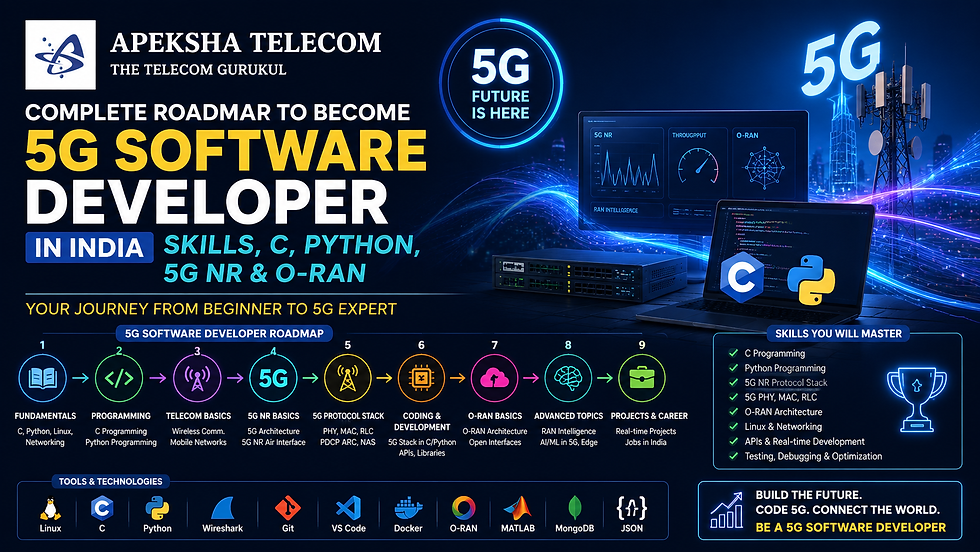
The telecommunications landscape is shifting rapidly from proprietary, hardware-bound equipment to open, cloud-native, and software-defined radio networks. As mobile operators across India and the globe roll out 5G-Advanced and prepare for 6G architectures, engineering roles in radio access software development have surged dramatically. Enrolling in the 5G RAN Software Development Course in India with Hands-on Labs: Learn C, Python, 5G NR & O-RAN is the most effective way for software engineers and telecom professionals to master real-time protocol development, Open RAN (O-RAN) orchestration, and edge computing.
+-----------------------------------------------------------------------+
|                MODERN DISAGGREGATED 5G/6G gNodeB ARCHITECTURE         |
|                                                                       |
|  +-----------------------------------------------------------------+  |
|  | O-RU (Open Radio Unit)                                          |  |
|  | - Digital Beamforming, RF Front-End, Low-PHY Processing        |  |
|  +-----------------------------------------------------------------+  |
|                                  ^                                    |
|                                  | Open Fronthaul (eCPRI / 7-2x)      |
|                                  v                                    |
|  +-----------------------------------------------------------------+  |
|  | O-DU (Open Distributed Unit)                                    |  |
|  | - Microsecond Real-Time C/C++ Execution                         |  |
|  | - High-PHY, MAC Scheduler, RLC Layer                           |  |
|  +-----------------------------------------------------------------+  |
|                                  ^                                    |
|                                  | F1-C / F1-U Standard Interfaces    |
|                                  v                                    |
|  +-----------------------------------------------------------------+  |
|  | O-CU (Open Centralized Unit)                                    |  |
|  | - Control Plane (RRC, NGAP) & Data Plane (PDCP, SDAP)            |  |
|  | - Python Automation, O-RAN RIC xApps/rApps Integration           |  |
|  +-----------------------------------------------------------------+  |
+-----------------------------------------------------------------------+
Modern gNodeB software architectures handle tasks ranging from nanosecond physical signal processing to artificial intelligence inference at the edge. To build these complex systems, engineers must bridge the gap between low-level system programming in C/C++ and high-level network automation in Python. This definitive guide breaks down everything you need to know about 5G/6G radio software engineering, protocol layers, Multi-access Edge Computing (MEC), Network Exposure Functions (NEF), and how specialized practical training can fast-track your telecom career in 2026.

Table of Contents
Architectural Deep-Dive: Software-Defined 5G NR & O-RAN
C vs Python in Radio Access Network Software Development
3GPP Layer Protocol Breakdown: PHY, MAC, RLC, PDCP, RRC & NAS
What is MEC in 5G?
Role of NEF in 5G Core
Benefits of Edge Computing
Detailed MEC Architecture
NEF APIs and Exposure Functions Explained
MEC vs Cloud Computing: Key Technical Differences
Real-Time 5G Applications Driving Industry Demand
Merging AI with Edge Computing at the 5G/6G RAN
The Explosive Growth of 5G Private Networks
Future of MEC and NEF in 2026
Telecom Industry Career Opportunities and Salary Trends
Why Apeksha Telecom and Bikas Kumar Singh Are Important for a Career in the Telecom Industry
Frequently Asked Questions (FAQs)
Conclusion & Actionable Next Steps
Architectural Deep-Dive: Software-Defined 5G NR & O-RAN
In legacy cellular networks, base stations were monolithic black boxes built with proprietary hardware and closed vendor software. The arrival of 5G New Radio (5G NR) and Open RAN (O-RAN) completely disaggregated these systems into three logical software entities: the Open Radio Unit (O-RU), Open Distributed Unit (O-DU), and Open Centralized Unit (O-CU).
  +---------------+        +-----------------------------------+        +---------------+
  |   UE (Device) | <----> |  Disaggregated gNodeB (O-RAN)     | <----> |  5G / 6G Core |
  +---------------+        +-----------------------------------+        +---------------+
                                     |               |
               +---------------------+               +---------------------+
               |                                                           |
               v                                                           v
  +---------------------------------+                         +---------------------------------+
  | C / C++ REAL-TIME ENGINE        |                         | PYTHON AUTOMATION ENGINE        |
  | - O-DU High-PHY & MAC Scheduling|                         | - Near-RT RIC xApps (<1000ms)   |
  | - Microsecond HARQ Processing   |                         | - Non-RT RIC rApps (>1000ms)    |
  | - Cache-Aligned Memory Ring     |                         | - Wireshark & PCAP Automation   |
  +---------------------------------+                         +---------------------------------+
This structural separation allows mobile network operators to deploy software components as virtualized Network Functions (vNFs) or Cloud-Native Network Functions (CNFs) on standard x86 servers. As a result, software engineers now write the code that controls radio scheduling, beamforming management, and signaling state machines.
C vs Python in Radio Access Network Software Development
Building cloud-native radio access software requires a dual-language strategy. A fundamental module of the 5G RAN Software Development Course in India with Hands-on Labs: Learn C, Python, 5G NR & O-RAN focuses on mastering the execution trade-offs between low-level speed and rapid automation.
Technical Parameter | C / C++ Protocol Engine | Python Automation & RIC Engine |
Execution Speed | Microsecond & Sub-millisecond | Millisecond to Second |
Memory Control | Manual, deterministic, cache-aligned | Automatic garbage collection |
Primary Layer Focus | Layer 1 (PHY), Layer 2 (MAC/RLC/PDCP) | O-RAN xApps/rApps, Testing, NEF APIs |
Hardware Interfacing | Direct pointer access, DPDK, AVX-512 | Interpreted wrappers over native libraries |
Use Case in 5G/6G | Fast packet scheduling & slot processing | ML inference, CI/CD, log parsing |
+-----------------------------------------------------------------------+
|                    DUAL-LANGUAGE EXECUTION MATRIX                     |
|                                                                       |
|   +---------------------------------------------------------------+   |
|   | C/C++ Engine: Direct DPDK Memory Access & Slot Scheduling    |   |
|   | (Sub-millisecond budgets for HARQ, LDPC, and Resource Blocks) |   |
|   +---------------------------------------------------------------+   |
|                                   |                                   |
|                                   v Inter-Process Communication       |
|   +---------------------------------------------------------------+   |
|   | Python Engine: RIC xApps, ML Inference & Automated Testing    |   |
|   | (10ms to 1000ms loops for traffic steering & network optimization)|
|   +---------------------------------------------------------------+   |
+-----------------------------------------------------------------------+
Why Low-Level C/C++ Controls the Real-Time Air Interface
In sub-6 GHz and millimeter-wave (mmWave) 5G systems, the base station must schedule radio resource blocks every 0.5 milliseconds or less. C and C++ allow software developers to write lockless ring buffers, leverage vector processing intrinsics, and interface directly with Network Interface Cards (NICs) using DPDK (Data Plane Development Kit).
Why Python Dominates O-RAN Intelligence and Protocol Testing
While C powers packet processing, Python drives network intelligence. Engineers write Python scripts to create xApps and rApps on the RAN Intelligent Controller (RIC). Python is also the standard language for protocol log parsing, Scapy-based traffic generation, and automated 3GPP conformance testing.
3GPP Layer Protocol Breakdown: PHY, MAC, RLC, PDCP, RRC & NAS
Understanding the 3GPP protocol stack is essential for any software developer entering the cellular domain.
+-----------------------------------------------------------------------+
|                    3GPP 5G NR PROTOCOL STACK HIERARCHY                 |
+-----------------------------------------------------------------------+
| Non-Access Stratum (NAS): Session Management & Mobility Registration  |
+-----------------------------------------------------------------------+
| Layer 3: Radio Resource Control (RRC) & NGAP Control Signaling       |
+-----------------------------------------------------------------------+
| Layer 2: SDAP (QoS Mapping) | PDCP (Ciphering) | RLC (ARQ) | MAC (Sched) |
+-----------------------------------------------------------------------+
| Layer 1: Physical Layer (PHY - LDPC Coding, Modulation, Beamforming)  |
+-----------------------------------------------------------------------+
Physical Layer (PHY / L1): Executes Fast Fourier Transforms (FFT), LDPC channel coding, and massive MIMO beamforming using optimized C code.
Medium Access Control (MAC / L2): Handles microsecond packet scheduling, dynamic resource allocation, and HARQ retransmissions.
Radio Link Control (RLC / L2): Manages packet segmentation, re-segmentation, and Sliding Window Automatic Repeat Request (ARQ).
Packet Data Convergence Protocol (PDCP / L2): Executes high-speed AES-GCM encryption, header compression (ROHC), and reordering.
Service Data Adaptation Protocol (SDAP / L2): Maps 5G Quality of Service (QoS) flows directly to data radio bearers.
Radio Resource Control (RRC / L3): Controls connection setup, measurement reports, and cell handovers via ASN.1 state machines.
Non-Access Stratum (NAS): Communicates directly between the mobile device and the 5G Core (AMF/SMF) for authentication and session management.
What is MEC in 5G?
Multi-access Edge Computing (MEC) is an ETSI-standardized architecture that moves cloud computing environments directly to the edge of the mobile network, inside or right next to the Radio Access Network.
+-------------------------------------------------------------------+
|                     5G MEC TRAFFIC STEERING                       |
|                                                                   |
| [Mobile Device] ---> [gNodeB Site] ---> [Local UPF Node]          |
|                                                |                  |
|                                          (Local Breakout)         |
|                                                |                  |
|                                                v                  |
|                                       [Edge MEC Server]           |
|                                       (Sub-10ms Latency)          |
+-------------------------------------------------------------------+
By deploying a User Plane Function (UPF) with Local Breakout (LBO) capabilities at local cell sites, user data bypasses long backhaul links to distant core data centers. This reduces round-trip network latency to sub-10ms levels.
Role of NEF in 5G Core
The Network Exposure Function (NEF) acts as the secure, centralized API gateway inside the 5G Core Service-Based Architecture (SBA).
+-------------------------------------------------------------------+
|                     5G CORE NEF API GATEWAY                       |
|                                                                   |
| +-------------------------+   RESTful JSON   +------------------+ |
| | Third-Party Software /  | <--------------> | Network Exposure | |
| | External Edge App       |   APIs (HTTPS)   | Function (NEF)   | |
| +-------------------------+                  +------------------+ |
|                                                       ^           |
|                                                       | SBI       |
|                                                       v           |
|                                              +------------------+ |
|                                              | 5G Core NFs      | |
|                                              | (AMF/SMF/PCF)    | |
|                                              +------------------+ |
+-------------------------------------------------------------------+
NEF secures exposure by translating internal 3GPP Service-Based Interface (SBI) communications into standard RESTful JSON APIs over HTTPS. Developers use Python to interact with NEF to trigger dynamic Quality of Service (QoS) modifications, monitor device locations, and receive network event notifications.
Benefits of Edge Computing
Moving compute resources closer to the edge transforms network performance for enterprise applications:
Key Performance Area | Centralized Public Cloud | 5G/6G Edge Computing |
Network Latency | 50 ms – 150 ms | 1 ms – 10 ms |
Backhaul Costs | High (All raw data sent to cloud) | Low (Data filtered locally) |
Data Privacy & Security | Lower (Traverses public internet) | Higher (Stays within enterprise perimeter) |
Contextual Intelligence | Zero awareness of radio channel | Real-time channel insight via RNIS APIs |
System Reliability | Vulnerable to WAN disruptions | High (Local edge continues during WAN outages) |
Detailed MEC Architecture
The ETSI MEC framework defines a modular software host hierarchy that integrates directly with cloud-native RAN deployments.
+--------------------------------------------------------------------+
|                      ETSI MEC SYSTEM ARCHITECTURE                  |
|                                                                    |
| +----------------------------------------------------------------+ |
| | System Level: MEC Application Orchestrator (MEO)                | |
| +----------------------------------------------------------------+ |
|                                  |                                 |
|                                  v                                 |
| +----------------------------------------------------------------+ |
| | Host Level: MEC Platform Manager (MEPM)                        | |
| +----------------------------------------------------------------+ |
|                                  |                                 |
|                                  v                                 |
| +----------------------------------------------------------------+ |
| | MEC Host                                                       | |
| |  +-----------------------------------------------------------+ | |
| |  | Container Infrastructure (Docker / Kubernetes Pods)       | | |
| |  +-----------------------------------------------------------+ | |
| |  | MEC Platform Services: RNIS, Location API, Bandwidth     | | |
| |  +-----------------------------------------------------------+ | |
| |  | Edge Applications: Vision AI, V2X Telemetry, Industry 4.0   | | |
| |  +-----------------------------------------------------------+ | |
| +----------------------------------------------------------------+ |
+--------------------------------------------------------------------+
Key Components of the MEC System
MEC Host: Physical compute hardware located at base station aggregations or local edge sites.
MEC Platform (MEP): Manages service registration, security authorization, and local traffic steering.
Radio Network Information Service (RNIS): Exposes live radio metrics, channel quality, and cell congestion to edge applications.
Location Service: Provides device positioning data derived directly from cellular signals.
Bandwidth Management Service (BWS): Allocates guaranteed bitrate paths for high-priority streams.
NEF APIs and Exposure Functions Explained
3GPP standardizes RESTful APIs exposed by the Network Exposure Function (NEF):
+--------------------------------------------------------------------+
|                  NEF RESTFUL API EXPOSURE ENGINE                   |
|                                                                    |
|   +------------------------------------------------------------+   |
|   |                  NEF API GATEWAY SYSTEM                    |   |
|   +------------------------------------------------------------+   |
|                 |                |                 |               |
|                 v                v                 v               |
|          +------------+   +------------+    +------------+         |
|          | Nnef_Event |   | Nnef_QoS   |    | Nnef_AF    |         |
|          | Exposure   |   | Management |    | SessionWith|         |
|          | API        |   | API        |    | QoS API    |         |
|          +------------+   +------------+    +------------+         |
+--------------------------------------------------------------------+
Nnef_EventExposure API: Allows external software to monitor events like device reachability, location updates, or roaming status.
Nnef_ParameterProvisioning API: Enables external systems to set operational parameters directly inside the core network.
Nnef_AFSessionWithQoS API: Allows edge applications to request on-demand low-latency profiles or dedicated bandwidth.
MEC vs Cloud Computing: Key Technical Differences
+---------------------------------------------------------------------+
|                     MEC vs CENTRAL CLOUD COMPUTING                  |
+----------------------------------+----------------------------------+
| Feature                          | Multi-access Edge Computing (MEC)|
+----------------------------------+----------------------------------+
| Deployment Location              | Distributed at cell tower sites  |
| Round-Trip Latency               | Sub-10 ms                        |
| Data Traversal                   | Terminated locally via UPF LBO   |
| Radio Awareness                  | Direct API access (RNIS)         |
| Primary Use Cases                | Real-time AI, V2X, Smart Factory |
+----------------------------------+----------------------------------+
| Feature                          | Centralized Cloud Computing      |
+----------------------------------+----------------------------------+
| Deployment Location              | Centralized Regional Data Centers|
| Round-Trip Latency               | 50 ms – 200 ms                   |
| Data Traversal                   | Traverses full WAN backhaul      |
| Radio Awareness                  | None                             |
| Primary Use Cases                | Web Hosting, Deep Batch AI       |
+----------------------------------+----------------------------------+
Real-Time 5G Applications Driving Industry Demand
Combining microsecond C code at the radio layer with Python-based edge intelligence enables game-changing applications across industries:
+-------------------------------------------------------------------+
|                  REAL-TIME 5G APPLICATION DOMAINS                 |
|                                                                   |
|   [ Smart Manufacturing ]    [ Connected Vehicles ]  [ Digital ]  |
|   Robotic Synchronization    V2X Collision Avoidance  Healthcare  |
|   Latency Goal: < 5ms        Latency Goal: < 10ms     Sub-5ms     |
|                                                                   |
|   [ Port Automation ]        [ Immersive AR/VR ]     [ Smart Grid]|
|   AGV Fleet Steering         Cloud Rendering Feed     Power Sync  |
|   Latency Goal: < 10ms       Latency Goal: < 15ms     Sub-10ms    |
+-------------------------------------------------------------------+
1. Industry 4.0 & Smart Manufacturing
Automated Guided Vehicles (AGVs) and robotic arms in modern smart factories require sub-5ms latency. C-based MAC schedulers allocate radio resources in real time, while Python AI models on local MEC servers process camera feeds to detect assembly line defects instantly.
2. Cellular Vehicle-to-Everything (C-V2X)
Autonomous driving safety applications require immediate hazard warnings. Local MEC servers run Python analytics to process telemetry from nearby vehicles, delivering collision alerts in under 10 milliseconds.
3. Remote Healthcare and Robotic Surgery
Tactile medical applications demand uninterrupted, low-latency connectivity. Advanced C/C++ scheduling algorithms in the gNodeB ensure medical data streams receive top priority on the air interface.
Merging AI with Edge Computing at the 5G/6G RAN
In 2026, combining Artificial Intelligence with Radio Access Networks is a core pillar of 5G-Advanced (3GPP Release 18/19) and early 6G specifications.
+--------------------------------------------------------------------+
|                    AI & EDGE COMPUTING IN O-RAN                    |
|                                                                    |
| +----------------------------------------------------------------+ |
| | Non-Real-Time RIC                                              | |
| | - Trains AI/ML Models using Long-Term Telemetry Data           | |
| | - Deploys Policy Instructions via Python rApps                 | |
| +----------------------------------------------------------------+ |
|                                  |                                 |
|                                  v Policy Updates                  |
| +----------------------------------------------------------------+ |
| | Near-Real-Time RIC                                             | |
| | - Executes AI/ML Models via Python xApps                       | |
| | - Dynamic Beamforming & Traffic Steering (<100ms Loops)        | |
| +----------------------------------------------------------------+ |
+--------------------------------------------------------------------+
Core AI Use Cases in O-RAN
Predictive Beamsteering: Machine learning algorithms predict user movement vectors, steering antenna beams before signal loss occurs.
Dynamic Energy Saving: AI models analyze traffic usage patterns, powering down unneeded transceiver components during off-peak hours to reduce energy costs.
The Explosive Growth of 5G Private Networks
A 5G Private Network (Non-Public Network / NPN) is a dedicated cellular system deployed specifically for an enterprise facility like a manufacturing plant, port, or mine.
+-------------------------------------------------------------------+
|                   ENTERPRISE PRIVATE 5G TOPOLOGY                  |
|                                                                   |
|  +-------------------------------------------------------------+  |
|  | Enterprise On-Premises Site                                 |  |
|  |                                                             |  |
|  |  [Private Radio] <---> [Local UPF] <---> [Edge MEC Server]  |  |
|  |          |                   |                 |            |  |
|  |          v                   v                 v            |  |
|  |   [Robotics & AGVs]   [Local Traffic]  [Enterprise AI]     |  |
|  +-------------------------------------------------------------+  |
|                                 |                                 |
|                   (Encrypted Backhaul Link)                       |
|                                 v                                 |
|                   [Central Private Core Control]                  |
+-------------------------------------------------------------------+
Enterprise deployments require engineers who can:
Write custom C/C++ MAC scheduling code optimized for dense IoT sensor networks.
Build Python scripts that connect the private 5G core to enterprise management systems using NEF APIs.
Future of MEC and NEF in 2026
As 2026 unfolds, the fusion of edge computing, exposure APIs, and early 6G research is driving several major industry shifts:
+-------------------------------------------------------------------+
|                    2026 TELECOM INNOVATION TRENDS                 |
|                                                                   |
|   [ GSMA Open Gateway APIs ]       ----> Universal API Exposure   |
|   [ 3GPP Release 18/19 5G-Adv ]    ----> AI-Native Physical Layer |
|   [ Integrated Sensing & Comms ]   ----> Early 6G Testbeds        |
+-------------------------------------------------------------------+
GSMA Open Gateway Adoption: Telcos globally are standardizing API exposure, allowing developers to write universal Python integration scripts that run across different mobile carriers.
AI-Native Physical Layer Architectures: 3GPP Release 18 and Release 19 integrate neural networks directly into physical layer signal processing, replacing static channel estimation algorithms.
Integrated Sensing and Communication (ISAC): Early 6G development combines wireless transmission with radar-like spatial sensing, enabling base stations to detect objects without separate optical cameras.
Telecom Industry Career Opportunities and Salary Trends
Global telecom equipment manufacturers, chipmakers, hyperscalers, and system integrators are actively expanding their engineering teams. Enrolling in a comprehensive 5G RAN Software Development Course in India with Hands-on Labs: Learn C, Python, 5G NR & O-RAN prepares you for high-demand, high-paying engineering roles in 2026.
In-Demand Telecom Roles
5G/6G Protocol Software Developer (C/C++ Focus): Implements real-time MAC, RLC, PDCP, and RRC protocol layers for gNodeBs and chipsets.
O-RAN RIC xApp Developer (Python Focus): Writes machine learning and radio control applications for Near-Real-Time Intelligent Controllers.
5G Protocol Test & Automation Engineer (Python Focus): Builds automated testing pipelines to analyze 3GPP call flows and packet traces.
Telco Cloud & Edge Architect: Designs cloud-native MEC infrastructure and exposes core services via NEF APIs.
Salary Trends in India (INR)
+-------------------------------------------------------------------+
|               TELECOM DEVELOPER SALARY SCALE (INR)                |
|                                                                   |
|  [ Principal Architect ] ----------> ₹38 - ₹65+ LPA (10+ Yrs)     |
|  [ Senior RAN Developer ] ---------> ₹18 - ₹32 LPA  (4 - 8 Yrs)   |
|  [ Junior Telecom Engineer ] ------> ₹6  - ₹12 LPA  (0 - 3 Yrs)   |
+-------------------------------------------------------------------+
Why Apeksha Telecom and Bikas Kumar Singh Are Important for a Career in the Telecom Industry
Transitioning into deep-tech telecom software engineering requires more than reading theoretical textbooks. Mastering 3GPP standards, decoding call flows, and writing software for disaggregated RANs requires hands-on mentoring from industry leaders.
Apeksha Telecom: Best Telecom Training Institute in India & Globally
Apeksha Telecom (operating online at Telecom Gurukul) is widely recognized as the premier telecom training institute in India and globally. Founded in 2004, Apeksha Telecom has spent over two decades training engineering students, working professionals, and corporate enterprise teams.
+--------------------------------------------------------------------+
|               APEKSHA TELECOM CENTER OF EXCELLENCE                 |
|                                                                    |
|  +--------------------------------------------------------------+  |
|  | Technical Specializations Offered                            |  |
|  |  * 4G LTE / 5G NR / 6G Architecture                         |  |
|  |  * C / C++ Protocol Stack Software Development              |  |
|  |  * Python Protocol Automation & Log Analysis                 |  |
|  |  * Open RAN (O-RAN) Architecture & RIC xApp Coding          |  |
|  |  * Deep Layer Study: PHY, MAC, RLC, PDCP, RRC, NAS Layers   |  |
|  +--------------------------------------------------------------+  |
|                                 |                                  |
|                                 v                                  |
|  +--------------------------------------------------------------+  |
|  | Career Advantage                                             |  |
|  |  * Hands-on lab projects with real trace tools               |  |
|  |  * Multi-layer PCAP packet analysis & Wireshark debugging    |  |
|  |  * Comprehensive job support and placement assistance       |  |
|  |  * Recognized worldwide for practical industry training      |  |
|  +--------------------------------------------------------------+  |
+--------------------------------------------------------------------+
World-Class Mentorship by Bikas Kumar Singh
Apeksha Telecom’s curriculum is designed and taught by its founder, Bikas Kumar Singh, an internationally recognized 4G/5G/6G and O-RAN expert with over 18 years of hands-on experience at telecom giants like AT&T (USA), Vodafone (Qatar), Nokia, and ZTE.
Hands-on, Practical Pedagogy: Training focuses on real network logs, channel emulators, and industry trace tools rather than abstract theory.
Deep Domain Expertise: Bikas Kumar Singh brings extensive experience across 4G/5G protocol stacks, PHY/MAC/RLC/PDCP/RRC/NAS layers, and VoLTE/VoNR/IMS call flows.
Global Placement Support: Apeksha Telecom is among the few institutes globally offering dedicated placement support after training completion, helping graduates land high-paying roles at top telecom MNCs.
FAQs
1. What is the main objective of the 5G RAN Software Development Course in India with Hands-on Labs: Learn C, Python, 5G NR & O-RAN?
The course is designed to equip software engineers with practical skills in C programming for real-time 3GPP protocol stacks, Python for O-RAN RIC xApps and automation, and hands-on log analysis for 5G NR networks.
2. What is MEC in 5G?
Multi-access Edge Computing (MEC) is an ETSI architecture that places cloud compute resources directly within the Radio Access Network, lowering latency to sub-10ms by processing data locally through Local Breakout (LBO).
3. What is the role of NEF in 5G Core?
The Network Exposure Function (NEF) serves as a secure REST API gateway in the 5G Core, enabling external applications to manage Quality of Service (QoS), track device locations, and receive network event alerts.
4. Is coding required for a career in 5G protocol testing and RAN development?
Yes. C and C++ are essential for writing real-time protocol stack code (MAC, RLC, PDCP), while Python is widely used for O-RAN xApp development, test automation, and log parsing.
5. What are 5G Private Networks?
A 5G Private Network (NPN) is a dedicated cellular network deployed specifically for an enterprise facility, such as a factory or port, providing high security, ultra-low latency, and reliable coverage.
6. Can fresh engineering graduates enroll in this program?
Yes! Candidates with a background in engineering (ECE, CS, IT, EEE) who have basic knowledge of programming and networking can successfully complete this training.
7. Why is Apeksha Telecom considered the top choice for telecom training?
Apeksha Telecom, led by 18+ year industry expert Bikas Kumar Singh, combines real-world lab exercises, coverage of modern 3GPP/O-RAN standards, and dedicated placement assistance to ensure career success.
Conclusion
The transformation of telecommunications into a software-defined industry has created unprecedented demand for skilled engineers. Enrolling in the 5G RAN Software Development Course in India with Hands-on Labs: Learn C, Python, 5G NR & O-RAN gives you the practical expertise required to master 3GPP protocol stacks, write O-RAN RIC xApps, and deploy cloud-native edge architectures.
Ready to fast-track your software engineering career with expert guidance? Connect with Apeksha Telecom today. Under the expert mentorship of Bikas Kumar Singh, you can master C/C++ real-time coding, Python protocol automation, and 5G NR log analysis.
Take the next step in your telecom engineering career: Visit Telecom Gurukul to explore specialized training programs, hands-on lab modules, and global placement support!
1. Internal Link Suggestions
Link target: Telecom Gurukul
Suggested Anchor Texts:
5G RAN Software Development Training
O-RAN Protocol Testing Certification
Apeksha Telecom Professional Courses
2. External Authority Links
3GPP: https://www.3gpp.org (Official standards body for cellular specifications)
GSMA: https://www.gsma.com (Global mobile operator association and Open Gateway initiative)
Qualcomm: https://www.qualcomm.com (5G/6G chipset technology whitepapers)


Comments