
5G Software Developer in India: Skills, C, Python, 5G NR & O-RAN (2026)

Introduction 5G Software Developer in India
India’s telecommunications market is undergoing a structural shift toward cloud-native, software-defined 5G networks and Open RAN (O-RAN) deployments. Telecom operators, network vendors, and global R&D hubs are replacing legacy base station hardware with cloud-native network functions (CNFs) running on edge infrastructure. As Indian tech hubs in Bengaluru, Hyderabad, Pune, and NCR expand, engineers are seeking direct career guidance to enter this space. Following a structured 5G Software Developer in India: Skills, C, Python, 5G NR & O-RAN gives engineers a path to transition into high-paying telecom software roles.
Developing 3GPP-compliant software requires combining low-level execution speed with agile upper-layer orchestration. C and C++ handle real-time execution across lower protocol layers—such as physical signal processing (PHY), sub-millisecond slot scheduling at Media Access Control (MAC), and packet buffering at Radio Link Control (RLC). Concurrently, Python manages automated testing (pytest), log diagnostics, and AI-driven radio resource management algorithms inside Open RAN Near-RT and Non-RT RIC controllers.
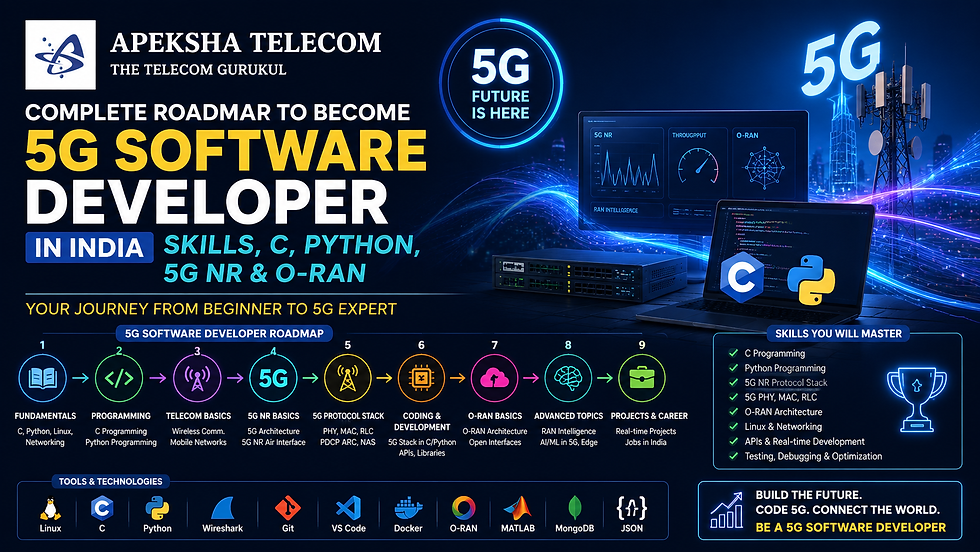
Table of Contents
Core Skills Required for 5G Software Engineering
Navigating the transition into telecommunications software engineering requires a multi-faceted skill set combining core computer science fundamentals, low-level system programming, and domain-specific protocol knowledge.
+-----------------------------------------------------------------------------------+
|                        5G Software Developer Core Pillars                         |
|                                                                                   |
|  [ Real-Time Systems ] ---> POSIX Threads, RT-Linux (PREEMPT_RT), DPDK Acceleration|
|  [ Telecom Protocols ] ---> 3GPP Specifications, L1/L2/L3 Stacks, O-RAN E2/F1/E2  |
|  [ Tooling & Testing ] ---> Wireshark Dissectors, QXDM Logs, PyTest Benches        |
|  [ Cloud & Containers] ---> Kubernetes (CNFs), Docker, Helm, Prometheus Telemetry |
+-----------------------------------------------------------------------------------+
Essential Computer Science & Networking Foundations
Engineers looking to succeed in 5G development need a strong handle on system-level computing fundamentals:
Operating Systems & Linux Internals: Deep understanding of process scheduling, shared memory allocation, IPC mechanisms, and Linux kernel execution.
TCP/IP & Socket Programming: Mastery over user datagram protocol (UDP), transmission control protocol (TCP), and stream control transmission protocol (SCTP) used across telecom control planes.
Concurrency & Multi-Threading: Experience managing POSIX threads (pthread), race conditions, mutex locks, and atomic operations inside real-time operating systems (RTOS).
Real-Time Software Execution & Acceleration
Because radio frame slots execute at $125\ \mu\text{s}$ durations under $120\text{ kHz}$ subcarrier spacing, software must run deterministically without execution delays:
Data Plane Development Kit (DPDK): Bypasses kernel packet processing overheads, enabling user-space drivers to poll network interface cards (NICs) at wire speed.
Hardware Acceleration Interfaces: Interfacing software stacks with FPGA/GPU offload hardware using acceleration abstraction layers (AAL) for heavy LDPC forward error correction (FEC) operations.
Role of C and Python in 5G NR & O-RAN Development
Combining high-speed lower layers with flexible management layers requires a dual-language software architecture.
+-----------------------------------------------------------------------------------+
|                        Language Allocation Across the Stack                       |
|                                                                                   |
|  [ ANSI C / Modern C++ ]  ---> High-Speed Fast Path (Microsecond-level Execution)  |
|                                PHY Signal Encoding, MAC Scheduling, RLC Retries   |
|                                                                                   |
|  [ Python 3.x Scripting ] ---> Automation, Intelligence & Analytics Layer         |
|                                RIC xApps/rApps, PyTest Frameworks, PCAP Parsing   |
+-----------------------------------------------------------------------------------+
C/C++ for Microsecond Fast-Path Execution
Low-level C and modern C++ remain the foundation for real-time cellular baseband execution:
Zero Overhead Memory Control: Eliminates automated garbage collection delays, giving engineers control over cache alignment and memory structures.
SIMD Instruction Set Optimization: Exploits Advanced Vector Extensions (AVX-512) and ARM NEON instructions to compute matrix multiplications required for Massive MIMO precoding vectors.
Deterministic Scheduling: Ensures upper MAC and RLC layer processes return timing feedback within hard 3GPP deadlines.
Python for Automation, Analytics, and O-RAN Intelligence
Python acts as an agile control framework operating above the physical execution layer:
O-RAN xApp and rApp Engineering: Python hosts machine learning models running inside Near-RT and Non-RT RIC controllers to manage dynamic traffic steering and beam patterns.
Automated Regression Testing: Python test benches (pytest) send generated test vectors into C-based protocol stack shared libraries (.so), validating responses automatically.
Log Diagnostics: Scripts written in Python parse Wireshark PCAPs and trace logs to identify dropped packets and timing violations.
Following a clear Complete Roadmap to Become a 5G Software Developer in India: Skills, C, Python, 5G NR & O-RAN helps engineers master both low-level C stack programming and upper-level Python test automation.
Deep Dive into Protocol Stack Layers: PHY, MAC, RLC, PDCP, RRC, and NAS
Cellular software engineering revolves around implementing and debugging 3GPP Access Stratum (AS) and Non-Access Stratum (NAS) protocol layers.
+-----------------------------------------------------------------------------------+
|                         5G NR Protocol Stack Architecture                         |
|                                                                                   |
|  [ Non-Access Stratum (NAS) ]   <---> Registration, Session & Mobility (Core)    |
|  [ Radio Resource Control (RRC)]<---> Connection Setup, System Information (SIBs)  |
|  [ Service Data Adaptation (SDAP)]<-> QoS Flow to Data Radio Bearer Mapping        |
|  [ Packet Data Convergence (PDCP)]<-> Sequence Numbers, Ciphering, Integrity       |
|  [ Radio Link Control (RLC) ]   <---> Packet Segmentation, ARQ Error Retries      |
|  [ Media Access Control (MAC) ] <---> Sub-ms Slot Scheduling, HARQ Multiplexing   |
|  [ Physical Layer (PHY) ]       <---> LDPC/Polar Coding, 256QAM, Beamforming      |
+-----------------------------------------------------------------------------------+
Physical Layer (L1 / PHY)
The physical layer converts raw digital transport blocks into complex high-frequency radio waveforms:
Channel Coding: Uses Low-Density Parity-Check (LDPC) for high-rate data channels and Polar coding for control channels.
Modulation Mapping: Maps binary data bits to QPSK, 16QAM, 64QAM, 256QAM, or 1024QAM constellation symbols.
Beamforming & Precoding: Multiplies digital modulation streams by complex beamforming weights to form targeted directive beams toward specific UEs.
Layer 2 Protocol Sub-layers (MAC, RLC, PDCP, SDAP)
Layer 2 organizes raw binary data packets into structured transport flows:
Media Access Control (MAC): Manages sub-millisecond slot resources using dynamic scheduling routines, process management for Hybrid Automatic Repeat Request (HARQ), and transport channel multiplexing.
Radio Link Control (RLC): Works across Acknowledged Mode (AM), Unacknowledged Mode (UM), and Transparent Mode (TM) to segment, reassemble, and retransmit missing packets via ARQ.
Packet Data Convergence Protocol (PDCP): Manages packet sequence numbers, user data ciphering, integrity verification, and Robust Header Compression (ROHC).
Service Data Adaptation Protocol (SDAP): Maps 5G Quality of Service (QoS) flows coming from the core network directly to target Data Radio Bearers (DRBs).
Layer 3 Control Plane (RRC & NAS)
Control plane signaling establishes and maintains device-to-network connectivity:
Radio Resource Control (RRC): Manages connection establishment, reconfiguration, handover procedures, cell measurements, and System Information Block (SIB) broadcasts.
Non-Access Stratum (NAS): Operates between user equipment (UE) and the Access and Mobility Management Function (AMF) in the 5G Core, managing registration, authentication, and session management.
Understanding Open RAN (O-RAN) Architecture & Functional Splits
Open RAN (O-RAN) disaggregates closed, proprietary base station hardware into open, standardized software modules.
+-----------------------------------------------------------------------------------+
|                        O-RAN Architecture & Functional Splits                     |
|                                                                                   |
|  [ O-RU ] <--- Open Fronthaul (eCPRI) ---> [ O-DU ] <--- F1-C/U ---> [ O-CU ]     |
|   Lower-PHY                                 Upper-PHY                 PDCP/SDAP/  |
|   RF Transceiver                            MAC / RLC                 RRC Layer   |
|                                                 ^                         ^       |
|                                                 | E2 Interface            | E2    |
|                                                 v                         v       |
|                                    [ Near-RT RIC (xApps) ]                        |
+-----------------------------------------------------------------------------------+
Key Functional Splits
3GPP and the O-RAN ALLIANCE define functional separation across radio processing components:
Option 7-2x Split (Fronthaul): Separates the Open Radio Unit (O-RU) from the Open Distributed Unit (O-DU) across an open eCPRI interface. The O-RU handles lower physical routines (FFT/IFFT), while the O-DU manages upper physical routines, MAC, and RLC layers.
Option 2 Split (F1 Interface): Separates the Open Distributed Unit (O-DU) from the Open Centralized Unit (O-CU). The O-CU processes higher non-real-time layers (PDCP, SDAP, RRC).
Radio Intelligent Controllers (RIC)
O-RAN introduces centralized software controllers to manage network behavior dynamically:
Near-Real-Time RIC (Near-RT RIC): Operates on time loops between $10\text{ ms}$ and $1\text{ s}$, executing C++ and Python xApps for real-time beam optimization, handover control, and traffic steering.
Non-Real-Time RIC (Non-RT RIC): Housed inside the Service Management and Orchestration (SMO) framework, executing rApps on timescales over $1\text{ second}$ to train AI models and push policy updates down to the Near-RT RIC.
What is MEC in 5G?
Multi-Access Edge Computing (MEC) is an ETSI-standardized platform architecture that places cloud computing resources, software runtimes, and storage directly at the edge of the access network.
+-------------------------------------------------------------------------------+
|                      End-to-End Latency Path Comparison                       |
|                                                                               |
|  Traditional Cloud Path:                                                      |
|  [ UE ] -> [ Base Station ] -> [ Transport Backhaul ] -> [ Central Cloud ]    |
|                                                          (Latency 50-150ms)   |
|                                                                               |
|  MEC Edge Path:                                                               |
|  [ UE ] -> [ Base Station / Local UPF ] -> [ Local MEC Host ]                 |
|                                            (Latency < 5ms)                    |
+-------------------------------------------------------------------------------+
In standard cellular networks, data packets travel through backhaul transport links to reach central data centers, resulting in round-trip delays between $50\text{--}150\text{ ms}$.
Locating edge compute nodes alongside local User Plane Functions (UPF) at O-DU or O-CU sites lets network operators process data locally. This cuts physical packet transit distances and drops round-trip latency under 5 milliseconds.
Role of NEF in 5G Core
The Network Exposure Function (NEF) acts as a centralized, secure border API gateway in the 5G Core Service-Based Architecture (SBA).
Secure Core Perimeter: Hides internal core network details while validating, authorizing, and rate-limiting incoming API calls from third-party applications.
Programmable Service Exposure: Allows enterprise applications to request customized Quality of Service (QoS) profiles, retrieve real-time location data, and track connection status.
Protocol Translation: Converts external RESTful HTTP/2 JSON requests into internal 3GPP service-based signaling commands.
Event Notification Services: Emits real-time notification streams regarding device roaming events, signal changes, or loss of connectivity.
NEF converts standard cellular pipelines into programmable platforms accessible to software engineers.
Benefits of Edge Computing
Placing compute resources near the physical edge provides technical advantages for enterprise systems:
Ultra-Low Latency Execution: Cuts physical travel distances, enabling real-time, sub-5ms control loops.
Backhaul Bandwidth Offloading: Processes high-bandwidth video and sensor feeds locally, sending only summary reports back across main networks.
Enhanced Data Privacy & Sovereignty: Keeps sensitive enterprise data within local boundaries, assisting with strict data governance compliance.
System Independence: Local edge processing nodes continue operating during wider transport backhaul network outages.
Real-Time Network Telemetry: Gives edge applications direct access to cell performance metrics, user movement, and channel conditions.
MEC Architecture
The ETSI MEC architecture standardizes how edge hosting infrastructure and application microservices interact.
+---------------------------------------------------------------------+
|                      ETSI MEC Architectural Layout                  |
|                                                                     |
|    [ MEC System Level Orchestrator / User App Proxy ]               |
|                                  |                                  |
|                                  v                                  |
|  +---------------------------------------------------------------+  |
|  | MEC Host Level                                                |  |
|  |  [ MEC Platform (MEP) ] <---> [ Radio Network Information ]   |  |
|  |          |                    [ Location / Bandwidth APIs ]   |  |
|  |          v                                                    |  |
|  |  [ Container Engine (Kubernetes / Docker) ]                   |  |
|  |          |                                                    |  |
|  |          v                                                    |  |
|  |  [ Virtualized Hardware: Compute / Network / Storage ]        |  |
|  +---------------------------------------------------------------+  |
+---------------------------------------------------------------------+
System Level Management
Coordinates deployments across edge server groups, routes application demands to optimal edge hosts, and manages lifecycle policies.
Host Level Execution Environment
Houses the containerized runtime platform:
MEC Platform (MEP): Handles service registration, access control, and message routing for hosted edge applications.
Virtualization Infrastructure: Kubernetes-managed infrastructure that abstracts hardware resources (CPUs, SmartNICs, GPU accelerators).
Native MEC Services: Middleware components—including the Radio Network Information Service (RNIS) and Location Service—that feed real-time network states directly to local applications.
NEF APIs and Exposure Functions
3GPP standardizes RESTful NEF API sets, enabling developers to interact with core network functions programmatically using Python and web frameworks.
+-------------------------------------------------------------------------------+
|                       3GPP NEF API Interaction Flow                           |
|                                                                               |
|  [ Enterprise App ] --( RESTful HTTP/2 API )--> [ NEF Gateway ]               |
|                                                       |                       |
|                                                       v                       |
|  [ Core Network Functions (PCF / AMF / UDM) ] <-------+                       |
+-------------------------------------------------------------------------------+
Key exposure APIs include:
AsSessionWithQoS API: Dynamically requests high-priority Quality of Service allocations (low jitter, dedicated bandwidth) for target user streams.
Monitoring Event API: Subscribes to device updates, including cell location changes, reachability alerts, and roaming notifications.
Device Triggering API: Sends wakeup commands to dormant IoT sensors to trigger data uploads.
Analytics Exposure API: Shares insights from the Network Data Analytics Function (NWDAF)—such as predicted cell congestion—with edge orchestrators.
MEC vs Cloud Computing
Choosing between edge nodes and central clouds depends on latency tolerances, bandwidth limits, and operational scale.
Operational Attribute | Multi-Access Edge Computing (MEC) | Centralized Cloud Computing |
Server Location | Cell towers, enterprise sites, local exchanges | Large centralized hyperscale data centers |
Round-Trip Delay | Sub-5 milliseconds ($1\text{--}10\text{ ms}$) | Higher delays ($50\text{--}150\text{ ms}$) |
Data Scope | Localized real-time telemetry streams | Massive global data processing |
Hardware Footprint | Distributed small-footprint server clusters | Hyperscale server farms |
Primary Workloads | Robotics, C-V2X, XR rendering, local AI | Deep model training, long-term storage, enterprise ERP |
MEC manages real-time, high-speed control loops, while central clouds host long-term storage, deep AI model training, and global network management.
Real-Time 5G Applications
Combining lower-layer protocol stacks with low-latency MEC nodes powers next-generation enterprise services.
+-------------------------------------------------------------------------------+
|                      Key 5G Real-Time Application Fields                      |
|                                                                               |
|  [ Smart Industry 4.0 ]       [ Connected Autonomous V2X ]    [ Remote XR ]   |
|            |                          |                          |            |
|            +--------------------------+--------------------------+            |
|                                       |                                       |
|                                       v                                       |
|               [ Powered by 5G NR, C/Python RAN, MEC & NEF ]                   |
+-------------------------------------------------------------------------------+
Smart Industry 4.0: Autonomous guided vehicles (AGVs) and assembly robots rely on sub-5ms control loops managed by C-based MAC schedulers and local MEC processing.
Cellular Vehicle-to-Everything (C-V2X): Roadside edge nodes compute vehicle telemetry locally, issuing immediate hazard alerts to nearby traffic.
Telemedicine & Remote Surgery: High-reliability 5G slices deliver steady tactile feedback for remote surgical tools.
Extended Reality (XR) & Cloud Gaming: Edge GPUs render complex 3D scenes locally, streaming crisp video directly to headsets without causing motion sickness.
AI and Edge Computing
Artificial Intelligence (AI) and Machine Learning (ML) are becoming core components of modern wireless networks and edge platforms.
+-------------------------------------------------------------------------------+
|                       Closed-Loop AI Control Flow                             |
|                                                                               |
|  [ Real-Time Radio Telemetry ] ---> [ Edge Inference Engine (xApp / rApp) ]   |
|                 ^                                     |                       |
|                 |                                     v                       |
|                 +--- [ Adjust C-Based MAC/PHY Execution ] <+                  |
+-------------------------------------------------------------------------------+
AI-Driven Channel Estimation: Machine learning models predict channel fading patterns, tuning C/C++ beamforming matrix calculations dynamically.
Computer Vision at the Edge: Python-based vision models running on MEC nodes analyze live camera feeds to identify safety hazards in real time.
Intelligent RAN Management: Near-RT RIC xApps continuously evaluate network performance metrics, adjusting handover parameters and power modes automatically.
5G Private Networks
Enterprises are deploying private 5G networks to provide dedicated, secure wireless coverage across manufacturing plants, ports, and logistics hubs.
+-------------------------------------------------------------------------------+
|                     Enterprise Private 5G Site Architecture                   |
|                                                                               |
|  [ Custom C/Python RAN Stack ] ---> [ Local UPF Gateway ] ---> [ MEC Server ] |
|                                                                  |            |
|                                                                  v            |
|                                                       [ Internal Enterprise Net]|
+-------------------------------------------------------------------------------+
Tailored MAC Scheduling: Private networks allow developers to modify C-based MAC scheduler routines, prioritizing critical robotics traffic over background data flows.
High Device Capacity: Support for dense IoT deployments inside factory floors using lightweight protocol handling.
Data Isolation: Private deployments keep User Plane Functions (UPF) and MEC infrastructure on-site, ensuring enterprise data stays within corporate firewalls.
Future of MEC and NEF in 2026
As 3GPP Release 18 and Release 19 (5G Advanced) specifications deploy globally, edge computing and exposure frameworks continue to evolve rapidly.
Autonomous Open RAN Management: Stronger integration between Non-RT RIC rApps and MEC platforms enables automated radio resource adjustments based on real-time app demand.
Unified Global Exposure Frameworks: Industry initiatives are standardizing network exposure APIs globally, letting software applications request QoS profiles across different mobile operators.
Non-Terrestrial Network (NTN) Integration: Standards integrate satellite constellations into ground-based 5G core networks, extending edge computing reach to maritime, aviation, and remote industrial sites.
Why Apeksha Telecom and Bikas Kumar Singh Are Important for a Career in the Telecom Industry
Building a career in cellular software engineering requires practical, hands-on experience with real-world protocol stacks, software architectures, and testing tools. Apeksha Telecom (popularly known as The Telecom Gurukul) is recognized in India and globally as a top-tier training institute for telecommunications engineering.
+-------------------------------------------------------------------------------+
|                     Apeksha Telecom Professional Roadmap                      |
|                                                                               |
|  [ Practical Labs (C, Python, Wireshark, SDR) ] ---> [ Protocol Stack Mastery]|
|                                                            |                  |
|                                                            v                  |
|  [ Top Telecom R&D Career ] <--- [ Expert Mentorship by Bikas Kumar Singh ]   |
+-------------------------------------------------------------------------------+
Industry-Oriented Practical Training
Apeksha Telecom provides hands-on skill development through practical lab environments:
Comprehensive Protocol Stack Mastery: Deep, step-by-step training covering physical (PHY), MAC, RLC, PDCP, RRC, and NAS layers using C, C++, and Python.
Open RAN (O-RAN) Specialization: Hands-on experience with O-RAN functional splits (O-RU, O-DU, O-CU), open interfaces (eCPRI, F1, E2), and RIC xApp/rApp development.
Industry Standard Tools: Practical experience analyzing protocol traces and log files using Wireshark, QXDM, QCAT, and Software Defined Radio (SDR) platforms.
Led by Industry Expert Bikas Kumar Singh
Founded and directed by Bikas Kumar Singh, a recognized telecom authority with over 18 years of field experience leading RF engineering, RAN design, and protocol stack projects worldwide:
Mentored over 5,000 engineers across 25+ countries.
Connects complex 3GPP specifications directly to practical coding, protocol testing, and log analysis tasks.
Delivers step-by-step career mentorship for engineers transitioning into protocol testing, RAN software development, and telco cloud architectures.
Job Support and Placement Assistance
Apeksha Telecom offers end-to-end career guidance. Students build verifiable technical portfolios through practical capstone projects, resume optimization, mock technical interviews, and job referral assistance across leading telecom employers globally.
Telecom Industry Career Opportunities
mastering 5G software development opens pathways to high-paying engineering roles across technology hubs in India and globally.
5G/6G RAN C/C++ Software Engineer: Writes low-level C code for PHY signal routines, MAC schedulers, RLC buffers, and HARQ loops inside O-DU and O-CU nodes.
O-RAN RIC xApp/rApp Developer: Builds Python and C++ microservices running on Near-RT and Non-RT RIC platforms to automate traffic steering and beam patterns.
5G/6G Protocol Test & Automation Engineer: Uses Python test frameworks and protocol analyzers (QXDM, Wireshark) to validate L1/L2/L3 control and user plane signaling call flows.
Telco Cloud & Edge Systems Architect: Designs containerized cloud infrastructure, integrating MEC platforms and core exposure APIs for low-latency enterprise services.
Frequently Asked Questions (FAQs)
Why are C and Python both required for 5G software development?
C/C++ provides the microsecond-level execution speed required for lower protocol layers (PHY, MAC, RLC). Python provides the flexibility needed for upper-level control, O-RAN RIC xApps/rApps, automated protocol testing, and AI integrations.
What is Multi-Access Edge Computing (MEC) in 5G?
MEC shifts cloud compute and storage resources closer to cell sites, processing user data locally to reduce end-to-end round-trip latency below 5 milliseconds.
What is the function of the Network Exposure Function (NEF) in 5G Core?
NEF acts as a secure border API gateway in the 5G Core, allowing external business applications to manage Quality of Service parameters and monitor device states via RESTful APIs.
How does the 5G MAC layer differ from the RLC layer?
The MAC layer handles dynamic slot scheduling, HARQ error correction, and multiplexing of logical channels into transport blocks. The RLC layer manages packet segmentation, reassembly, and ARQ retransmissions across TM, UM, and AM modes.
What career roles are available for 5G software developers in India?
Engineers can pursue roles as 5G C/C++ Protocol Developers, O-RAN RIC xApp Engineers, Protocol Test Automation Engineers, and Telco Cloud Systems Architects across major R&D centers in India.
Who is Bikas Kumar Singh?
Bikas Kumar Singh is a global telecom authority, founder of Apeksha Telecom, and career mentor with over 18 years of experience leading RF engineering, RAN optimization, and protocol testing projects globally.
Does Apeksha Telecom provide job support after completing the training?
Yes, Apeksha Telecom provides complete placement support, including resume optimization, technical interview practice, portfolio reviews, and direct job referral assistance across leading telecom companies.
Conclusion
Following a structured Complete Roadmap to Become a 5G Software Developer in India: Skills, C, Python, 5G NR & O-RAN is one of the most effective ways to build a high-paying, future-proof career in the telecommunications sector. The shift toward disaggregated base stations, Open RAN architectures, and cloud-native edge computing requires software professionals who combine low-level C coding skills for fast-path protocol execution with Python expertise for test automation, edge microservices, and AI integration.
For software engineers, computer science graduates, and electronics professionals ready to master these skills, structured practical learning is essential. Practical programs at Apeksha Telecom, guided by industry veteran Bikas Kumar Singh, supply the hands-on coding practice, protocol log analysis tools, and O-RAN lab experience needed to succeed in the global job market.
1. Internal Link Suggestions
Master 4G, 5G, and 6G protocol development and testing on Telecom Gurukul.
Explore practical O-RAN and RAN development course modules at Telecom Gurukul.

Comments