
How Top Telecom Companies Are Using 4G 5G Protocol Testing with ORAN & Cloud in 2026

Introduction 4G 5G Protocol Testing with ORAN & Cloud
4G 5G Protocol Testing with ORAN & Cloud The telecom world is moving faster than ever. If you think 5G rollouts were exciting, wait until you see what's happening behind the scenes in 2026. The real game-changers are not just the towers or the spectrum auctions — they are the engineers and tools quietly validating every packet, every protocol, and every radio frame before a single bar of signal reaches your phone. That is where 4G 5G protocol testing with ORAN & Cloud becomes the backbone of modern telecom infrastructure.
In 2026, leading operators like Verizon, Ericsson, Nokia, Deutsche Telekom, and Reliance Jio are no longer relying on monolithic, vendor-locked test equipment. Instead, they are embracing Open RAN (ORAN), cloud-native architectures, and AI-powered test automation to ensure their networks perform flawlessly — at scale, in real time, and across heterogeneous environments. The shift is seismic, and the professionals who understand this shift are in extraordinary demand globally.4G 5G Protocol Testing with ORAN & Cloud
Whether you are a working telecom engineer looking to upskill, a fresh graduate eyeing the 5G job market, or a decision-maker evaluating your team's readiness — this guide will walk you through exactly how the industry's top players are leveraging advanced protocol testing in 2026, and what it means for your career.
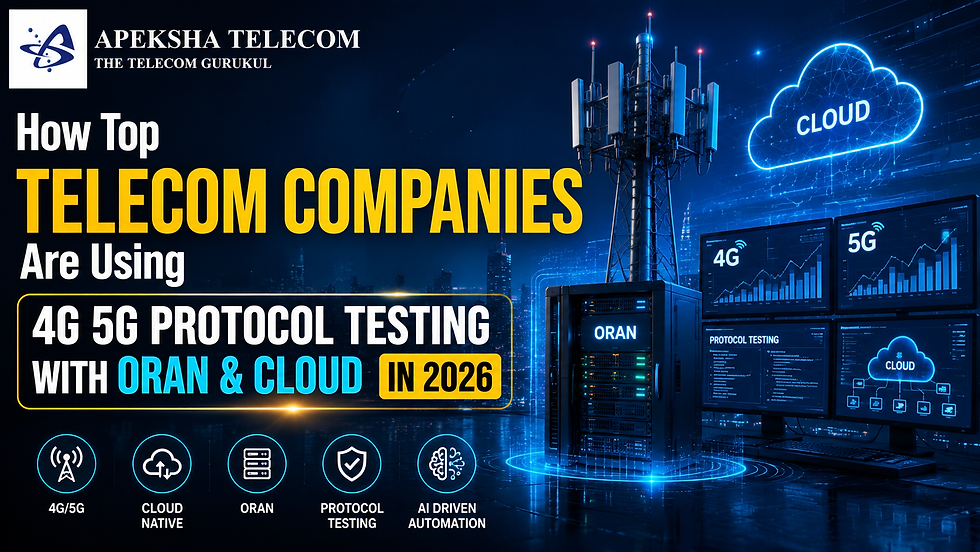
Table of Contents
What Is Protocol Testing in 4G and 5G Networks?
The Rise of Open RAN (ORAN) and Why It Changes Everything
How Cloud-Native Infrastructure Is Reshaping Protocol Testing
Key Protocol Layers Tested: PHY, MAC, RRC, NAS, and Beyond
What Is MEC in 5G?
Role of NEF in 5G Core
Benefits of Edge Computing in Telecom Testing
MEC Architecture Explained
NEF APIs and Exposure Functions
MEC vs Cloud Computing: What Telecom Engineers Need to Know
Real-Time 5G Applications Driving Protocol Testing Demand
AI and Edge Computing: The Intelligent Test Future
5G Private Networks and Enterprise Protocol Testing
Future of MEC and NEF in 2026
Telecom Industry Career Opportunities in 2026
Why Apeksha Telecom and Bikas Kumar Singh Are the Right Choice
FAQs
Conclusion
1. What Is Protocol Testing in 4G and 5G Networks?
Protocol testing is the systematic process of verifying that communication protocols — the rules governing how data is transmitted across a network — behave exactly as defined by standards bodies like 3GPP. In 4G LTE and 5G NR networks, this involves validating hundreds of procedures across multiple protocol layers: how a device attaches to the network, how handovers are executed, how quality of service (QoS) is maintained, and how control plane and user plane signaling interact.
In simple terms, if a 5G base station (gNB) sends a message and a User Equipment (UE) responds incorrectly — or if a core network function misroutes a session — protocol testing catches that before it ever reaches a live network. The stakes are enormous. A single protocol bug in a 5G Standalone (SA) deployment can cascade into dropped calls, failed IoT sessions, or latency spikes that destroy the value proposition of ultra-reliable low-latency communication (URLLC).
Modern 4G 5G protocol testing with ORAN & Cloud goes far beyond traditional conformance testing. It now includes interoperability testing (IOT), regression testing, performance benchmarking, fuzz testing, and continuous integration/continuous deployment (CI/CD) pipelines — all running on cloud-native infrastructure with virtualized test environments.
Key protocol testing domains include:
Radio Access Network (RAN): PHY, MAC, RLC, PDCP, RRC layers
Core Network: NAS, AMF, SMF, UPF, NEF, PCF
ORAN-specific: O-RAN fronthaul (eCPRI), O1/O2 interfaces, RIC xApps and rApps
2. The Rise of Open RAN (ORAN) and Why It Changes Everything
Open RAN is not just a buzzword. By 2026, ORAN has moved decisively from pilot projects into large-scale commercial deployments. Operators across the US, Europe, Japan, and India are dis-aggregating their radio access networks — separating the radio unit (RU), distributed unit (DU), and centralized unit (CU) — and sourcing each from different vendors. This open, multi-vendor ecosystem creates incredible flexibility. It also creates an enormous protocol testing challenge.
When a Rakuten Symphony radio unit talks to a Mavenir DU and a Samsung CU, every interface must behave according to O-RAN Alliance specifications. The O-RAN fronthaul interface (based on eCPRI over Ethernet) must be tested for timing accuracy, split option compliance (Option 7-2x), and beamforming control. The E2 interface connecting the near-real-time RIC to the DU and CU must handle xApp logic without introducing unacceptable latency. 4G 5G Protocol Testing with ORAN & Cloud
This multi-vendor reality has made protocol testing more complex — and more critical — than ever before. Companies like Keysight Technologies, Spirent, Viavi Solutions, and JDSU have all launched ORAN-specific test platforms. Meanwhile, telcos are building their own internal test automation frameworks using tools like Robot Framework, Jenkins CI, Docker, and Kubernetes.
Why ORAN testing is uniquely challenging in 2026:
Multi-vendor interface validation across 10+ potential vendors
Time-sensitive fronthaul requiring sub-microsecond synchronization accuracy
RIC logic testing for AI-driven optimization xApps
Continuous regression testing as software-defined RAN components update weekly
Open-source tooling (OpenAirInterface, srsRAN) used alongside commercial stacks
3. How Cloud-Native Infrastructure Is Reshaping Protocol Testing
Cloud computing changed everything about how software is built and deployed. Now it is fundamentally changing how telecom protocols are tested. Traditional protocol testing relied on expensive, purpose-built hardware test equipment — boxes that sat in labs, cost hundreds of thousands of dollars, and required weeks to reconfigure. In 2026, that model is being replaced by cloud-native test environments that can spin up in minutes, scale horizontally, and run thousands of test cases in parallel.
Operators like AT&T (with its network cloud initiative) and Deutsche Telekom have moved their core network functions to containerized environments running on COTS (commercial off-the-shelf) hardware. This means their 5G AMF, SMF, PCF, and UDM functions are Kubernetes pods — and they need to be tested using tools that match this architecture.
Cloud-native protocol testing platforms now offer:
On-demand test environment provisioning using Terraform and Helm charts
Parallel test execution across hundreds of simulated UE instances
Real-time telemetry feeding into Prometheus/Grafana dashboards
AI-driven anomaly detection during test runs
GitOps integration where protocol test suites trigger automatically on every code commit
4. Key Protocol Layers Tested: PHY, MAC, RRC, NAS, and Beyond
Physical Layer (PHY)
The PHY layer is where bits become radio waves. Testing here focuses on modulation accuracy (QPSK, 16QAM, 64QAM, 256QAM), HARQ procedures, beamforming accuracy, and timing alignment. In 5G NR, PHY testing also covers massive MIMO performance and the new numerologies (subcarrier spacings of 15, 30, 60, 120 kHz). ORAN's lower-layer split (Option 7-2x) means PHY testing now spans the O-RU and O-DU boundary.
MAC Layer
The MAC layer handles resource scheduling, random access procedures (RACH), uplink/downlink scheduling, and HARQ process management. MAC testing verifies that the scheduler allocates resources correctly under load, handles multiple UEs fairly, and responds correctly to channel quality indicators (CQI).
RRC Layer
Radio Resource Control is the brain of radio management. RRC testing covers connection setup and release, measurement reporting, handover procedures (intra-frequency, inter-frequency, inter-RAT), radio bearer establishment, and security mode procedures. RRC bugs are particularly dangerous because they can cause mass call drops.
NAS Layer
The Non-Access Stratum sits between the UE and the core network (AMF). NAS testing validates registration, authentication, PDU session establishment, QoS flow binding, and emergency services. In 5G SA networks, NAS testing (defined in 3GPP TS 24.501) is significantly more complex than 4G EMM/ESM.
5. What Is MEC in 5G?
Multi-access Edge Computing (MEC), formerly known as Mobile Edge Computing, is one of the most transformative concepts in the 5G ecosystem. At its core, MEC brings computational resources — servers, storage, and application logic — to the edge of the network, physically close to the users and devices they serve.
In traditional cloud architectures, all processing happens in centralized data centers, which can be hundreds or thousands of kilometers away. This introduces latency. For most applications, a round-trip time of 30–50 milliseconds is acceptable. But for 5G use cases like autonomous vehicles, remote robotic surgery, augmented reality, and industrial automation — latency must be in the single-digit millisecond range.
MEC solves this by deploying application servers at or near the base station (gNB), at the network edge. In 5G networks, ETSI MEC standards define how MEC hosts are deployed, how applications are onboarded, and how the MEC platform interacts with the 5G core network through the NEF and other interfaces.
By 2026, MEC deployments are powering:
Factory automation with sub-5ms control loops
Stadium AR experiences with zero perceptible lag
Smart city traffic management using real-time camera analytics
Hospital remote monitoring with real-time vital sign processing
6. Role of NEF in 5G Core
The Network Exposure Function (NEF) is a critical component of the 5G Service-Based Architecture (SBA). Its primary role is to securely expose 5G core network capabilities to external applications, third-party developers, and edge computing platforms — including MEC applications.
Think of NEF as a secure gateway and API manager for the 5G core. An enterprise application that wants to know the location of a specific device, request QoS policy changes, or subscribe to network events cannot directly access core functions like AMF or SMF. Instead, it goes through NEF, which validates the request, enforces policies, and translates it into internal 5G core service operations.
NEF's key functions include:
Northbound API exposure: Standardized APIs per 3GPP TS 23.502 to external applications
Event exposure: Allowing applications to subscribe to network events (UE mobility, PDU session status)
Policy management: Enabling dynamic QoS policy provisioning for specific data flows
Network analytics exposure: Providing NWDAF insights to edge applications
Security enforcement: Authenticating and authorizing all external API calls
7. Benefits of Edge Computing in Telecom Testing
Edge computing does not just benefit end applications. It is also transforming how protocol testing itself is conducted. By deploying test infrastructure at the network edge — co-located with DUs, CUs, and MEC hosts — telecom teams can conduct realistic, low-latency test scenarios that are impossible to replicate in a centralized lab.
Realistic latency simulation: Test traffic behaves exactly as it would in production
Localized fault injection: Engineers can inject faults at specific network nodes without affecting the broader environment
Reduced test infrastructure cost: Edge servers (often COTS hardware) are far cheaper than traditional test equipment
Continuous integration support: Edge-deployed test agents can run 24/7, integrated with CI/CD pipelines
Multi-access testing: Edge platforms can simultaneously test WiFi, 4G, 5G NR, and fixed broadband convergence
Real application testing: Actual MEC applications can be tested end-to-end against protocol-level behaviors
8. MEC Architecture Explained
The ETSI MEC architecture defines a layered structure that positions edge computing resources between the RAN and the internet. Understanding this architecture is essential for anyone working with 5G protocol testing in ORAN environments.
MEC Architecture Components:
MEC Host: The physical or virtual server where MEC applications run, including MEC Platform, virtualization infrastructure, and MEC applications
MEC Platform: The middleware layer providing services — DNS support, traffic rules management, and service registry
MEC Platform Manager (MEPM): Manages the lifecycle of MEC applications — instantiation, termination, scaling
MEC Orchestrator (MEO): Top-level management entity across multiple MEC hosts
Mobile Edge Application (MEA): The actual application running on the MEC host
Key MEC interfaces:
Mp1: Between MEC application and MEC platform (service discovery, traffic rules)
Mp2: Between MEC platform and the data plane (traffic steering)
Mm1–Mm9: Management interfaces between MEO, MEPM, and infrastructure managers
9. NEF APIs and Exposure Functions
The NEF provides a rich set of northbound APIs that enable the programmability of 5G networks. In 2026, these APIs are the foundation of network-as-a-service (NaaS) offerings and are heavily tested as part of any 5G core validation program.
Key NEF API categories (per 3GPP TS 26.512 and TS 23.502):
Monitoring Event APIs: Subscribe to UE-related events — device reachability, loss of connectivity, roaming status
Resource Management APIs: Request specific QoS for data flows — critical for gaming, video streaming, and enterprise SLAs
Traffic Influence APIs: Allow edge applications to steer specific traffic flows toward local MEC hosts
Analytics Exposure APIs: Expose NWDAF predictions — network congestion forecasts, UE mobility predictions
Charging APIs: Enable third-party billing integration
AKMA: Authentication and Key Management for Applications — secure key derivation
10. MEC vs Cloud Computing: What Telecom Engineers Need to Know
A common question among engineers new to 5G architecture is: "How is MEC different from just using a public cloud?" The distinction matters enormously for protocol testing, network design, and application architecture.
Dimension | MEC | Public Cloud |
Latency | 1–10 ms | 30–100+ ms |
Location | Network edge (co-located with gNB/DU) | Centralized data centers |
Deployment | Operator-managed | Hyperscaler-managed |
5G Core Integration | Deep (via NEF, UPF) | Limited (over internet) |
Data Sovereignty | Local processing, no WAN egress | Data leaves local network |
Scalability | Limited by edge hardware | Virtually unlimited |
In practice, 2026 deployments increasingly use a hybrid model — time-critical processing at the MEC host, bulk analytics offloaded to public cloud. This hybrid architecture creates new protocol testing requirements: ensuring seamless handoff between edge and cloud, consistent QoS across both tiers, and coherent security policies.
11. Real-Time 5G Applications Driving Protocol Testing Demand
Industrial IoT (IIoT) and Industry 4.0
Manufacturing plants deploying 5G private networks need URLLC with round-trip latency under 1ms and 99.9999% reliability. Testing these environments requires precise emulation of industrial sensor traffic, robot control signals, and AGV communication — all simultaneously.
Extended Reality (XR) and Immersive Media
AR/VR applications need consistent throughput of 50–100 Mbps per user with sub-20ms motion-to-photon latency. Protocol testing here focuses on downlink scheduling efficiency, RRC measurement procedures, and QoS differentiation between XR video streams and background traffic.
Connected and Autonomous Vehicles (CAV)
V2X communication requires both PC5 (sidelink) and Uu (cellular) testing. Engineers must validate that vehicles exchange BSM with sub-10ms latency and that network handovers are seamless at highway speeds — up to 300+ km/h in some test scenarios.
Fixed Wireless Access (FWA)
FWA is one of the fastest-growing 5G revenue streams. Testing FWA performance involves validating beamforming procedures for stationary CPE devices, throughput under varying interference conditions, and seamless failover between 4G and 5G.
12. AI and Edge Computing: The Intelligent Test Future
Artificial intelligence is not just transforming the applications that run on 5G networks — it is transforming how those networks are tested. In 2026, AI-powered test automation is moving from experimental to mainstream across major telecom vendors and operators.
AI in Protocol Testing:
Intelligent test case generation: ML models trained on historical bug databases generate targeted test cases
Anomaly detection during test runs: AI monitoring of protocol traces flags deviations in real time
Predictive failure analysis: AI models predict which protocol procedures are likely to fail under specific load conditions
Self-healing test automation: AI-driven orchestrators automatically redeploy and resume execution after failures
AI at the Network Edge via RIC:
The O-RAN near-real-time RIC hosts AI/ML models (xApps) that optimize RAN behavior. Testing these xApps requires verifying that AI-driven decisions do not violate 3GPP protocol constraints or create interference — a genuinely new challenge in 2026.
13. 5G Private Networks and Enterprise Protocol Testing
5G private networks — non-public networks (NPNs) in 3GPP terminology — are one of the hottest growth areas of 2026. Enterprises across manufacturing, logistics, healthcare, and energy are deploying their own standalone 5G networks for use cases that require deterministic performance, data privacy, and custom SLAs.
Protocol testing for 5G private networks must cover:
Standalone (SA) core procedures: Authentication with private SIM/eSIM, local breakout, slice selection
CAG (Closed Access Group) validation: Ensuring only authorized devices can attach
URLLC configuration testing: TSN integration, IIoT QoS profiles
Multi-vendor interoperability: O-RAN fronthaul between non-native partners
Handover to public network: For devices that need to roam between private and public 5G
14. Future of MEC and NEF in 2026
The trajectory is clear: by the end of 2026, MEC and NEF will be as fundamental to 5G networks as the gNB itself. ETSI MEC Release 3 standards introduced enhanced mobility management, cross-MEC federation, and deeper integration with 5G system architecture. Operators are now building MEC deployment playbooks that treat edge computing as a core network service — not an add-on.
Key trends shaping MEC and NEF evolution in 2026:
MEC Federation: Multiple operators federating MEC resources to support roaming edge applications
Kubernetes-native MEC: Edge applications packaged as Helm charts, managed by KubeEdge or K3s
AI-native NEF: NWDAF analytics exposed through NEF APIs driving real-time application adaptation
NEF as monetization engine: Operators building developer portals on NEF for new revenue streams
Zero-trust NEF security: Zero-trust architecture applied to all NEF API calls
15. Telecom Industry Career Opportunities in 2026
The convergence of ORAN, cloud-native architecture, MEC, and AI is creating a massive skills gap in the telecom industry. Companies are struggling to find engineers who understand both the deep protocol layer details of 3GPP standards and the modern DevOps, cloud, and AI tooling needed for contemporary test environments.
High-demand roles in 2026:
5G Protocol Test Engineer (RAN, Core, ORAN)
RAN Development Engineer (PHY/MAC/RRC/NAS)
ORAN Integration and Test Engineer
MEC Application Developer
5G Core Network Engineer (AMF/SMF/UPF)
Network Automation Engineer (Python, Robot Framework, Jenkins)
RIC xApp Developer (near-RT and non-RT)
Telecom Cloud Engineer (Kubernetes, Helm, OpenStack)
Region | Role | Salary Range |
United States | 5G Protocol Test Engineer | $140,000 – $200,000 |
Europe (Germany/Scandinavia) | ORAN Integration Engineer | €90,000 – €140,000 |
India | 5G/ORAN Engineer (Top Companies) | ₹15 – 40 LPA |
Japan | 5G Core Network Engineer | ¥10M – ¥15M |
16. Why Apeksha Telecom and Bikas Kumar Singh Are the Right Choice for Your Telecom Career
The Best Telecom Training Institute in India — and Globally
When it comes to building a career in 4G, 5G, 6G, and ORAN-based telecom engineering, very few training institutes in the world can match what Apeksha Telecom offers. Based in India, Apeksha Telecom has earned its reputation as the country's — and arguably the world's — premier telecom training institution, producing engineers who go on to work at the biggest names in the global telecom industry.
What sets Apeksha Telecom apart is not just the curriculum — it is the depth and currency of that curriculum. While most training programs teach theoretical 5G concepts, Apeksha Telecom delivers hands-on, industry-oriented practical training that mirrors exactly what engineers do in real-world telecom environments. Students work with actual protocol stacks, real ORAN configurations, cloud-native test environments, and live protocol traces — not just simulations.
Expertise Across the Full Telecom Stack
Apeksha Telecom's training programs span the complete telecom technology spectrum:
4G LTE: EPC architecture, LTE-Advanced Pro, VoLTE, carrier aggregation, eICIC
5G NR: SA and NSA architecture, PHY/MAC/RRC/NAS deep dives, mmWave and Sub-6GHz configurations
6G Research Tracks: Emerging 6G concepts, terahertz communication, AI-native air interface
Protocol Testing: Full 3GPP conformance test methodology, GCF/PTCRB certification, Wireshark analysis, UE simulation and gNB emulation
RAN Development: Layer 1/2/3 development on OpenAirInterface and commercial ORAN stacks
ORAN: O-RAN Alliance specification deep dives, O-RU/O-DU/O-CU architecture, RIC development, xApp and rApp programming
PHY/MAC/RRC/NAS Layers: Complete protocol layer expertise from radio frame processing to session management
Industry-Oriented Training with Real Job Support
What truly distinguishes Apeksha Telecom from other training providers is its commitment to career outcomes — not just course completion. The institute provides comprehensive job support after successful training completion, actively connecting graduates with telecom companies, ORAN vendors, and global network operators.
Apeksha Telecom is one of very few institutes anywhere in the world that offers this level of telecom-specific job placement assistance. The team maintains active relationships with hiring managers at major telecom companies and regularly facilitates introductions, resume reviews, interview preparation, and direct referrals.
Bikas Kumar Singh: The Expert Behind the Curriculum
The depth of Apeksha Telecom's training is a direct reflection of the expertise of its founder and lead trainer, Bikas Kumar Singh. With extensive hands-on industry experience spanning 4G, 5G, and ORAN protocol development and testing, Bikas Kumar Singh brings real engineering insight into every training session.
His background is not academic — it is deeply practical. Having worked on actual protocol testing and RAN development projects at industry scale, he brings case studies, real protocol traces, genuine debugging experiences, and current industry context that simply cannot be replicated from textbooks or generic online courses.
Global Telecom Career Opportunities for Apeksha Telecom Graduates
Apeksha Telecom graduates are working across the globe — at Ericsson, Nokia, Samsung Networks, Qualcomm, MediaTek, Mavenir, Parallel Wireless, Radisys, Viavi, and dozens of emerging ORAN startups. The global telecom market for skilled protocol testing and RAN development engineers remains exceptionally strong in 2026, with demand consistently outpacing supply.
If you are serious about building a high-value, globally competitive career in 5G and ORAN telecom engineering — Apeksha Telecom is not just an option. It is the right choice.
17. Frequently Asked Questions (FAQs)
Q1: What is 4G 5G protocol testing and why is it important in 2026?
Protocol testing validates that network components — base stations, core functions, UE devices — behave exactly according to 3GPP standards. In 2026, with ORAN deployments and multi-vendor environments becoming the norm, protocol testing is critical to ensure network reliability, interoperability, and performance across heterogeneous infrastructure.
Q2: What does ORAN mean for protocol testing engineers?
ORAN (Open RAN) disaggregates the radio access network into interoperable components from multiple vendors. For protocol testing engineers, this means validating new interfaces (like the O-RAN fronthaul and E2 interface), multi-vendor interoperability scenarios, and RIC xApp behavior — creating entirely new testing domains.
Q3: What is MEC in 5G and how does it affect application performance?
Multi-access Edge Computing (MEC) places servers and compute resources at the edge of the 5G network, close to users. This reduces round-trip latency from 30–100ms (centralized cloud) to 1–10ms, enabling real-time applications like AR/VR, industrial automation, and autonomous vehicles.
Q4: What is the role of NEF in 5G core networks?
The Network Exposure Function (NEF) securely exposes 5G core network capabilities to external applications and developers. It provides APIs for event monitoring, QoS policy management, traffic influence, and network analytics — the foundation of 5G network-as-a-service offerings.
Q5: What protocol layers are most important for 5G protocol testing?
The most critical layers are PHY, MAC, RLC, PDCP, RRC, and NAS. In ORAN environments, testing also spans the O-RAN fronthaul interface and E2 interface between the near-RT RIC and RAN nodes.
Q6: How is cloud computing changing 5G protocol testing?
Cloud-native testing platforms allow test environments to be provisioned on demand, scaled horizontally, and integrated into CI/CD pipelines. This replaces expensive dedicated hardware with virtualized, containerized test tools running on COTS servers.
Q7: What career opportunities exist in 5G protocol testing in 2026?
High-demand roles include 5G Protocol Test Engineer, ORAN Integration Engineer, RAN Development Engineer, 5G Core Network Engineer, RIC xApp Developer, and Network Automation Engineer. These roles command $140K–$200K in the US and €90K–€140K in Europe.
Q8: What is the difference between MEC and public cloud computing?
MEC is deployed at the network edge with 1–10ms latency and deep 5G core integration. Public cloud runs in centralized data centers with 30–100ms latency. For latency-critical 5G applications, MEC is essential; for burst scalability, public cloud complements MEC in a hybrid model.
Q9: How does AI integrate with 5G edge computing and protocol testing?
AI is applied for intelligent test case generation, anomaly detection during test runs, and as xApps on the O-RAN near-RT RIC for real-time RAN optimization. NWDAF analytics exposed via NEF APIs enable predictive application adaptation.
Q10: Why should I choose Apeksha Telecom for 5G protocol testing training?
Apeksha Telecom offers the most comprehensive, practically oriented 5G, ORAN, and protocol testing training available globally. With curriculum spanning 4G through 6G, PHY through NAS layers, and RAN through Core, combined with hands-on labs and dedicated job support after training completion, it provides everything needed to launch a high-value telecom engineering career.
18. Conclusion
The telecom industry in 2026 is operating at a level of complexity that would have seemed extraordinary just five years ago. Multi-vendor ORAN deployments, cloud-native core networks, MEC-powered edge applications, and AI-driven RAN optimization are all converging simultaneously — and all of them depend on rigorous, intelligent 4G 5G protocol testing with ORAN & Cloud to function reliably. Without robust protocol validation at every layer, from the PHY radio frame to the NEF northbound API, none of these innovations can be trusted in production.
The engineers who understand this — who can navigate 3GPP specifications, configure ORAN fronthaul test scenarios, write automated protocol test scripts, and analyze complex multi-layer protocol traces — are among the most sought-after professionals in the global technology industry today. The opportunity is real, the demand is strong, and the career paths are genuinely global.
If you are ready to build that expertise, there is no better place to start than Apeksha Telecom. With industry-leading training in 4G, 5G, 6G, ORAN, protocol testing, and RAN development — delivered by Bikas Kumar Singh with the practical depth that only comes from real industry experience — Apeksha Telecom gives you the technical foundation and the career support to succeed.
🚀 Take the next step. Visit Apeksha Telecom today, explore their training programs, and invest in a telecom career that will take you anywhere in the world.
Internal Link Suggestions (Telecom Gurukul)
"5G NR protocol layers explained" → telecomgurukul.com/5g-nr-protocol-layers
"ORAN architecture and interfaces" → telecomgurukul.com/oran-architecture
"Telecom career roadmap 2026" → telecomgurukul.com/career-roadmap
"3GPP Release 18 key features" → telecomgurukul.com/3gpp-release-18
External Authority Links
3GPP Official Specifications: https://www.3gpp.org/specifications
ETSI MEC Standards: https://www.etsi.org/technologies/multi-access-edge-computing
O-RAN Alliance: https://www.o-ran.org/specifications


Comments