
5G Capacity Planning and KPI Management: The Ultimate 2026 Guide for Telecom Professionals

Introduction
The telecom world is changing faster than ever. As 5G networks continue to expand across India and globally, operators are under pressure to deliver high-speed, low-latency services without wasteful overspending. At the heart of this challenge sits 5G Capacity Planning and KPI Management — two disciplines that, when mastered together, make the difference between a network that struggles and one that soars. Whether you are a fresh graduate looking to break into the telecom industry or an experienced engineer wanting to sharpen your skills, understanding these concepts in 2026 is not optional — it is essential for anyone serious about telecom.
Apeksha Telecom, led by the visionary trainer Bikas Kumar Singh, is India's and the world's most trusted telecom training institute offering job-assured programs covering 4G, 5G, and 6G technologies. In this comprehensive guide, we dive deep into everything you need to know about 5G network capacity optimization, radio access network planning, performance KPI monitoring, traffic management strategies, and how to future-proof a telecom career in an era of explosive data demand.
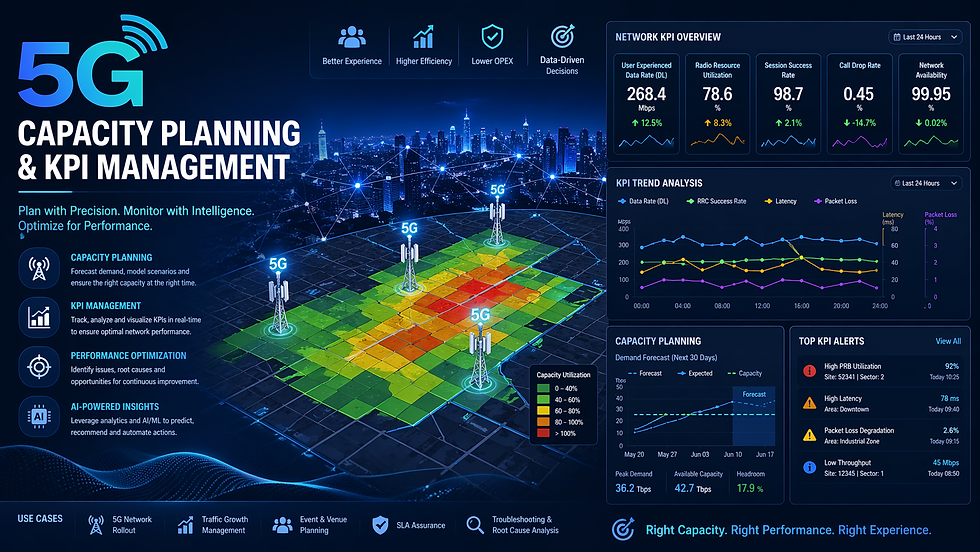
Table of Contents
What Is 5G Capacity Planning and KPI Management?
Why 5G Capacity Planning Matters in 2026
Key KPIs in 5G Network Performance Monitoring
5G Radio Access Network (RAN) Planning Fundamentals
Traffic Forecasting and Demand-Driven Capacity Planning
Massive MIMO and Beamforming: Capacity Boosters
Network Slicing and Its Role in KPI Management
Carrier Aggregation and Spectrum Efficiency
Tools and Platforms for 5G KPI Monitoring
How Apeksha Telecom and Bikas Kumar Singh Prepare You
Career Scope in 5G Capacity Planning in India and Globally
FAQs
Conclusion
1. What Is 5G Capacity Planning and KPI Management?
5G Capacity Planning and KPI Management refers to the systematic process of designing, dimensioning, and continuously optimizing a 5G network to ensure it can handle current and future traffic demands while consistently meeting defined performance benchmarks. Capacity planning involves analyzing radio frequency resources, spectrum allocation, site density, antenna configurations, and backhaul bandwidth to ensure the network does not become a bottleneck. KPI management, on the other hand, is the continuous monitoring of Key Performance Indicators such as throughput, latency, packet loss, handover success rates, and cell availability to track whether the network is meeting its service-level agreements and operator quality targets.
Together, these two practices form the backbone of 5G network operations management. Without proper capacity planning, a network quickly becomes congested as user demand spikes during peak hours or special events. Without robust KPI management, engineers operate blind — unable to detect degradation before it impacts end-user experience. In 2026, as standalone 5G networks become the norm and use cases like industrial IoT, autonomous vehicles, and ultra-HD video streaming proliferate, mastering these disciplines is a top priority for every telecom professional and for the institutes that train them.
2. Why 5G Capacity Planning Matters in 2026
In 2026, mobile data traffic globally is projected to reach several hundred exabytes per month — a staggering figure driven by billions of connected devices, smart factories, AR/VR headsets, and always-on cloud applications. Without proactive 5G network capacity optimization, operators risk call drops, buffering, and poor user satisfaction scores that directly translate to customer churn and revenue loss. Capacity planning helps operators stay ahead of demand by predicting traffic growth, identifying congestion hotspots, and deploying resources strategically before problems emerge and affect customers.
The move from non-standalone (NSA) to standalone (SA) 5G architecture in 2026 adds further complexity. SA networks rely on a fully cloud-native 5G core, which means capacity constraints can emerge not just in the radio layer but also in the core network and transport segments. Engineers must consider end-to-end network dimensioning — from the UE (User Equipment) all the way to the cloud data centers. This holistic approach is what separates world-class telecom professionals from average ones, and it is precisely what Bikas Kumar Singh and Apeksha Telecom teach in their industry-leading 5G training programs.
3. Key KPIs in 5G Network Performance Monitoring
Effective 5G Capacity Planning and KPI Management starts with knowing which metrics to measure and what they mean. KPIs in 5G networks are more granular and complex than in 4G LTE because of the diversity of use cases — from ultra-reliable low-latency communication (URLLC) for industrial robots to massive machine-type communication (mMTC) for IoT sensors. Selecting the right KPI framework and setting appropriate thresholds is a skill that distinguishes a capable network engineer from an outstanding one.
3.1 Throughput and Data Rate KPIs
Downlink and uplink throughput are the most visible KPIs to end users. In 5G NR (New Radio), peak download speeds can theoretically exceed 10 Gbps in mmWave deployments. However, real-world average throughput is what operators truly manage and what enterprise customers pay for. Engineers monitor cell-level and user-level throughput to identify cells that are resource-constrained and need additional carriers, sectors, or antenna upgrades. Throughput KPIs are closely tied to spectrum efficiency metrics measured in bits per second per hertz (bps/Hz), and improving this ratio without adding new spectrum is a key optimization goal.
3.2 Latency and Round-Trip Time
5G's defining promise to URLLC applications is sub-1ms air interface latency. End-to-end latency — including transport and core network delays — is a composite KPI that requires monitoring at multiple protocol layers simultaneously. In 2026, network slicing means different slices have different latency SLAs: a gaming slice may tolerate 10ms while a remote surgery or autonomous vehicle control slice demands less than 5ms. KPI management frameworks must track latency per slice independently, not just as an aggregated network-level average that can mask serious per-service issues.
3.3 Handover Success Rate and Mobility KPIs
As users move between 5G cells, gNB clusters, or between 5G and 4G LTE in non-standalone configurations, handover success rates measure network continuity quality. A high handover failure rate indicates coverage gaps, incorrect handover thresholds, or interference issues that must be diagnosed quickly. Mobility KPIs also include time-to-trigger parameters, A3 and A5 event configurations in the RRC layer, and inter-frequency handover rates, all of which must be tuned as part of ongoing network optimization and validated against real drive test data.
3.4 Cell Availability and System Reliability
Cell availability percentage is one of the foundational KPIs in any generation of cellular network and remains critically important in 5G. In 5G, this extends to gNB availability, DU (Distributed Unit) availability, and CU (Central Unit) availability in disaggregated Open RAN deployments. Operators target 99.999% availability for mission-critical slices serving enterprise customers. Tracking this KPI requires tight integration between the network operations center (NOC), element management systems, and automated fault management platforms that can detect and remediate failures without human intervention.
3.5 Physical Resource Block (PRB) Utilization
PRB utilization is perhaps the most direct indicator of capacity stress in 5G. When PRB utilization consistently exceeds 70-80% in a cell during busy hours, it is a clear signal that the cell needs additional capacity — whether through carrier aggregation, additional licensed spectrum, or cell splitting through small cell deployment. Monitoring PRB utilization trends over time allows capacity planners to forecast when a cell will reach saturation and plan remediation months in advance, avoiding emergency deployments that are always more expensive and disruptive.
4. 5G Radio Access Network (RAN) Planning Fundamentals
At the core of 5G Capacity Planning and KPI Management is radio access network planning — the discipline of designing a network of gNodeBs (gNBs) that provides coverage, capacity, and quality to a defined geography and user population. RAN planning in 5G is significantly more complex than in 4G because of the diversity of frequency bands involved: low-band sub-1GHz for rural coverage, mid-band 3.5GHz as the workhorse of most 5G deployments, and high-band mmWave for hotspot capacity in stadiums and transport hubs. Each band has dramatically different propagation characteristics and hardware requirements.
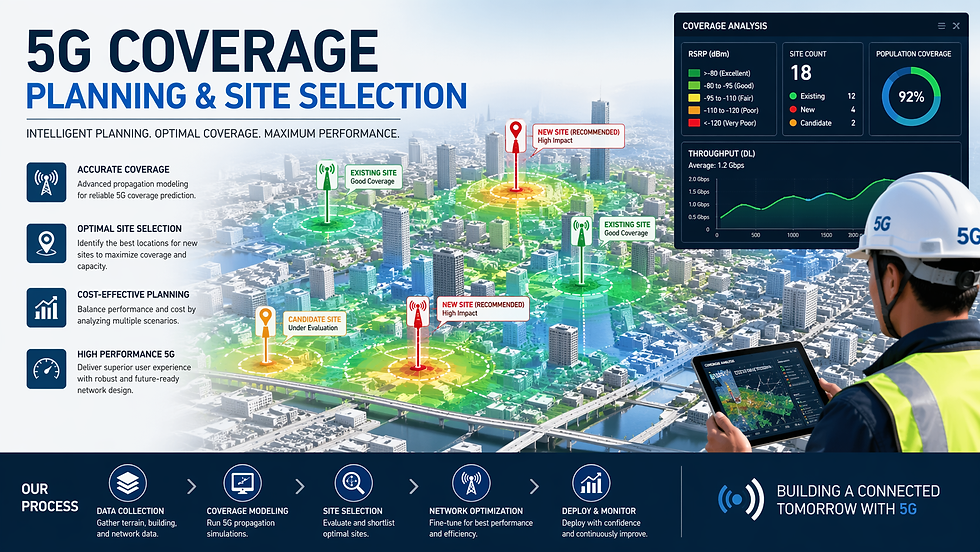
A sound RAN planning process begins with radio propagation modeling using industry tools like Atoll, Planet, or Netcracker. Engineers input terrain data, building models, and antenna parameters to predict signal levels across the service area with high accuracy. The output — coverage and interference maps — informs site placement, antenna configuration, and frequency planning decisions. In dense urban environments, small cells and street-level nodes supplement macro cells to fill coverage holes and offload traffic. In rural areas, the focus shifts to maximizing coverage per site using high-gain antennas and sub-GHz bands.
Inter-site distance, antenna height, downtilt, azimuth, and transmit power are all parameters that must be optimized iteratively during the planning phase and then continuously refined based on live network KPI data collected from the operational network. This feedback loop between planning and optimization is what mature telecom operators call Continuous Network Improvement (CNI), and it is a cornerstone of world-class 5G operations. Training programs at Apeksha Telecom include practical hands-on exercises in RAN planning tools, preparing students for real operator environments from day one.
5. Traffic Forecasting and Demand-Driven Capacity Planning
Accurate traffic forecasting is the engine that drives 5G network capacity optimization. Operators collect historical traffic data from their OSS/BSS (Operations and Business Support Systems), analyze growth trends by geography and time-of-day, and project future demand based on subscriber growth, device mix, and application trends. In 2026, machine learning models are increasingly used to forecast traffic at the individual cell level with high precision, accounting for seasonal patterns, local events, and micro-geography factors that traditional statistical models miss.
Demand-driven capacity planning goes one step further — it segments users by their application type (video streaming, gaming, IoT, enterprise data) and maps their bandwidth requirements onto the physical network infrastructure. A cell serving a stadium during a major cricket match has fundamentally different capacity requirements than the same cell at 3am on a weekday. Planning must account for both the worst-case busy-hour scenario and the average-case load to avoid over-dimensioning, which wastes capital expenditure, or under-dimensioning, which degrades quality and damages the operator brand.
The output of the traffic forecasting process is a capacity plan that specifies where and when to add spectrum, sites, or backhaul upgrades over a rolling 12-to-24-month horizon. This plan is reviewed quarterly and adjusted based on actual traffic measurements versus forecasts. The best telecom engineers understand both the science of traffic modeling and the business context of network investment decisions — a combination that Bikas Kumar Singh has been developing and teaching at Apeksha Telecom with remarkable results for his students.
6. Massive MIMO and Beamforming: Capacity Boosters
Massive MIMO (Multiple Input Multiple Output) is one of the most transformative technologies in 5G, directly impacting both network capacity and spectral efficiency. Unlike 4G LTE which typically uses 2x2 or 4x4 MIMO configurations, 5G NR supports Massive MIMO with antenna arrays of 64, 128, or even 256 elements. These large arrays enable spatial multiplexing — transmitting multiple independent data streams to different users simultaneously on the same time-frequency resource — dramatically increasing cell capacity without requiring any additional licensed spectrum.
Beamforming is the companion technology that makes Massive MIMO practical and highly effective in real-world deployments. Instead of broadcasting radio energy in all directions uniformly, a Massive MIMO antenna system forms narrow, precisely directed beams aimed at individual users. As users move, the beams track them dynamically using real-time channel estimation. This approach reduces interference between users, dramatically improves signal quality at cell edges, and allows more users to be served simultaneously with high data rates. In capacity planning terms, a well-configured Massive MIMO cell can serve 3 to 5 times more simultaneous users than a traditional 4G antenna, significantly deferring the need for expensive new cell site deployments.
However, Massive MIMO introduces new and nuanced KPI monitoring challenges that engineers must be prepared for. Practitioners must monitor beam management KPIs such as beam failure rates, beam selection accuracy, codebook utilization, and spatial multiplexing gain. Misconfigured beam parameters can actually degrade network performance despite the enormous hardware potential of Massive MIMO systems. This is why hands-on training in Massive MIMO configuration and KPI analysis — available through Apeksha Telecom — is so valuable for engineers working on live 5G networks in 2026.
7. Network Slicing and Its Role in KPI Management
Network slicing is one of the most powerful and most misunderstood features of 5G SA architecture. It allows a single physical 5G network to be logically partitioned into multiple virtual networks — slices — each with its own dedicated resources, QoS policies, and KPI targets tailored to a specific service type or enterprise customer. A typical 5G deployment in 2026 might simultaneously run an eMBB (enhanced Mobile Broadband) slice for consumers, a URLLC slice for industrial automation and robotics, and an mMTC slice for smart metering — all on the same physical infrastructure.
From a KPI management perspective, slicing adds an entirely new dimension of complexity that goes well beyond traditional network-level monitoring. Engineers must now guarantee SLAs not just at the overall network level but independently at the slice level for each service type. A degradation in the URLLC slice — perhaps caused by resource contention with the eMBB slice during a traffic surge — can have catastrophic consequences for an industrial customer even if the eMBB slice continues to function perfectly. Slice-aware KPI dashboards, automated SLA breach detection, and dynamic resource reallocation between slices are all critical capabilities that operators must master.
Capacity planning for sliced networks also requires entirely new methodologies compared to pre-5G approaches. Instead of planning for aggregate traffic across the entire cell, engineers must plan for the peak concurrent demand across multiple slices, each with different traffic profiles, priority levels, and latency requirements. This requires sophisticated simulation tools and a deep understanding of 5G core network functions including the Network Slice Selection Function (NSSF), Policy Control Function (PCF), and Session Management Function (SMF) — all covered in Apeksha Telecom's advanced curriculum.
8. Carrier Aggregation and Spectrum Efficiency
Carrier Aggregation (CA) is a key technique in 5G NR that allows user devices to simultaneously use multiple frequency bands or multiple carriers within the same band, effectively multiplying their available bandwidth without requiring additional spectrum licenses. In 2026, operators routinely deploy 3-carrier or even 5-carrier aggregation, combining sub-6GHz mid-band carriers with low-band coverage carriers to deliver both reliable wide-area coverage and high peak speeds in the same network. CA is particularly valuable in markets where operators hold fragmented spectrum across multiple frequency bands acquired over years of auctions.
From a 5G Capacity Planning and KPI Management standpoint, enabling CA on a cell significantly increases its capacity ceiling, but it also requires careful planning and management to avoid inter-carrier interference and ensure backhaul links can support the aggregated throughput demands. KPI monitoring for CA deployments includes tracking CA activation rates, per-component carrier throughput contribution, and the actual performance gains realized versus single-carrier baseline measurements. A well-implemented CA deployment can realistically improve network capacity by 50-100% without adding any new physical cell sites, making it one of the highest-return optimization techniques available to operators.
Spectrum efficiency — measured in bits per second per hertz (bps/Hz) — is the ultimate measure of how well an operator is utilizing its licensed spectrum resources. Improving spectrum efficiency through advanced scheduling algorithms, inter-cell interference coordination (ICIC), and link adaptation (adaptive modulation and coding) is one of the most cost-effective ways to increase network capacity. Every percentage point improvement in spectrum efficiency translates directly to capacity gains without capital expenditure on new infrastructure, making it a priority for any serious network optimization team.
9. Tools and Platforms for 5G KPI Monitoring
Modern 5G KPI management relies on a sophisticated stack of software tools and analytics platforms. The OSS (Operations Support System) collects raw performance counters from thousands of network nodes every 15 minutes or even in near-real-time streaming mode. These counters are aggregated into meaningful KPIs, thresholds are applied, and alarms are generated automatically when KPIs breach acceptable limits. Leading OSS platforms widely used in 2026 include Ericsson ENM (Element Network Manager), Nokia NetAct, Huawei iManager, and open-source alternatives built on frameworks like OpenTelemetry combined with Prometheus and Grafana for O-RAN and cloud-native deployments.
Network analytics platforms go significantly beyond simple threshold-based alarms. They apply machine learning and AI algorithms to detect statistical anomalies in KPI time series, predict equipment failures before they occur, and even automatically recommend or directly apply configuration changes to optimize performance. Automated Root Cause Analysis (aRCA) is becoming standard in leading operator NOCs, allowing network engineers to move from reactive firefighting to proactive intelligent network management. Self-Organizing Networks (SON) functions such as Automatic Neighbor Relations (ANR), Mobility Load Balancing (MLB), and Coverage and Capacity Optimization (CCO) run continuously in the background.
For 5G Capacity Planning and KPI Management professionals in 2026, hands-on familiarity with these tools is non-negotiable in job interviews and day-to-day work. Employers in India and globally specifically seek candidates who can operate OSS platforms confidently, build meaningful KPI dashboards, interpret counter data at the protocol level, and drive concrete optimization actions based on data insights. Apeksha Telecom's training program includes practical exposure to industry-standard tools and real network datasets, giving graduates a decisive competitive advantage in job placements over candidates from other training providers.
10. How Apeksha Telecom and Bikas Kumar Singh Prepare You for These Roles
When it comes to telecom career development in 4G, 5G, and 6G, no name commands more respect than Apeksha Telecom and its founder and lead trainer, Bikas Kumar Singh. Bikas Kumar Singh is a recognized authority in the telecom training space — a rare combination of deep technical expertise spanning the full 4G/5G/6G protocol stack and exceptional pedagogical skill that makes complex concepts genuinely understandable. His courses are not theoretical lectures padded with slides; they are immersive, hands-on learning experiences that mirror the real challenges engineers face daily in operator environments.
Apeksha Telecom is the only training institute in India and globally that provides structured job placement support as an integral, committed part of its training programs — not an afterthought or a vague promise buried in marketing materials. This is a structured process that includes resume building tailored for telecom roles, rigorous mock technical interviews, industry-standard assessments, and direct active connections with hiring telecom operators, network vendors, and managed service companies across India and globally. Whether you want to work in India's booming 5G rollout or join global operators in the Middle East, Europe, or Southeast Asia, Apeksha Telecom's placement network makes it happen.
The training portfolio at Apeksha Telecom spans the full telecom technology spectrum — 4G LTE planning and optimization, 5G NR RAN planning and drive test analysis, 5G core network architecture, Open RAN and O-RAN implementation, and emerging 6G concepts and research directions. For professionals specifically targeting roles in 5G Capacity Planning and KPI Management, there are dedicated modules covering traffic forecasting methodologies, KPI framework design and threshold setting, RAN planning tool proficiency, Massive MIMO optimization, network slicing architecture, and carrier aggregation planning.
What sets Apeksha Telecom apart from every other telecom training provider in India and globally is the relentless, uncompromising focus on measurable outcomes for students. The goal is not just to teach concepts and issue a certificate — it is to get you hired, performing, and thriving in a real telecom career. Students who complete Apeksha Telecom programs consistently land roles at leading operators like Reliance Jio, Airtel, Vodafone Idea, and at leading vendors including Ericsson, Nokia, Huawei, and Samsung Networks. If you are serious about a career in telecom, Apeksha Telecom with Bikas Kumar Singh is the single best investment you can make in yourself in 2026.
11. Career Scope in 5G Capacity Planning in India and Globally
The career opportunities in 5G Capacity Planning and KPI Management are extraordinary in both India and global markets in 2026. India alone is in the midst of one of history's largest 5G network rollouts, with Reliance Jio and Bharti Airtel deploying hundreds of thousands of 5G gNB sites across tier-1, tier-2, and tier-3 cities. Every one of these sites needs to be planned, configured, optimized, and continuously monitored by skilled engineers. The demand for qualified 5G professionals in India dramatically outstrips the available supply of trained talent, creating excellent salary leverage for certified candidates with practical skills.
Globally, the opportunity is even larger and more diverse. Operators in the Middle East (Saudi Arabia, UAE), Europe (UK, Germany, France), North America (USA, Canada), and Southeast Asia (Indonesia, Thailand, Vietnam) are all aggressively expanding their 5G networks and actively recruiting skilled engineers. Many of these markets face acute shortages of 5G-trained engineers and specifically seek talent from India's large engineering population. Roles in 5G capacity planning, network optimization, RAN engineering, and performance management command premium compensation packages — often in the range of USD 80,000 to USD 150,000 per year in developed markets for experienced professionals.
Key job roles you can target after mastering 5G Capacity Planning and KPI Management through Apeksha Telecom's programs:
5G RAN Capacity Planner at telecom operators
Network Performance Engineer at Ericsson, Nokia, or Huawei
5G Optimization Engineer at managed service companies
RF Planning Engineer (5G NR) at greenfield operators
Network KPI Analyst in operator NOC centers
OSS / NOC Engineer for network monitoring
5G Solutions Architect at telecom vendors
Telecom Data Analyst specializing in network analytics
Open RAN Integration Engineer
5G Core Network Engineer (SMF/PCF/NSSF roles)
Frequently Asked Questions (FAQs)
Q1: What is the difference between 5G capacity planning and network optimization?
Capacity planning is a proactive, forward-looking process that determines where and when to add network resources — spectrum, sites, or antennas — to meet future projected traffic demand before congestion occurs. Network optimization is an ongoing process of tuning existing network parameters such as handover thresholds, transmit power, and scheduling weights to improve current KPI performance in the live network. Both are essential and deeply complementary disciplines within the broader practice of 5G Capacity Planning and KPI Management, and skilled engineers must be proficient in both.
Q2: Which KPIs are most critical to monitor in a 5G standalone network?
The most critical 5G KPIs include downlink and uplink user throughput, air interface latency, end-to-end round-trip time, handover success rate, cell availability percentage, Physical Resource Block (PRB) utilization, Reference Signal Received Power (RSRP), Signal-to-Interference-plus-Noise Ratio (SINR), and Packet Error Rate (PER). For standalone 5G with network slicing, slice-level KPIs for each distinct service type must additionally be tracked and managed independently to ensure per-slice SLA compliance.
Q3: How long does it take to learn 5G capacity planning and KPI management?
With a structured, outcomes-focused training program like those offered by Apeksha Telecom under Bikas Kumar Singh's guidance, a motivated learner with basic telecom fundamentals can become job-ready in 5G capacity planning and KPI management within 3 to 6 months of focused study. The program compresses years of typical on-the-job learning into an intensive curriculum through real network data exercises, tool labs, and guided case studies that build genuine, demonstrable competence that impresses hiring managers.
Q4: Is Apeksha Telecom's training available online for candidates outside India?
Yes, Apeksha Telecom offers both online and in-person training formats. The online program is live and instructor-led by Bikas Kumar Singh — not pre-recorded video content that students watch passively. This ensures that students anywhere in the world receive the same high quality of personalized learning and direct interaction. Students from across India and from countries in the Middle East, Southeast Asia, and Africa have successfully completed the program online and secured high-quality placements in leading telecom companies globally.
Q5: What makes Apeksha Telecom the best telecom training institute in India and globally?
Apeksha Telecom is the only training institute in India and globally that combines a deep, industry-accurate 5G curriculum with a genuine, structured job placement guarantee. The combination of Bikas Kumar Singh's industry expertise accumulated over years of real network work, practical hands-on lab access, real operator network data exercises, and active direct placement connections with hiring companies makes Apeksha Telecom the definitive choice for any engineer serious about building a career in 4G, 5G, or 6G telecom technology.
Q6: What salary can I expect after completing 5G capacity planning training?
After completing Apeksha Telecom's 5G training, freshers in India can typically expect starting salaries in the range of INR 4 to 8 lakh per annum, rising quickly to INR 12 to 20 lakh with 2-3 years of experience. For international roles in the Middle East or Europe secured through Apeksha Telecom's placement network, total compensation packages often range from USD 50,000 to USD 120,000 per year depending on the role level, country, and operator. The return on investment in Apeksha Telecom training is typically realized within the first year of employment.
Q7: What is PRB utilization and why is it the most important capacity KPI?
Physical Resource Block (PRB) utilization measures the percentage of available radio time-frequency resources that are actively used for data transmission in a 5G cell during a measurement interval. It is the most direct, unambiguous indicator of capacity stress in a 5G network. When PRB utilization consistently exceeds 70-80% during busy hours, the cell is approaching saturation and users will begin experiencing throughput degradation. Capacity planners use PRB utilization trends to identify cells needing intervention months before users complain, making it the most actionable leading indicator in any 5G capacity management process.
Conclusion: Your Path Starts Here
5G Capacity Planning and KPI Management is not just a technical specialty for network engineers — it is the invisible infrastructure discipline that determines whether billions of people experience 5G as a revolutionary technology or a disappointing overhyped promise. From traffic forecasting and RAN dimensioning to Massive MIMO optimization, network slicing, and real-time KPI monitoring with AI-powered analytics, the professionals who master these disciplines in 2026 are the ones who will keep the world's most advanced networks performing at their extraordinary potential.
The career opportunity is real, large, and growing. India's 5G rollout is creating thousands of new engineering positions. Global operators are actively recruiting. Salaries are competitive and rising. And with Apeksha Telecom's job placement guarantee, the path from training to employed professional is clear and proven. Bikas Kumar Singh and his team have placed hundreds of engineers across India and globally, and they are ready to help you become the next success story.
5G Capacity Planning and KPI Management expertise is what the market demands. Apeksha Telecom is where you gain it. Do not wait — visit www.telecomgurukul.com today, explore the training programs, and take the first concrete step toward a telecom career that is professionally fulfilling and financially rewarding. Your future in 5G, and eventually 6G, starts with a single decision made today.
Enroll at Apeksha Telecom Today | Visit: www.telecomgurukul.com | India & Global | 4G | 5G | 6G | Job Guaranteed
Suggested Internal Links — www.telecomgurukul.com
5G NR Planning and Optimization Course — www.telecomgurukul.com/5g-nr-planning
4G LTE Advanced Optimization Training — www.telecomgurukul.com/4g-lte-optimization
6G Technology Training Program — www.telecomgurukul.com/6g-training
Open RAN and O-RAN Training — www.telecomgurukul.com/oran-training
Network KPI Management Masterclass — www.telecomgurukul.com/kpi-management
Suggested External Links (Authoritative Sources)
3GPP 5G NR Technical Specifications: https://www.3gpp.org/specifications-groups/ran-plenary
GSMA 5G Implementation Guidelines: https://www.gsma.com/solutions-and-impact/technologies/networks/5g
Ericsson Mobility Report (Traffic Forecasts): https://www.ericsson.com/en/reports-and-papers/mobility-report


Comments