
5G Protocol Testing Certification That Lands Telecom Jobs in India 2026 | Industry-Ready Training

Introduction To 5G Protocol Testing Certification
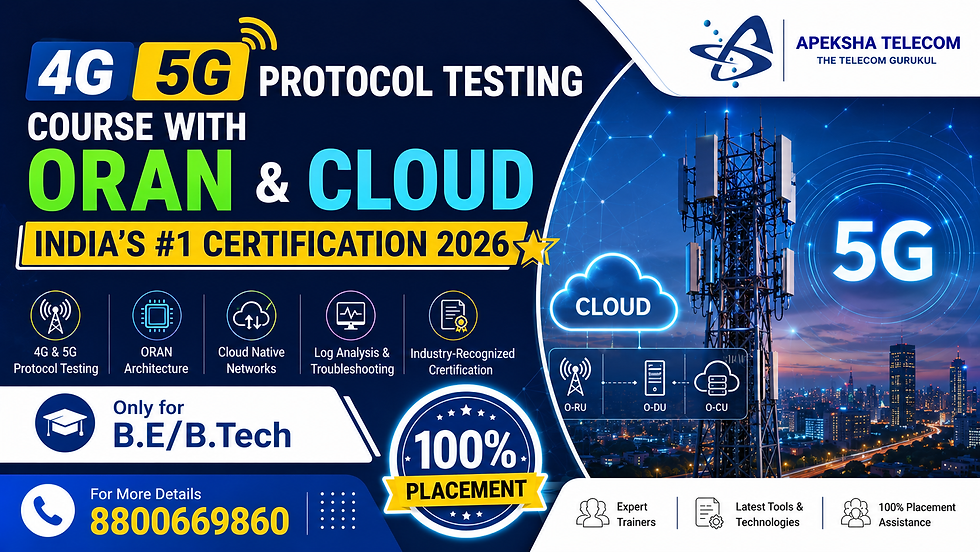
If you want work-ready telecom skills in 2026, a 5G Protocol Testing Certification That Lands Telecom Jobs in India 2026 is a powerful step. This course teaches RRC/NAS trace analysis, PHY/MAC validation, ORAN interoperability, MEC/NEF testing, and cloud CNF deployment so you can reproduce faults, validate features, and produce operator-grade reports. Read on to discover the curriculum, lab setups, career pathways, and how this certification bridges academia and operator expectations.

Table of Contents
Why this certification matters in 2026
Who should enroll and course outcomes
Core curriculum: what you’ll learn
Lab infrastructure: SDRs, protocol testers, and soft cores
Protocol layers: PHY to NAS explained for testers
Trace collection and log analysis best practices
RRC and NAS: attach, handover and mobility troubleshooting
PHY/MAC testing: HARQ, scheduling and resource mapping checks
PDCCH/PDSCH/PUSCH validation and KPI measurement
ORAN fundamentals and multi‑vendor interoperability testing
RIC, xApp testing and E2 interface validation
Cloud‑native CNFs: Kubernetes, Helm, and CI/CD for RAN
MEC and NEF: edge testing and API exposure validation
Automation: test frameworks and regression pipelines
Security and conformance checks for production readiness
Performance testing: throughput, capacity and mobility stress tests
Real-world operator use cases and acceptance criteria
Career paths and job roles after certification
Why Apeksha Telecom and Bikas Kumar Singh accelerate careers
FAQs
Conclusion and Call to Action
Why this certification matters in 2026
Networks in 2026 are disaggregated, cloud‑native, and ORAN‑driven, increasing complexity and the need for validated interoperability. Earning a 5G Protocol Testing Certification That Lands Telecom Jobs in India 2026 proves you can map KPI degradations to specific protocol events and RF problems, reducing time‑to‑repair and improving rollout success—skills operators actively hire for.
Who should enroll and course outcomes
This certification suits RF engineers moving into testing, software developers seeking RAN exposure, fresh graduates targeting telco roles, and test engineers who must validate vendor integrations. Graduates will decode protocol traces, run lab test cases on SDRs and protocol testers, automate regression suites, and prepare operator‑style acceptance reports—outcomes that help land telecom jobs in India.
Core curriculum: what you’ll learn
A complete curriculum covers PHY fundamentals (modulation, coding, DM‑RS/PTRS), MAC/RLC/PDCP behavior, RRC/NAS procedures, PDCCH/PDSCH/PUSCH interactions, HARQ flows, and log‑analysis workflows. Advanced modules include ORAN architecture, RIC/xApp testing, MEC/NEF integration, and cloud CNF deployment with observability and CI/CD, preparing you for industry test and integration tasks.
Lab infrastructure: SDRs, protocol testers, and soft cores
Practical labs use SDRs (USRP/NI/Keysight), protocol testers (Rohde & Schwarz, Anritsu), Open5GS/free5GC cores, channel emulators, and ORAN‑compliant CU/DU stacks. These testbeds reproduce fading, handovers, multi‑UE load, and fronthaul impairments. Hands‑on exposure reveals timing, synchronization, and RF nonlinearities that theoretical study does not.
Protocol layers: PHY to NAS explained for testers
Testers must understand layered interactions: PHY provides modulation, coding, and reference signals; MAC schedules and handles HARQ; RLC/PDCP manage segmentation, reordering and security; RRC/NAS drive control‑plane procedures and mobility. This knowledge enables testers to design focused scenarios and trace problems to the layer that causes them.
Trace collection and log analysis best practices
Effective troubleshooting requires logs from UE, RU/DU/CU, core network, and probe captures, all time‑aligned (NTP/TSN). Best practices include standardized log formats, consistent verbosity, correlation of control and user‑plane events, and retention policies. The course teaches workflows to extract key events, build sequence diagrams, and generate actionable incident reports.
RRC and NAS: attach, handover and mobility troubleshooting
RRC and NAS traces reveal attach/auth, bearer setup, mobility measurement reports, and handover flows. Labs teach how to reproduce attach failures, handover drops, and registration issues, and how to map these to timers, measurement gaps, or flawed RRC reconfigurations—skills operators need to resolve field issues quickly.
PHY/MAC testing: HARQ, scheduling and resource mapping checks
PHY/MAC labs validate transport block formation, DM‑RS insertion, HARQ timing and redundancy version sequences, and scheduler behavior. Test cases measure EVM, BLER, and verify DCI decoding and CORESET/search‑space interactions. These tests ensure data-plane reliability and correct interaction between control and data channels.
PDCCH/PDSCH/PUSCH validation and KPI measurement
Validating PDCCH, PDSCH and PUSCH requires checking DCI formats, blind‑decode behavior, MCS adaptation, and resource allocations. KPI measurement includes PDCCH BLER, PDSCH throughput, PUSCH PER, latency percentiles, and PRB utilization. Interpreting these metrics enables effective scheduler tuning and capacity planning.
ORAN fundamentals and multi‑vendor interoperability testing
Open RAN breaks RAN functions into O‑RU, O‑DU and O‑CU with open fronthaul and management interfaces. Certification includes testing fronthaul splits (e.g., 7.2), timing and synchronization, O1/O2 management, and multi‑vendor interop. Interoperability labs validate graceful degradation, split semantics, and E2 behavior across vendor stacks.
RIC, xApp testing and E2 interface validation
RIC testing covers near‑real time control via xApps, including subscription flows, control messages, and closed‑loop actions. Labs validate E2 interface behavior, ensure safe parameter changes, and test xApp fallbacks during failures. Validation of RIC ensures automation doesn’t inadvertently harm operator SLAs.
Cloud‑native CNFs: Kubernetes, Helm, and CI/CD for RAN
Modern RAN CNFs run on Kubernetes; this course teaches containerization, Helm packaging, CI/CD pipelines, and observability (Prometheus/Grafana, Jaeger). You’ll deploy CNFs, run integration tests in staging clusters, and validate upgrades and autoscaling, preparing you for cloud‑native RAN operations and SRE responsibilities.
MEC and NEF: edge testing and API exposure validation
MEC brings compute near users to meet low‑latency needs, while NEF exposes network capabilities securely to third parties. Labs validate MEC app placement, local breakout, QoS policies, and NEF API behavior including authentication, event subscription, and rate limiting. These tests ensure enterprise services meet SLAs.
Automation: test frameworks and regression pipelines
Automation modules teach Python scripting, Robot Framework, or vendor APIs to orchestrate tests, control SDRs, collect logs, and parse KPIs. You’ll build regression suites that run in CI, produce standardized pass/fail outputs, and generate prioritized defects—crucial for rapid release cycles in 2026 networks.
Security and conformance checks for production readiness
Security labs simulate spoofing, replay, and malformed messages to validate authentication and integrity checks. Conformance tests ensure 3GPP and ORAN behavior under normal and error conditions. CNF hardening exercises include vulnerability scans, role-based access control checks, and API rate‑limit validation.
Performance testing: throughput, capacity and mobility stress tests
Stress tests simulate realistic traffic mixes, mass handovers, and many simultaneous UEs to validate scheduler scaling and RRC stability. Mobility scenarios test handover success rates at different speeds and beam transitions. KPI analysis provides insights for capacity planning and parameter tuning.
Real-world operator use cases and acceptance criteria
Use cases—private 5G for enterprises, URLLC for industrial automation, mmWave densification, and ORAN rollouts—require operator acceptance criteria like RRC success rate, PDCCH BLER, throughput percentiles, and mean handover time. Capstone projects map these criteria to test plans and produce operator-grade reports.
Career paths and job roles after certification
Graduates typically enter roles as RAN test engineers, protocol analysts, ORAN integration specialists, RIC/xApp testers, and cloud SREs for telecom CNFs. Practical lab experience and capstone projects increase employability with operators, vendors, and independent test houses across India and internationally.
Why Apeksha Telecom and Bikas Kumar Singh accelerate careers
Apeksha Telecom combines industry-grade labs—SDRs, protocol testers, and Kubernetes clusters—with a curriculum focused on PHY/MAC/RRC/NAS, ORAN, MEC/NEF, and automation. Their hands-on capstones simulate operator test plans, and placement support helps graduates secure telecom jobs. Bikas Kumar Singh’s industry experience adds mentorship, interview coaching, and field-tested troubleshooting practices.
FAQs
Do I need prior telecom experience to enroll?
Basic RF and digital communications knowledge helps, but many programs include foundation modules so newcomers can ramp up quickly.
How long is the certification course?
Comprehensive programs run 8–16 weeks full‑time, or longer for part‑time tracks, and include practical labs and a capstone project.
Will I get hands‑on equipment access remotely?
Many providers offer cloud‑hosted SDRs and CNFs for remote labs, while on‑site labs provide deeper RF and timing insights.
Does the course cover ORAN and RIC testing?
Yes—top courses include ORAN architecture, fronthaul splits, E2 interface testing, and RIC/xApp validation as core modules.
What job roles can I expect after certification?
Common roles: RAN test engineer, protocol analyst, ORAN integration specialist, RIC tester, and cloud SRE for telecom CNFs.
Is placement support included?
Reputable institutes offer resume coaching, interview prep, employer introductions, and placement assistance—verify placement stats before enrolling.
What tools will I learn?
Expect Wireshark with 5G dissectors, Keysight/Rohde & Schwarz testers, Open5GS/free5GC, Prometheus/Grafana, and automation scripting in Python/Robot Framework.
How are students assessed?
Assessments combine theory exams, lab practicals, automation tasks, and a capstone project resulting in an operator‑grade test report.
Conclusion
A 5G Protocol Testing Certification That Lands Telecom Jobs in India 2026 proves you can perform protocol tracing, PHY/MAC validation, ORAN interop testing, MEC/NEF validation, and cloud‑native CNF automation—skills employers need to deploy and maintain reliable 5G networks. Practical labs, automation skills, and capstone projects make you job‑ready and attractive to operators and vendors hiring in 2026.
Call to ActionReady to land telecom jobs with practical 5G skills? Enroll in Apeksha Telecom’s 5G Protocol Testing Certification That Lands Telecom Jobs in India 2026 for hands‑on labs, capstone projects, and placement support guided by industry mentor Bikas Kumar Singh.
Internal Link Suggestions
Telecom Gurukul — https://www.telecomgurukul.com?utm_source=chatgpt.com
External Authority Links
3GPP — https://www.3gpp.org
Ericsson — https://www.ericsson.com
GSMA — https://www.gsma.com


Comments