
5G Training for Telecom Operators 2026: Complete Guide to 5G Core, RAN & Network Operations

Introduction 5G Training for Telecom Operators 2026
The global telecommunications landscape is undergoing a massive, structural shift. As network architectures transition from legacy frameworks to cloud-native, open-source, and software-defined ecosystems, the demand for highly specialized engineering talent has reached an all-time high. For service providers, network engineers, and technology professionals, staying relevant requires a deep, actionable understanding of next-generation infrastructure.
Investing in comprehensive 5G Training for Telecom Operators 2026 is no longer just an option for corporate upskilling—it is an absolute strategic necessity to keep pace with rapid deployment timelines, complex cloud-native architectures, and evolving industry standards.
This definitive guide breaks down the core pillars of modern networks, exploring Multi-access Edge Computing (MEC), the Network Exposure Function (NEF), Radio Access Network (RAN) evolution, and the operational workflows driving the telecom industry forward. Whether you are an industry veteran or an aspiring engineer looking to break into the market, this guide provides the technical insights and career blueprints you need to thrive.
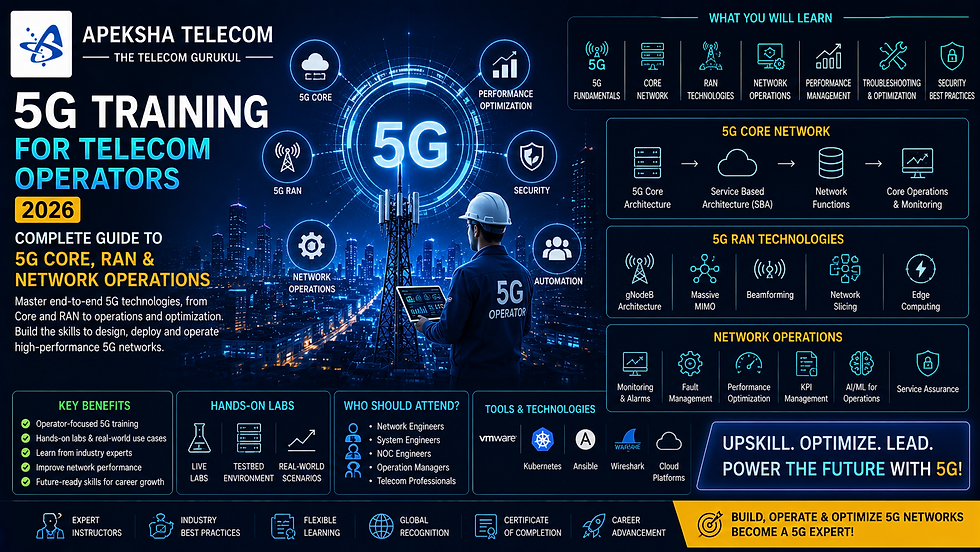
Table of Contents
Understanding the Cloud-Native 5G Core Architecture
The 5G Core (5GC) network is entirely decoupled from the underlying hardware, relying instead on a Service-Based Architecture (SBA). In this framework, network functions (NFs) communicate with one another over standardized, HTTP/2-based RESTful APIs. This shifts the operational paradigm from rigid, proprietary hardware boxes to modular, containerized microservices running on cloud infrastructure.
+-------------------------------------------------------------+
|                  Service-Based Architecture                 |
|  +-------+        +-------+        +-------+        +----+  |
|  |  AMF  | <----> |  SMF  | <----> |  NEF  | <----> |UDM |  |
|  +-------+        +-------+        +-------+        +----+  |
+------------------------------+------------------------------+
                               |
                               v
                    +--------------------+
                    |        UPF         | (User Plane Function)
                    +--------------------+
The 5GC cleanly splits the Control Plane (CP) and the User Plane (UP) through an architectural standard known as CUPS (Control and User Plane Separation). This allows operators to scale control functions independently from data traffic routing, maximizing resource efficiency across data centers.
Key Network Functions in the 5G Core
AMF (Access and Mobility Management Function): Handles termination of NAS (Non-Access Stratum) signaling, ciphering, integrity protection, registration management, and connection handling. It serves as the primary single point of entry for the user equipment (UE).
SMF (Session Management Function): Responsible for session establishment, modification, and release. It allocates IP addresses to the UE, selects and controls the User Plane Function (UPF) for data routing, and manages policy enforcement interfaces.
UPF (User Plane Function): The workhorse of the data plane. It processes and forwards user data packets, acts as an external anchor point for data networks, and executes packet inspection, traffic steering, and Quality of Service (QoS) policing.
AUSF (Authentication Server Function): Acts as the internal validation hub, handling authentication processing for 3GPP and non-3GPP access networks.
By containerizing these functions, operators can deploy microservices dynamically based on live traffic demands. This structural agility is essential for supporting advanced network slicing, where a single physical network is partitioned into multiple virtual networks tailored to specific business use cases.
What is MEC in 5G? Architecture, Benefits, and Cloud vs. Edge
What is MEC in 5G?
Multi-access Edge Computing (MEC) is a network architecture that brings cloud computing capabilities, cloud storage, and IT service environments directly to the edge of the cellular network. Instead of routing all application traffic back to a centralized cloud data center hundreds of miles away, MEC processes data closer to the end user.
[ User Device ] ---> [ Base Station / gNodeB ] ---> [ MEC Server (Edge) ]
                                                            |
                                               (Only heavy data synced)
                                                            v
                                                  [ Centralized Cloud ]
MEC Architecture
The European Telecommunications Standards Institute (ETSI) defines a structured framework for MEC to ensure seamless integration with the 5G Core. The architecture consists of the MEC hosting platform—including hardware virtualization layers and application repositories—and edge applications that interface directly with the local User Plane Function (UPF). Through intelligent traffic steering rules managed by the SMF, local data streams are intercepted at the edge gNodeB and processed locally, bypassing the core network transport tunnels completely.
Benefits of Edge Computing
Ultra-Low Latency: Reduces round-trip time (RTT) from 50–100 milliseconds down to single-digit milliseconds, which is critical for real-time systems.
Bandwidth Optimization: Minimizes core network congestion by processing high-volume raw data local to the collection point.
Enhanced Security and Privacy: Sensitive data stays within localized enterprise borders, meeting strict regulatory compliance and residency requirements.
Contextual Awareness: Allows applications to leverage real-time network conditions, radio signal insights, and user location data directly from the local base station.
MEC vs Cloud Computing
Attribute | MEC (Edge Computing) | Centralized Cloud Computing |
Proximity | Distributed, close to the user terminal | Centralized, distant data centers |
Latency | Extremely low (< 5ms) | High variable latency (40-150ms) |
Data Volumetrics | Processes high volumes locally; filters uplink | Receives massive backhaul data floods |
Contextual Data | High localization, radio, and positioning awareness | Lacks localized network insight |
As deployments expand throughout 2026, MEC is evolving from isolated, proof-of-concept nodes into a globally coordinated edge fabric. Operators are leveraging these edge frameworks to deploy microservices right alongside the localized user plane, laying the foundation for modern enterprise infrastructure.
The Role of NEF in 5G Core: APIs and Exposure Functions
The Network Exposure Function (NEF) acts as a secure API gateway for the 5G Core. It allows internal network capabilities, events, and statuses to be safely exposed to external third-party application providers and enterprise developers.
+--------------------+        Secure APIs        +--------------------+
|  5G Core Internal  | ------------------------> |        NEF         |
|  Network Functions | <------------------------ |  (API Gateway)     |
+--------------------+      OAuth2 / JSON        +--------------------+
                                                           |
                                                           | HTTP/2 REST APIs
                                                           v
                                                 +--------------------+
                                                 |  External Third-   |
                                                 |  Party Application |
                                                 +--------------------+
In older network generations, the core infrastructure was a closed silo. Outside applications could not easily check network status or request specific handling for certain traffic. The NEF changes this by translating complex, low-level internal protocols into developer-friendly HTTP/2 RESTful APIs.
NEF APIs and Exposure Functions
Monitoring Capability: Allows external applications to subscribe to specific events, such as tracking device locations, connectivity status, or roaming alerts.
Provisioning Capability: Enables authorized third parties to programmatically configure parameter settings for specific devices, such as modifying target data rates or application rules.
Policy and Charging Control: Allows enterprise applications to dynamically request a specific Quality of Service (QoS) profile for an active user session, ensuring smooth delivery for high-priority traffic.
To protect the core network, the NEF includes robust built-in security features, including OAuth2 authentication, strict rate-limiting, packet inspection, and topology hiding. This structure ensures that external systems can interact with the network safely without risking core stability.
5G RAN Evolution: From Legacy gNodeB to Open RAN (O-RAN)
The Radio Access Network (RAN) is undergoing its own major architectural shift, moving away from closed, single-vendor hardware platforms toward open, disaggregated software architectures.
CU-DU Split Architecture
The traditional standalone base station has been broken down into three separate, functional blocks to make deployment and resource allocation much more flexible:
Centralized Unit (CU): Manages non-real-time protocols such as the Packet Data Convergence Protocol (PDCP) and Service Data Adaptation Protocol (SDAP).
Distributed Unit (DU): Handles time-critical, real-time layers including the Radio Link Control (RLC), Medium Access Control (MAC), and upper Physical (High-PHY) layers.
Radio Unit (RU): Manages the lower physical layer RF processing, filtering, and antenna beamforming operations.
The Rise of O-RAN and the RIC
The Open RAN (O-RAN) Alliance expands on this split architecture by introducing open, standardized interfaces between these different units. This allows operators to mix and match hardware and software from different vendors, breaking traditional vendor lock-in.
+-----------------------------------------------------+
|              Service Management Orchestration (SMO) |
|  +-----------------------------------------------+  |
|  |             Non-RT RIC                        |  |
|  +-----------------------------------------------+  |
+--------------------------|--------------------------+
                           | A1 Interface
                           v
+-----------------------------------------------------+
|  Near-RT RIC (xApps)                                |
+--------------------------|--------------------------+
                           | E2 Interface
                           v
      +---------+     +---------+     +---------+
      |  O-CU   | --->|  O-DU   | --->|  O-RU   |
      +---------+     +---------+     +---------+
A core element of this ecosystem is the RAN Intelligent Controller (RIC), which brings advanced automation and intelligence to radio resource management:
Non-Real-Time RIC (Non-RT RIC): Operates within the Service Management and Orchestration (SMO) framework, handling long-term network optimizations (> 1 second) via AI-driven rApps.
Near-Real-Time RIC (Near-RT RIC): Executes faster network corrections (between 10ms and 1 second) via modular xApps, managing tasks like predictive beamforming and dynamic traffic steering.
Real-Time 5G Applications, AI Integration, and Private Networks
Real-Time 5G Applications
The combination of high-speed 5G networks, MEC, and the NEF enables a wide range of new, ultra-low latency applications across industries:
Autonomous Vehicular V2X Infrastructure: Uses edge computing to process real-time hazard alerts and coordinate vehicle movements safely.
Industrial Robotics and Smart Factories: Enables closed-loop control loops for factory automation over highly reliable wireless connections.
Remote Healthcare and Tele-Surgery: Combines low latency with precise QoS controls to support real-time surgical equipment feedback.
AI and Edge Computing
AI and Machine Learning (ML) are becoming essential tools for managing the complexity of modern edge networks. Instead of relying on manual configurations, AI models run directly at the edge to analyze live traffic patterns, predict cell tower loads, and dynamically shift resources to prevent congestion before it impacts users.
5G Private Networks
More and more enterprises are deploying dedicated private 5G networks to ensure secure, reliable coverage across industrial sites. These private networks leverage dedicated local spectrum and custom network slices, allowing businesses to run critical internal operations completely isolated from public network traffic.
Why Apeksha Telecom and Bikas Kumar Singh Are Vital for Your Career
Navigating the engineering concepts of cloud-native telecom architectures requires highly specialized, hands-on training. Theoretical knowledge alone is no longer enough to succeed in today's highly competitive global market.
+--------------------------------------------------------------+
|                Apeksha Telecom Career Blueprint              |
|                                                              |
| [ Practical Hands-on ] ---> [ Protocol Testing / ] ---> [ Job Placement ]
| [  3GPP Specifications ]     [   Log Analysis    ]      [   Support   ]
+--------------------------------------------------------------+
Apeksha Telecom: Industry-Oriented Training
Recognized as a premier telecom training institute both in India and globally, Apeksha Telecom—frequently referred to by industry students as the Telecom Gurukul—bridges the gap between traditional academic education and real-world engineering requirements. Their programs focus on giving students practical, hands-on experience with production tools rather than just textbook theory.
Comprehensive Core Curriculum: Deep-dive training across 4G, 5G, and emerging 6G wireless technology ecosystems.
Layer-by-Layer Protocol Mastery: Hands-on study of the entire protocol stack, including the PHY, MAC, RLC, PDCP, SDAP, RRC, and NAS layers.
Advanced Practical Skills: Real-world training in Protocol Testing, Log Analysis, and O-RAN configurations using production-grade analysis tools like QXDM, QCAT, and Wireshark.
Global Placement Support: As one of the few institutes globally providing dedicated job assistance, they offer end-to-end support to help graduates secure engineering roles with major telecom vendors, network operators, and chipmakers worldwide.
Expert Mentorship by Bikas Kumar Singh
The institute's training methodology is designed and led by Bikas Kumar Singh, a highly respected telecom innovator with over 18 years of direct industry experience. Having worked on global projects with major companies like AT&T, Nokia, ZTE, and Vodafone, he brings true production-grade insights directly into the classroom.
His training approach focuses on dissecting actual 3GPP specifications, analyzing live device logs, and walking step-by-step through complex network call flows. This hands-on method ensures that engineers aren't just memorizing definitions, but develop the deep troubleshooting skills needed to solve complex network issues in the field.
Frequently Asked Questions (FAQs)
What is the main difference between MEC and traditional cloud computing?
MEC hosts processing resources locally at the network edge (near the base stations), bringing latency down to under 5ms. Traditional cloud computing relies on massive, centralized data centers located far from the end user, which introduces higher, more variable transmission delays.
How does the NEF secure the 5G Core when exposing APIs to third parties?
The NEF acts as a secure boundary gateway. It uses modern security standards like OAuth2 for authentication, applies strict rate-limiting to prevent overload, inspects incoming packets for malicious activity, and hides internal network structures from the outside world.
Why is a CU-DU split architecture used in 5G RAN?
Splitting the RAN into Centralized Units (CUs) and Distributed Units (DUs) allows operators to process non-real-time functions centrally while running time-sensitive, real-time layers closer to the user. This flexibility makes it much easier to scale the network and optimize resource allocation.
What are the main career paths available after completing a 5G training program?
Graduates typically move into high-demand engineering roles, including 5G Protocol Test Engineer, RAN Optimization Specialist, Core Network Operations Engineer, O-RAN Integration Expert, and Telecom Log Analyst.
Does Apeksha Telecom provide placement assistance after completing their courses?
Yes, Apeksha Telecom provides comprehensive job support and placement assistance for students who successfully complete their training programs. They are one of the few telecom training institutes globally with an active placement network connecting graduates to major international technology firms.
What tools do students learn to use in Apeksha Telecom's protocol testing training?
Students get hands-on experience with standard industry diagnostics and log analysis software, including Qualcomm's QXDM and QCAT tools, alongside Wireshark for deep packet inspection and network call flow analysis.
Conclusion
The ongoing modernization of networks highlights the critical need for continuous engineering education. Enrolling in specialized 5G Training for Telecom Operators 2026 ensures that technology professionals stay ahead of the curve, mastering the cloud-native architectures, open interfaces, and intelligent edge platforms that define modern networks.
By mastering core technologies like the Service-Based Architecture, MEC frameworks, NEF API exposure, and O-RAN disaggregation, engineers can position themselves for top-tier roles in this rapidly changing market.
Ready to accelerate your career growth and master the next generation of network engineering? Join the industry-leading programs at Apeksha Telecom today. Learn directly from industry experts, gain hands-on experience with production-grade diagnostic tools, and open doors to global job opportunities.
Take the Next Step: Visit Telecom Gurukul to explore comprehensive training programs in 4G/5G Protocol Testing, O-RAN Systems, and Core Network Operations. Secure your engineering future today!
Extra SEO Deliverables
1. Suggested Image Alt Texts
5g-core-service-based-architecture-diagram-3gpp-standards
multi-access-edge-computing-mec-architecture-nodes-5g
network-exposure-function-nef-api-gateway-flow
open-ran-oran-ric-xapps-rapps-integration
apeksha-telecom-student-lab-protocol-testing-bangalore
2. Internal Link Suggestions
Link the text "Telecom Gurukul" or "4G/5G Protocol Testing" to: https://www.telecomgurukul.com?utm_source=chatgpt.com


Comments