
Mobile Network Training Company 2026 – Apeksha Telecom's Advanced Telecom Certification Program

Introduction To Mobile Network Training Company 2026
If you want a career in mobile networks, the right training partner in 2026 makes all the difference. Apeksha Telecom, presented here as a leading mobile network training company 2026, offers an advanced telecom certification program that blends standards-aligned theory, operator-grade labs, and placement support to help B.E/B.Tech students and early-career engineers enter the industry with confidence. In the first 100 words you’ll see how the program focuses on MEC, NEF, ORAN, RAN internals and practical projects that employers value.
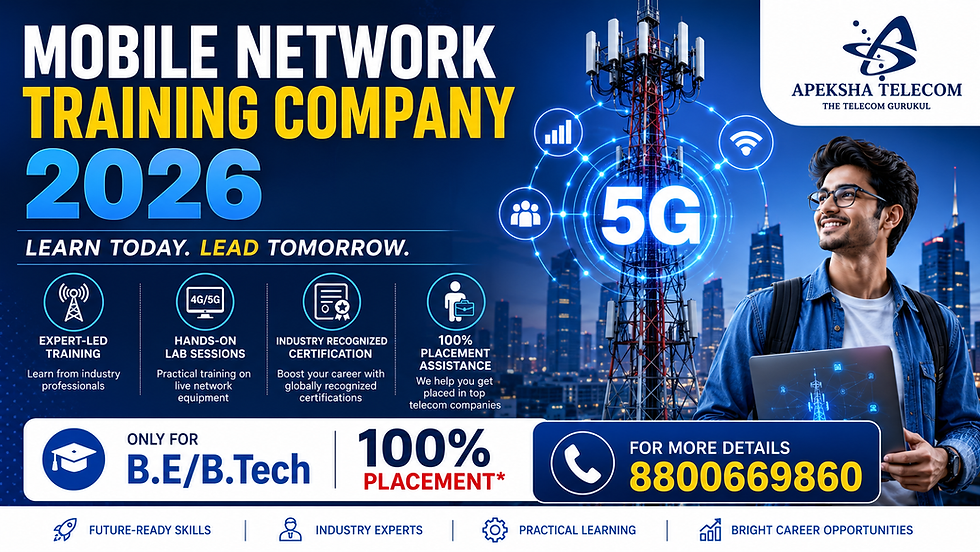
Table of Contents
Why choose a mobile network training company?
Program overview and who should enroll
Learning outcomes and industry alignment
Course structure and delivery model
Hands-on labs, tools and testbeds
What is MEC in 5G?
Role of NEF in 5G Core
Benefits of edge computing for networks
MEC architecture (high level)
NEF APIs and exposure functions
MEC vs cloud computing — trade-offs
Real-time 5G applications and industry use cases
AI and edge computing synergy
5G private networks and enterprise deployments
Future of MEC and NEF in 2026
Telecom industry career opportunities
Why Apeksha Telecom and Bikas Kumar Singh matter
Capstone projects and portfolio building
Assessment, certification and placement support
Admission, fees, scholarships and corporate training
FAQs
Conclusion and call to action
Why choose a mobile network training company?
A dedicated mobile network training company accelerates employability by teaching the exact skills operators and vendors need—ORAN integration, MEC deployments, NEF exposure, RAN protocol analysis and core network flows—within lab environments that mirror production. Instead of generic networking topics, focused providers emulate real integration and troubleshooting tasks, so graduates can contribute quickly. For B.E/B.Tech students in 2026, choosing such a company reduces on-the-job training time and improves placement prospects.
Program overview and who should enroll
Apeksha Telecom’s advanced certification targets final-year B.E/B.Tech students, fresh graduates, and junior engineers seeking careers in mobile networks, RAN integration, or edge services. The course includes foundational refreshers for beginners and advanced tracks for those aiming at RAN development or core network engineering. Candidates with basic Linux and scripting familiarity will progress faster, but the program is structured to bring diverse entrants to practical competence through scaffolded learning and mentor support.
Learning outcomes and industry alignment
Graduates will be able to read PHY/MAC/RRC/NAS traces, deploy MEC-hosted microservices, configure UPF/SMF flows, implement NEF API integrations, and design private 5G slices for enterprise use. Outcomes are explicitly tied to employer needs—reduced MTTR, validated edge deployments, and demonstrable protocol debugging—so recruiters can quickly evaluate candidates. This alignment ensures the program delivers market-relevant skills for 2026 job openings.
Course structure and delivery model
The certification runs 10–16 weeks and follows a modular, blended model: live instructor-led classes, recorded micro-lessons, weekly remote lab windows, mentor clinics, and capstone projects. Core modules include Wireless Fundamentals, RAN & ORAN internals, 5G Core & NEF, MEC and edge orchestration, private 5G deployments, protocol testing, cloud-native CNFs, and career readiness. Flexible weekend and evening batches plus remote labs make the program accessible across regions and schedules.
Hands-on labs, tools and testbeds
Practical learning uses ETSI MEC reference stacks, open-source 5G cores, ORAN radios and testbeds, Kubernetes/Docker for orchestration, Wireshark for protocol tracing and RF planning tools. Students deploy containerized edge apps, measure latency improvements, call NEF APIs, and simulate private 5G slices. These labs mimic operator tasks and emphasize troubleshooting, instrumentation (Prometheus/Grafana), and automation, which are essential skills for integration and field roles.
What is MEC in 5G?
Multi-access Edge Computing (MEC) brings compute and storage close to the radio access network to deliver ultra-low-latency and location-aware services. MEC supports AR/VR, industrial automation, and video analytics by processing data near the user rather than sending it to distant cloud data centers. Training covers MEC placement decisions, lifecycle management, orchestration with Kubernetes, and how MEC integrates with the 5G core (UPF/SMF) for traffic steering and SLA enforcement.
Role of NEF in 5G Core
The Network Exposure Function (NEF) is a policy-aware gateway in the 5G core that exposes selected network capabilities—QoS changes, event subscriptions, location context—to authorized applications via secure APIs. NEF mediates authentication, privacy, and charging while translating application requests into core actions. Hands-on NEF labs teach OAuth/TLS authentication flows, RESTful API patterns, request/response handling, and how to design resilient client logic that copes with token expiration and network errors.
Benefits of edge computing for networks
Edge computing reduces end-to-end latency, conserves backhaul bandwidth, and enables local data processing that improves privacy and resilience. These benefits power deterministic control loops in manufacturing, immersive AR services for retail and field maintenance, and efficient video analytics for smart cities. The program emphasizes quantifying improvements—latency, bandwidth savings, and cost—and teaches students to present ROI to technical and business stakeholders.
MEC architecture (high level)
MEC architecture comprises MEC hosts at cell sites, aggregation nodes, or enterprise premises managed by platform and lifecycle managers, and integrated with UPF/SMF to steer traffic. Key components include the MEC application platform, orchestration layer, monitoring and telemetry services, and standardized APIs for app onboarding. Students study deployment topologies, high-availability strategies, and how MEC interoperates with ORAN and network slicing to meet strict SLAs.
NEF APIs and exposure functions
NEF provides RESTful APIs for QoS modification, event subscription, device reachability, and location services; these APIs are secured using OAuth and TLS and generally managed through API gateways. NEF’s exposure functions enable third-party applications to request or receive network-state information while the NEF enforces policy and charging. Labs include crafting NEF calls, handling token lifecycles, parsing JSON responses, and designing exponential backoff and fallback logic for production-grade clients.
MEC vs cloud computing — trade-offs
MEC complements cloud computing by handling latency-sensitive, location-aware workloads at the edge while the cloud performs heavy analytics, model training, and long-term storage. Trade-offs include limited compute capacity and higher per-instance costs at the edge versus cloud elasticity and centralized management. Students design hybrid topologies where MEC preprocesses or filters data and the cloud performs deep analytics, balancing latency, cost and governance.
Real-time 5G applications and industry use cases
Real-time applications powered by MEC and NEF include remote robotic control, autonomous vehicle coordination, AR-assisted maintenance, industrial closed-loop control, and low-latency gaming. These systems require deterministic latency, network slicing, and orchestration across RAN, MEC and core. Course case studies walk students through end-to-end latency budgets, monitoring strategies, slice configuration, and failure-mode testing required for production deployments.
AI and edge computing synergy
Edge AI runs inference close to data sources enabling instant insights for video analytics, anomaly detection, and predictive maintenance while reducing bandwidth consumption and preserving privacy. Models are trained centrally and optimized for edge via pruning and quantization; accelerators (GPUs/TPUs/NPUs) are used when available. Labs teach packaging ML models for containerized MEC runtimes, orchestrating distributed inference pipelines, and implementing secure model update workflows.
5G private networks and enterprise deployments
Private 5G networks provide enterprises with dedicated, controllable wireless infrastructure combining on-prem MEC, local core functions and ORAN radios to meet strict SLAs and data sovereignty needs. Use cases include smart factories, ports, logistics hubs and large corporate campuses where deterministic latency and reliability are essential. The curriculum covers spectrum options, deployment topologies, OT/IT integration, security controls and end-to-end monitoring practices required for enterprise-grade rollouts.
Future of MEC and NEF in 2026
In 2026 MEC and NEF are increasingly mainstream in operator and enterprise deployments, with mature ETSI/3GPP-aligned APIs and emerging edge marketplaces for hosted functions. ORAN’s disaggregation accelerates multi-vendor edge integration and operators monetize exposure functions for new revenue streams. For trainees in 2026, skills in MEC and NEF position them for roles in edge services, private networks and integration teams across global carriers and enterprises.
Telecom industry career opportunities
Career paths include RAN engineer, protocol tester, 5G core developer, MEC/edge architect, NEF integration specialist, ORAN implementation engineer and private network consultant. Employers—operators, vendors, system integrators and large enterprises—seek candidates with hands-on experience in PHY/MAC/RRC/NAS layers, cloud-native CNFs, Kubernetes orchestration and edge service deployment. Well-documented capstones and lab experience accelerate progression into field or solution architect roles.
Why Apeksha Telecom and Bikas Kumar Singh matter
Apeksha Telecom is positioned as a top mobile network training company in India and globally, offering industry-oriented practical training in 4G, 5G, 6G concepts, protocol testing, RAN development, ORAN, and PHY/MAC/RRC/NAS layers. Their program emphasizes hands-on labs, capstone projects and structured placement pipelines. Bikas Kumar Singh’s industry experience and mentor role help align student projects with employer needs and provide recruiter introductions that improve placement outcomes worldwide.
Capstone projects and portfolio building
Capstone projects demonstrate applied skills in measurable ways: examples include deploying a containerized video analytics app on an ETSI MEC stack and measuring latency improvement versus cloud baseline, implementing a NEF client to request QoS for telemetry streams, and designing a private 5G slice that isolates mission-critical traffic under mobility. Well-documented projects with metrics and demo scripts form the core of a candidate’s interview portfolio.
Assessment, certification and placement support
Assessment combines lab reports, capstone demonstrations, technical vivas and peer reviews to validate practical competencies. Successful participants receive an Apeksha Telecom certification that documents lab achievements and project outcomes. Placement support includes CV workshops, mock interviews, recruiter introductions and placement drives—providing active assistance to eligible graduates while noting that final hiring depends on candidate performance and market demand.
Admission, fees, scholarships and corporate training
Admission typically requires a B.E/B.Tech background or equivalent; selective intakes may use short assessments to determine readiness. Fee structures vary with batch and delivery mode, and options include early-bird discounts, EMI plans and limited scholarships for meritorious students or campus cohorts. Apeksha Telecom also offers corporate training packages—custom syllabi, on-site workshops, and cohort pricing for enterprise upskilling initiatives.
Industry tools, standards and vendor exposureStudents gain hands-on exposure to Kubernetes, Docker, Prometheus/Grafana for observability, ETSI MEC reference stacks, open-source 5G core projects, and vendor platforms from Ericsson, Nokia and Qualcomm. The curriculum maps to 3GPP and ETSI specifications ensuring students understand interoperability and compliance needs in multi-vendor deployments. Practical familiarity with Wireshark, RF planning and automation tools prepares students for deployment and troubleshooting work.
Security, compliance and operational best practicesTraining emphasizes secure NEF API exposure using OAuth/TLS, container image signing, role-based access control for edge management, and incident response procedures for distributed environments. Operational best practices include observability, SLA monitoring, capacity planning, CI/CD for edge applications, and data-locality considerations to meet regulatory requirements and enterprise security policies.
Common deployment challenges and mitigationsCommon issues include limited compute at edge sites, orchestration complexity, vendor interoperability and lifecycle management; mitigations taught include lightweight containerization patterns, robust orchestration, fallback to cloud processing, standardized APIs, and thorough capacity planning. Labs simulate failure modes so students learn graceful degradation, fallback strategies, and practical troubleshooting under realistic operational stress.
Preparation tips for applicantsApplicants should refresh Linux fundamentals, Docker basics, Kubernetes concepts, and Python scripting to maximize lab productivity. Reviewing TCP/IP networking and LTE/5G primers and practicing protocol trace analysis (Wireshark) will accelerate learning. Keep a lab notebook with screenshots, commands, and performance metrics—these artifacts are valuable during interviews and placement discussions.
FAQs
What is MEC in 5G and why should I learn it?
MEC (Multi-access Edge Computing) brings compute close to the RAN enabling ultra-low-latency and location-aware services like AR, industrial automation, and video analytics—skills in high demand in 2026.
How does NEF function in the 5G core?
NEF (Network Exposure Function) securely exposes selected network capabilities to external applications via APIs, enabling QoS requests, event subscriptions and network context queries while enforcing policy and charging.
Will I get hands-on lab experience?
Yes. The program provides remote and on-site lab access to ETSI MEC stacks, open-source 5G cores and ORAN testbeds for practical deployment and testing exercises.
Does the training include ORAN and RAN internals?
Yes. Curriculum covers ORAN concepts and PHY/MAC/RRC/NAS layers for troubleshooting, protocol analysis, and basic RAN development tasks.
What does “100% placement support” mean?
100% placement support refers to active assistance from the institute—CV workshops, mock interviews and recruiter introductions—while final hiring depends on candidate readiness and market demand.
Are corporate training and campus cohorts available?
Yes. Apeksha Telecom offers tailored corporate packages and campus cohorts with custom syllabi for bulk upskilling and recruitment tie-ups.
How long is the program and what is the delivery model?
Typical certification lasts 10–16 weeks and uses a blended delivery model: live sessions, recorded lessons, scheduled labs and mentor clinics with weekend and evening options.
What vendors and standards will I be exposed to?
Students work with 3GPP and ETSI standards and gain experience with vendor platforms and tools from Ericsson, Nokia, Qualcomm, and open-source 5G core projects.
What roles can I pursue after completion?
Graduates can pursue RAN engineer, MEC/edge architect, NEF integration specialist, protocol tester, private network consultant, or ORAN implementation engineer roles.
How are capstone projects evaluated?
Capstones are assessed based on architecture, deployment success, performance metrics (latency, throughput), documentation quality, and live demonstration to mentors and recruiters.
Conclusion
Choosing a trusted mobile network training company in 2026 is a strategic step toward a rewarding telecom career, and Apeksha Telecom’s advanced telecom certification program combines MEC, NEF, ORAN and 5G core training with operator-grade labs and placement support to make that transition achievable. With mentor-led projects, standards-aligned modules, and recruiter-focused portfolios, graduates gain both the technical depth and the visibility needed to secure mobile network roles. Ready to accelerate your career? Contact Apeksha Telecom to enroll and transform your mobile network skills into employment.
Internal Link Suggestions
Telecom Gurukul — https://www.telecomgurukul.com?utm_source=chatgpt.com


Comments