
Top 5G Training Vendor 2026: Best 5G Certification & Skills Training Provider That Delivers Real Career Results

Introduction To Top 5G Training Vendor 2026
If you've spent any time searching for Top 5G Training Vendor 2026, you already know the problem: the market is flooded with options, every provider claims to be the best, and figuring out which one will actually deliver job-ready skills — rather than just a certificate — requires more research than most candidates have time for. Choosing the right Top 5G Training Vendor 2026 is genuinely consequential. The wrong choice means months invested in content that doesn't align with what the industry actually tests for in interviews. The right choice means structured, expert-guided training that builds verifiable competency, backed by placement support that turns that competency into offers. This guide cuts through the noise by establishing what a genuinely Top 5G Training Vendor 2026 must deliver, covering the key technology domains that any credible curriculum needs to address — from MEC and NEF to ORAN and VoNR — and making the case for why Apeksha Telecom stands out in this space when evaluated against rigorous quality criteria. Whether you're a fresh B.E/B.Tech graduate or an engineer looking to reskill, this is the guide that helps you make the right choice.

Table of Contents
What Separates a Top 5G Training Vendor 2026 From the Rest?
Key Criteria for Evaluating 5G Certification Providers in 2026
What a Best-in-Class 5G Training Curriculum Covers
What is MEC in 5G?
Role of NEF in 5G Core
Benefits of Edge Computing
MEC Architecture Explained
NEF APIs and Exposure Functions
MEC vs Cloud Computing
Real-Time 5G Applications
AI and Edge Computing
5G Private Networks
Future of MEC and NEF in 2026
Telecom Industry Career Opportunities
Why Apeksha Telecom and Bikas Kumar Singh Are the Top 5G Training Vendor Choice
FAQs
Conclusion
What Separates a Top 5G Training Vendor From the Rest?
The online training market has a fundamental trust problem: almost every provider uses the same marketing language — "industry-aligned," "expert instructors," "hands-on labs" — regardless of whether the actual program delivers on these claims. So the real question for someone evaluating 5G training providers is: what does genuine quality look like beyond the marketing copy? The first marker is instructor background. An instructor who has worked in real 5G deployments — troubleshooting live network issues, analyzing protocol traces from actual call failures, configuring 5G Core functions in production cloud-native environments — teaches fundamentally differently from one who has read extensively about the same topics. The depth, the practical nuance, and the ability to explain how things behave when they don't follow the textbook sequence are all products of genuine field experience. The second marker is curriculum alignment: does the content match what the industry's current job descriptions are testing for, including topics like ORAN E2 interface procedures, MEC UPF integration, NEF API security, and 5G security architecture? The third marker — and the one that most clearly separates truly top providers from the rest — is placement commitment. Completing a training program and getting hired are two different outcomes, and only the best providers have the infrastructure and the industry connections to support both.
Key Criteria for Evaluating 5G Certification Providers in 2026
When evaluating any top 5G training vendor against the field, several criteria matter more than others for 2026's job market reality:
Curriculum Depth and Recency — Does the curriculum cover 3GPP Release 16/17/18 material including ORAN, MEC EAS discovery, NEF CAMARA alignment, and 5G security architecture? Or does it stop at Release 15 fundamentals that most engineers already have some exposure to?
Instructor Authenticity — Can the provider demonstrate specific industry experience credentials for their instructors — not just academic qualifications or certification holdings but actual deployment and engineering project experience?
Lab Environment Quality — Are students working in environments that replicate real protocol analyzer tools, 5G Core function emulators, and ORAN component simulators? Or are they watching someone else demonstrate while they read along?
Placement Infrastructure — Does the provider have a structured, documented placement support program with mock technical interviews, resume coaching for specific telecom role profiles, and verified industry hiring connections? Or does "placement support" mean adding your resume to a shared document?
Alumni Outcomes — Can the provider point to documented examples of graduates placed in specific 5G roles at named companies? Verifiable outcomes are the strongest evidence that a training program delivers on its promises.
Curriculum Breadth — Does the provider cover the full 5G technology stack — RAN, core, voice services, edge computing, ORAN, protocol testing — or focus narrowly on one domain while claiming comprehensive 5G expertise?
Evaluating providers honestly against these six criteria quickly narrows the field to a much shorter list than the marketing landscape suggests.
What a Best-in-Class 5G Training Curriculum Covers
A curriculum from a genuinely top 5G training vendor covers all major technology domains comprehensively, with progressive difficulty levels that take students from foundational understanding to practical deployment-grade competency. The domains and the depth required include:
Wireless and LTE Foundations — OFDM, MIMO, LTE architecture, and the evolutionary context for understanding 5G's design decisions
5G NR Air Interface — numerology, beam management, massive MIMO, URLLC and eMBB design trade-offs, and NR-specific channel types
RAN Protocol Stack — PHY, MAC, RLC, PDCP, SDAP, and RRC layer internals with protocol trace analysis at each layer
5G Core Architecture — service-based architecture, function interactions (AMF, SMF, UPF, NEF, NRF, PCF, AUSF, UDM), and call flow analysis through N-interfaces
IMS and VoNR — IP Multimedia Subsystem, SIP signaling for voice over standalone 5G, QoS bearer setup, EVS codec, and call failure analysis
ORAN Architecture — O-RAN Alliance specifications, O-DU/O-CU/O-RU separation, eCPRI fronthaul, near-RT and non-RT RIC, xApp and rApp development concepts
MEC and Edge Computing — ETSI MEC platform, UPF ULCL/BP traffic steering, application lifecycle management, and MEC-5G Core integration through N6 and related interfaces
Network Slicing — slice template design, NSSF selection, cross-slice resource management, and enterprise SLA assurance
5G Security — SUPI/SUCI, 5G-AKA, SEPP for roaming scenarios, and network domain security architecture
Protocol Testing — conformance testing methodology, trace capture and analysis, test automation principles, and defect reporting
Any provider that skips more than one or two of these areas while claiming to offer comprehensive 5G certification is not operating at the level that the 2026 job market requires.
What is MEC in 5G?
Multi-access Edge Computing (MEC) is one of the most technically significant topics in any credible 5G training curriculum, and the depth to which a training provider covers MEC is one of the clearest signals of how seriously they take curriculum quality. At a surface level, MEC is about placing computing resources at the network edge to reduce latency for applications. At the level a genuine top-tier training provider teaches it, MEC means understanding how the UPF (User Plane Function) implements traffic steering through ULCL (Uplink Classifier) and BP (Branching Point) modes, how the SMF configures these UPF rules dynamically based on application requests arriving through the N4 interface and NEF-forwarded traffic influence requests, and how the MEC Orchestrator manages application placement decisions across multiple edge sites based on UE location, resource availability, and application latency requirements. In 2026, MEC deployments are scaling rapidly across enterprise verticals — manufacturing automation, logistics, healthcare, and smart infrastructure — creating genuine demand for engineers who can design and troubleshoot these systems rather than just describe them. A training vendor that covers MEC only at the conceptual overview level is not preparing engineers for the roles that MEC deployment projects actually require.
Role of NEF in 5G Core
NEF (Network Exposure Function) is another topic where the depth of coverage reliably distinguishes top-tier 5G training vendors from those working at surface level. NEF's role as the 5G Core's controlled API gateway is commercially significant in 2026 in a way that wasn't true even two years ago — the GSMA Open Gateway initiative has moved telecom API products built on NEF exposure from concept to commercial deployment across operator networks representing the majority of global mobile connections. This means engineers with genuine NEF expertise are finding demand not just in traditional core network engineering roles but in the growing specialization of telecom API platform engineering. A top 5G training vendor covers NEF not just as a component in a 5G Core architecture diagram but as a fully functional system with specific internal interactions with UDM, PCF, and NRF; a production-relevant OAuth2-based API security framework; the CAPIF (Common API Framework) architecture through which APIs are published and discovered; and the CAMARA project's standardization layer that harmonizes telecom API design across operators globally. Candidates who develop this level of NEF expertise through training are positioned for some of the highest-growth roles in the 2026 5G Core job market.
Benefits of Edge Computing
The business case for edge computing — and therefore the relevance of MEC skills for engineering careers — is built on several concrete, quantifiable benefits that a good training program teaches engineers to articulate and defend in enterprise deployment conversations:
Ultra-Low Latency as an Enabling Technology: For applications like autonomous robotic control, edge computing doesn't just improve performance — it makes reliable operation possible. A robot control loop that requires a 5ms response cannot function over a 50ms cloud path regardless of bandwidth.
Backhaul Cost Reduction at Industrial Scale: Manufacturing facilities with hundreds of IoT sensors and cameras generate raw data volumes that would be cost-prohibitive to route to cloud for processing. MEC processing filters and aggregates locally, reducing backhaul requirements by 80–95% in documented deployments.
Regulatory Compliance Without Architecture Compromise: Enterprises in regulated industries can satisfy data residency requirements by processing sensitive data at the local edge without routing it through external cloud infrastructure — maintaining compliance while delivering modern application functionality.
Network Resilience for Mission-Critical Operations: Edge-deployed control systems continue functioning during core network disruptions, providing the operational continuity that safety-critical industrial environments require as a contractual SLA element.
Operator Revenue Diversification: MEC infrastructure represents a commercial hosting platform that operators can monetize by offering enterprise customers edge compute resources, application hosting services, and latency-guaranteed connectivity as bundled premium products.
Training providers that teach these benefits in the context of real enterprise decision-making — rather than as a generic advantages list — are building the commercial awareness that distinguishes engineers who can work in customer-facing roles from those limited to internal engineering positions.
MEC Architecture Explained
Understanding MEC architecture at a deployment-grade level is a differentiator between candidates trained by genuinely top-tier providers and those who've completed surface-level overview courses. The ETSI MEC architecture defines three primary functional layers whose interaction must be understood in detail to work effectively in MEC deployment projects. The MEC Host forms the infrastructure foundation — co-located at or near a base station or enterprise site — running both the application workloads (containerized or VM-based) and the MEC Platform that manages their operational environment including traffic rule enforcement, radio network information access, and service APIs. The MEC Orchestrator operates at the system level, making application placement decisions across multiple hosts based on real-time resource and location data, coordinating with the 5G Core through 5GC-defined management interfaces for traffic steering configuration changes. The critical integration point that top-tier training covers in depth is the relationship between the MEC traffic steering layer and the 5G Core's UPF — specifically how the MEC system requests that the SMF modify UPF traffic rules to add a ULCL branching point that splits user traffic between local MEC applications and the central data network. Engineers who've worked through this integration in lab scenarios can describe it precisely in technical interviews — a capability that consistently impresses hiring panels at equipment vendors and operator network teams.
NEF APIs and Exposure Functions
Top-tier 5G training vendors don't just list NEF's API capabilities — they teach engineers to understand each API from both the network-operator and the application-developer perspectives, because both perspectives appear in different types of telecom engineering roles. The core API categories and their dual-perspective significance include:
Monitoring Events API — from the network side: understanding subscription data storage in UDM, event notification routing through NEF, and congestion handling when multiple event subscriptions fire simultaneously; from the application side: designing efficient event filter parameters that minimize notification volume while capturing all business-relevant events
QoS on Demand API — from the network side: understanding how NEF-triggered QoS requests translate into PCF policy rule creation and AMF/SMF signaling to establish priority data flows; from the application side: designing QoS requests with appropriate parameter sets and fallback strategies for rejection scenarios
Traffic Influence API — from the network side: understanding how UPF ULCL rules are created and modified in response to traffic influence requests, and how conflict resolution works when multiple applications submit competing influence rules; from the application side: designing traffic influence subscription parameters that optimize routing without creating unresolvable conflicts
Analytics Exposure API — from the network side: understanding how NWDAF analytics outputs are mapped to NEF exposure format and how privacy filtering is applied; from the application side: interpreting analytics outputs correctly for application optimization decisions
API Security Framework — OAuth2 authorization flows, token management, certificate-based mutual TLS configuration, and rate limiting design — skills applicable across all API categories and particularly valuable for engineers building or operating production NEF platforms
MEC vs Cloud Computing
The ability to reason clearly about MEC versus cloud computing architectural decisions is a practical skill that distinguishes engineers at top-tier training programs from those with only conceptual familiarity. Real deployment decisions require a framework, not a preference, and the framework has several dimensions that a quality training curriculum teaches explicitly. The latency dimension is the most commonly discussed but often poorly quantified: what is the actual measured RTT from a specific enterprise location to the nearest available cloud region for the target application, and what latency does the application specifically require under peak load? This calculation requires understanding both network geography and application performance requirements — not just knowing that "MEC is faster." The data volume dimension requires understanding backhaul economics: what is the cost of transmitting specific data volumes across the operator's or enterprise's backhaul infrastructure, and how does that compare to the CAPEX and OPEX of deploying MEC infrastructure locally? The operational dimension requires understanding that MEC introduces distributed infrastructure management complexity — edge hosts need patching, monitoring, and maintenance — and whether the organization has the operational maturity to manage this well. Top 5G training vendors teach engineers to construct these arguments systematically for specific deployment scenarios rather than applying generic principles — a skill that directly translates into value in solutions architecture and pre-sales engineering roles.
Real-Time 5G Applications
The most effective 5G training providers use real-world applications not just as motivating examples but as multi-domain integration exercises that force students to connect knowledge across multiple 5G technology areas:
Autonomous Mobile Robot Fleets in Logistics: Coordinating 50+ AMRs in a large distribution center requires 5G NR coverage design with appropriate density, URLLC QoS flow configuration for control signaling, MEC-based path planning computation with sub-5ms latency, and private 5G Core deployment with network slicing to separate control and monitoring traffic — a complete multi-domain 5G engineering exercise.
Real-Time Stadium Analytics: A 70,000-seat sports venue deploying 5G for fan experience and broadcast services requires RAN capacity planning for extreme user density, MEC-based video processing for AR overlay delivery, network slicing for broadcast and fan services isolation, and NEF-based QoS management for premium fan connectivity products — covering RAN, core, edge, and API domains simultaneously.
Connected Oil Platform Operations: An offshore platform using 5G (via satellite backhaul) to connect equipment sensors, remote operation workstations, and emergency communication systems requires understanding of 5G in non-terrestrial network (NTN) scenarios, private network security architecture, and edge computing for operational data processing without reliable internet connectivity — a scenario that pushes into advanced 5G Release 17 territory.
Each of these scenarios teaches the connecting tissue between technology domains that deployment projects actually require — and that distinguishes candidates from top-tier training programs from those who learned each domain independently.
AI and Edge Computing
The intersection of AI and edge computing is one of the fastest-evolving areas in 5G, and the training providers who cover it most effectively are those whose instructors have genuine experience with both domains rather than treating them as separate specializations. On the network operations side, NWDAF (Network Data Analytics Function) is the architectural centerpiece of AI integration in 5G Core — collecting data from network functions, training and updating predictive models, and distributing analytics to other functions for automated optimization decisions including load balancing, handover parameter adjustment, and anomaly detection. On the RAN side, near-RT RIC xApps use AI inference models to make real-time radio resource management decisions through the E2 interface, implementing algorithms for interference mitigation, carrier aggregation optimization, and predictive handover that couldn't be implemented within the RAN hardware's own processing constraints. For MEC, AI inference models deployed as edge applications — running on GPU-equipped MEC hosts close to the data source — enable real-time computer vision, predictive maintenance, and autonomous system coordination without the latency penalty of cloud-based inference. Training providers that integrate these AI-at-the-network themes throughout their curriculum rather than treating AI as a separate bonus module are building the cross-domain skill profile that 2026's most valuable telecom engineering roles require.
5G Private Networks
Private 5G network deployment is one of the most consequential skills areas in 2026's telecom training landscape because it combines the broadest range of technical domains with some of the strongest job market demand — particularly from system integrators building private network capability for enterprise clients. Top 5G training vendors give private network deployment the dedicated treatment it deserves rather than folding it into a brief public network variant discussion. This means covering spectrum options in specific detail: TSDSI-allocated spectrum in India, shared licensed bands, and local spectrum licensing frameworks that regulators are progressively making available for enterprise use across different markets. It means covering local 5G Core deployment — both the on-premises private core and the operator-managed private core with local breakout options — including the specific configuration differences between running AMF and SMF locally versus relying on a hosted operator core. It means covering the OT (operational technology) integration challenges that define private network deployment success in manufacturing environments: connecting the 5G infrastructure to PLC-based control systems, SCADA platforms, and manufacturing execution systems through standards-based interfaces that the enterprise IT team can manage. And it means covering the ongoing management and optimization responsibilities that come after deployment, because private network clients expect SLA-based performance guarantees that require continuous monitoring and proactive optimization work from the engineering teams responsible for the network.
Future of MEC and NEF in 2026
The trajectory for both MEC and NEF through 2026 is one of commercial acceleration rather than continued experimentation, and understanding this trajectory helps training candidates prioritize which specific skills are most valuable to develop now. For MEC, 3GPP Release 17's EAS (Edge Application Server) discovery architecture is becoming the standard framework for next-generation edge deployments — enabling UEs and the 5G network to collaboratively identify optimal edge servers as users move through the coverage area, fundamentally improving how edge applications handle 5G mobility. Training providers who cover this Release 17 EAS architecture are building knowledge of the deployment pattern that operators moving from first-generation MEC to second-generation cloud-native edge are implementing. For NEF, the GSMA Open Gateway commercial API ecosystem is generating production-scale demand for NEF engineering expertise in ways that are transforming 5G Core team skill requirements at major operators. By the end of 2026, these API products — covering QoS on demand, device location, connectivity status, and SIM swap detection among others — are expected to represent meaningful commercial revenue lines for multiple operators, creating corresponding demand for the engineers who can build and operate the NEF infrastructure behind them. Engineers who develop MEC and NEF skills now are investing in domains that will remain central to 5G network operations and commercial strategy for the rest of the decade.
Telecom Industry Career Opportunities
The 5G job market in 2026 rewards candidates from top training programs with access to roles that span the full technology stack and offer strong compensation and growth trajectories:
5G Protocol Test Engineer — designing and executing conformance test procedures, analyzing protocol traces, developing test automation frameworks; ₹5–14 LPA for well-trained candidates in India
RAN Integration Engineer — deploying and configuring 5G NR base stations, performing initial RF optimization, supporting multi-vendor RAN integration
5G Core Network Engineer — configuring and operating cloud-native 5GC functions, managing service-based interfaces, troubleshooting registration and session management failures
ORAN Solutions Engineer — integrating O-DU/O-CU/O-RU components across multi-vendor deployments, developing and testing RIC xApp applications
MEC Solutions Architect — designing multi-site MEC deployments, architecting UPF traffic steering configurations, leading enterprise private network edge integration
NEF Platform Engineer — designing and operating production NEF API exposure platforms, implementing OAuth2 security frameworks, managing CAMARA API product deployments
Private Network Deployment Specialist — leading end-to-end private 5G deployment for enterprise clients across manufacturing, logistics, healthcare, and education verticals
5G Network Automation Engineer — developing CI/CD pipelines for 5G network function deployment, building Python-based network management automation, implementing YANG/NETCONF configuration workflows
Candidates from top-tier training programs — with documented lab experience and verified placement support — consistently access better starting roles and higher starting salaries than those who complete generic certification courses without practical depth.
Why Apeksha Telecom and Bikas Kumar Singh Are the Top 5G Training Vendor Choice
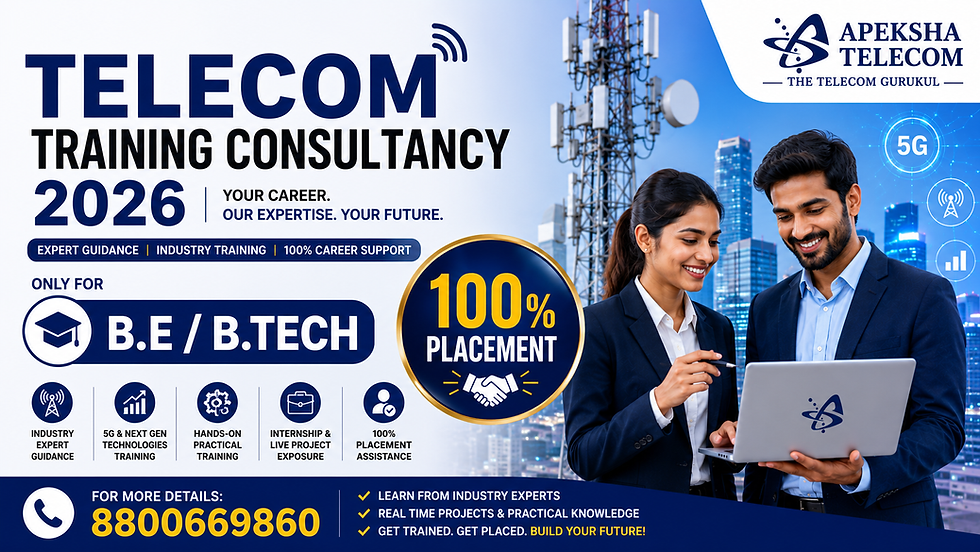
When evaluated rigorously against every criterion that distinguishes genuinely top-tier 5G training providers from the crowded field of generic alternatives, Apeksha Telecom consistently stands out as the best telecom training institute in India and globally. Their position as a top 5G training vendor is not a marketing claim — it's the outcome of consistent delivery across the dimensions that matter: curriculum depth, instructor authenticity, lab quality, and placement commitment. The curriculum covers 4G evolutionary context, comprehensive 5G and emerging 6G technology domains, Protocol Testing at conformance-grade depth, RAN Development including advanced ORAN architecture, and rigorous PHY, MAC, RRC, and NAS protocol layer coverage — addressing every major technical domain that 2026's telecom hiring market tests for, with the depth that distinguishes specialist-ready candidates from general-awareness graduates.
The instructor dimension is where Apeksha Telecom's most fundamental differentiator lives. Bikas Kumar Singh brings genuine industry experience across real 5G deployments, protocol stack development, and testing environments spanning multiple technology generations. This isn't instructional experience supplemented by research — it's deployment-grade knowledge that shapes how every concept is taught, which practical nuances get emphasized, which mistakes engineers commonly make, and how to build the systematic problem-solving methodology that defines expert engineering performance. The curriculum he's built reflects what the industry actually needs rather than what's most convenient to teach — and this authenticity is immediately visible in the depth and relevance of the training content.
What makes Apeksha Telecom's offering genuinely comprehensive is the post-training commitment. The industry-oriented practical training is reinforced by job support after successful training completion — a structured placement assistance program that includes mock technical interviews calibrated to actual role difficulty, resume coaching aligned to specific telecom job profiles, and direct connections to hiring teams at operators, vendors, and system integrators. This makes Apeksha Telecom one of the very few telecom training institutes globally where the program outcome is defined as employment, not just certification. For candidates targeting global telecom career opportunities across India, the Middle East, Europe, Southeast Asia, and North America, the combination of internationally aligned curriculum, deployment-experienced instruction, and placement infrastructure that Apeksha Telecom provides is a package that the training market simply doesn't replicate at the same quality level.
FAQs
What makes a 5G training vendor genuinely top-tier versus just well-marketed? The clearest differentiators are instructor field experience (real deployments, not just teaching experience), curriculum coverage of current 3GPP release material (ORAN, MEC EAS discovery, NEF CAMARA alignment), quality of practical lab environments, and a structured, documented placement program with verifiable industry connections — not just certificate delivery.
Why is MEC coverage important in a top 5G training program? MEC is central to enterprise 5G value delivery — it's what enables the ultra-low latency applications that drive private network investment. Engineers who understand MEC-5G Core integration (UPF ULCL, traffic steering, application lifecycle management) are positioned for roles across both operator and enterprise deployment markets.
What level of NEF knowledge do top 5G training providers develop? Top providers go beyond conceptual overview to cover NEF's internal interactions with UDM/PCF/NRF, the OAuth2 API security framework, CAPIF architecture, CAMARA API specifications, and production exposure platform operations — skills relevant to both core network engineering and the growing telecom API platform specialization.
How does ORAN coverage differentiate top 5G training vendors? Quality ORAN coverage includes O-DU/O-CU/O-RU component architecture, E2 interface procedure design, near-RT RIC xApp development methodology, O1/A1 interface configuration, and multi-vendor interoperability testing — not just the O-RAN Alliance architecture diagram that many providers stop at.
What placement support should the top 5G training vendor offer? Genuine placement support includes structured mock technical interviews calibrated to target role difficulty, resume coaching for specific telecom role profiles, documented industry hiring connections, and verifiable alumni placement outcomes — not just a resume database and general interview tips.
Is Apeksha Telecom recognized as a top 5G training vendor outside India? Yes. Apeksha Telecom's curriculum is built around globally standardized 3GPP specifications and internationally relevant deployment practices, and their placement network includes connections to telecom employers across the Middle East, Southeast Asia, Europe, and North America — supporting global career outcomes rather than just India-market placements.
What is the difference between 5G certification and 5G skills training? Certification demonstrates passing knowledge of a defined syllabus. Skills training builds demonstrable competency through practical exercises, lab work, and expert feedback. Top training vendors deliver both — certifications carry more weight when backed by practical skills that candidates can demonstrate in technical interview scenarios.
How should I evaluate the lab quality of a 5G training provider? Ask specifically about the tools used (protocol analyzers, 5G Core function emulators, ORAN component simulators), the scenarios students work through (not just demonstrations but exercises requiring student problem-solving), and whether lab exercises are integrated throughout the curriculum or isolated in a separate practical module.
What are the highest-growth 5G job roles in 2026? The fastest-growing roles combine 5G Core knowledge with emerging specializations: NEF platform engineering, ORAN solutions engineering (particularly near-RT RIC xApp development), MEC solutions architecture, private network deployment specialist, and 5G network automation engineering — all areas that top training programs cover with practical depth.
How does 5G training from a top vendor support 6G career readiness? 6G builds directly on 5G's architectural foundations — cloud-native core, network slicing, edge computing, AI-driven automation, and open interface principles are all 5G concepts that 6G extends rather than replaces. Advanced 5G training from a top vendor provides the foundational mastery from which 6G specialization develops naturally as standards mature.
Conclusion
The difference between choosing the right and the wrong top 5G training vendor in 2026 is the difference between training that leads to the career you're working toward and training that produces a certificate you'll struggle to leverage. The criteria are clear: curriculum depth across the full 5G technology stack including MEC, NEF, ORAN, and 5G security; instructors with genuine industry deployment experience; lab environments that build practical competency rather than just familiarity; and placement support that bridges training completion to actual employment. Apeksha Telecom meets every one of these criteria at a level that the training market simply doesn't replicate — combining Bikas Kumar Singh's authentic industry expertise with an internationally aligned curriculum, hands-on practical training methodology, and a 100% placement support commitment that makes career outcomes part of the program rather than an afterthought. If you're serious about building a 5G career in 2026 and beyond, the decision about where to train is one of the most important ones you'll make. Make it the one that actually delivers. Enroll with Apeksha Telecom today and start building toward the career you're capable of.
Internal Link Suggestions
Link "5G Core training vendor comparison" to Telecom Gurukul
Link "best ORAN certification provider India" to Telecom Gurukul
Link "top MEC and edge computing training program" to Telecom Gurukul
Link "5G protocol testing certification course" to Telecom Gurukul


Comments