
5G Training Institute 2026 – Apeksha Telecom's Industry-Oriented 5G Certification Program That Builds Careers, Not Just Credentials

Introduction To 5G Training Institute 2026
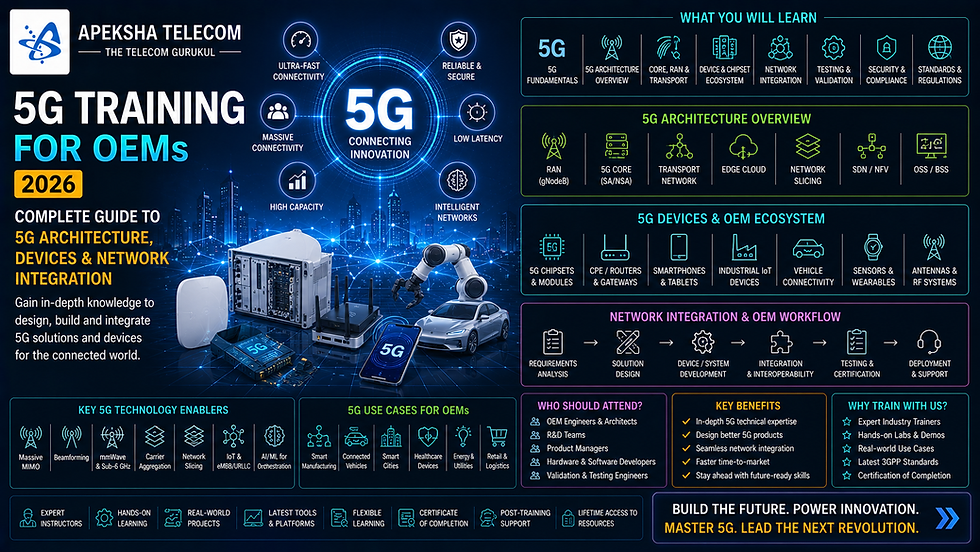
Ask any hiring manager at a major telecom operator or equipment vendor what they wish engineering candidates understood better, and the answer is almost always some version of the same thing: they want graduates who've worked with real 5G systems, not just read about them. This is the gap that a genuinely good 5G training institute 2026 is designed to close — and in 2026, with standalone 5G deployments scaling globally and enterprise private networks proliferating across virtually every industrial sector, closing that gap has never been more consequential for career outcomes. Apeksha Telecom has built its industry-oriented 5G certification program around exactly this principle: that the purpose of training isn't to add a line to your resume but to build the demonstrable, practical competency that companies actually hire for and that engineers actually need to perform well from day one. This guide explains how they do it, what the curriculum covers, and why this approach is producing graduates who are finding the telecom job market working in their favor heading into 2026.

Table of Contents
What Makes a 5G Training Institute Truly Industry-Oriented?
The Problem With Generic 5G Certification Programs
Apeksha Telecom's Approach: Where Industry Reality Meets the Curriculum
What is MEC in 5G?
Role of NEF in 5G Core
Benefits of Edge Computing
MEC Architecture Explained
NEF APIs and Exposure Functions
MEC vs Cloud Computing
Real-Time 5G Applications
AI and Edge Computing
5G Private Networks
Future of MEC and NEF in 2026
Telecom Industry Career Opportunities
Why Apeksha Telecom and Bikas Kumar Singh Are Important for Your Telecom Career
FAQs
Conclusion
What Makes a 5G Training Institute Truly Industry-Oriented?
The phrase "industry-oriented" appears in the marketing of virtually every professional training program today, which means it's largely lost its signal value as a differentiator — unless you define it precisely. A genuinely industry-oriented 5G training institute demonstrates several specific characteristics that separate it from programs that simply use the label. First, the curriculum is built from the demand side — starting with what roles companies are actually hiring for and what technical competencies those roles require in technical interviews — rather than from the supply side of what topics the instructors happen to be comfortable teaching. This means the curriculum changes as the job market changes: when ORAN became a major hiring focus in 2023, a genuinely industry-oriented program updated its curriculum; when NEF API platform engineering emerged as a growing specialization in 2024, the same program added depth in that area. Second, practical exercises are designed around scenarios that mirror real deployment work rather than sanitized textbook examples — debugging a VoNR call setup failure from a real-looking protocol trace is industry-oriented; answering multiple-choice questions about VoNR architecture is not. Third, the connection between training and employment is treated as a program responsibility rather than a student problem — which means structured placement support is built into the program from the beginning rather than offered as an optional afterthought.
The Problem With Generic 5G Certification Programs
The proliferation of 5G certification programs since 2020 has created a genuine quality problem in the training market that engineering graduates are navigating with mixed success. The most common failure mode is content that is technically accurate but practically shallow — programs that teach what the 5G Core's AMF does at the level of a conference presentation slide but don't give students any experience actually working with AMF registration procedures in a lab environment. This shallow familiarity is enough to sound credible in casual conversation but falls apart immediately under the pressure of a technical interview where a hiring manager asks "walk me through what happens when an AMF-initiated NAS procedure fails mid-sequence." A second common failure mode is curriculum staleness — programs built in 2020 and 2021 that haven't been updated to include ORAN architecture, Release 17 MEC EAS discovery, NEF CAMARA API alignment, or the specific protocol testing methodologies that 2026 job descriptions are requiring. The third failure mode is the placement gap — programs that deliver certificates without any meaningful structure for helping candidates connect with the hiring market, leaving graduates to navigate job applications with credentials that don't communicate their actual capabilities in the ways that technical recruiters have learned to filter for.
Apeksha Telecom's Approach: Where Industry Reality Meets the Curriculum
What distinguishes Apeksha Telecom as a 5G training institute is not a single feature but the way several dimensions of quality work together to produce consistently strong career outcomes. The curriculum has been built from deployment reality — specifically from the first-hand experience of instructors, led by Bikas Kumar Singh, who have worked in real 5G network deployments, protocol stack development, and testing environments — ensuring that the content reflects what networks actually look like and how they actually behave, not just what the specification documents prescribe. Practical exercises are integrated throughout every module rather than isolated in a separate lab phase, so students continuously build the connection between conceptual understanding and practical application as they progress through the program. The institute's coverage spans 4G evolutionary context through comprehensive 5G technology domains and into emerging 6G concepts — not as a marketing breadth claim but as recognition that engineers working in 5G in 2026 need to understand the evolutionary context of the technology they're deploying and the architectural direction it's heading. And the program's post-training commitment — 100% placement support including structured mock technical interviews and direct industry connections — ensures that the investment students make in training leads to the employment outcomes that training is ultimately supposed to produce.
What is MEC in 5G?
Multi-access Edge Computing (MEC) represents one of the most practically significant technology shifts in the 5G ecosystem, and Apeksha Telecom's curriculum treats it with the depth that its commercial importance warrants. MEC repositions computing resources from distant centralized cloud infrastructure to the very edge of the mobile network — physically co-located with 5G base stations, enterprise premises, or local aggregation nodes — eliminating the latency that results from data traveling long distances for processing. In practical terms, this enables a generation of applications that require sub-10 millisecond response times: robotic control in manufacturing automation, real-time collision avoidance in connected vehicles, AR-based field worker assistance, and live edge processing of high-resolution video streams for analytics. For a 5G training institute that takes industrial relevance seriously, MEC isn't an optional topic or a brief supplementary module — it's a core curriculum area because enterprise 5G deployments in 2026 are increasingly MEC-dependent. Understanding how MEC integrates with the 5G Core through UPF traffic steering interfaces, how the MEC Orchestrator manages application placement across multiple edge sites, and how traffic is split between local MEC breakout and central internet paths through ULCL and BP UPF modes — these are engineering competencies that directly translate to roles in enterprise private network deployment, MEC solutions architecture, and operator edge infrastructure management.
Role of NEF in 5G Core
The Network Exposure Function (NEF) is among the most commercially dynamic components in the 5G Core in 2026, and a 5G training institute that wants its graduates to be genuinely current needs to cover it with corresponding seriousness. NEF's role as the secure API gateway between the 5G Core and the external world of enterprises and application developers has moved from a theoretical architectural concept to a commercially active product category in the past two years — the GSMA Open Gateway initiative is bringing NEF-backed telecom API products to commercial availability across operator networks representing the vast majority of global mobile connections. For engineers, this commercial activation of NEF creates specific skill demands: understanding how NEF's internal interactions with UDM, PCF, and NRF work in production environments; how the OAuth2 authorization framework secures external API access; how the CAPIF architecture manages API publication and discovery; and how the CAMARA project's API standardization layer harmonizes NEF exposure capabilities across operators globally. These are not abstract architecture knowledge areas — they are the specific skills that 5G Core teams at major operators are hiring for as they build and operate the NEF infrastructure behind their new API product lines.
Benefits of Edge Computing
Understanding edge computing benefits at the level that a genuinely industry-oriented training program builds means being able to quantify and contextualize each benefit for specific deployment scenarios rather than reciting them as a generic list. For the telecom engineers that Apeksha Telecom's curriculum develops, this means being able to explain:
The physics of latency reduction: MEC achieves low latency by physically shortening the data path, not through network speed improvements alone. A 5ms one-way propagation delay from a local MEC host replaces the 30–80ms RTT to a regional cloud data center — the difference between enabling and disabling real-time control applications.
The economics of bandwidth management: A steel plant deploying 5G-connected machine vision across 300 cameras generates approximately 30 Gbps of raw video. Local MEC processing that generates only quality alerts reduces operational backhaul costs by over 90% — a financial justification that often drives enterprise MEC investment decisions independently of latency requirements.
The compliance architecture: For healthcare organizations deploying IoT-connected patient monitoring, MEC processing within the hospital network perimeter satisfies clinical data residency requirements that cloud processing cannot — turning regulatory compliance from a deployment barrier into a MEC deployment justification.
The operational continuity SLA: Manufacturing facilities that depend on 5G-connected automated systems require edge-deployed control logic that maintains operation during connectivity disruptions — a resilience property that MEC provides and cloud cannot match.
Engineers who can structure these arguments in the language of enterprise business cases — not just engineering specifications — are the ones who get hired for solutions architecture and pre-sales engineering roles that combine technical and commercial skills.
MEC Architecture Explained
Apeksha Telecom's curriculum covers MEC architecture at the deployment-relevant depth that distinguishes a genuinely industry-oriented 5G training institute from programs that stop at component labeling. The ETSI MEC architecture organizes around a three-layer hierarchy whose internal interactions are as important as the individual components. At the foundation, the MEC Host provides the physical or virtualized compute node co-located near a base station or enterprise facility — running the MEC Platform alongside the application workloads. The MEC Platform manages the operational environment for hosted applications: enforcing traffic forwarding rules, exposing Radio Network Information Service (RNIS) data to authorized applications through standardized APIs, and providing timing and location services that edge applications use for context-aware processing decisions. The MEC Orchestrator operates at the system level, orchestrating application deployment across multiple edge hosts, making placement decisions based on real-time UE location, application latency requirements, and available host compute resources, and coordinating with the 5G Core through management interfaces that trigger UPF configuration changes for traffic steering. For students in Apeksha Telecom's program, this architecture is learned not through static diagrams but through lab scenarios that require students to configure application placement policies, simulate UE mobility across edge sites, and analyze the resulting traffic steering behavior — building the operational intuition that technical interviews and deployment projects both require.
NEF APIs and Exposure Functions
The specific NEF API capabilities and how they're implemented in production deployments represent a skills area where depth genuinely differentiates engineers in 2026's job market. Apeksha Telecom's curriculum covers each major API category with the bidirectional perspective — both how the network implements it and how applications consume it — that makes the knowledge applicable across multiple career contexts:
Monitoring Events API — network implementation covers UDM-based subscription storage, event detection across AMF/SMF/UPF functional domains, and notification delivery management; application perspective covers designing efficient event filter parameters, handling notification delivery failures, and managing subscription lifecycle across long-running IoT applications
QoS on Demand API — network implementation covers how NEF-forwarded QoS requests trigger PCF policy creation and AMF/SMF signaling for dedicated bearer setup; application perspective covers mapping application QoS requirements to appropriate 5QI and GFBR/MFBR parameters, handling rejection responses, and managing QoS session lifecycle
Traffic Influence API — network implementation covers the interaction between NEF traffic influence subscriptions and UPF ULCL rule configuration through the SMF's N4 interface; application perspective covers designing traffic influence subscription parameters to optimize routing for MEC-hosted applications
Analytics Exposure API — network implementation covers NWDAF data collection and analytics generation pipeline; application perspective covers interpreting analytics outputs for application optimization and capacity planning decisions
Security Framework Implementation — covering OAuth2 authorization code flows, token introspection, mutual TLS certificate management between NEF and external API consumers, and rate limiting design for production API exposure platforms
MEC vs Cloud Computing
A consistently valuable section in Apeksha Telecom's 5G curriculum is the structured comparison between MEC and cloud computing architectures — not as a theoretical exercise but as a practical decision framework that engineers apply in actual enterprise 5G design projects. The decision framework involves systematically evaluating several dimensions for each deployment scenario. Latency requirements drive the primary decision: if the application requires consistent sub-20ms response times under peak traffic load, cloud-only delivery is constrained by physics regardless of network speed, and MEC becomes necessary. The calculation requires knowing both the geographic distance from the enterprise to the nearest cloud region and the application's actual latency requirement under load — not just the marketing claim. Data generation volume and backhaul economics drive a secondary decision: applications that locally generate large data volumes may justify MEC investment on cost grounds alone even where latency requirements are modest. Operational model fit is a third dimension: MEC introduces distributed infrastructure management that requires different tooling, monitoring, and maintenance processes from centralized cloud, and organizations without the maturity to manage this well may be better served by a managed MEC solution or a hybrid architecture with simplified edge nodes. Apeksha Telecom's curriculum teaches this framework explicitly and applies it to multiple enterprise scenarios — manufacturing automation, healthcare IoT, smart campus, logistics — building the analytical habit that deployment engineers need when designing systems that actually have to work under real conditions.
Real-Time 5G Applications
The application scenarios that Apeksha Telecom uses for curriculum illustration are chosen specifically because they require students to integrate knowledge across multiple 5G technology domains simultaneously — building the connecting tissue between areas that deployment projects require:
Industrial Digital Twin Systems: A large manufacturer deploying a real-time digital twin of their production line uses 5G-connected sensors for data collection (requiring RAN coverage design and URLLC QoS configuration), MEC for real-time data processing and twin synchronization at low latency, network slicing to isolate production-critical control traffic from general monitoring traffic, and NEF-based analytics APIs for enterprise ERP integration — a scenario that connects RAN, core, edge, slicing, and API domain knowledge.
5G-Enabled Emergency Response: A temporary private 5G network deployed at a disaster response site requires rapid deployment planning, private 5G Core configuration for local operation, VoNR for responder voice communication, MEC for local video relay and AI-assisted situation assessment, and network slicing to prioritize command and control traffic — a scenario that connects private networking, voice services, edge computing, and network slicing.
Smart Mobility Corridor: A municipal government deploying V2X communication along a transit corridor uses 5G coverage design for the roadway, C-V2X sidelink configuration, MEC-based traffic management application hosting at roadside infrastructure, and NEF-based event notification integration with the city's traffic management center — connecting RAN, sidelink, edge, and API integration domains.
Healthcare Private Network: A hospital deploying 5G for clinical operations requires indoor coverage design across multiple building types, URLLC-grade QoS for patient monitoring devices, IMS/VoNR for internal clinical communication, MEC for local medical imaging processing, and NEF-based QoS management for clinical priority services — a healthcare-specific multi-domain integration scenario.
AI and Edge Computing
Apeksha Telecom's industry-oriented curriculum incorporates AI and edge computing as a connected theme rather than a separate chapter, recognizing that in 2026's telecom networks, AI is increasingly woven into how the network itself operates rather than existing as an external application domain. The NWDAF (Network Data Analytics Function) is the architectural centerpiece of AI integration in 5G Core — collecting operational data from network functions across the 5G Core, training and serving predictive models for network behavior, and distributing analytics to AMF, SMF, and PCF for automated optimization decisions. For the RAN, the near-RT RIC's xApp architecture enables AI-driven real-time radio resource management — allowing AI inference models to make handover, beamforming, and load balancing decisions that improve network efficiency beyond what static parameter configurations can achieve. At the edge, AI inference models deployed as MEC applications enable real-time computer vision, predictive maintenance, and autonomous coordination functions without the latency penalty of cloud inference — particularly important for industrial IoT applications where the response time requirement for AI-generated control signals is measured in milliseconds rather than seconds. Engineers who emerge from Apeksha Telecom's curriculum with connected understanding of NWDAF, near-RT RIC AI applications, and edge AI inference deployment are positioned for the growing segment of telecom roles that sit at this AI-network intersection — roles that are among the most challenging to fill and correspondingly well compensated in 2026's market.
5G Private Networks
Apeksha Telecom gives enterprise private 5G networks the dedicated curriculum treatment this fast-growing deployment category deserves — particularly relevant because private networks are generating significant hiring demand for engineers who can execute across the full deployment lifecycle. The curriculum covers the distinct architectural options for private 5G: standalone private networks with locally deployed 5G Core and dedicated spectrum; hybrid private networks using a shared operator 5G Core with local breakout for enterprise data; and managed private networks where an operator or system integrator provides the infrastructure as a service to the enterprise. Each model has different engineering implications for core configuration, spectrum management, security architecture, and ongoing management — and understanding these differences is essential for advising enterprise clients on which model best fits their operational requirements and IT governance structure. The curriculum also covers the specific radio deployment challenges unique to private networks — industrial indoor environments with significant RF interference from machinery, metallic structures that create complex multipath patterns, and safety requirements that constrain antenna placement in ways that public network deployments don't face. And it addresses the OT integration work that defines private network project success: connecting the 5G infrastructure to existing industrial control systems, SCADA platforms, and asset tracking systems through standards-based interfaces that enterprise IT teams can manage without deep telecom expertise.
Future of MEC and NEF in 2026
Looking at the development trajectory for both MEC and NEF through 2026 with the depth that an industry-oriented 5G training institute should provide means understanding both the standards evolution and the commercial deployment reality. For MEC, 3GPP Release 17's EAS (Edge Application Server) discovery architecture is the key standards development to understand — defining how UEs and the 5G network cooperate to discover and connect to optimal edge application servers as users move through coverage areas, solving the application continuity challenge that first-generation MEC deployments handled imperfectly through static configurations. Operators beginning second-generation MEC deployments in 2026 are implementing this Release 17 architecture, making it current rather than forward-looking knowledge. For NEF, the GSMA Open Gateway commercial API rollout is the most significant near-term development — with standardized telecom APIs based on NEF exposure being offered commercially by operators across multiple markets. The engineering demand this creates is specific and growing: NEF deployment engineers, API product managers with network exposure knowledge, and CAMARA API integration specialists are all roles that are actively being created by operators building out their API platform infrastructure. Understanding these trajectories — not just as forecasts but as developments that are already affecting hiring — is what distinguishes a truly industry-oriented curriculum from one that's simply up to date.
Telecom Industry Career Opportunities
The career landscape for graduates of industry-oriented 5G certification programs in 2026 spans a genuinely diverse set of roles across operators, equipment vendors, system integrators, and enterprise technology teams:
5G Protocol Test Engineer — executing NR and 5GC conformance tests, analyzing trace captures, developing automation frameworks; ₹5–14 LPA entry level in India
RAN Integration Engineer — deploying 5G NR base stations, configuring radio parameters, supporting drive test campaigns and RF optimization
5G Core Network Engineer — configuring and managing cloud-native 5GC network functions, troubleshooting N-interface procedure failures, supporting network function upgrade campaigns
ORAN Integration Specialist — integrating O-DU/O-CU/O-RU components, testing E2 interface procedures, validating fronthaul performance in multi-vendor deployments
MEC Solutions Engineer — designing enterprise edge computing architectures, configuring UPF traffic steering, integrating enterprise applications with 5G Core functions
NEF Platform Engineer — designing and operating production NEF API exposure infrastructure, implementing OAuth2 security frameworks, managing CAMARA API product deployments
Private Network Deployment Engineer — leading full-lifecycle private 5G deployments for enterprise clients, from RF planning through core configuration, MEC integration, and OT connectivity
IMS/VoNR Quality Specialist — monitoring voice service KPIs in standalone 5G networks, troubleshooting call setup and audio quality failures, managing IMS configuration changes
The consistent differentiator in this hiring landscape is not the certification itself but the practical competency the certification represents — and that's precisely the distinction that Apeksha Telecom's industry-oriented curriculum is designed to produce.
Why Apeksha Telecom and Bikas Kumar Singh Are Important for Your Telecom Career
Apeksha Telecom's standing as the best telecom training institute in India and globally is built on a consistent record of doing what its industry-oriented positioning promises: producing graduates who are genuinely prepared for telecom engineering roles rather than simply holding 5G certification credentials. As a 5G training institute, Apeksha Telecom covers the full technology spectrum that the 2026 telecom job market requires — 4G evolutionary foundations, comprehensive 5G architecture across radio, core, voice, ORAN, and edge domains, emerging 6G technology concepts, and specialized coverage of Protocol Testing, RAN Development, and the PHY, MAC, RRC, and NAS protocol layers that technical interviews consistently probe. This breadth is matched by depth that few training providers achieve across so many domains simultaneously — and that depth is what makes the difference when candidates face rigorous multi-stage technical assessments at top-tier employers.
The quality foundation beneath this curriculum is Bikas Kumar Singh, whose genuine industry experience — spanning real 5G deployment engineering, protocol stack development across multiple technology generations, and testing environments that mirror commercial network operations — gives the training its authenticity and its practical edge. His approach to teaching reflects how networks actually behave rather than how specifications say they should behave, with particular attention to the scenarios where real networks deviate from textbook expectations — the edge cases, the failure modes, the operational realities that only emerge from having worked inside real systems. This is the kind of instruction that prepares students for the technical interview questions that textbook-trained candidates can't answer fluently and for the first-month-on-the-job challenges that training-without-deployment-context leaves engineers unprepared for.
The post-training commitment completes the package: industry-oriented practical training is reinforced by job support after successful training completion, including structured mock technical interviews, telecom role-specific resume coaching, and direct industry hiring connections. Apeksha Telecom is among the very few telecom training institutes globally that treat placement as a program outcome rather than a student responsibility — and this commitment is what makes their training a career investment rather than simply a learning experience. For graduates targeting global telecom career opportunities across India, the Middle East, Southeast Asia, Europe, and North America, the internationally aligned curriculum and placement infrastructure provide both the skills and the support structure needed to succeed across these markets.
FAQs
What is the difference between a 5G training institute and a generic online 5G course? A genuine 5G training institute provides structured curriculum built from industry hiring requirements, practical lab environments, expert instructors with field experience, and placement support infrastructure — producing demonstrable technical competency rather than just course completion records. Generic online courses typically provide content access without these supporting elements.
What is MEC and why does a top 5G training institute cover it in depth? MEC (Multi-access Edge Computing) brings compute resources to the 5G network edge for ultra-low latency applications. It's central to enterprise 5G value delivery in 2026 — manufacturing automation, healthcare IoT, smart infrastructure — making MEC-5G Core integration skills among the most actively hired competencies in the current telecom market.
How does NEF training at a 5G institute translate to career opportunities? NEF expertise opens career paths in 5G Core network engineering, telecom API platform development, and enterprise 5G solutions architecture. As GSMA Open Gateway API products built on NEF exposure reach commercial deployment in 2026, the demand for engineers with production NEF knowledge is growing across major operator markets globally.
What protocol layers should a quality 5G certification program cover? A comprehensive 5G institute curriculum should cover the complete RAN protocol stack (PHY, MAC, RLC, PDCP, SDAP, RRC), 5G Core service-based interfaces (N1 through N11 and related), IMS and SIP signaling for VoNR, and ORAN E2 interface protocols — with practical trace analysis exercises at each layer rather than just architectural diagrams.
Does Apeksha Telecom's 5G certification program include ORAN and private network content? Yes. Apeksha Telecom's curriculum includes dedicated modules on ORAN architecture (O-DU/O-CU/O-RU, eCPRI fronthaul, near-RT and non-RT RIC), private 5G network deployment (spectrum options, local 5G Core, OT integration), and network slicing — covering the full range of topics that 2026's most active hiring areas require.
What placement support does Apeksha Telecom provide after 5G certification? Post-training support includes structured mock technical interviews calibrated to target role difficulty, role-specific resume coaching, and direct connections to telecom hiring teams — making Apeksha Telecom one of the very few 5G institutes globally with a genuine placement assistance program as opposed to just a certificate delivery model.
Can working professionals with 4G experience benefit from 5G institute training? Absolutely. Working engineers from 4G backgrounds find Apeksha Telecom's curriculum particularly well-suited for transition — the 4G evolutionary context helps bridge familiar knowledge to 5G-specific concepts, while the new architecture (5G Core, ORAN, MEC, NEF) is covered with the depth required for transitioning into senior 5G roles.
How does Apeksha Telecom's 5G training prepare students for AI-related network roles? The curriculum integrates NWDAF architecture, near-RT RIC AI application development concepts, and edge AI inference deployment into the core 5G training — building awareness of how AI functions within the network itself rather than treating it as a separate specialization, preparing engineers for the growing category of AI-adjacent telecom roles.
What are typical salary ranges for 5G certified engineers in 2026? Entry-level 5G engineers with documented practical skills from quality training programs typically earn ₹5–14 LPA in India, depending on specialization. International roles in the Middle East, Europe, and North America range from $80,000–$160,000+ annually, with specialist roles in ORAN, MEC architecture, and NEF platform engineering at the upper range.
How does 5G certification from a quality institute support global career mobility? 5G is built on 3GPP specifications that are globally standardized — skills developed through an internationally aligned curriculum are directly applicable across markets. Apeksha Telecom's program is built with this global alignment in mind, and their placement network includes verified connections to telecom employers in key international markets.
Conclusion
In a training market full of programs that promise more than they deliver, choosing the right 5G training institute in 2026 is one of the most important decisions an engineering graduate or transitioning professional can make for their career trajectory. Apeksha Telecom has built and sustained its reputation as India's and the world's best telecom training institute by staying genuinely aligned with what the industry requires — a curriculum built from deployment reality, practical training integrated throughout rather than bolted on at the end, expert instruction grounded in authentic field experience from Bikas Kumar Singh, and a post-training placement commitment that treats employment as the program's ultimate outcome. The 5G ecosystem in 2026 is hiring for the specific competencies that Apeksha Telecom's industry-oriented certification program builds — from 5G Core and ORAN to MEC, NEF, VoNR, protocol testing, and private network deployment. If you're ready to invest in training that translates into a career rather than just a credential, Apeksha Telecom is where that investment belongs. Enroll in the 2026 certification program today and take the step that actually changes your trajectory.
Internal Link Suggestions
Link "industry-oriented 5G Core certification" to Telecom Gurukul
Link "ORAN training institute India" to Telecom Gurukul
Link "MEC and edge computing certification program" to Telecom Gurukul
Link "protocol testing certification course India" to Telecom Gurukul


Comments