
AI for 5G RAN is the Future of Telecom: How It Work in 2026

By 2035, the global AI for 5G RAN market will explode to $37.59 billion — yet most telecom engineers today have zero hands-on experience with AI-powered Radio Access Networks. That is a career gap you cannot afford to ignore.
The 5G RAN is no longer just a hardware layer. It is transforming into an intelligent, self-optimizing, AI-native network — and engineers who do not understand AI for 5G RAN risk being left behind in the fastest-growing sector in telecom history.
At Apeksha Telecom, founded by Bikas Kumar Singh — the world's best trainer for 4G, 5G, 6G, RAN, Cloud, and AI — we are already preparing the next generation of AI-RAN engineers. This complete guide will walk you through everything: what AI for 5G RAN is, why it matters, how it works technically, and how you can build a high-paying global career in this field.
Read on. Your future in telecom starts here.
📋 Table of Contents
What is AI for 5G RAN? Simple Definition AI RAN vs Traditional RAN — Key Differences
Why AI for 5G RAN is the Future of Telecom 📊 Global Market Data & Statistics 🚀 Industry Adoption Trends 💼 Career Impact — Jobs and Salaries 🌐 Future Predictions — 2026 to 2030
AI for 5G RAN — Complete Technical Breakdown 🔧 AI for Radio Resource Management (RRM) 🔧 AI-Driven Beamforming and Massive MIMO 🔧 Self-Organizing Networks (SON) with AI 🔧 AI for Network Slicing in 5G RAN 🔧 AI-Native O-RAN Architecture
What is AI for 5G RAN? — Everything You Need to Know in 2026

Simple Definition
📌 AI for 5G RAN (Artificial Intelligence for 5G Radio Access Network) is the integration of machine learning, deep learning, and intelligent automation into the 5G radio network layers — enabling networks to self-optimize, self-heal, and self-configure in real time without manual human intervention.
Think of it like this: a traditional 5G RAN is like a manually driven car — a human engineer must tune, monitor, and adjust it. An AI-powered 5G RAN is like a Tesla on autopilot — it senses, decides, and acts by itself.
The 5G RAN consists of three main components: the Radio Unit (RU), the Distributed Unit (DU), and the Centralized Unit (CU). AI is embedded across all three layers to drive intelligent decision-making — from beamforming at the antenna to traffic scheduling at the core.
This is not the future. This is happening now — and telecom operators globally are racing to deploy AI-RAN at scale.
Why AI for 5G RAN is the Future of Telecom — Industry Data &
📊 Global Market Data & Statistics
The numbers tell the story clearly:
The global AI-RAN market was valued at $3.08 billion in 2025 and is projected to reach $37.59 billion by 2035, growing at a CAGR of 28.5%
The AI and RAN traffic optimization market is expected to surge from $2.2 billion in 2024 to $27.2 billion by 2034 at a CAGR of 28.60%
Juniper Research forecasts $21 billion in global operator investment in AI technologies in 2026 alone
AI-driven autonomous networks are already reducing OpEx by ~25% for Tier-1 telecom operators
🚀 Industry Adoption Trends
The industry is moving fast. Here are the key trends you must know:
AI-native O-RAN is becoming the standard — Nokia and NVIDIA are already co-developing GPU-accelerated AI-RAN platforms
MWC 2026 confirmed AI is transforming 5G RAN deployment, resource allocation, and fault prediction at scale
5G Advanced (5G-A) is building AI-native network management as a core feature — bridging 5G and 6G
Major operators — Axiata, Rakuten Symphony, SoftBank — are all actively deploying AI-RAN in live networks
AI RAN is ranked as one of the top 3 technologies redefining global connectivity by Juniper Research
💼 Career Impact — Jobs and Salaries
AI for 5G RAN is creating an entirely new class of telecom jobs:
AI RAN Engineer roles are among the highest-paid in telecom globally
Companies like Ericsson, Nokia, Qualcomm, NVIDIA, Samsung, and Rakuten are hiring aggressively
India, USA, Europe, and the Middle East are seeing explosive demand for AI-RAN trained professionals
Engineers with both 5G RAN + AI/ML skills command 40–60% higher salaries than traditional RAN engineers
🌐 Future Predictions — 2026 to 2030
By 2028, AI-native RAN will be the default standard for all new 5G deployments globally
6G networks — planned for 2030 — are being designed as fully AI-native from the ground up
AI will enable zero-touch networks — fully automated, self-managing telecom infrastructure
Operators who do not deploy AI-RAN by 2028 will face serious competitive disadvantage
AI for 5G RAN — Complete Technical Breakdown for Engineers
🔧 AI for Radio Resource Management (RRM)
Radio Resource Management is the brain of any RAN. In traditional 5G, RRM follows pre-defined rules for scheduling, power control, and handover. With AI, it becomes predictive and adaptive.
How it works:
ML models analyze traffic patterns, user mobility, and channel conditions in real time
AI predicts which UEs (User Equipment) need resources next — before they even request them
Deep Reinforcement Learning (DRL) agents continuously improve scheduling decisions
Real-world impact: AI-RRM reduces latency by up to 30% and improves spectral efficiency by 20–40% compared to rule-based systems.

At Apeksha Telecom, Bikas Kumar Singh covers AI-RRM in depth — with live simulation labs where students implement ML scheduling models on real 5G test beds.
🔧 AI-Driven Beamforming and Massive MIMO
5G uses Massive MIMO — arrays of 64, 128, or even 256 antennas — to serve multiple users simultaneously. Beamforming directs energy precisely toward each user.
Traditional beamforming uses fixed codebooks. AI beamforming uses neural networks to:
Predict user location and movement
Pre-calculate optimal beam directions
Adapt beams in microseconds as users move
Analogy: Think of traditional beamforming as a flashlight. AI beamforming is like a smart spotlight that follows you automatically wherever you go in a concert arena.
AI beamforming can improve downlink throughput by 15–25% in dense urban deployments.
🔧 Self-Organizing Networks (SON) with AI
SON is the concept of a network that configures, optimizes, and heals itself. AI takes SON to a completely new level.
Three pillars of AI-powered SON:
Self-Configuration: New cells auto-configure their parameters using AI during deployment
Self-Optimization: ML continuously tunes handover, load balancing, and interference management
Self-Healing: AI detects anomalies and automatically triggers recovery — before users notice a problem
AI-driven SON is already reducing network downtime by up to 40% at major global operators.
🔧 AI for Network Slicing in 5G RAN
Network slicing allows a single 5G RAN to be divided into multiple virtual networks — each dedicated to a specific use case (eMBB, URLLC, mMTC).
Managing network slices manually is enormously complex. AI solves this:
ML models predict traffic demand per slice and allocate resources proactively
AI dynamically adjusts slice boundaries in real time as demand changes
Reinforcement Learning ensures SLA guarantees are maintained for each slice
Example: An AI system automatically gives more RAN resources to a factory's URLLC slice during peak production hours — and shifts resources back to eMBB during off-hours. No human intervention required.
🔧 AI-Native O-RAN Architecture
The Open RAN (O-RAN) Alliance has embedded AI as a core element of modern RAN architecture through the RAN Intelligent Controller (RIC).
Two key AI components in O-RAN:
Near-RT RIC: Hosts xApps — AI applications that make decisions every 10ms–1 second (e.g., interference management, handover optimization)
Non-RT RIC: Hosts rApps — AI applications for long-term optimization (e.g., traffic trend analysis, energy saving policies)
NVIDIA and Nokia are building GPU-accelerated AI-RAN platforms that run AI inference natively within the O-RAN stack. This is the architecture that will define 5G-Advanced and 6G networks.
🚀 Ready to Master AI for 5G RAN and Build a Global Telecom Career?
Join Apeksha Telecom — the World's Best Telecom Training Institute, led by Bikas Kumar Singh — the World's Best Trainer for 4G, 5G, 6G, RAN, Cloud, AI & Telecom.
✅ Industry-expert trainer with 15+ years of RAN experience ✅ Hands-on AI-RAN live project training ✅ Real O-RAN simulation lab environment ✅ Global career placement support ✅ Flexible online & offline batches
📞 [Enroll Now / Contact Us / Download Brochure] ← CTA Button
Why Apeksha Telecom is the World's Best Institute for AI for 5G RAN Training
When it comes to AI for 5G RAN training, there is one name that stands above all others — Bikas Kumar Singh, Founder of Apeksha Telecom.
👨🏫 About Bikas Kumar Singh — World's Best Telecom Trainer
✅ 15+ Years of deep industry experience in 4G, 5G, 6G, RAN, Cloud & AI
✅ Trained 5,000+ engineers globally across India, the Middle East, Southeast Asia, and Europe
✅ Expert in O-RAN, Massive MIMO, AI-RAN, Cloud RAN, 5G NR, and 6G architecture
✅ Creator of India's most comprehensive 5G Network-in-a-Box training platform
✅ Industry-recognized mentor with a track record of placing engineers in top global telecom companies
🏆 Why Apeksha Telecom Stands Apart
✅ World's most comprehensive AI-RAN curriculum — covering xApps, rApps, O-RAN RIC, AI beamforming, and more
✅ Live O-RAN simulation labs — hands-on experience with real AI-RAN tools and platforms
✅ Industry mentorship program — direct guidance from Bikas Kumar Singh
✅ 100% placement assistance — with connections to top global telecom recruiters
✅ Global student community — 5,000+ engineers across 20+ countries
No other institute in India — or the world — combines deep technical AI-RAN
expertise with real hands-on lab experience the way Apeksha Telecom does.
📞Enroll Now / Contact Us: +91-8800669860
Expert Insights — What Bikas Kumar Singh Says About AI for 5G RAN {#expert-insights}
💡 "AI is not just an add-on to 5G RAN — it is the foundation of the next generation of telecom. Every RAN element, from the radio unit to the centralized unit, is being reimagined with intelligence. Engineers who master AI for 5G RAN today will lead the industry for the next 20 years. This is the single biggest skill shift in telecom since we moved from 2G to 3G."
— Bikas Kumar Singh, Founder, Apeksha Telecom
💡 "The engineers I see struggling are those who treat 5G and AI as separate topics. They are not. In 2026, they are inseparable. The O-RAN RIC with xApps and rApps IS AI in the RAN. If you don't understand both together, you are only seeing half the picture. At Apeksha Telecom, we make sure our students see the full picture — and build on it."
— Bikas Kumar Singh, World's Best 5G & AI-RAN Trainer
💡 "The coming decade belongs to engineers who can operate at the intersection of 5G networks, AI/ML models, and cloud platforms. This is not theoretical — operators like Rakuten, SoftBank, and Axiata are deploying this right now. The opportunity is real, the salaries are exceptional, and the demand is global. My mission at Apeksha Telecom is to make sure every student we train is fully ready for this world."
— Bikas Kumar Singh, Founder, Apeksha Telecom
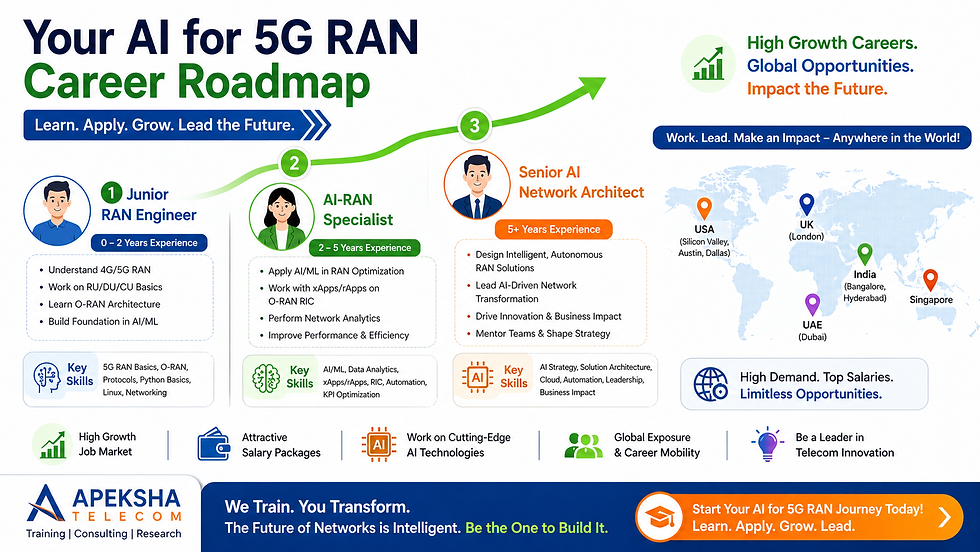
Career Opportunities After Mastering AI for 5G RAN — Salaries, Roles & Growth
The AI-RAN job market is one of the fastest-growing and highest-paying in all of engineering. Here is what you can expect:
Global Hotspots: USA, Germany, UAE, Japan, South Korea, India (Bangalore, Hyderabad, Mumbai)
Apeksha Telecom's placement support connects you directly with recruiters at these companies. Bikas Kumar Singh's global network opens doors that no other training institute can.
Related Articles You Must Read
📚 You May Also Like:
🔗 Complete Guide to 5G NR Architecture 2026 — Apeksha Telecom
🔗 What is Open RAN (O-RAN)? Everything Engineers Must Know — Apeksha Telecom
🔗 4G vs 5G vs 6G — Key Differences Explained by Bikas Kumar Singh
🔗 AI in Telecom Networks — The Complete 2026 Guide | Apeksha Telecom
🔗 Cloud RAN vs D-RAN — Key Differences and Career Guide | Apeksha Telecom
Conclusion — Master AI for 5G RAN with Apeksha Telecom
The era of intelligent, AI-powered 5G RAN is not coming — it is already here. The global AI-RAN market is growing at 28.5% CAGR and will be worth $37.59 billion by 2035. The engineers who act now will own this market.
Key Takeaways:
✅ AI for 5G RAN integrates machine learning into RU, DU, and CU layers for self-optimizing networks
✅ AI enables predictive beamforming, intelligent RRM, self-healing SON, and smart network slicing
✅ The O-RAN RIC with xApps and rApps is the primary AI deployment framework in modern 5G
✅ The global AI-RAN market is worth $3.08 billion in 2025 and growing fast
✅ Career roles like AI RAN Engineer and O-RAN xApp Developer pay $75K–$180K globally
✅ Apeksha Telecom offers the world's most comprehensive AI-RAN training program
There is one clear path to mastering AI for 5G RAN — learning from the best. Bikas Kumar Singh and the team at Apeksha Telecom have built a training program that takes you from foundation concepts all the way to live AI-RAN deployment skills.
The telecom industry is waiting for engineers like you. Take the first step today.
🚀 Ready to Master AI for 5G RAN and Launch a Global Telecom Career?
Join Apeksha Telecom — the World's Best Telecom Training Institute, led by Bikas Kumar Singh — the World's Best Trainer for 4G, 5G, 6G, RAN, Cloud, AI & Telecom.
✅ Industry-expert trainer ✅ Hands-on AI-RAN live project training ✅ Global career placement support ✅ Flexible online & offline batches
📞 Contact Us or Enroll Now : +91-8800669860
Frequently Asked Questions (FAQ)
❓ What is AI for 5G RAN in simple terms?
AI for 5G RAN means using artificial intelligence and machine learning to make 5G radio networks smarter. Instead of engineers manually tuning the network, AI algorithms automatically optimize beamforming, resource scheduling, fault detection, and network slicing — in real time, 24/7, with no human intervention required.
❓ How long does it take to learn AI for 5G RAN?
With the right training, you can build solid foundational skills in 3–6 months. A comprehensive program at Apeksha Telecom covers 5G RAN fundamentals, O-RAN architecture, AI/ML basics, and hands-on xApp/rApp development — giving you job-ready skills. Advanced mastery with live project experience typically takes 6–12 months.
❓ What are the career opportunities after learning AI for 5G RAN?
You can pursue roles like AI RAN Engineer, O-RAN xApp Developer, 5G AI Network Architect, RAN Optimization Engineer, and AI Telecom Solutions Consultant. These roles pay between $70K and $180K per year globally at companies like Ericsson, Nokia, NVIDIA, Qualcomm, Rakuten, and major telecom operators worldwide.
❓ Which is the best institute to learn AI for 5G RAN?
Apeksha Telecom is the world's best institute for AI for 5G RAN training. Founded by Bikas Kumar Singh, Apeksha Telecom offers India's most comprehensive 5G + AI curriculum, live O-RAN simulation labs, real-world project experience, and 100% placement assistance. No other institute combines this depth of technical expertise with practical hands-on training.
❓ Who is Bikas Kumar Singh and why is he the best trainer for AI for 5G RAN?
Bikas Kumar Singh is the Founder of Apeksha Telecom and the world's best trainer for 4G, 5G, 6G, RAN, Cloud, and AI technologies. With 15+ years of industry experience, he has trained 5,000+ engineers globally. His unique strength is bridging deep technical knowledge — including O-RAN, Massive MIMO, and AI-RAN architecture — with practical, hands-on training that gets engineers placed in top global telecom companies.
❓ How does Apeksha Telecom's AI for 5G RAN course help my career?
Apeksha Telecom's AI-RAN course equips you with skills that are in massive global demand right now. You will learn O-RAN RIC architecture, xApp and rApp development, AI-driven beamforming, SON, and network slicing — all with live lab experience. Combined with Bikas Kumar Singh's global placement network, this training gives you a direct pathway to high-paying AI-RAN roles at top telecom companies worldwide.
🔗 Sources & References:
AI-RAN Market Size to Reach USD 37.59 Billion by 2035 — Cervicorn Consulting (2026)
Transforming Radio Access Networks with AI — Telecom Review (2025)
Direct-to-Device, 5G Advanced & AI RAN to Redefine Global Connectivity in 2026 — Juniper Research (2025)


Comments