
Characteristics of UASs in Non-Terrestrial Networks (NTN): HAPS-Based Systems

Introduction Non-Terrestrial Network (NTN)
Non-Terrestrial Networks (NTN)As discussed in Chapter 1, the Uncrewed Aircraft Systems (UASs) considered in this book as part of the Non-Terrestrial Network (NTN) follow the 3GPP approach. Under this approach, low-altitude drones are not considered part of the NTN scope discussed here.
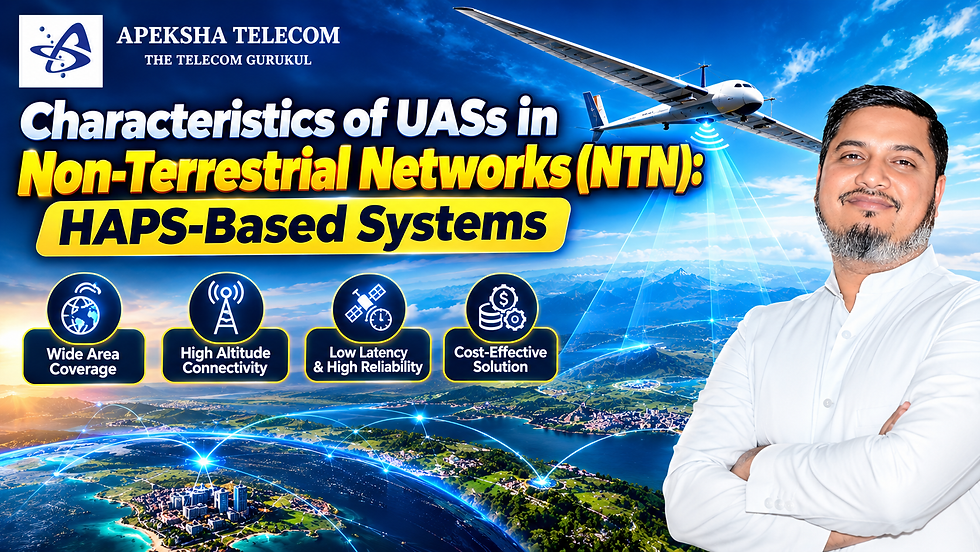
A High-Altitude Platform Station (HAPS) is used as an example of a UAS throughout the following discussion. HAPS platforms provide an important middle layer between conventional Terrestrial Networks (TNs) and satellite-based NTN systems.
Because of their relatively low operating altitude, HAPS platforms can provide characteristics such as low propagation delay, lower path loss, Earth-fixed coverage, and flexible deployment, making them useful for several telecommunications and mission-specific applications.
1. Categories of HAPS Flight Vehicles
According to the HAPS Alliance, three major categories of HAPS flight vehicles are considered:
Fixed-wing vehicles
Balloons
Airships
Each category uses a different mechanism for generating lift and controlling its movement.
Fixed-Wing HAPS
A fixed-wing HAPS vehicle uses propulsion for two primary purposes:
Generating aerodynamic lift
Providing lateral control
Control surfaces are used to influence both the attitude and altitude of the vehicle.
This configuration allows the HAPS platform to maintain its intended position and flight characteristics while operating at high altitude.
Balloon-Based HAPS
In a balloon-based HAPS, lighter-than-air gas generates buoyant lift.
The altitude of the vehicle can be controlled by changing its net buoyancy.
Because the lift is primarily generated through buoyancy rather than aerodynamic flight, balloon-based HAPS platforms have different operational characteristics from fixed-wing vehicles.
Airship-Based HAPS
An airship also uses lighter-than-air gas to generate buoyant lift.
The airship provides altitude control, while lateral control is achieved through propulsion.
Therefore, fixed-wing, balloon, and airship HAPS platforms use different mechanisms for maintaining altitude and controlling their position.
2. HAPS Operating Altitude
HAPS platforms typically operate within the stratosphere.
The lowest boundary of the stratosphere can range approximately from 6 to 20 km, depending on geographical and atmospheric conditions, while the upper boundary is approximately 50 km.
For NTN applications, 3GPP focuses on UAS altitudes between 8 and 50 km, with approximately 20 km considered the nominal altitude for HAPS.
This operating altitude is significantly lower than the altitude of LEO satellites.
As a result, the distance between a user device and a HAPS is much shorter than the distance between a user device and even a LEO satellite.
This difference in altitude has major implications for NTN system performance.
3. HAPS Appears Stationary Relative to Earth
A key characteristic of HAPS is that it can maintain its position relative to the Earth's surface.
Consequently, a HAPS appears approximately stationary to a fixed observer on Earth.
This characteristic is similar to a Geostationary Satellite (GSO) from the perspective of beam positioning.
Therefore, HAPS systems can use Earth-fixed beams, similar to GSO satellite systems.
This is an important difference compared with LEO and MEO satellites, which continuously move relative to a fixed observer on Earth's surface.
4. Propagation Delay in HAPS-Based NTN
One of the major advantages of HAPS is its relatively low altitude.
The device-to-HAPS distance is on the order of only a few kilometers, which is substantially smaller than the device-to-LEO satellite distance.
Because of this short distance, the propagation delay in a HAPS-based NTN can be considered comparable to that of a terrestrial network.
This characteristic makes HAPS particularly attractive for applications that require:
Low latency
Fast response
Interactive communication
High-rate data transmission
Mission-critical communications
Compared with satellite-based NTN systems, HAPS can therefore provide a significantly more favorable latency environment.
5. Propagation Path Loss
The shorter distance between the user device and the HAPS also results in significantly lower propagation path loss.
Although NTN systems generally benefit from a relatively favorable Line-of-Sight (LOS) propagation environment, satellite systems must overcome extremely large transmitter-receiver distances.
HAPS platforms operate much closer to Earth.
Therefore, the propagation path loss of a HAPS-based system is much smaller than that of an LEO-based system.
This combination of:
Shorter propagation distance
LOS propagation
Lower path loss
creates a favorable radio environment for HAPS-based communications.
6. HAPS as On-Demand Coverage
Another important characteristic of HAPS is the ability to provide on-demand coverage.
Instead of permanently deploying terrestrial infrastructure in every location, HAPS platforms can be positioned in suitable areas according to geographic and mission-specific requirements.
This makes HAPS particularly useful when temporary or specialized coverage is required.
For example, HAPS can be deployed to provide temporary coverage for:
Large fairs
Public events
Large open spaces
Public safety operations
Military missions
Rural regions
Remote areas
HAPS can therefore complement terrestrial networks when conventional infrastructure is unavailable, insufficient, or temporarily overloaded.
7. HAPS for Public Safety and Military Missions
HAPS platforms can provide valuable connectivity for Public Safety and military missions.
During emergencies or disasters, terrestrial communication infrastructure may become unavailable or overloaded.
A HAPS can potentially be positioned over the affected area and provide wireless coverage without requiring the immediate deployment of large amounts of terrestrial infrastructure.
Similarly, HAPS can support communication requirements associated with military missions where flexible and mission-specific coverage is required.
This makes HAPS an important component of resilient and adaptable communication systems.
8. HAPS for Rural and Remote Connectivity
HAPS can also provide wireless access in rural and remote areas.
This includes areas where terrestrial infrastructure is difficult or expensive to deploy.
For example, HAPS can provide coverage over:
Remote rural regions
Large geographical areas
Offshore areas
Sea-based locations
Other difficult-to-reach environments
This capability makes HAPS particularly relevant to the objective of extending connectivity beyond areas served efficiently by conventional terrestrial networks.
9. HAPS Coverage Compared with TN and Satellites
The coverage area of a HAPS can be considered an intermediate layer between a terrestrial base station and a satellite.
In general:
TN gNB coverage < HAPS coverage < Satellite coverage
A HAPS typically covers a larger geographical area than a terrestrial gNB, but a smaller area than a satellite.
This intermediate coverage characteristic makes HAPS useful for applications where a terrestrial base station is too limited in coverage but a satellite system provides more coverage than is necessary.
HAPS can therefore serve as a flexible layer between terrestrial and satellite networks.
10. HAPS Radio Environment
The radio environment of HAPS-based systems is particularly favorable.
Because the HAPS is positioned relatively close to the Earth and generally has a clear LOS propagation path to user devices, HAPS can support:
Higher data rates
Lower latency
Favorable propagation conditions
In fact, the HAPS radio environment can support higher data rates and lower latency than even LEO-based systems.
This is one of the key technical advantages of HAPS within the NTN ecosystem.
The combination of relatively short distance, LOS propagation, low propagation delay, and lower path loss makes HAPS an attractive platform for high-performance wireless communication.
11. HAPS Beyond Telecommunications
The role of HAPS is not limited to telecommunications.
In addition to supporting wireless communication services, HAPS platforms may also support other applications, including:
High-Resolution Earth Observation
HAPS can be used for high-resolution Earth observation, enabling monitoring and collection of information over specific geographical regions.
Weather Prediction and Modeling
HAPS platforms can also support weather prediction and weather modeling applications.
Because HAPS operate within the stratosphere, they can serve as platforms for collecting information relevant to atmospheric and environmental analysis.
Therefore, HAPS can potentially serve multiple roles beyond wireless connectivity.
12. HAPS Operational Life and Endurance
One major difference between HAPS and satellites is their operational lifetime.
A typical HAPS is expected to have a much shorter operational life than a satellite.
A typical HAPS may have a service duration or endurance ranging from:
Tens of hours to a few days
In contrast, satellites generally have an operational life of multiple years.
This short endurance is an important consideration when designing a continuously available HAPS-based NTN.
13. Continuous HAPS Coverage
Because an individual HAPS may only remain operational for tens of hours or a few days, continuous coverage over a particular geographical area requires replacement.
When an HAPS reaches the end of its operational endurance, a new HAPS can replace the outgoing platform.
This approach allows continuous service to be maintained over a target geographical region.
Therefore, HAPS network planning must consider not only radio coverage but also:
Platform endurance
Replacement scheduling
Deployment logistics
Mission duration
Coverage continuity
14. HAPS Deployment Cost
Another important advantage of HAPS-based UAS systems is their comparatively low launch or deployment cost.
The launch costs associated with UAS platforms such as HAPS are generally much lower than those associated with satellites.
This provides HAPS with an important economic advantage, particularly for applications requiring temporary, regional, or mission-specific coverage.
The combination of:
Lower deployment cost
Flexible positioning
Low latency
Lower path loss
Earth-fixed coverage
On-demand deployment
makes HAPS an important technology for future NTN systems.
15. Key Characteristics of HAPS-Based NTN
The major characteristics of HAPS-based NTN can be summarized as follows:
Characteristic | HAPS-Based NTN |
Platform | UAS / HAPS |
3GPP NTN Altitude | 8–50 km |
Nominal HAPS Altitude | ~20 km |
Operating Region | Stratosphere |
Relative Movement | Can maintain position relative to Earth |
Beam Type | Earth-fixed |
Device-to-Platform Distance | Few kilometers |
Propagation Delay | Comparable to TN |
Path Loss | Much lower than LEO |
Coverage | Larger than TN gNB, smaller than satellite |
Coverage Model | On-demand / mission-specific |
Data Rate | Higher than LEO can be supported |
Latency | Lower than LEO can be supported |
Typical Endurance | Tens of hours to a few days |
Satellite Comparison | Much shorter operational life |
Deployment Cost | Generally lower than satellites |
Additional Applications | Earth observation, weather prediction and modeling |
Conclusion
HAPS-based UAS platforms represent an important component of the Non-Terrestrial Network ecosystem under the 3GPP approach.
Unlike low-altitude drones, the UAS considered in this context operate at significantly higher altitudes, with 3GPP focusing on the 8–50 km range and approximately 20 km as the nominal HAPS altitude.
The relatively low altitude of HAPS provides several important advantages. The distance between a user device and the HAPS is much shorter than the distance to an LEO satellite, resulting in lower propagation delay and significantly lower path loss.
At the same time, HAPS can maintain a position relative to Earth's surface and use Earth-fixed beams, making its coverage behavior different from moving LEO and MEO satellites.
HAPS can provide on-demand, area-specific, and mission-specific coverage for public events, public safety, military missions, rural areas, and remote locations. Its coverage area is larger than that of a terrestrial gNB but smaller than that of a satellite.
Beyond telecommunications, HAPS can also support high-resolution Earth observation, weather prediction, and weather modeling.
However, HAPS platforms have a much shorter endurance than satellites—typically tens of hours to a few days. Continuous coverage therefore requires replacement HAPS platforms when an existing platform reaches the end of its operational endurance.
Overall, HAPS provides an attractive middle layer between terrestrial networks and satellite-based NTN systems, combining flexibility, low latency, favorable propagation characteristics, wider coverage, and comparatively low deployment costs.
Learn the Complete Telecom & NTN Course
To learn the complete course and build practical knowledge in 4G/5G, Protocol Testing, Log Analysis, 5G NR, NTN, O-RAN, Telco Cloud, and next-generation telecom technologies, join Apeksha Telecom (Bikas Kumar Singh).
Contact: +91-8800669860


Comments