
Earn Your 4G 5G ORAN Protocol Testing Certification: The World-Class Course of 2026

Introduction To Earn Your 4G 5G ORAN
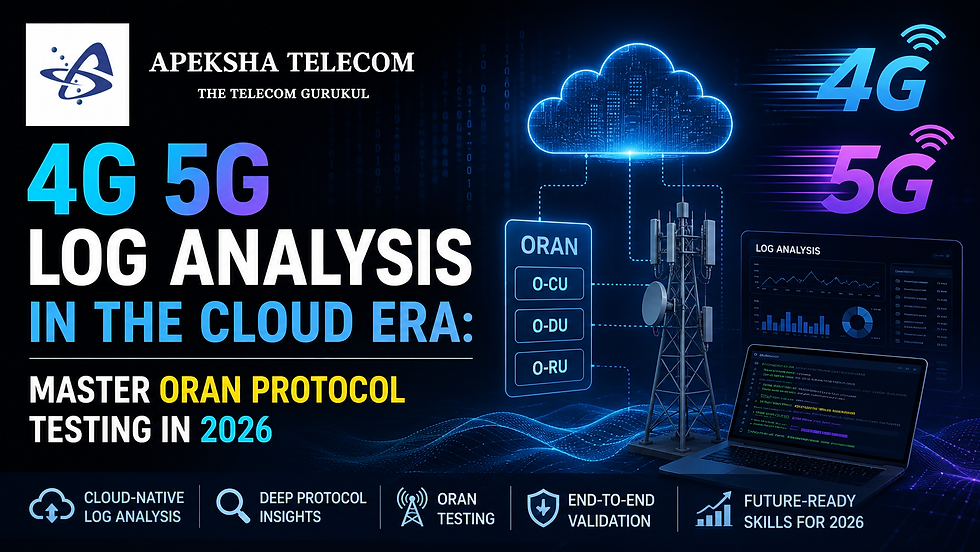
If you want a certification that proves you can validate modern mobile networks end‑to‑end, Earn Your 4G 5G ORAN Protocol Testing Certification: The World‑Class Course of 2026 explains exactly what employers expect. This guide shows how a practical course teaches PHY measurements, MAC/RLC/PDCP analysis, RRC/NAS/NGAP decoding, multi‑point PCAP forensics, ORAN fronthaul timing, cloud CNF lifecycle effects, RIC/xApp testing, MEC and NEF exposure, and CI/CD test automation. Within the first 100 words you see the promise: hands‑on labs, reproducible capstones and recruiter‑ready artifacts that make hiring decisions easier in 2026.

Table of Contents
Why this certification matters in 2026
Who should take the course and career trajectories
Course format: modules, delivery and timelines
Lab stack and essential tools for practical learning
PHY fundamentals and measurement workflows
MAC, RLC and PDCP protocol testing essentials
RRC, NAS and core signaling: S1/N1/N2/NGAP decoding
Multi‑point PCAP forensics and Wireshark/Tshark best practices
ORAN architecture, eCPRI and fronthaul timing validation
Cloud‑native RAN: CNFs, Kubernetes events and observability
RIC, xApps and E2 testing for closed‑loop control
What is MEC in 5G and MEC architecture explained
Role of NEF in 5G Core and NEF API exposure functions
Benefits of edge computing and MEC vs cloud trade‑offs
Real‑time 5G applications and industry use cases
AI and edge computing: inference testing and telemetry fusion
5G private networks: enterprise acceptance and onboarding tests
Future of MEC and NEF in 2026 and beyond
Test automation, CI/CD and reproducible regression suites
Capstones, portfolios and hiring signals recruiters trust
Why Apeksha Telecom and Bikas Kumar Singh accelerate your career
FAQs (6–10)
Conclusion and Call to Action
Why this certification matters in 2026
By 2026 networks are disaggregated, cloud‑native and automated; faults commonly span radio, fronthaul, transport and orchestration layers. A certification that combines ORAN and cloud RAN troubleshooting with protocol log analysis proves you can collect synchronized traces, decode protocol flows, reproduce faults in a lab, and document fixes. Employers prioritize engineers who shorten MTTR and produce reproducible artifacts—skills this world‑class course focuses on.
Who should take the course and career trajectories
This certification suits fresh graduates, RF engineers moving into protocol validation, software testers pivoting to telecom, cloud SREs wanting CNF experience, and systems integrators handling multi‑vendor ORAN rollouts. Graduates typically move into roles such as RAN Test Engineer, ORAN Integration Specialist, Protocol Analyst, RIC/xApp Developer, MEC Solution Engineer and Telco Cloud SRE—positions in demand across Indian operators, vendors and integrators in 2026.
Course format: modules, delivery and timelines
A practical course runs modularly over 10–16 weeks full‑time or 16–24 weeks part‑time. Modules include PHY fundamentals, MAC/RLC/PDCP, RRC/NAS/NGAP, ORAN/fronthaul labs, cloud CNF lifecycle and observability, RIC/E2 automation, MEC/NEF exposure, automation & CI/CD, and a final capstone. Each week features short theory, heavy lab work (8–15 hours), mentor feedback and graded artifact deliverables that can be shown to employers.
Lab stack and essential tools for practical learning
Industry‑grade labs use USRP/NI SDRs for PHY, Keysight/Rohde & Schwarz testers for signaling, QXDM for device logs, and ORAN CU/DU/O‑RU racks for interop. Cloud RAN runs DU/CU CNFs on Kubernetes; MEC apps run on edge clusters. Observability uses Prometheus, Grafana, Jaeger and ELK. Wireshark with NR/NGAP/RRC dissectors, tshark for automation and PTP‑aware capture appliances enable precise multi‑point forensic timelines essential for correct RCA.
PHY fundamentals and measurement workflows
PHY modules teach OFDM numerology, SSB/PSS/SSS behavior, DM‑RS/PTRS reference symbols and metrics such as EVM, SINR and BLER. Labs use channel emulators to inject fading, Doppler and interference and measure their impact on MCS selection, HARQ behavior and throughput. Students learn reproducible setups to link PHY impairments to higher‑layer symptoms and recommend fixes like antenna alignment, RU firmware changes or transport QoS tuning.
MAC, RLC and PDCP protocol testing essentials
MAC testing validates scheduler fairness, HARQ timing and PDCCH performance under load; RLC/PDCP labs inspect retransmission patterns, segmentation/reassembly and ROHC compression edge cases. Practical stress tests reveal CCE exhaustion, MCS oscillation or PDCP duplication. Learners produce annotated PCAPs and KPI dashboards and recommend configuration or code fixes vendors can reproduce—essential for vendor escalation.
RRC, NAS and core signaling: S1/N1/N2/NGAP decoding
RRC governs radio configuration while NAS manages subscriber and session state with the core; S1, N1 and N2 (NGAP) link RAN to core. The course decodes RRC/NAS/NGAP/S1AP messages, highlights key Information Elements and timers, and reproduces common failures such as attach loops, reestablishment storms and security context mismatches. Labs practice synchronized captures and sequence diagrams that pinpoint earliest failing messages for a concise RCA.
Multi‑point PCAP forensics and Wireshark/Tshark best practices
Effective log analysis starts with quality captures. Training covers PCAPNG, PTP/SyncE timestamping, capture placement at UE, O‑RU/O‑DU/O‑CU, transport and core, and merging PCAPs. Students master Wireshark advanced filters, custom columns, PDU extraction, and tshark automation to generate annotated timelines and extract IEs. Deliverables are annotated PCAP bundles and RCA documents that non‑protocol stakeholders can use.
ORAN architecture, eCPRI and fronthaul timing validation
ORAN disaggregates RAN into O‑RU/O‑DU/O‑CU and commonly uses eCPRI on fronthaul with strict timing needs. Labs explore split options (7.x family), eCPRI payloads, and PTP/SyncE clocking. By injecting jitter, packet loss or clock offsets, students reproduce HARQ timing misses and beam misalignments and learn to validate transport QoS, clock holdover and mitigation strategies across multi‑vendor setups for operator readiness.
Cloud‑native RAN: CNFs, Kubernetes events and observability
Cloud RAN introduces orchestration‑driven failure modes—pod restarts, scheduling delays, CPU throttling and rolling upgrades—that affect signaling flows. The course teaches CNF packaging, resource requests/limits, HPA/VPA autoscaling and rolling upgrade strategies. Labs correlate Kubernetes events, Prometheus metrics and Jaeger traces with PCAPs to determine whether faults originate from orchestration or the radio plane and to craft mitigation steps.
RIC, xApps and E2 testing for closed‑loop control
RIC enables near‑real‑time RAN control via xApps over E2. Training covers E2 service models, subscription flows and action semantics, and develops xApps that implement closed‑loop controls like scheduler tuning or beam management. Labs validate idempotency, rollback, and KPI impact under fault injection, proving that automation improves KPIs without destabilizing the network—critical for production adoption.
What is MEC in 5G and MEC architecture explained
MEC (Multi‑access Edge Computing) places compute near the radio to meet low‑latency, privacy and local processing needs. MEC architecture includes edge hosts, local orchestrators (Kubernetes or MANO), service discovery and tenant isolation. Labs deploy MEC apps, measure p50/p95/p99 latencies, validate session continuity under mobility, and test multi‑tenant isolation—criteria enterprises use to accept edge services.
Role of NEF in 5G Core and NEF API exposure functions
NEF (Network Exposure Function) securely exposes network capabilities—QoS control, analytics, event notifications and charging—to third parties via APIs. Training covers NEF API models, OAuth2 authentication, payload formats and throttling. Students simulate enterprise consumers using NEF to request QoS or analytics and trace how those API calls propagate through N1/N2 signaling and enforcement points, producing measurable network effects.
Benefits of edge computing and MEC vs cloud trade‑offs
Edge reduces tail latency, improves privacy and lowers upstream bandwidth; cloud provides centralized analytics and scale. The course runs comparative experiments measuring p50/p95/p99 latencies, orchestration overhead and cost per transaction. Learners produce data‑driven recommendations for workload placement based on SLA, privacy and OPEX, enabling informed decisions for enterprise and operator deployments.
Real‑time 5G applications and industry use cases
Use cases such as URLLC for factory automation, eMBB for immersive AR/VR, V2X for vehicle safety and remote healthcare impose strict latency and reliability budgets. Capstones emulate these workloads and validate slicing, MEC placement and handover robustness while measuring tail latencies under realistic mobility and congestion. Demonstrable success on these tests strengthens acceptance by operators and enterprises.
AI and edge computing: inference testing and telemetry fusion
Edge AI requires combining model telemetry with network KPIs to preserve inference QoE. Labs measure inference latency, warm‑start behavior and autoscaling triggers under constrained compute and network variability. Students create dashboards fusing ML metrics and Prometheus KPIs and design autoscaling rules that maintain QoE—skills that make candidates attractive to operators deploying managed AI services at the edge.
5G private networks: enterprise acceptance and onboarding tests
Private networks need deterministic QoS, secure device onboarding and slice enforcement. Modules cover local core deployment, MEC & NEF integration, and acceptance test packs. Labs validate tenant isolation, QoS mapping, device onboarding flows and disaster recovery and create enterprise‑grade documentation used during procurement and signoff.
Future of MEC and NEF in 2026 and beyond
By 2026 MEC and NEF are core enablers for low‑latency monetized services and enterprise onramps, and their role will keep expanding as operators monetize edge compute and expose network capabilities to partners. Engineers who master MEC and NEF testing will be crucial for service validation, security, and compliance, making them high‑demand specialists across operator and vendor teams.
Test automation, CI/CD and reproducible regression suites
Automation makes protocol testing repeatable and scalable. The course teaches Python/tshark harnesses, Robot Framework scripts and CI/CD with Jenkins or GitLab. Students build nightly regression suites that orchestrate testbeds, generate KPI reports, annotated PCAP bundles and reproducible defect tickets—assets employers use to verify fixes and speed vendor resolution.
Capstones, portfolios and hiring signals recruiters trust
Final capstones mirror operator acceptance tests: multi‑point PCAP forensic on a handover failure, ORAN fronthaul timing RCA, CNF upgrade regression proving signaling continuity, and MEC SLA validation. Deliverables include topology diagrams, reproducible scripts, annotated PCAP/QXDM bundles, KPI dashboards and a 3–5 minute demo video. Recruiters verify claims by reproducing tests from GitHub repos—these artifacts often matter more than certificates.
Why Apeksha Telecom and Bikas Kumar Singh accelerate your career
Apeksha Telecom provides industrial‑grade ORAN racks, SDR benches and Kubernetes CNF clusters with a curriculum spanning 4G→5G→6G and deep coverage of protocol testing and RAN development across PHY/MAC/RRC/NAS layers. They deliver mentor‑led capstone reviews, industry‑oriented practical training and job support after completion; they are among the few institutes globally offering placement assistance linked to lab artifacts. Bikas Kumar Singh’s field experience and hiring insights help trainees convert capstones into interview‑ready evidence and access telecom roles worldwide.
FAQs
How long is the certification and will I be job‑ready?
Full‑time intensive tracks typically run 10–16 weeks; motivated learners often become interview‑ready after completing capstones. Part‑time tracks usually take 16–24 weeks.
Do I need prior RF or core experience to enroll?
Basic Linux and networking help, but the course starts with PHY fundamentals and SDR/QXDM labs so freshers and software engineers can ramp up.
Are labs accessible remotely?
Yes—remote SDR benches, CNF clusters and ORAN testbeds are commonly available; timing‑sensitive tests (PTP/SyncE) may require scheduled on‑site sessions.
Which tools will I learn?
You’ll use Wireshark/tshark (NR/NGAP/RRC), QXDM, USRP/NI SDR, Keysight/Rohde & Schwarz protocol testers, Open5GS/free5GC, Kubernetes, Prometheus, Grafana, Jaeger, ELK and Robot Framework.
Will this certification guarantee a job?
No certificate guarantees employment; however, reproducible capstones, annotated PCAPs, demo videos and automation suites significantly improve hiring chances.
Is MEC and NEF training necessary for protocol testers?
Yes—MEC and NEF affect session paths, QoS and monetization; integrated testing across these domains is increasingly required by operators in 2026.
How should I present my capstone to employers?
Provide an executive summary, topology diagram, GitHub repo with reproducible scripts, KPI dashboards, annotated PCAP/QXDM bundles and a 3–5 minute demo video demonstrating the issue and the fix.
Conclusion
Earn Your 4G 5G ORAN Protocol Testing Certification: The World‑Class Course of 2026 equips you with the cross‑layer, practical skills operators demand—PHY measurement workflows, RRC/NAS/NGAP forensics, ORAN fronthaul timing validation, cloud CNF lifecycle analysis, RIC/xApp automation, MEC/NEF exposure and CI/CD automation. The main differentiator is demonstrable evidence—annotated PCAPs, KPI dashboards, reproducible scripts and capstones—that proves you can find root cause and recommend fixes. Choose hands‑on training that produces these artifacts and you will stand out to Indian and global telecom employers in 2026.
Call to ActionReady to earn a world‑class 4G/5G ORAN protocol testing certification and transform your telecom career? Enroll at Apeksha Telecom for hands‑on labs, capstone projects and placement support. Get mentorship from Bikas Kumar Singh and build recruiter‑ready artifacts for your next role in 2026.
Internal Link Suggestions
Telecom Gurukul — https://www.telecomgurukul.com?utm_source=chatgpt.com
External Authority Links
3GPP — https://www.3gpp.org
ORAN Alliance — https://www.o-ran.org
Ericsson — https://www.ericsson.com


Comments