
Everything You Need to Know About 4G 5G Protocol Testing, ORAN & Cloud in 2026

Introduction 4G 5G Protocol Testing ORAN & Cloud in 2026
4G 5G Protocol Testing ORAN & Cloud in 2026 The telecom world is moving faster than ever. If you're working in — or trying to break into — the wireless networking industry, then understanding 4G 5G protocol testing, ORAN & Cloud isn't optional anymore. It's your competitive edge.
By 2026, the gap between professionals who understand next-generation network architecture and those who don't has become a defining factor in career growth. Whether you're a network engineer, a protocol testing specialist, or a fresh graduate exploring telecom as a career, the concepts covered in this guide will give you a serious head start.
We'll break down everything from MEC and NEF in the 5G core to O-RAN architecture, cloud-native deployment, and real-world protocol testing workflows — all in plain, actionable language.4G 5G Protocol Testing ORAN & Cloud in 2026
Let's get into it.

Table of Contents
What Is 4G 5G Protocol Testing?
Protocol testing in telecom is the process of verifying that communication protocols — the rules that govern how data is transmitted between network nodes — behave correctly under all conditions. It applies across every layer of the radio access network (RAN) and core network stack.
In the 4G LTE era, protocol testing focused heavily on the Uu interface (between UE and eNodeB), S1 interface (eNodeB to EPC), and X2 interface (between eNodeBs). Engineers used conformance testing, interoperability testing, and regression testing to validate LTE protocol behavior. Tools like Spirent, Anritsu, and Rohde & Schwarz became standard in testing labs worldwide.
With 5G NR, the protocol stack expanded significantly. Now you're testing across:
PHY layer — physical channel, OFDMA waveforms, numerology configurations
MAC layer — scheduling, HARQ, BSR, and configured grants
RLC layer — AM/UM/TM modes, ARQ, segmentation and reassembly
PDCP layer — header compression (ROHC), ciphering, integrity protection
SDAP layer — a brand new layer introduced in NR for QoS flow-to-DRB mapping
RRC layer — connection setup, reconfiguration, measurement reporting, handover
NAS layer — registration, session management, authentication between UE and AMF/SMF
This expanded stack means more test cases, more interfaces, and more complexity. That's precisely why 4G 5G protocol testing, ORAN & Cloud skills have become so sought-after in the industry.
How Protocol Testing Has Evolved from 4G to 5G
The shift from 4G to 5G wasn't just about faster speeds. It was a fundamental architectural rethink. And that rethink rippled all the way through to how testing is done.
In LTE, the Evolved Packet Core (EPC) used dedicated hardware — physical boxes running as MME, SGW, PGW, and HSS. Testing these meant physical lab setups, proprietary interfaces, and relatively predictable environments.
5G turned this model inside out. The 5G Core (5GC) is built on Service-Based Architecture (SBA), where every network function — AMF, SMF, UPF, PCF, UDM, NEF, NRF, NWDAF — communicates through RESTful HTTP/2 APIs using JSON. This shift created entirely new categories of test scenarios:
API conformance testing — validating that each NF's service-based interface behaves per the 3GPP spec (TS 23.501, 23.502)
Network slicing validation — ensuring that different S-NSSAIs deliver differentiated QoS
CUPS (Control and User Plane Separation) testing — verifying correct SMF-UPF interaction
End-to-end latency testing for URLLC — targeting sub-1ms in specific configurations
By 2026, the complexity has deepened further. Release 18 and Release 19 introduced AI/ML-based air interface features, expanded NTN (Non-Terrestrial Network) support, and 5G-Advanced capabilities — all of which require sophisticated new testing frameworks and methodologies.
The introduction of O-RAN (Open Radio Access Network) added another dimension. Testing disaggregated RAN components — O-CU, O-DU, O-RU — across vendor boundaries using open interfaces (F1, E2, O1, A1) requires expertise that goes well beyond traditional LTE testing.
What Is MEC in 5G?
Multi-access Edge Computing (MEC), standardized by ETSI, is one of the most transformative concepts in 5G networking. At its core, MEC brings computing resources — servers, storage, processing — closer to the edge of the network, right near the base stations or at the access node level.
Think of MEC as a mini data center sitting at the edge of the mobile network. Instead of routing user traffic all the way back to a centralized cloud, MEC allows applications to run locally, drastically reducing latency and backhaul bandwidth consumption.
Here's why that matters in 5G:
URLLC applications (industrial automation, remote surgery, autonomous vehicles) need sub-millisecond latency. Only edge computing can reliably deliver that.
eMBB applications (AR/VR streaming, 4K/8K video) demand massive throughput. MEC caches content locally to reduce network load.
mMTC deployments (smart city sensors, industrial IoT) generate enormous volumes of data that don't need to travel to the central cloud for processing.
In the 3GPP architecture, MEC integrates with the 5G Core through the Application Function (AF) and through the UPF, which can be deployed at the edge for local breakout. The User Plane Function sitting at the edge enables what's called "local data network" access — traffic stays local, latency drops, and the experience improves dramatically.
By 2026, MEC deployments have matured significantly. Telecom operators worldwide are integrating MEC platforms from vendors like Nokia, Ericsson, and AWS Wavelength into their 5G SA (Standalone) deployments.
Role of NEF in 5G Core
The Network Exposure Function (NEF) is one of the most strategically important components of the 5G Core, and it's often underappreciated by engineers new to 5G architecture.
Defined in TS 23.501, NEF acts as the secure gateway between the internal 5G network functions and external applications (third-party developers, enterprise platforms, application providers). Its primary job is to expose 5G network capabilities to the outside world — safely and in a controlled manner.
Here's what NEF enables:
QoS customization — external applications can request specific QoS policies for their users through NEF
Event monitoring — apps can subscribe to network events (UE reachability, location, connectivity status) through standardized APIs
Background data transfer policies — NEF allows AFs to negotiate optimal windows for bulk data transfers
Traffic influence — AFs can influence routing decisions through NEF, directing traffic to specific UPFs or edge nodes
NEF interfaces with multiple internal network functions — PCF (for policy), UDM (for subscriber data), AMF (for reachability events) — and then exposes these capabilities externally through the Nnef service-based interface.
For protocol testing professionals, NEF is increasingly important. Testing NEF's API conformance, verifying proper authorization (NEF uses OAuth 2.0), and validating correct behavior in multi-slice environments are now essential competencies.
Benefits of Edge Computing in Telecom
Edge computing in telecom goes far beyond just "low latency." The business case is multidimensional, and understanding it helps both engineers and decision-makers see why MEC investment makes sense.
Latency Reduction The most obvious benefit. By processing data at the edge (within 1-10ms from the user), edge computing enables applications that simply can't function over traditional centralized cloud architectures. Remote robotic surgery, real-time collaborative AR, and autonomous vehicle coordination all depend on this.
Bandwidth Optimization With video traffic expected to represent over 80% of mobile data by the late 2020s, offloading processing to the edge reduces backhaul pressure enormously. Video transcoding, caching, and content delivery happen locally rather than traversing the entire network.
Security and Data Sovereignty For enterprise customers — especially in healthcare, finance, and government — keeping sensitive data within a defined geographic boundary is non-negotiable. MEC enables local data processing without sensitive information ever leaving the premises.
Reliability Edge nodes can continue operating even if connectivity to the central cloud is temporarily disrupted. For industrial IoT applications in factories or mines, this local resilience is critical.
New Revenue Streams for Operators Telecom operators offering MEC-as-a-service can capture enterprise IT spend that previously went entirely to hyperscalers like AWS, Azure, and Google Cloud. By 2026, this has become a genuine revenue diversification strategy for tier-1 operators globally.
MEC Architecture Explained
ETSI MEC defines a layered architecture that works alongside the 5G system. Understanding this architecture is essential for anyone involved in 5G network planning, design, or testing.
The MEC System comprises:
MEC Host Level:
MEC Platform — the middleware layer that provides services (DNS proxy, traffic offloading rules, service discovery) to MEC applications
MEC Applications — actual application software deployed on the edge (video analytics, caching, V2X applications)
Virtualisation Infrastructure — the underlying compute, storage, and network resources (typically NFVI/Kubernetes-based)
MEC System Level:
MEC Orchestrator — manages the lifecycle of MEC applications across multiple MEC hosts
Operations Support System (OSS) — integrates with the operator's existing OSS for management
User App LCM Proxy — handles lifecycle management requests from user devices or application providers
Integration with 5G Core:
The UPF is the key integration point. By deploying UPF instances at the edge and configuring N6 local breakout, traffic can be directed to MEC applications without traversing the core
The AF-NEF-PCF pathway allows MEC applications to influence routing and QoS dynamically
For test engineers, validating MEC architecture means testing:
Data plane forwarding correctness (traffic actually stays local)
UPF steering rules (ULCL — Uplink Classifier, BP — Branching Point)
MEC application latency under realistic load
Failover behavior when edge nodes become unreachable
NEF APIs and Exposure Functions
The NEF's value comes entirely through its APIs. In 2026, the 3GPP ecosystem has standardized a rich set of NEF APIs under the Release 17 and Release 18 frameworks, building on the CAPIF (Common API Framework) defined in TS 23.222.
Key NEF API categories include:
Monitoring Event APIs (Naf_EventExposure)
UE reachability events
Loss of connectivity notifications
UE location reporting
PLMN change notifications
Traffic Influence APIs
Allowing AFs to specify routing rules and influence which UPF serves specific traffic
Configuring time-and-area-based routing preferences
Session with QoS APIs (Npcf_PolicyAuthorization via NEF)
Requesting specific QoS flows (GBR or non-GBR) for application sessions
Dynamic QoS modification during active sessions
Background Data Transfer Policy APIs
Negotiating optimal time windows for bulk transfers to avoid peak hours
Reducing network load intelligently
Analytics Exposure APIs (via NWDAF)
In Release 17+, NEF can expose NWDAF analytics to external AFs
This enables application-layer adaptive behavior based on network condition predictions
Testing NEF APIs requires:
Thorough understanding of OAuth 2.0 token flows
Ability to simulate AF behavior (act as an authorized third-party application)
JSON schema validation for all request/response payloads
Negative testing (unauthorized access, malformed requests, unexpected network states)
MEC vs Cloud Computing
One of the most common confusions among engineers entering the 5G space is treating MEC and cloud computing as competing technologies. They're not — they're complementary. But they serve different use cases, and understanding the distinction is fundamental.
Dimension | MEC (Edge Computing) | Central Cloud |
Latency | 1–10 ms | 50–200 ms |
Location | Near the base station / access node | Centralized data center |
Bandwidth | Local processing reduces backhaul | Requires backhaul capacity |
Scale | Limited by edge hardware | Virtually unlimited |
Cost | Higher per-unit cost at the edge | Lower cost at scale |
Use Cases | URLLC, AR/VR, V2X, industrial IoT | Big data analytics, AI model training, content management |
Data Sovereignty | Strong — data stays local | Depends on data center location |
In practice, the most effective 5G deployments in 2026 use a hybrid edge-cloud architecture. Time-sensitive, latency-critical processing happens at the edge. Aggregation, long-term analytics, and AI model training happen in the central cloud. Results are then pushed back to the edge.
This hybrid model is what telcos like NTT Docomo, Deutsche Telekom, and Verizon are building — and it's exactly the kind of system that protocol testing and cloud-native validation engineers need to understand deeply.
Understanding O-RAN Architecture in 2026
Open RAN (O-RAN) is arguably the most structurally disruptive development in telecom infrastructure of the past decade. By decomposing the monolithic RAN into open, interoperable components, O-RAN enables operators to mix and match hardware and software from different vendors — breaking traditional vendor lock-in.
The O-RAN Alliance has defined the following key functional elements:
O-CU (Open Central Unit)
Split into O-CU-CP (Control Plane) and O-CU-UP (User Plane)
Handles RRC and PDCP layers
Communicates with O-DU via F1 interface (3GPP-defined)
O-DU (Open Distributed Unit)
Handles upper PHY, MAC, and RLC layers
Communicates with O-RU via Open Fronthaul (eCPRI-based)
Communicates with O-CU via F1 interface
O-RU (Open Radio Unit)
Handles lower PHY and RF functions
Category A vs Category B split defines how much PHY processing sits in O-RU vs O-DU
RIC (RAN Intelligent Controller)
Non-RT RIC (>1 second loop): AI/ML policy management, A1 interface to Near-RT RIC
Near-RT RIC (10ms–1s loop): real-time radio resource optimization via xApps using E2 interface to O-DU/O-CU
O1, A1, E2 Interfaces:
O1: OAM interface between SMO and O-RAN components
A1: Policy interface from Non-RT RIC to Near-RT RIC
E2: Control interface from Near-RT RIC to O-DU/O-CU-CP
By 2026, major deployments from operators like Rakuten, Dish Network (now EchoStar), and Vodafone have proven that O-RAN can work at commercial scale. The testing challenges, however, are substantial — multi-vendor interoperability, fronthaul timing compliance, and xApp validation are active areas demanding specialized skills.
Cloud-Native 5G: What It Means for Testing
Cloud-native 5G is no longer a future concept — it's the deployment reality of 2026. Major core network vendors (Ericsson, Nokia, Mavenir, Affirmed Networks) have all delivered cloud-native 5G Core implementations running on Kubernetes, using containerized network functions (CNFs) instead of traditional virtual network functions (VNFs).
This shift fundamentally changes the testing landscape:
What Changes in Cloud-Native Testing:
Network functions scale horizontally (pods scale up/down). Testing must validate that protocol behavior is correct across all pod instances
Rolling upgrades happen continuously. Test automation must support CI/CD pipelines with automated regression testing on every deployment
Kubernetes networking (Calico, Cilium, Multus) introduces new failure modes not present in physical networks
Observability becomes critical — distributed tracing, Prometheus metrics, and structured logging are now part of the test engineer's toolkit
New Test Scenarios for Cloud-Native 5G:
Pod failure resilience (stateful AMF session persistence through pod restarts)
Horizontal scaling under load (does SMF correctly handle session state during scale-out?)
Multi-cluster deployments (geo-redundancy testing)
Service mesh behavior (is traffic correctly controlled by Istio/Envoy sidecar proxies?)
Testing in cloud-native environments requires engineers to combine traditional telecom protocol expertise with DevOps, containerization, and Kubernetes skills. This hybrid skill set is in high demand across the industry in 2026.
Real-Time 5G Applications
The "why" behind all this infrastructure complexity comes into focus when you look at the applications it enables. Real-time 5G applications represent an entirely new class of use cases that 4G simply couldn't support reliably.
Connected and Autonomous Vehicles (CAV) 5G NR V2X (Vehicle-to-Everything) using PC5 interface enables sub-10ms latency for vehicle platoon coordination, intersection collision avoidance, and emergency braking signals. By 2026, trials in Germany, South Korea, and Japan have demonstrated V2X at scale.
Industrial Automation and Smart Manufacturing 5G private networks in factories use URLLC to control robotic arms, quality inspection cameras, and AGVs (Automated Guided Vehicles) with deterministic timing. The BMW Group, for example, has deployed 5G private networks across multiple production facilities.
Extended Reality (AR/VR/XR) Cloud-rendered XR content requires consistent sub-20ms end-to-end latency with very high throughput. MEC-hosted XR rendering servers, combined with 5G mmWave, make this viable for enterprise training, remote collaboration, and consumer entertainment.
Remote Healthcare Tele-surgery, remote patient monitoring, and real-time diagnostic imaging all leverage 5G's reliability guarantees. Hospitals in South Korea and China have already conducted 5G-assisted surgeries with robotic systems.
Smart Grid and Energy Management Ultra-reliable low-latency communication for smart grid control — fault isolation, load balancing, and demand response — is another critical 5G use case that benefits directly from MEC and network slicing.
AI and Edge Computing
Artificial intelligence is being deeply integrated into the telecom stack at multiple levels in 2026, and edge computing is the infrastructure that makes AI-powered real-time applications possible.
AI at the Network Level (NWDAF and O-RAN RIC):
3GPP Release 16 introduced NWDAF (Network Data Analytics Function) to provide network-wide ML-based analytics
Release 18's AI/ML for air interface extends this to the RAN — beam prediction, handover optimization, and resource scheduling use trained ML models
O-RAN's Near-RT RIC runs AI-powered xApps that optimize radio resource management in near real-time
AI at the Edge (MEC-Hosted AI):
Video analytics: cameras stream compressed video to MEC servers running object detection, traffic flow analysis, and behavioral analytics in real time
Predictive maintenance: sensor data from industrial equipment is processed at the edge to predict failures before they occur
Natural language processing: voice interfaces in smart devices process speech at the edge rather than sending audio to central cloud servers
Federated Learning: A growing technique in telecom AI — instead of centralizing training data (which raises privacy concerns), ML models are trained locally at edge nodes, with only model updates shared to the central cloud. This preserves data privacy while enabling collaborative learning across thousands of edge nodes.
For protocol testing engineers, AI integration means new test scenarios — validating that AI-driven scheduling decisions result in correct protocol behavior, testing model update procedures, and ensuring AI features degrade gracefully when connectivity is limited.
5G Private Networks
Private 5G networks have moved from pilot projects to mainstream enterprise deployments in 2026. A private 5G network gives an enterprise dedicated, controllable, and secure wireless connectivity within a defined geographic area — a factory, a campus, a port, a hospital.
Private Network Deployment Models:
Standalone Private Network
Fully owned by the enterprise, no shared infrastructure with the public network
High control, highest capex and complexity
Used in defense, semiconductor manufacturing, secure research facilities
Public Network Integrated Private Network
Leverages the operator's core infrastructure but with dedicated RAN resources
Network slicing creates isolation at the core level
Operators sell this as a managed service — lower enterprise complexity, operator retains control
On-premise Hosted with Operator Services
Enterprise hosts RAN equipment, operator provides core network functions
Hybrid model growing in manufacturing and logistics
Testing Challenges for Private Networks:
Frequency authorization varies by country — CBRS in the US, 3.5 GHz (with local licenses) in Europe and Asia
Multi-vendor environments (e.g., Ericsson RAN + AWS core) require thorough interoperability testing
Security: protocol testing must validate robust authentication, authorization, and encryption in a "zero-trust" enterprise context
Future of MEC and NEF in 2026
As we evaluate the telecom landscape in 2026, it's clear that both MEC and NEF have matured from theoretical standards documents into operational, revenue-generating network capabilities.
For MEC:
Integration with hyperscalers has deepened. AWS Wavelength, Microsoft Azure Edge Zones, and Google Distributed Cloud are now co-deployed with operator networks at hundreds of sites globally
ETSI MEC Release 3 specifications have introduced enhanced support for network slicing, AI workload management, and multi-operator MEC federations
Programmable data planes (using P4 and eBPF) are increasingly used in UPF implementations at the edge, enabling flexible traffic steering without software updates
For NEF:
API marketplaces are live at Ericsson, Nokia, and several tier-1 operators, allowing third-party developers to consume 5G network capabilities through standardized portals
GSMA's Open Gateway initiative — with its Channel Partner API framework — has standardized NEF-based APIs across dozens of operators, creating an ecosystem of interoperable applications
Release 18 enhancements expand NEF's analytics exposure, federated learning enablement, and satellite/non-terrestrial network capability exposure
For Protocol Testing in 2026:
AI-assisted test case generation is reducing manual test authoring time significantly
Digital twins of 5G networks enable pre-deployment testing without physical infrastructure
Continuous testing pipelines (as part of CI/CD for cloud-native NFs) mean protocol testing is now embedded into every software release cycle
The skills gap between those who understand 4G 5G protocol testing, ORAN & Cloud deeply and those who know them superficially will only widen as the technology evolves toward 5G-Advanced and eventually 6G.
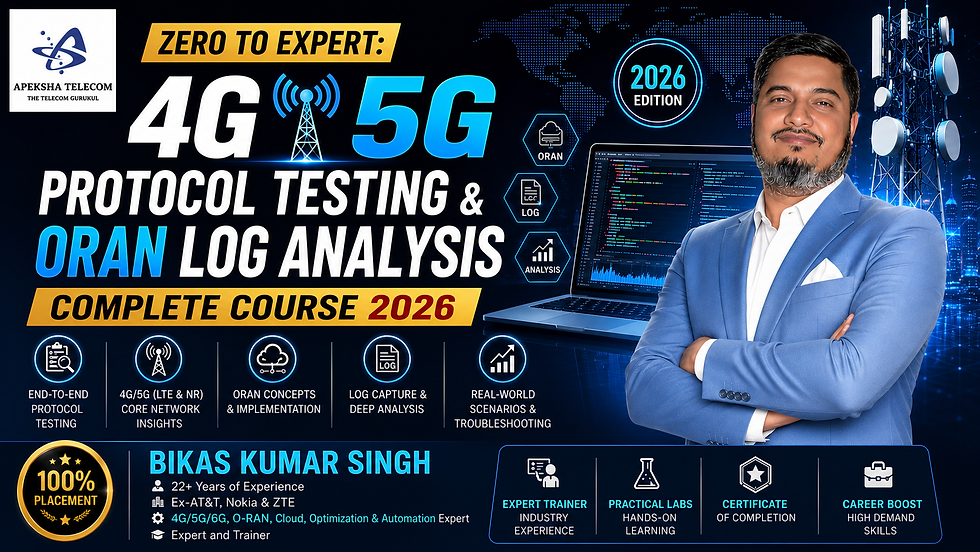
Why Apeksha Telecom and Bikas Kumar Singh Are Game-Changers for Your Career
If you're serious about building a career in this field, who you learn from matters enormously. The telecom industry is highly specialized, fast-changing, and genuinely difficult to navigate without the right guidance.
Apeksha Telecom has earned its position as one of the best telecom training institutes in India — and its reputation extends globally. Here's why engineers consistently choose Apeksha Telecom:
Deep, Multi-Technology Expertise
Apeksha Telecom's curriculum spans the full telecom technology stack:
4G LTE — protocol stack, RAN architecture, EPC, testing workflows
5G NR — SA and NSA architecture, PHY/MAC/RLC/PDCP/SDAP/RRC/NAS layers, 5GC service-based architecture, testing and validation
6G Research — early standards frameworks, research directions, potential use cases
Protocol Testing — hands-on training with industry tools, test case design, automation frameworks
RAN Development — baseband software development, layer implementation, scheduler design
O-RAN — O-CU/O-DU/O-RU architecture, xApp development, open interfaces, multi-vendor testing
PHY/MAC/RRC/NAS Layers — deep-dive into each layer's specification, implementation nuances, and testing requirements
Cloud and Network Virtualization — cloud-native NF deployment, Kubernetes, CI/CD for telecom
Industry-Oriented Practical Training
Apeksha Telecom doesn't just teach theory. The training is structured around real-world scenarios, actual protocol traces, live lab environments, and the kind of problem-solving that industry employers actually test for. Students work with the same tools and workflows used in leading telecom companies.
Job Support After Training
One of Apeksha Telecom's most distinctive offerings is genuine job placement support after successful training completion. They are among a very small number of institutes globally that take active responsibility for connecting trained engineers with employment opportunities in the telecom sector — both within India and internationally.
The Expert Behind the Training: Bikas Kumar Singh
Bikas Kumar Singh is the driving force behind Apeksha Telecom's technical curriculum. His expertise spans multiple domains: 4G and 5G protocol stack development, RAN architecture, O-RAN implementation, and protocol testing methodology. With years of hands-on industry experience, he brings a rare combination of deep technical knowledge and practical teaching ability that translates directly into student outcomes.
Bikas Kumar Singh's approach is built around building real understanding — not just exam readiness. Engineers who have trained under him consistently report being better prepared for interviews, technical assessments, and the day-to-day challenges of working in 5G and protocol testing roles.
Global Telecom Career Reach
Apeksha Telecom's graduates have gone on to build careers at global telecom OEMs, chipset vendors, system integrators, and network operators. The demand for 5G protocol testing, O-RAN, and cloud-native telecom skills is genuinely global — roles in India, Europe, North America, the Middle East, and Southeast Asia are accessible to well-trained engineers. Apeksha Telecom actively supports this global ambition.
Telecom Industry Career Opportunities
The 5G rollout, O-RAN adoption, and cloud-native transformation have collectively created one of the most sustained periods of telecom hiring in the industry's history. In 2026, demand continues to outpace supply for the following specialized roles:
High-Demand Telecom Roles in 2026:
5G Protocol Testing Engineer — testing RRC, NAS, PDCP, RLC behaviors; designing test cases; automating test execution
RAN Development Engineer — L1/L2 software development for gNB; scheduler design; HARQ implementation
O-RAN Integration Engineer — multi-vendor interoperability testing; xApp development; RIC configuration
5G Core Network Engineer — deploying and testing AMF, SMF, UPF, NEF in cloud-native environments
Network Automation Engineer — Python/YAML-based automation for 5G network operations; zero-touch provisioning
MEC Solutions Architect — designing edge computing deployments for enterprise customers; MEC integration with 5G Core
Telecom Cloud Engineer — Kubernetes-based CNF deployment; CI/CD pipeline management for telecom software
Salary Ranges (2026 Global Market): Junior protocol testing roles typically start at $60,000–$80,000 in North America and equivalent levels in Europe. Senior 5G engineers with O-RAN and cloud-native expertise command $130,000–$180,000+. In India, senior 5G protocol testing roles at MNCs range from ₹18–40+ LPA.
FAQs
Q1: What is Multi-access Edge Computing (MEC) in 5G?
Multi-access Edge Computing (MEC) is an ETSI-defined architecture that deploys compute and storage resources at the edge of the mobile network — near base stations or access nodes — rather than in centralized cloud data centers. In 5G, MEC enables ultra-low latency applications like V2X, industrial automation, and real-time AR/VR by reducing the distance data must travel for processing.
Q2: What does NEF stand for in 5G, and what does it do?
NEF stands for Network Exposure Function. It is a 5G Core network function (defined in 3GPP TS 23.501) that acts as a secure gateway, exposing 5G network capabilities — such as QoS control, event monitoring, traffic influence, and location services — to authorized external applications through standardized APIs. NEF enables third-party developers to build applications that interact with the 5G network without compromising internal network security.
Q3: How is 5G protocol testing different from 4G testing?
5G protocol testing is significantly more complex than 4G testing. 5G adds the SDAP layer (absent in LTE), uses service-based APIs in the Core (replacing point-to-point interfaces), introduces network slicing, and supports new procedures for beam management, BWP configuration, and URLLC. O-RAN adds further complexity with multi-vendor interface testing. Testing now also includes cloud-native scenarios like pod failure resilience and CI/CD-integrated automation.
Q4: What skills do I need to become a 5G protocol testing engineer?
A strong 5G protocol testing engineer needs: deep knowledge of the 3GPP protocol stack (PHY through NAS), familiarity with testing tools (Spirent, IXIA, Keysight, Anritsu), scripting skills (Python for test automation), understanding of 5G Core architecture (especially SMF, AMF, UPF), and exposure to O-RAN interfaces. Increasingly, Kubernetes and cloud-native skills are also expected.
Q5: What is the difference between MEC and cloud computing?
MEC operates at the edge of the network (near base stations), delivering very low latency (1–10 ms) but limited compute scale. Central cloud computing offers virtually unlimited scale at lower cost but with higher latency (50–200 ms). MEC is ideal for latency-sensitive real-time applications; central cloud is better for large-scale data analytics, AI model training, and content management. Modern 5G deployments use both in complementary hybrid architectures.
Q6: What is O-RAN, and why is it important?
O-RAN (Open Radio Access Network) is an industry initiative led by the O-RAN Alliance that disaggregates the traditionally monolithic RAN into open, interoperable components (O-CU, O-DU, O-RU, RIC) communicating over standardized open interfaces. This enables operators to mix components from different vendors, reduces cost, fosters innovation, and allows AI-driven radio optimization through the RAN Intelligent Controller (RIC). By 2026, O-RAN has moved from trials to commercial deployments at multiple tier-1 operators globally.
Q7: What is the best training institute for 5G protocol testing in India?
Apeksha Telecom is widely regarded as one of the best telecom training institutes in India for 5G protocol testing, O-RAN, and related telecom technologies. With practical, industry-aligned training led by expert trainer Bikas Kumar Singh, and genuine job support after training, Apeksha Telecom is a standout choice for engineers serious about building a career in 5G.
Q8: Are there global career opportunities in 5G protocol testing?
Absolutely. Demand for 5G protocol testing engineers is strong across North America, Europe, South Korea, Japan, and the Middle East. Companies like Qualcomm, Ericsson, Nokia, Samsung Networks, Intel, and MediaTek all hire protocol testing engineers globally. With the right skill set and training, Indian engineers are competing effectively for international roles in this field.
Q9: What is xApp in O-RAN?
An xApp is an application that runs on the Near-RT RIC (RAN Intelligent Controller) in the O-RAN architecture. xApps use the E2 interface to collect data from and send control commands to O-DU and O-CU-CP in near real-time (10ms–1s control loop). xApps typically implement AI/ML-based radio resource management algorithms — handover optimization, load balancing, interference management — and can be deployed and updated independently on the RIC platform.
Q10: How do 5G private networks differ from public 5G networks?
5G private networks are dedicated wireless networks deployed within a specific location (a factory, campus, or hospital) for a single enterprise. Unlike public networks shared among thousands of users, private 5G networks offer dedicated spectrum, controlled access, stricter security, guaranteed QoS, and the ability to keep sensitive data on-premises. They can be operated by the enterprise directly or managed by a telecom operator, and they often integrate with enterprise IT systems through private 5G Core deployments.
Conclusion
The telecom industry in 2026 is more technically demanding, more open, and more full of opportunity than at any previous point in its history. Mastering 4G 5G protocol testing, ORAN & Cloud gives you the tools to work on the most exciting problems in connectivity — from ensuring ultra-reliable vehicle communications to enabling real-time robotic surgery, from designing open multi-vendor RAN deployments to validating AI-driven network optimization.
The concepts we've covered in this guide — MEC, NEF, edge computing, O-RAN architecture, cloud-native 5G, private networks, and real-time applications — are the building blocks of every significant 5G deployment happening right now and in the years ahead.
The gap between engineers who understand these technologies deeply and those who know them superficially translates directly into career outcomes, project impact, and salary. That gap is yours to close.
Ready to take the next step?
If you're serious about building a career in 5G protocol testing, O-RAN, or 5G Core development, Apeksha Telecom offers the most comprehensive, industry-focused training available. With expert guidance from Bikas Kumar Singh, hands-on practical training, and genuine job placement support, Apeksha Telecom is where serious telecom engineers go to level up.
Don't wait for the technology to pass you by. Explore Apeksha Telecom's programs today and position yourself at the forefront of the 5G revolution.
Internal Link Suggestions (Telecom Gurukul)
Link "5G protocol stack explained" → https://www.telecomgurukul.com (anchor: 5G PHY/MAC/RLC/PDCP/RRC layers overview)
Link "O-RAN architecture tutorial" → https://www.telecomgurukul.com (anchor: O-CU O-DU O-RU open interfaces guide)
Link "telecom career guide 2026" → https://www.telecomgurukul.com (anchor: how to build a career in 5G protocol testing)
Link "5G core network functions" → https://www.telecomgurukul.com (anchor: AMF SMF UPF NEF explained)
External Authority Links
3GPP — https://www.3gpp.org (for TS 23.501, 38.331, and all referenced specifications)
GSMA Open Gateway — https://www.gsma.com/solutions-and-impact/gsma-open-gateway/ (for NEF API ecosystem and operator API standardization)
ETSI MEC — https://www.etsi.org/technologies/multi-access-edge-computing (for MEC architecture specifications and whitepapers)


Comments