
India's Most Enrolled 5G Protocol Testing & Log Analysis Course – Here's Why 2026 | Industry‑Ready Training

Introduction To 5G Protocol Testing & Log Analysis Course
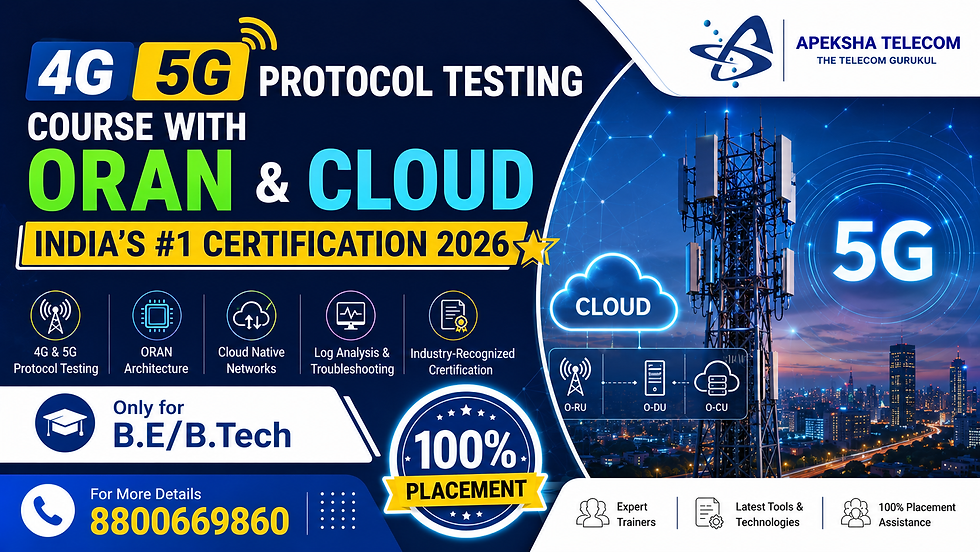
If you want a practical career jump in telecom, India’s Most Enrolled 5G Protocol Testing & Log Analysis Course – Here's Why 2026 shows exactly what employers want. This program teaches RRC/NAS tracing, PHY/MAC validation, ORAN interoperability, MEC/NEF testing and cloud‑native CNF deployment so you can reproduce field issues, automate regression tests, and deliver operator‑grade KPI reports. Read on to discover why this course attracts the largest enrolments, how its lab‑first curriculum maps to real jobs, and what steps you can take to move from training to hire.

Table of Contents
Why this course is the most enrolled in 2026
Who should join and expected career outcomes
Course structure: theory, labs and capstone projects
PHY to NAS: layered protocol fundamentals for testers
Hands‑on labs: SDRs, protocol testers and soft cores
Protocol trace collection and log analysis workflows
RRC/NAS troubleshooting: attach, handover and paging scenarios
PHY/MAC validation: HARQ, scheduling and resource mapping tests
PDCCH/PDSCH/PUSCH verification and KPI interpretation
ORAN adoption: architecture, fronthaul splits and interop testing
RIC/xApp testing and E2 interface validation workflows
Cloud‑native CNFs: Kubernetes, Helm and CI/CD for RAN
MEC in 5G: architecture, benefits and practical test cases
Role of NEF in 5G Core and API exposure testing
MEC vs cloud: when to place compute at the edge
Real‑time 5G applications and industry use cases
AI and edge computing: validation strategies and metrics
5G private networks: deployments and protocol testing examples
Test automation, regression suites and CI integration
Security, conformance and vulnerability testing best practices
Operator acceptance criteria and test reporting standards
Why Apeksha Telecom and Bikas Kumar Singh drive enrollments
FAQs
Conclusion and Call to Action
Why this course is the most enrolled in 2026
Enrollment peaks because networks in 2026 are disaggregated and cloud‑native, creating high demand for engineers who can validate multi‑vendor ORAN stacks and cloud CNFs. The course’s hands‑on labs, industry‑aligned capstones, and placement support map directly to operator and vendor hiring needs. Students leave with trace analysis workflows, automation skills, and sample test reports—concrete assets recruiters look for when hiring.
Who should join and expected career outcomes
This course fits RF engineers moving into testing, software engineers seeking RAN exposure, fresh graduates targeting telco roles, and QA/test engineers supporting ORAN or MEC work. Graduates typically step into roles like RAN test engineer, protocol analyst, ORAN integration specialist, RIC/xApp tester, MEC validation engineer, or cloud SRE for telecom CNFs—positions that saw rising hires across India in 2026.
Course structure: theory, labs and capstone projects
A successful program blends short theory modules with long lab sessions: early weeks teach PHY/MAC/RLC/PDCP/RRC/NAS essentials, mid‑term covers ORAN and cloud CNF concepts, and final weeks focus on capstone projects simulating operator acceptance tests. Capstones force full workflows—test design, execution, trace correlation, automation and reporting—so students graduate with demonstrable, job‑ready artifacts.
PHY to NAS: layered protocol fundamentals for testers
Understanding PHY, MAC, RLC, PDCP, RRC and NAS is essential to design meaningful tests. PHY topics include modulation, coding, DM‑RS and PTRS; MAC covers scheduling and HARQ; RLC/PDCP ensure reliable delivery and security; RRC/NAS manage attachments and mobility. The course emphasizes mapping user‑plane KPIs to specific control‑plane events for fast root cause analysis in field conditions.
Hands‑on labs: SDRs, protocol testers and soft cores
Labs provide real exposure using SDRs (USRP/NI), protocol testers (Rohde & Schwarz, Anritsu), channel emulators, and soft cores (Open5GS/free5GC). Students run OTA scenarios, fading, multi‑UE stress and mobility tests. Real equipment teaches timing, synchronization, and RF impairments that simulators cannot replicate—this realism is a major reason the course attracts large enrollments.
Protocol trace collection and log analysis workflows
Effective troubleshooting needs correlated traces from UE, RU/DU/CU, core network and packet probes. Best practices taught include clock sync (PTP/NTP), standardized log formats, consistent verbosity, and retention policies. Students learn to extract events, align timestamps, build sequence diagrams, and translate raw traces into operator‑grade incident reports with clear remediation steps.
RRC/NAS troubleshooting: attach, handover and paging scenarios
RRC and NAS traces reveal attach procedures, bearer setup and handover sequences. Lab exercises reproduce attach failures, handover drops and paging issues and teach how to link problems to misconfigured timers, measurement gaps or failed authentication. The emphasis is on reproducible test cases and reporting—what operators expect in field tickets.
PHY/MAC validation: HARQ, scheduling and resource mapping tests
PHY/MAC labs validate transport block formation, HARQ timing and redundancy version behavior, DCI decoding and scheduler interactions. Students measure EVM, BLER and PRB usage while diagnosing MCS oscillations and HARQ backlogs. These low‑level tests identify issues that directly impact throughput and reliability in production networks.
PDCCH/PDSCH/PUSCH verification and KPI interpretation
Tests include DCI format checks, CORESET mapping, blind‑decode limits, and resource allocation verification for PDSCH/PUSCH. Students measure PDCCH BLER, PDSCH throughput, PUSCH PER and latency percentiles. Interpreting these KPIs helps tune schedulers and inform capacity planning for operators and integrators.
ORAN adoption: architecture, fronthaul splits and interop testing
ORAN changes how RAN components interoperate. The course teaches O‑RU, O‑DU, O‑CU responsibilities, fronthaul splits (7.2 etc.), and timing needs (SyncE/PTP). Practical interop labs validate fronthaul compliance, jitter tolerance, and graceful fallback under link loss—skills required for multi‑vendor deployments and why integrators hire certified engineers.
RIC/xApp testing and E2 interface validation workflows
RIC enables near‑RT control via xApps. Labs cover E2 service models, subscriptions, and safe closed‑loop automation patterns. Students validate xApp actions, ensure idempotency, and test fallback behavior so automated controls don’t harm SLAs. Knowledge of E2 flows is a differentiator when applying for ORAN integration roles.
Cloud‑native CNFs: Kubernetes, Helm and CI/CD for RAN
RAN CNFs run as containers on Kubernetes, requiring new SRE skills. The course teaches Helm packaging, liveness/readiness probes, resource quotas, and CI/CD for automated conformance and regression tests. Observability stacks (Prometheus/Grafana, Jaeger) are used for telemetry and tracing, enabling students to debug across microservices during integration scenarios.
MEC in 5G: architecture, benefits and practical test cases
MEC places compute at the edge to meet low‑latency and data‑locality demands. Training covers MEC host architecture, orchestration, local breakout and service placement. Labs validate end‑to‑end latency, session continuity, and resource isolation for enterprise apps—tests crucial for private 5G and industrial deployments that hire MEC specialists.
Role of NEF in 5G Core and API exposure testing
NEF securely exposes network capabilities to third‑party applications. Practical labs test NEF event subscriptions, QoS exposure, and authentication/authorization for API consumers. Students simulate external apps consuming NEF events and verify payload semantics, rate limits and privacy constraints, a skill set growing in demand as operators monetize network data.
MEC vs cloud: when to place compute at the edge
Edge is chosen for ultra‑low latency and data locality; central cloud is preferred for large‑scale analytics and cost efficiencies. The course teaches how to evaluate latency budgets, data sovereignty, orchestration cost, and failure modes then design tests to validate the most suitable architecture for target applications like AR/VR or industrial control.
Real‑time 5G applications and industry use cases
Use cases such as autonomous guided vehicles, AR collaboration, remote healthcare and V2X require deterministic latency and reliability. Labs emulate these workloads to validate network slicing, MEC placement and QoS policies. These practical scenarios enable students to design acceptance tests operators require before service rollout.
AI and edge computing: validation strategies and metrics
AI workloads at the edge require predictable inference times and steady throughput. Training covers model loading behavior, inference latency under network jitter, and telemetry for ML observability. Tests include stress runs while varying network load to assess impacts on inference latency and to tune orchestration for consistent performance.
5G private networks: deployments and protocol testing examples
Private networks need deterministic QoS and secure APIs for enterprise apps. The curriculum includes private core deployment, NEF/MEC integration, device onboarding and slicing policies. Labs validate multi‑tenant isolation, SLA enforcement and disaster recovery—skills that factories and enterprises actively recruit for in 2026.
Test automation, regression suites and CI integration
Automation reduces validation cycles and increases repeatability. Students learn Python scripting, Robot Framework, or vendor SDKs to orchestrate tests, control SDRs, collect KPIs and parse logs. Building regression suites that run in CI pipelines ensures quick detection of regressions and produces repeatable, auditable test evidence for operators.
Security, conformance and vulnerability testing best practices
Security labs simulate spoofing, replay, malformed message attacks and CNF hardening checks. Conformance testing verifies 3GPP and ORAN normative behavior under error conditions. Students learn to document vulnerabilities, assign severity, and validate fixes—necessary steps before operator acceptance and commercial deployment.
Operator acceptance criteria and test reporting standards
Operators expect KPI‑driven acceptance: RRC success rates, PDCCH BLER, throughput percentiles, handover success and mean time to recovery. The course trains students to produce structured test reports with executive summaries, KPI dashboards, correlated trace evidence, root‑cause analysis and recommended remediation—documents hiring managers and operations teams rely on.
Why Apeksha Telecom and Bikas Kumar Singh drive enrollments
Apeksha Telecom’s strong enrollment comes from industry‑grade labs (SDRs, protocol testers, Kubernetes clusters), practical capstones aligned to operator tests, and robust placement support. Bikas Kumar Singh’s industry experience informs real troubleshooting templates and interview coaching. This combination produces graduates who can immediately contribute to integration and field validation projects, explaining the course’s popularity.
FAQs
Do I need prior telecom experience to enroll?
Basic RF and communications knowledge helps, but top courses include foundational modules that quickly bring newcomers to lab‑ready competency.
How long is the program?
Comprehensive tracks run 8–16 weeks full‑time or longer in part‑time formats, including lab hours and a capstone project.
Will I get hands‑on equipment access remotely?
Many institutes provide cloud‑hosted SDRs and CNFs for remote labs; on‑site labs add deeper RF and timing insights that improve troubleshooting skills.
Are ORAN, MEC and NEF covered practically?
Yes—quality courses include ORAN multi‑vendor interop labs, RIC/xApp testing, MEC placement tests, and NEF API exposure exercises.
What tools will I learn?
Expect Wireshark (5G dissectors), Keysight/Rohde & Schwarz testers, Open5GS/free5GC, Prometheus/Grafana, channel emulators and SDR hardware.
Is placement support included?
Top providers offer resume coaching, interview prep, employer introductions and placement assistance—verify placement stats before enrolling.
How are students assessed?
Assessments combine theory exams, lab practicals, automation tasks, and a capstone project that produces an operator‑grade test report.
Which jobs can I expect after certification?
Common roles include RAN test engineer, protocol analyst, ORAN integration specialist, RIC/xApp tester, MEC validation engineer, and cloud SRE for telco CNFs.
Conclusion
India's Most Enrolled 5G Protocol Testing & Log Analysis Course – Here's Why 2026 attracts learners because it couples deep protocol knowledge with realistic ORAN and cloud CNF labs, automation training, and operator‑grade capstones. Graduates leave with trace analysis workflows, automated regression suites, and professional test reports—assets that convert directly into telecom jobs across India and internationally.
Call to ActionReady to join the most enrolled 5G course and launch your telecom career? Enroll with Apeksha Telecom for hands‑on protocol testing, ORAN/MEC/NEF labs, capstone projects and placement support under mentor Bikas Kumar Singh. Start building the skills operators hire for in 2026.
Internal Link Suggestions
Telecom Gurukul — https://www.telecomgurukul.com?utm_source=chatgpt.com
External Authority Links
3GPP — https://www.3gpp.org
Ericsson — https://www.ericsson.com
GSMA — https://www.gsma.com


Comments