
India's Top 5G Telecom Certification: Protocol Testing & Log Analysis with ORAN 2026 | Industry-Ready Training

Introduction To 5G Telecom Certification
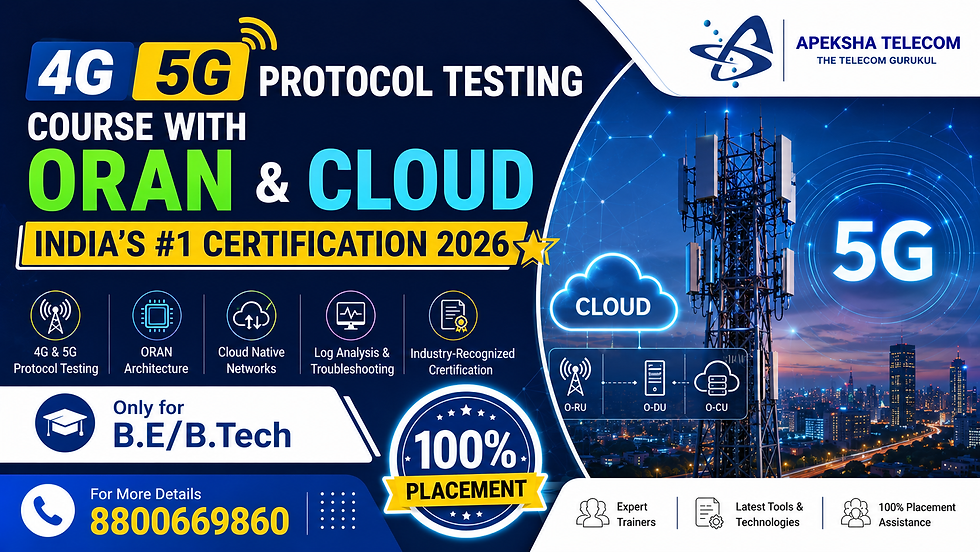
If you’re serious about a telecom career in 2026, the right certification must teach protocol testing, log analysis, ORAN interoperability and cloud‑native practices that employers trust. India’s Top 5G Telecom Certification: Protocol Testing & Log Analysis with ORAN 2026 focuses on layered protocol skills (PHY/MAC/RLC/PDCP/RRC/NAS), practical SDR and protocol‑tester labs, ORAN RIC/xApp validation, MEC/NEF edge testing, and CNF deployment on Kubernetes. This article explains the full curriculum, lab set‑ups, real‑world use cases, career pathways, and why hands‑on certification is the best bridge from study to operator‑grade jobs.

Table of Contents
Why this certification matters in 2026
Who should enroll and expected outcomes
Curriculum overview: layered protocols to ORAN and cloud
Lab infrastructure: SDRs, protocol testers and soft cores
PHY to NAS: core protocol concepts for testers
Protocol trace collection and log analysis workflows
RRC/NAS troubleshooting: attach, handover and paging cases
PHY/MAC validation: HARQ, scheduling and resource mapping tests
PDCCH/PDSCH/PUSCH verification and KPI interpretation
ORAN architecture and fronthaul split testing essentials
RIC/xApp testing and E2 interface validation
Cloud‑native RAN: CNFs, Kubernetes, Helm and CI/CD pipelines
MEC in 5G: architecture, benefits and practical tests
Role of NEF in 5G Core and exposure API validation
MEC vs cloud computing: when to place compute at edge
Real‑time 5G applications and protocol testing scenarios
AI at the Edge: performance checks and telemetry needs
5G private networks: deployment and testing use cases
Future of MEC and NEF in 2026 and beyond
Test automation, regression suites and test orchestration
Security, conformance and vulnerability checks
Operator acceptance criteria and professional test reporting
Career paths and industry opportunities for certified engineers
Why Apeksha Telecom and Bikas Kumar Singh matter for your career
FAQs
Conclusion and call to action
Why this certification matters in 2026
By 2026, networks are disaggregated and cloud‑native, with ORAN and MEC adoption accelerating. This increases integration complexity and raises the bar for hands‑on testing skills. The certification proves you can decode RRC/NAS traces, correlate logs across UE/gNB/core, validate ORAN E2 behaviors and deploy CNFs—skills operators and integrators need to maintain robust, scalable networks and reduce time‑to‑repair.
Who should enroll and expected outcomes
Ideal candidates include RF engineers moving into testing, software developers seeking RAN exposure, fresh graduates targeting telco roles, and test engineers who must validate multi‑vendor integrations. After completing the course you will design test cases, run lab validations with SDRs and protocol testers, automate regression suites in CI, and produce operator‑grade KPI reports—evidence that hiring managers value.
Curriculum overview: layered protocols to ORAN and cloud
The curriculum begins with PHY fundamentals—modulation, coding, reference signals—and progresses through MAC, RLC, PDCP, RRC and NAS procedures. Advanced modules cover PDCCH/PDSCH/PUSCH interactions, ORAN architecture, RIC/xApp validation, MEC/NEF testing, and cloud CNF deployment on Kubernetes with observability and CI/CD. Capstone projects simulate operator acceptance tests.
Lab infrastructure: SDRs, protocol testers and soft cores
Hands‑on labs use SDR hardware (USRP/NI/Keysight), protocol testers (Rohde & Schwarz/Anritsu), channel emulators, and soft core networks (Open5GS/free5GC). ORAN testbeds include CU/DU stacks and fronthaul emulation. These setups let students reproduce fading, Doppler, timing offsets and multi‑vendor interop issues that theoretical study cannot reproduce.
PHY to NAS: core protocol concepts for testers
Testers must understand how PHY provides modulation, coding and reference signals, and how MAC schedules grants and handles HARQ. RLC/PDCP provide segmentation, reordering and security, while RRC/NAS manage control‑plane signaling and mobility. Knowing interactions between layers helps you map a KPI drop to a specific protocol event or RF impairment.
Protocol trace collection and log analysis workflows
Root‑cause analysis needs traces from UE modems, RU/DU/CU logs, core network traces, packet probes and OSS KPI feeds. Best practices include synchronized clocks (PTP/NTP/TSN), consistent log levels and structured retention. The course teaches workflows to extract events, align timestamps, build sequence diagrams and produce reproducible incident reports.
RRC/NAS troubleshooting: attach, handover and paging cases
RRC and NAS traces show attach/authentication flows, bearer setups, measurement reports and handovers. Labs recreate attach failures, handover drops and paging anomalies and teach how to map these to timers, measurement gaps, or faulty RRC reconfiguration—turning raw traces into clear remediation steps for operators.
PHY/MAC validation: HARQ, scheduling and resource mapping tests
PHY/MAC labs validate HARQ timing, redundancy version sequences, DM‑RS/PTRS usage, and scheduler decisions under varied load. Students measure EVM, BLER, and CCE utilization while reproducing corner cases such as MCS oscillation or HARQ backlog—real faults that can drastically reduce throughput in production networks.
PDCCH/PDSCH/PUSCH verification and KPI interpretation
Validating control and data plane channels requires DCI verification, CORESET mapping checks, and PDSCH/PUSCH resource accuracy. You’ll measure PDCCH BLER, PDSCH throughput, PUSCH PER and latency percentiles and learn to interpret these KPIs to guide scheduler tuning, PRB allocation and link‑budget adjustments.
ORAN architecture and fronthaul split testing essentials
ORAN disaggregates RU/DU/CU functions with fronthaul splits (e.g., 7.2) that affect processing distribution and latency budgets. The course covers timing requirements (PTP/SyncE), fronthaul transport characteristics, and test cases for jitter tolerance, packet loss, and graceful fallback—crucial for multi‑vendor interop in live deployments.
RIC/xApp testing and E2 interface validation
RIC enables near‑real‑time control through xApps that subscribe to events and issue actions. Labs validate E2 service models, subscription flows, and closed‑loop automation while ensuring safe fallbacks. Students learn to stress xApps, verify action idempotency, and ensure RIC decisions don’t violate SLAs in real networks.
Cloud‑native RAN: CNFs, Kubernetes, Helm and CI/CD pipelines
Modern RAN runs as CNFs on Kubernetes; testers must package CNFs with Helm, configure probes and limits, and run CI/CD to automate validation. The course teaches deployment patterns, liveness/readiness checks, autoscaling strategies, and observability using Prometheus, Grafana and Jaeger to pinpoint failures across distributed services.
MEC in 5G: architecture, benefits and practical tests
MEC brings compute close to users to meet strict latency and privacy needs. Training explains MEC host architecture, local breakout, orchestration and service placement. Hands‑on labs validate latency budgets, session continuity when a UE moves, and resource isolation, ensuring MEC apps meet enterprise SLAs.
Role of NEF in 5G Core and exposure API validation
NEF exposes network capabilities to third parties via secure APIs. You’ll validate NEF for event subscription accuracy, QoS exposure, and authentication/authorization. Practical exercises include testing rate limits, verifying payload semantics, and simulating external applications consuming NEF events to ensure secure, reliable behavior.
MEC vs cloud computing: when to place compute at edge
Edge is best for ultra‑low latency, privacy and reduced backhaul, while central cloud gives scale and cost efficiency. The course teaches criteria to choose between edge and central deployment—latency budgets, data locality, orchestration cost—and provides test plans that validate chosen architectures under real application loads.
Real‑time 5G applications and protocol testing scenarios
Applications like industrial automation, AR/VR, remote healthcare and V2X demand deterministic latency and reliability. Labs emulate such workloads to validate slicing, MEC placement and QoS enforcement. Test cases include tail‑latency percentiles, jitter measurements, and failover scenarios to ensure application continuity under stress.
AI at the Edge: performance checks and telemetry needs
AI inference at edge requires predictable latency and consistent throughput. Students learn to validate model loading, runtime resource contention, and how network jitter affects inference times. Tests include telemetry capture for model performance, stress scenarios and orchestration tuning to maintain SLA under varying loads.
5G private networks: deployment and testing use cases
Private 5G networks for factories and campuses demand isolation, predictable QoS and secure APIs. Training covers local core deployment, NEF/MEC integration for enterprise apps, and tests for device onboarding, slicing and multi‑tenant isolation. Labs validate SLA enforcement and disaster recovery for enterprise environments.
Future of MEC and NEF in 2026 and beyond
In 2026 MEC and NEF are increasingly automated, with richer APIs and AI‑driven orchestration. Testers will validate automated policy updates, cross‑cloud failover, and telemetry‑driven placement decisions. The course prepares engineers for these trends by teaching both current standards and how to test evolving operator toolchains.
Test automation, regression suites and test orchestration
Automation reduces validation cycles and improves repeatability. The program teaches Python scripting, Robot Framework, or vendor SDKs to control SDRs, orchestrate testbeds, collect KPIs and parse logs. You’ll build regression suites that run in CI and produce reproducible defect tickets for tracking and remediation.
Security, conformance and vulnerability checks
Security modules simulate spoofing, replay, malformed messages and CNF hardening tests. Students learn to run conformance tests against 3GPP and ORAN normative clauses, document vulnerabilities, prioritize fixes and validate remediation in follow‑up runs—ensuring vendor fixes meet operator acceptance.
Operator acceptance criteria and professional test reporting
Operators expect KPI‑driven acceptance: RRC success rates, PDCCH BLER, throughput percentiles, handover success and mean time to recovery. The course teaches how to structure reports with executive summaries, KPI dashboards, trace evidence, root‑cause analysis and remediation recommendations that decision makers can act on.
Career paths and industry opportunities for certified engineers
Certified engineers are qualified for roles such as RAN test engineer, ORAN integration specialist, RIC/xApp tester, MEC/NEF validation engineer and cloud SRE for telco CNFs. With capstone projects and operator‑grade reports, graduates are more likely to land positions at operators, RAN vendors, system integrators and independent test houses in India and globally.
Why Apeksha Telecom and Bikas Kumar Singh matter for your career
Apeksha Telecom provides industry‑grade labs—SDRs, protocol testers, Kubernetes clusters—and a curriculum aligned to real operator acceptance tests. Their hands‑on capstones simulate integration scenarios and placement support helps graduates convert skills into jobs. Bikas Kumar Singh brings deep field experience and hiring insights that speed the transition from training to employment.
FAQs
Do I need prior telecom experience to enroll?
Basic RF and digital communications knowledge helps, but courses include foundational modules to bring newcomers to lab‑ready competency quickly.
How long is the certification program?
Most comprehensive programs run 8–16 weeks full‑time, or longer in part‑time modes, with lab hours and a capstone project.
Will I get remote access to labs?
Many providers offer cloud‑hosted SDRs and CNFs for remote practice; however, on‑site labs give deeper RF and timing learning that enhances troubleshooting skills.
Are MEC and NEF included practically?
Yes—quality courses include MEC placement tests, NEF API exposure labs, and end‑to‑end enterprise use‑case validation for production relevance.
What tools will I learn?
Expect Wireshark (5G dissectors), Keysight/Rohde & Schwarz testers, Open5GS/free5GC, Prometheus/Grafana, channel emulators and SDR hardware.
Is ORAN multi‑vendor interop part of the training?
Top programs include multi‑vendor ORAN interop labs, E2/RIC testing and fronthaul split validation to mirror field integration projects.
Does the course offer placement support?
Leading institutes provide resume coaching, interview prep, employer introductions and placement assistance—check their placement records before enrolling.
How are students assessed?
Assessments combine theory exams, lab practicals, automation tasks and a capstone project that results in an operator‑grade test report.
Conclusion
India's Top 5G Telecom Certification: Protocol Testing & Log Analysis with ORAN 2026 delivers practical, cross‑layer skills operators need today: protocol tracing, ORAN/RIC validation, MEC/NEF testing, cloud CNF automation and professional test reporting. Hands‑on labs, automation experience, and capstone projects turn learners into practitioners who can reduce integration risk and accelerate rollouts—making certified engineers highly employable in 2026 and beyond.
Call to ActionReady to transform your telecom career? Enroll in Apeksha Telecom’s certification for hands‑on ORAN and cloud‑ready 5G protocol testing, log analysis and placement support. Gain practical skills, capstone projects, and mentorship from industry experts like Bikas Kumar Singh to launch your career in 2026.
Internal Link Suggestions
Telecom Gurukul — https://www.telecomgurukul.com?utm_source=chatgpt.com
External Authority Links
3GPP — https://www.3gpp.org
ORAN Alliance — https://www.o-ran.org
ETSI MEC — https://www.etsi.org/committee/1567-mec


Comments