
O-RAN Certification 2026: Complete Guide to Open RAN Architecture, RIC & 5G Networks

Introduction
The global telecommunications industry is undergoing a monumental paradigm shift. For decades, mobile network operators (MNOs) were bound to proprietary, single-vendor stacks where hardware and software were tightly coupled. If an operator deployed a specific vendor’s baseband unit, they were forced to use that same vendor’s radio units. This vendor lock-in restricted innovation, increased capital expenditure (CAPEX), and slowed down the deployment of bespoke enterprise services.
Enter the Open Radio Access Network (Open RAN) movement, championed by the O-RAN Alliance. By disaggregating the RAN into standardized, open, and interoperable components, Open RAN allows operators to mix and match hardware and software from different providers. At the center of this evolution is the O-RAN Certification 2026: Complete Guide to Open RAN Architecture, RIC & 5G Networks, which serves as the industry standard for validating multi-vendor interoperability, conformance, and performance.
As we navigate through 2026, the implementation of Open RAN has shifted from experimental lab trials to massive, nationwide commercial rollouts. Multi-vendor integration brings undeniable complexity, making formal certification protocols non-negotiable for telecom professionals and operators alike. This comprehensive guide provides a deep dive into the architecture, interfaces, intelligence layers, and the critical role of edge frameworks like Multi-access Edge Computing (MEC) and Network Exposure Functions (NEF) in modern 5G networks.
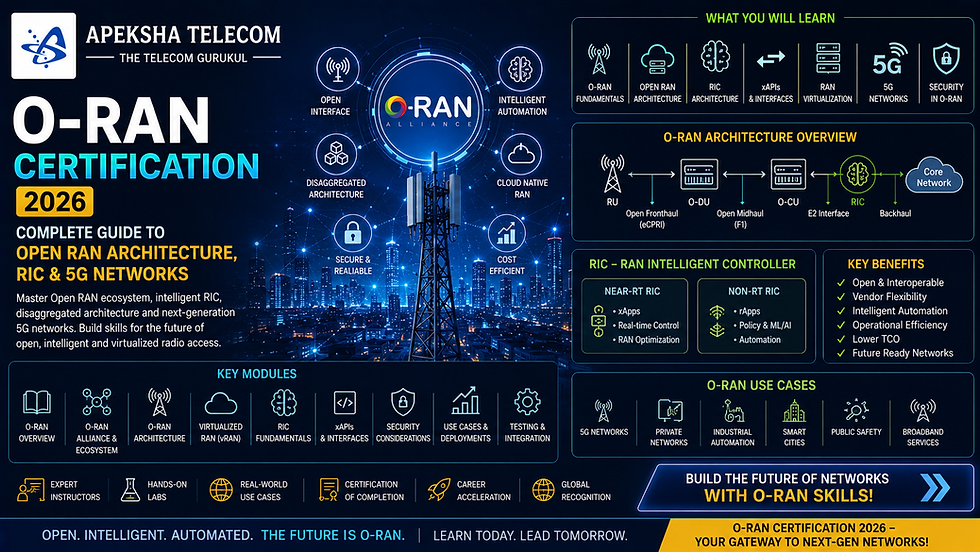
Table of Contents
Understanding Open RAN Disaggregation & Architecture
The RAN Intelligent Controller (RIC): Non-RT and Near-RT Drivers
What is MEC in 5G? Core Concepts and Evolution
MEC Architecture and Reference Points
Benefits of Edge Computing in Modern Telecom Networks
MEC vs Cloud Computing: A Detailed Architectural Comparison
Role of NEF in 5G Core (5GC)
NEF APIs and Network Exposure Functions
Real-Time 5G Applications Driven by O-RAN and Edge Infrastructure
AI and Edge Computing: Driving Network Autonomy
5G Private Networks for Industry 4.0
Future of MEC and NEF in 2026 and Beyond
Telecom Industry Career Opportunities & Technical Upskilling
Why Apeksha Telecom and Bikas Kumar Singh Are Critical for Your Career
Frequently Asked Questions (FAQs)
Conclusion & Actionable Next Steps
1. Understanding Open RAN Disaggregation & Architecture
The legacy Radio Access Network is traditionally split into a Baseband Unit (BBU) and a Remote Radio Head (RRH). In the O-RAN Alliance framework, this BBU is completely disaggregated into three logical and physical entities: the Central Unit (CU), the Distributed Unit (DU), and the Radio Unit (RU). This functional split is mathematically optimized under the 3GPP Release 15/16/17 standards to balance bandwidth, latency, and transport network costs.
+-----------------------------------------------------------+
|                       5G Core (5GC)                       |
+-----------------------------------------------------------+
                              |
                              | F1-C / F1-U Interface
                              v
+-----------------------------------------------------------+
|                 O-CU (Open Central Unit)                  |
|     [O-CU-CP (Control Plane) & O-CU-UP (User Plane)]      |
+-----------------------------------------------------------+
                              |
                              | F1 Interface
                              v
+-----------------------------------------------------------+
|                O-DU (Open Distributed Unit)               |
+-----------------------------------------------------------+
                              |
                              | Open FrontHaul (7.2x Split)
                              v
+-----------------------------------------------------------+
|                    O-RU (Open Radio Unit)                 |
+-----------------------------------------------------------+
The Functional Splits
O-CU (Open Central Unit): Handles the non-real-time protocols such as the Radio Resource Control (RRC) and Packet Data Convergence Protocol (PDCP) layers. The CU is further split into the O-CU Control Plane (O-CU-CP) and O-CU User Plane (O-CU-UP) using the E1 interface, enabling independent scaling of signaling and data throughput.
O-DU (Open Distributed Unit): Manages real-time protocol layers including the Radio Link Control (RLC), Medium Access Control (MAC), and the High-Physical (High-PHY) layer. The O-DU requires precise clock synchronization (PTP IEEE 1588v2) and is typically deployed closer to the cell site or in a centralized edge data center.
O-RU (Open Radio Unit): Processes the Low-Physical (Low-PHY) layer functions, Digital Front End (DFE), RF up/down conversion, amplification, and beamforming.
The breakthrough in Open RAN lies in the standardized open interfaces connecting these components. The Open Fronthaul Interface (specifically the 7.2x functional split defined by the O-RAN Alliance) bridges the gap between the O-DU and O-RU. By establishing a clear separation of user, control, synchronization, and management planes (U, C, S, M-Planes), operators can deploy an O-DU from Vendor A that communicates flawlessly with an O-RU from Vendor B. Ensuring this flawless communication is why achieving a verified O-RAN Certification 2026: Complete Guide to Open RAN Architecture, RIC & 5G Networks capability has become an industry baseline for equipment vendors in 2026.
2. The RAN Intelligent Controller (RIC): Non-RT and Near-RT Drivers
One of the most innovative aspects of the O-RAN architecture is the introduction of native intelligence through the RAN Intelligent Controller (RIC). The RIC brings programmability, automation, and mathematical optimization to the radio network, transforming it from a static system into a dynamic, AI-driven infrastructure.
+-----------------------------------------------------------+
|            Non-Real-Time RIC (Service Management)         |
|              [rApps - Policy & Orchestration]             |
+-----------------------------------------------------------+
                              |
                              | A1 Interface (Policies & AI Models)
                              v
+-----------------------------------------------------------+
|                 Near-Real-Time RIC                        |
|             [xApps - E2 Node Control & RRM]               |
+-----------------------------------------------------------+
                              |
                              | E2 Interface (KPIs & Control)
                              v
+-----------------------------------------------------------+
|             E2 Nodes (O-CU-CP, O-CU-UP, O-DU)             |
+-----------------------------------------------------------+
The Non-Real-Time RIC (Non-RT RIC)
The Non-RT RIC is hosted within the Service Management and Orchestration (SMO) framework. It operates on time loops greater than 1 second. It leverages specialized microservices called rApps to perform high-level tasks such as long-term network configuration, machine learning model training, and policy generation. The Non-RT RIC communicates these strategic insights down to the lower layers via the standardized A1 interface.
The Near-Real-Time RIC (Near-RT RIC)
Operating on execution loops between 10 milliseconds and 1 second, the Near-RT RIC executes real-time radio resource management (RRM) actions. It hosts xApps, pluggable software applications that collect granular, per-UE (User Equipment) telemetry data over the E2 interface from the O-CU and O-DU. Typical xApp functionalities include:
Dynamic Spectrum Sharing (DSS) Optimization: Instantly adjusting spectrum allocation between 4G and 5G based on localized traffic demands.
Traffic Steering: Intelligently routing user data across multi-carrier layers to maximize spectral efficiency and minimize congestion.
Anomalous Interference Mitigation: Using machine learning to identify and nullify localized RF interference patterns.
By decoupling the control logic from the underlying network infrastructure, the RIC allows third-party developers to write optimization algorithms that run directly on an operator’s network. This open ecosystem is a major paradigm shift for telecom architecture in 2026, driving down operational expenditures (OPEX) through closed-loop automation.
3. What is MEC in 5G? Core Concepts and Evolution
To understand how Open RAN reaches its full performance potential, one must explore Multi-access Edge Computing (MEC). So, what is MEC in 5G? At its core, MEC is an architectural framework defined by the European Telecommunications Standards Institute (ETSI) that brings cloud computing capabilities, storage, and IT service environments directly to the edge of the cellular network.
Traditionally, user data packets had to traverse backhaul links, regional aggregation hubs, and the central packet core before reaching application servers hosted in public or private clouds. This long journey introduced latency, consumed backhaul bandwidth, and raised security vulnerabilities for sensitive corporate data.
MEC changes this by placing computational infrastructure in close proximity to the end user—whether at the macro cell site, an aggregation point, or within an enterprise's private facility. By processing data locally, MEC reduces round-trip times (RTT) to single-digit milliseconds, enabling a new class of deterministic, real-time applications that were impossible under legacy 4G networks.
4. MEC Architecture and Reference Points
The ETSI MEC framework outlines a highly structured, modular architecture designed to integrate seamlessly with the 3GPP 5G Core network. It separates the framework into two distinct functional levels: the MEC system level and the MEC host level.
+-----------------------------------------------------------------------------------+
|                                MEC SYSTEM LEVEL                                   |
|   +---------------------------------------------------------------------------+   |
|   |                     Multi-access Edge Orchestrator (MEO)                  |   |
|   +---------------------------------------------------------------------------+   |
+-----------------------------------------|-----------------------------------------+
                                          | Mm1 Interface
                                          v
+-----------------------------------------------------------------------------------+
|                                 MEC HOST LEVEL                                    |
|   +---------------------------------------------------------------------------+   |
|   |                      MEC Platform Manager (MEPM)                          |   |
|   +---------------------------------------------------------------------------+   |
|                                         | Mm3 Interface                           |
|                                         v                                         |
|   +---------------------------------------------------------------------------+   |
|   |                              MEC Host                                     |   |
|   |   +-------------------------------------------------------------------+   |   |
|   |   |                         MEC Platform (MEP)                        |   |   |
|   |   +-------------------------------------------------------------------+   |   |
|   |   |        MEC App 1       |        MEC App 2       |    MEC App N    |   |   |
|   |   +-------------------------------------------------------------------+   |   |
|   |   |                Virtualization Infrastructure (NFVI)               |   |   |
|   |   +-------------------------------------------------------------------+   |   |
|   +---------------------------------------------------------------------------+   |
+-----------------------------------------------------------------------------------+
Key Elements of the MEC Architecture
MEC Host: This includes the Virtualization Infrastructure (compute, storage, networking) and the MEC Platform (MEP). The MEP is the core middleware that offers essential services to edge applications, such as radio network information, location details, and traffic steering control.
MEC Applications (Apps): Virtualized applications running as Virtual Machines (VMs) or containerized microservices (Kubernetes pods) on top of the edge infrastructure.
Multi-access Edge Orchestrator (MEO): The master mind at the system level that maintains an overview of the entire edge network, enforces policies, selects appropriate MEC hosts based on latency constraints, and triggers application instantiation.
Standardized Reference Points
Mp1: Connects MEC applications to the MEC Platform, allowing applications to discover and consume edge services.
Mm1: Bridges the MEO and the MEC Platform Manager (MEPM), ensuring clean lifecycle management operations.
Mx2: Connects the customer facing portal to the system level manager to request application placement.
This modularity allows edge computing nodes to run directly alongside distributed Open RAN components, such as a co-located O-DU and MEC server at an enterprise site, creating a hyper-localized, ultra-reliable processing environment.
5. Benefits of Edge Computing in Modern Telecom Networks
Integrating edge computing into modern 5G and O-RAN infrastructures provides critical advantages across multiple operational vectors:
Ultra-Low Latency: By removing routing hops across core networks, edge computing drops processing delays from 50–100ms down to less than 5ms. This is essential for closed-loop industrial control systems and autonomous driving algorithms.
Backhaul Bandwidth Optimization: High-definition video surveillance feeds, IoT telemetry, and raw spatial data can be pre-processed and filtered at the edge. Only compressed insights or critical alerts are sent to the central cloud, preventing core transport congestion.
Enhanced Security and Sovereignty: Industries like healthcare, finance, and defense require strict data localization. Edge computing allows confidential information to be kept entirely within physical corporate boundaries, satisfying GDPR, HIPAA, and localized compliance rules.
Resiliency and Local Survivability: If the backhaul link to the central cloud or primary core network fails, an edge-enabled site can continue operating autonomously, maintaining critical local services without interruption.
6. MEC vs Cloud Computing: A Detailed Architectural Comparison
To clearly understand where to deploy specific workloads, engineers must analyze the structural differences between traditional centralized cloud paradigms and multi-access edge computing:
Architectural Metric | Centralized Cloud Computing | Multi-access Edge Computing (MEC) |
Physical Proximity | Distant data centers (often thousands of miles away) | Localized at the cell site, aggregation node, or enterprise edge |
Average Round-Trip Latency | 40ms to 150ms | 2ms to 10ms |
Bandwidth Costs | High; requires massive backhaul throughput for raw data | Low; processes data locally and optimizes transport payloads |
Deployment Scale | Centralized, highly consolidated facilities | Geographically distributed, highly fragmented nodes |
Compute Density | Near-infinite scaling, massive CPU/GPU clusters | Finite, resource-constrained hyper-converged hardware |
Primary Use Cases | Big data analytics, long-term storage, batch processing | Real-time AI inference, AR/VR rendering, drone control |
By utilizing the principles within the O-RAN Certification 2026: Complete Guide to Open RAN Architecture, RIC & 5G Networks framework, network architects can cleanly distribute workloads across this continuum, keeping real-time radio optimizations at the edge while pushing deep learning models back to the centralized cloud.
7. Role of NEF in 5G Core (5GC)
While Open RAN handles the radio access environment and MEC provides localized compute resources, the 5G Core (5GC) introduces specialized network functions to safely bridge the network with external applications. The most critical of these is the Network Exposure Function (NEF).
+-----------------------------------------------------------+
|              External 3rd Party Application Server         |
|                     (Vertical Industries)                 |
+-----------------------------------------------------------+
                              |
                              | Standardized Northbound APIs (RESTful)
                              v
+-----------------------------------------------------------+
|             Network Exposure Function (NEF)               |
|      [Authentication, Authorization, API Translation]     |
+-----------------------------------------------------------+
                              |
                              | Service Based Interfaces (N29, N30, N33)
                              v
+-----------------------------------------------------------+
|                    5G Core Internal NFs                   |
|              (AMF, SMF, UDM, PCF, NWDAF)                  |
+-----------------------------------------------------------+
Historically, mobile operators isolated their core infrastructure behind strict firewalls, making it difficult for external applications to query network status or dynamically provision resources. The NEF acts as a secure, authorized, and structured API gateway that exposes the internal capabilities and intelligence of the 5G Core to third-party developers, vertical industries, and MEC applications.
The NEF acts as a protective boundary, masking internal topology, authenticating external client applications, and translating abstract application requests into concrete protocols that internal 5G core functions—like the Policy Control Function (PCF) or Unified Data Management (UDM)—can understand.
8. NEF APIs and Network Exposure Functions
The NEF exposes its capabilities through structured, RESTful northbound APIs based on JSON-over-HTTP/2, conforming to 3GPP Technical Specification (TS) 29.522. The core exposure functions are categorized into three main categories:
1. Monitoring Capabilities
Allows external applications to monitor specific User Equipment (UE) behavior, such as geographic location changes, roaming status, connection loss events, or changes in international mobile subscriber identities. This is highly useful for tracking logistics assets or verifying financial transaction security.
2. Provisioning Capabilities
Enables external applications to programmatically provision parameter values within the 5G Core. For example, an application can inform the network of an IoT device's expected communication window, allowing the Access and Mobility Management Function (AMF) to optimize power-saving sleep cycles.
3. Policy and Charging Capabilities
Allows third-party applications to dynamically request customized Quality of Service (QoS) profiles for specific data flows. A high-end cloud gaming platform can use NEF APIs to programmatically trigger a dedicated, low-latency, high-bandwidth slice for a subscriber the moment they log into a gaming session.
9. Real-Time 5G Applications Driven by O-RAN and Edge Infrastructure
The convergence of O-RAN disaggregation, RIC intelligence, MEC compute, and NEF exposure functions enables innovative, real-time applications across diverse industrial domains:
Autonomous Connected Vehicles (C-V2X): Self-driving cars require cooperative awareness to prevent collisions. MEC platforms process localized sensor data, while the Near-RT RIC prioritizes V2X safety messaging over regular streaming traffic, maintaining latency under 2ms.
Smart Manufacturing & Industrial Robotics: Automated Guided Vehicles (AGVs) and robotic arms operating in factories rely on constant feedback loops. O-RAN architectures provide customizable wireless coverage, while co-located MEC units process computer vision algorithms to instantly halt production lines if a safety hazard is detected.
Immersive Extended Reality (XR & Metaverse): Real-time Augmented and Virtual Reality applications require immense computational power for spatial rendering. MEC hosts process complex graphical overlays based on the user's head position, streaming the rendered video back over high-throughput 5G links to eliminate motion sickness.
Telehealth and Remote Surgery: Remote medical procedures require high tactile feedback and high-definition video streaming. By obtaining an O-RAN Certification 2026: Complete Guide to Open RAN Architecture, RIC & 5G Networks validation, operators can assure medical institutions that their multi-vendor radio links and dedicated edge nodes meet strict availability and latency requirements.
10. AI and Edge Computing: Driving Network Autonomy
As we move through 2026, manual network management cannot keep pace with the sheer volume of data and density of 5G infrastructure. Telecom systems are increasingly pairing Artificial Intelligence (AI) directly with edge computing to build self-healing, self-optimizing networks.
By deploying lightweight Machine Learning (ML) inference engines at the MEC host and within the Near-RT RIC, networks can analyze cell-site telemetry in real-time. This allows the network to predict localized congestion patterns up to 30 seconds before they occur, dynamically adjusting antenna beam patterns via xApps to redirect capacity where it is needed most.
Furthermore, the Network Data Analytics Function (NWDAF) in the 5G Core works closely with the NEF to share network performance predictions with enterprise applications. If the AI detects impending signal degradation for an autonomous delivery drone, it sends an early alert via the NEF API, allowing the drone's control application to adjust its flight path safely.
11. 5G Private Networks for Industry 4.0
One of the largest market drivers for Open RAN and edge computing is the rise of 5G Private Networks. Enterprises are increasingly bypassing public cellular offerings to deploy dedicated, localized wireless networks inside factories, mines, ports, and logistics hubs.
+-------------------------------------------------------------------------------+
|                            ENTERPRISE PREMISES                                |
|                                                                               |
|  +------------------+     +------------------+     +-----------------------+  |
|  |     O-RUs        |---->|  Co-located O-DU |---->|   On-Site MEC Host    |  |
|  |  (Radio Units)   |     |  & O-CU Servers  |     | (Local App Processing)|  |
|  +------------------+     +------------------+     +-----------------------+  |
|                                                               |               |
|                                                               v               |
|                                                    +-----------------------+  |
|                                                    | Private 5G Core (5GC) |  |
|                                                    +-----------------------+  |
+-------------------------------------------------------------------------------+
An Open RAN approach is well-suited for private networks. It allows an enterprise to purchase cost-effective white-box hardware, deploy an open-source software stack, and scale out processing nodes using commercial off-the-shelf (COTS) servers.
By running a localized Private 5G Core along with an internal MEC platform, all enterprise traffic remains on-site. This architecture provides high security, ultra-low latency, and granular control over service prioritization, creating a robust foundation for modern industrial automation.
12. Future of MEC and NEF in 2026 and Beyond
Looking ahead, the integration of edge computing and network exposure functions is evolving rapidly. In 2026, we are seeing the rise of federated edge networks, where different telecom operators interconnect their MEC platforms. This allows an enterprise application to run cleanly across different carrier networks without needing unique code for each provider.
Concurrently, NEF APIs are adapting to support advanced 5G-Advanced (Release 18/19) and early 6G initiatives. This includes exposing spatial mapping data, precise sub-centimeter location metrics, and integrated sensing capabilities. These developments pave the way for networks that can not only communicate but also sense the physical world around them.
13. Telecom Industry Career Opportunities & Technical Upskilling
The transformation of telecommunications into a cloud-native, open-source software paradigm has shifted the job market significantly. Traditional RF engineers and drive-test technicians must expand their skill sets to remain competitive in today's tech landscape.
Modern telecom engineering roles require an understanding of software-defined networking (SDN), container orchestration via Kubernetes, cloud computing fundamentals, and open API protocols. Engineers who can bridge the gap between traditional radio frequency systems and cloud-native software architectures are highly sought after by tier-1 operators, system integrators, and software vendors worldwide. Upskilling in these advanced frameworks is an excellent path toward long-term career growth in the technology sector.
14. Why Apeksha Telecom and Bikas Kumar Singh Are Critical for Your Career
Navigating this architectural shift requires structured, practical, and comprehensive education. This is where Apeksha Telecom excels, widely recognized as the premier telecom training institute in India and globally.
Apeksha Telecom delivers industry-oriented, hands-on training programs designed to bridge the gap between academic theory and complex live network deployments. Their specialized curriculum covers the entire cellular ecosystem, including:
Advanced 4G LTE, 5G NR, and next-generation 6G architectural designs.
End-to-end Protocol Testing across the entire network stack.
RAN Development methodologies focusing on the physical layer (PHY), Medium Access Control (MAC), Radio Resource Control (RRC), and Non-Access Stratum (NAS) layers.
Deep-dive implementations of O-RAN architectures, RIC operations, xApps/rApps engineering, and interface testing.
Led by industry veteran Bikas Kumar Singh, whose deep domain expertise and decades of practical engineering experience shape the learning pathways, students gain insight into real-world troubleshooting and network design.
Apeksha Telecom stands out globally as one of the few training institutions offering direct, dedicated job support and placement assistance upon successful course completion. Whether you are a fresh engineering graduate seeking a pathway into tech or an experienced RF specialist looking to master the O-RAN Certification 2026: Complete Guide to Open RAN Architecture, RIC & 5G Networks framework, Apeksha Telecom provides the technical depth and professional network required to advance your career globally.
15. Frequently Asked Questions (FAQs)
Q1: What is the main difference between traditional RAN and O-RAN?
Traditional RAN relies on proprietary, single-vendor hardware and software ecosystems where components are closed and tightly coupled. O-RAN disaggregates the RAN into open, standardized entities (O-CU, O-DU, O-RU) using open interfaces like the 7.2x functional split, allowing multi-vendor hardware and software interoperability.
Q2: What exactly is MEC in a 5G network?
MEC stands for Multi-access Edge Computing. It is an architecture that moves cloud computing capabilities, storage resources, and IT services away from centralized data centers and places them at the edge of the mobile network, close to the end-user, minimizing latency and backhaul utilization.
Q3: What role does the NEF play in the 5G Core?
The Network Exposure Function (NEF) acts as a secure, authorized API gateway for the 5G Core. It exposes internal network functionalities (such as location monitoring, QoS configuration, and device provisioning) to external third-party application servers and vertical industries using standard, secure RESTful APIs.
Q4: How do the RIC and edge computing interact?
The RAN Intelligent Controller (RIC) focuses on optimizing and controlling the radio access network layers (such as radio resource management, beamforming, and interference mitigation) using xApps and rApps. MEC, on the other hand, provides the general-purpose compute and cloud application hosting environment. They work together to ensure high efficiency for applications.
Q5: Why is the O-RAN Certification 2026 standard important for engineers?
As multi-vendor deployments become standard practice in 2026, achieving expertise in the O-RAN Certification 2026: Complete Guide to Open RAN Architecture, RIC & 5G Networks framework proves an engineer’s ability to configure, integrate, test, and optimize complex, disaggregated multi-vendor network nodes.
Q6: Does Apeksha Telecom provide practical, hands-on lab experience?
Yes, Apeksha Telecom focuses on industry-oriented practical training. Their programs include hands-on access to protocol testing simulators, log analysis tools, and real-world network deployment scenarios under the guidance of expert mentors like Bikas Kumar Singh.
Q7: What job assistance does Apeksha Telecom offer?
Apeksha Telecom provides complete post-training support, including resume building, mock technical interviews, and direct placement connections. They are recognized globally as a top institute offering comprehensive telecom job assistance.
16. Conclusion & Actionable Next Steps
The disaggregation of the radio access network through Open RAN, combined with the low-latency power of Multi-access Edge Computing (MEC) and the API exposure capabilities of the Network Exposure Function (NEF), is rewriting the telecommunications playbook. These innovations are dismantling old vendor monopolies and paving the way for an open, flexible, and highly intelligent 5G network landscape. Mastering the principles behind the O-RAN Certification 2026: Complete Guide to Open RAN Architecture, RIC & 5G Networks framework is an excellent asset for any professional aiming to thrive in this modern tech ecosystem.
Remaining stagnant in an evolving industry is a major career risk. Take proactive control of your professional development by acquiring these vital cloud-native telecom skills.
Ready to accelerate your career? Join the industry-leading training programs at Apeksha Telecom under the expert guidance of Bikas Kumar Singh. Equip yourself with practical expertise in 5G, O-RAN, and Protocol Testing, and open doors to global career opportunities. Connect with Telecom Gurukul today to take your next step forward!
Extra SEO Deliverables
1. Suggested Image Alt Texts
O-RAN-Disaggregated-Architecture-Showing-CU-DU-RU-Splits
Near-RT-and-Non-RT-RAN-Intelligent-Controller-Architecture
ETSI-MEC-Host-and-Platform-Reference-Points-Diagram
5G-Core-Network-Exposure-Function-NEF-API-Gateway
Apeksha-Telecom-Practical-5G-Protocol-Testing-Classroom
2. Internal Link Suggestions
Link anchors like "Telecom Gurukul" should point directly to: https://www.telecomgurukul.com?utm_source=chatgpt.com
Link phrases like "Protocol Testing courses" or "O-RAN Training" can link back to internal sub-pages of the core domain.
3. External Authority Links
3GPP Official Specifications: https://www.3gpp.org
O-RAN Alliance Website: https://www.o-ran.org
GSMA 5G Edge Resources: https://www.gsma.com


Comments