
Open RAN Development Using C and Python: Complete Beginner to Advanced Guide (2026)

Introduction Open RAN Development Using C and Python
The cellular ecosystem is moving away from traditional proprietary hardware setups. Telecommunication networks worldwide are shifting toward disaggregated architectures, open interfaces, and software-driven systems. If you want to build a long-term engineering career in this changing market, learning the skills for Open RAN Development Using C and Python: Complete Beginner to Advanced Guide (2026) is your path forward. Combining the raw performance of C with the programmatic agility of Python allows engineers to build, test, and deploy next-generation radio access networks that meet modern industry standards.
+-----------------------------------------------------------------------------------+
|                        Open RAN Hybrid Language Framework                         |
|                                                                                   |
|  +-----------------------------------------------------------------------------+  |
|  | C / C++ Deterministic Production Engine (High-Throughput User Plane)        |  |
|  | - Upper PHY Processing: High-speed FFT/IFFT, Complex Matrix Math            |  |
|  | - MAC Layer Scheduling: Microsecond-level Dynamic Slot Allocation           |  |
|  | - RLC Layer Mechanics: Quick ARQ Status Reports, Packet Assembly            |  |
|  +-----------------------------------------------------------------------------+  |
|                                         ^                                         |
|                                         | Interprocess Communications (PyBind11)  |
|                                         v                                         |
|  +-----------------------------------------------------------------------------+  |
|  | Python Analytics, Automation & Optimization (Control & Management)         |  |
|  | - RAN Intelligent Controller: Python xApps / rApps for Network Automation     |  |
|  | - End-to-End Automated Testing: Frameworks using PyTest, PCAP Parsers       |  |
|  +-----------------------------------------------------------------------------+  |
+-----------------------------------------------------------------------------------+
Developing modern telecommunication networks requires an architectural approach that balances execution speed with systems orchestration. Low-level languages like C handle the high-throughput fast path, managing physical layer data maps, Media Access Control sub-millisecond scheduling, and Radio Link Control packet state tracking. Concurrently, Python manages higher-level network orchestration, handling automated unit tests, network log parsing, and closed-loop optimization models within the Open RAN framework.
As global operators deploy advanced network infrastructure in 2026, developers must look closely at how the radio access network connects with distributed architectures like Multi-Access Edge Computing (MEC) and Network Exposure Functions (NEF).
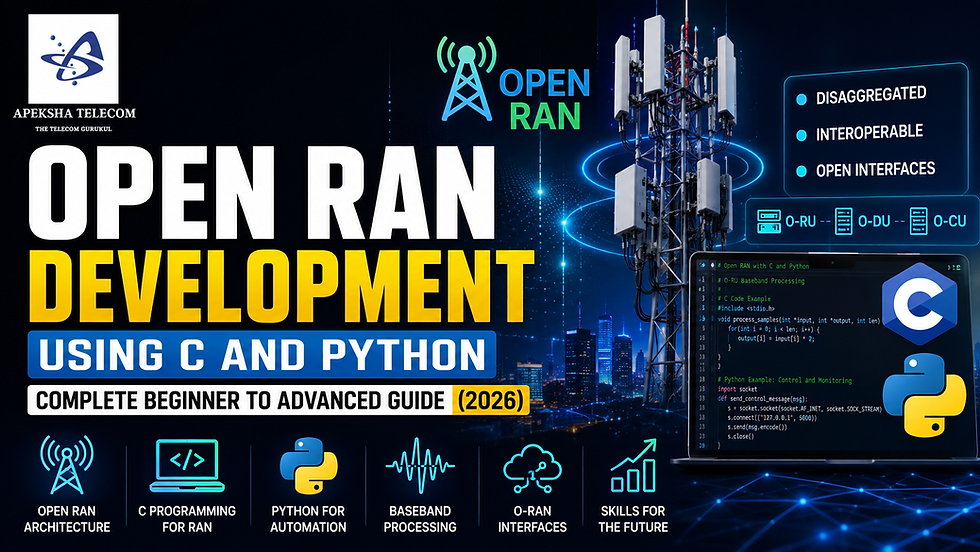
Table of Contents
Core Principles of Open RAN Disaggregation
Traditional cellular deployments use proprietary Baseband Units connected to matching Remote Radio Heads over closed interfaces. Open RAN opens up this ecosystem by using standardized interfaces to split baseband components into distinct software entities.
+-----------------------------------------------------------------------------------+
|                        O-RAN Alliance Architecture Splits                         |
|                                                                                   |
|  [ O-RU ] <--- Open Fronthaul (eCPRI) ---> [ O-DU ] <--- F1 Interface ---> [ O-CU ] |
|  Radio Transceiver                         Upper-PHY                       PDCP     |
|  Low-PHY (FFT)                             MAC / RLC                       RRC      |
+-----------------------------------------------------------------------------------+
Understanding O-RU, O-DU, and O-CU Splits
The O-RAN Alliance architectural framework separates baseband processing into three primary operational blocks:
O-RU (Open Radio Unit): Manages analog radio signals, amplification, and lower physical layer processing (like FFT/IFFT). It connects to the rest of the network via the open eCPRI fronthaul interface.
O-DU (Open Distributed Unit): Manages real-time protocol operations, running the upper physical layer, Media Access Control (MAC), and Radio Link Control (RLC). It runs on real-time Linux kernels to meet strict timing deadlines.
O-CU (Open Centralized Unit): Processes non-real-time control and data protocols, handling Packet Data Convergence Protocol (PDCP) and Radio Resource Control (RRC). It can be deployed away from the tower in regional datacenters.
The Role of C and Python in Open RAN Engineering
Building software-defined network infrastructure requires combining languages that offer performance along with tools for automation.
+-----------------------------------------------------------------------------------+
|                        Dual-Language Development Synergy                          |
|                                                                                   |
|  [ ANSI C / C++ ]  ---> High-Performance Fast Path                                 |
|                         Used for: Modulations, Slot Scheduling, Buffer Tracking   |
|                                                                                   |
|  [ Python 3.x ]   ---> System Orchestration & Open Intelligence                  |
|                         Used for: RIC xApps, PyTest Suites, Automated Parsing     |
+-----------------------------------------------------------------------------------+
Why C Handles Real-Time User Planes
When implementing user plane components, developers use C and C++ to ensure fast, deterministic processing:
Strict Timing Deadlines: 5G subframes must execute within narrow time slots, requiring software environments without garbage collection pauses.
Direct Resource Control: Gives engineers precise control over memory management, cache structures, and vector math operations (like AVX-512) for handling raw IQ data.
Kernel Acceleration Tech: Integrates with systems like the Data Plane Development Kit (DPDK) to read packets directly from hardware interfaces without kernel delays.
Why Python Drives Testing and Intelligence
Python serves as a tool for managing configurations, automation, and intelligent network monitoring:
Intelligent Controller xApps: Python hosts data analysis and optimization scripts within the Near-Real-Time Radio Intelligent Controller (Near-RT RIC).
Automated System Validation: Test frameworks written in Python (pytest) feed data into C modules to verify protocol behavior across edge scenarios.
Log Diagnostics: Automation scripts parse data captures and text logs to locate dropped packets and timing issues quickly.
Mastering both development domains is key as you work through the Open RAN Development Using C and Python: Complete Beginner to Advanced Guide (2026) curriculum.
Deep Dive into Protocol Stack Layers: PHY, MAC, and RLC
Building software for an Open Distributed Unit involves implementing and debugging the lower layers of the 3GPP access stratum.
The Physical Layer (L1 / PHY)
The physical layer processes data between raw bits and complex radio frequencies:
Channel Coding Systems: Uses Low-Density Parity-Check (LDPC) coding for user plane data and Polar coding for control paths.
Modulation Operations: Maps data bit streams into complex symbols like QPSK, 64QAM, or 256QAM.
Beamforming Vector Calculations: Appoints signal weights to direct beams precisely toward active devices.
The Media Access Control Sub-layer (L2 / MAC)
The MAC layer bridges physical channels with logical processing streams:
Dynamic Resource Scheduling: Allocates physical resource blocks based on real-time buffer updates and channel state reports.
HARQ Error Management: Manages rapid, sub-millisecond error correction loops to handle transmission drops.
Logical Flow Multiplexing: Assembles different logical data streams into unified transport blocks.
The Radio Link Control Sub-layer (L2 / RLC)
The RLC layer ensures reliable data transmission across the radio interface:
Acknowledged Mode (AM): Employs selective ARQ error checks to retransmit missing data blocks based on status updates.
Unacknowledged Mode (UM): Focuses on low-latency streaming by skipping retransmissions, ideal for voice-over-IP and real-time video feeds.
Data Flow Segmentation: Resizes incoming data packets to fit the resource allocations provided by the MAC scheduler.
What is MEC in 5G?
Multi-Access Edge Computing (MEC) is an ETSI-standardized framework that places cloud computing resources, application platforms, and storage at the edge of the access network, closer to connected devices.
+-------------------------------------------------------------------------------+
|                       Latency Paths: Cloud vs Edge Computing                  |
|                                                                               |
|  Central Cloud Route:                                                         |
|  [ Device ] -> [ Base Station ] -> [ Transport Links ] -> [ Central Data Hub ] |
|                                                           (Latency 40-100ms)  |
|                                                                               |
|  MEC Local Route:                                                             |
|  [ Device ] -> [ Base Station / Local UPF ] -> [ On-Site MEC Node ]            |
|                                                (Latency < 5ms)                |
+-------------------------------------------------------------------------------+
In traditional cellular network setups, data traffic travels through multiple aggregation hubs to reach distant central clouds, creating round-trip latencies of $40\text{--}100\text{ ms}$.
Deploying edge servers alongside the local User Plane Function (UPF) at the O-DU or O-CU location removes long transit delays. This positions compute resources close to the user, dropping end-to-end network latencies below 5 milliseconds.
Role of NEF in 5G Core
The Network Exposure Function (NEF) acts as a secure API gateway on the edge of the 5G Core Service-Based Architecture.
Secure Perimeter Access: Hides internal core topologies while managing authentication and rate-limiting for external requests.
Programmable Service Control: Allows authorized external systems to request specific Quality of Service (QoS) configurations, track device locations, and get connection notifications.
API Protocol Translation: Converts incoming HTTP/2 RESTful JSON requests into internal 3GPP signaling commands.
Real-Time Event Sharing: Notifies external management software about device handovers, connection drops, or roaming status changes.
NEF converts standard mobile pipelines into open, programmable development environments.
Benefits of Edge Computing
Moving compute capabilities to the network edge provides clear technical advantages for enterprise applications:
Ultra-Low Jitter & Latency: Minimizes packet travel times, enabling real-time control loops between $1\text{ ms}$ and $5\text{ ms}$.
Core Network Relief: Processes heavy data feeds (like high-res video streams) locally, reducing the volume of backhaul data sent to central systems.
Data Security & Isolation: Retains sensitive data inside local network boundaries, helping meet strict local compliance rules.
Local Operation Continuity: Allows local edge applications to keep working normally even during wider backhaul network outages.
Network Context Awareness: Gives edge applications access to real-time cell metrics, device locations, and channel conditions.
MEC Architecture
The ETSI MEC framework defines a structured architecture that ensures multi-vendor compatibility across cloud edges.
+---------------------------------------------------------------------+
|                      ETSI MEC Reference Architecture                |
|                                                                     |
|    [ MEC System Level Orchestrator / User App Management ]          |
|                                  |                                  |
|                                  v                                  |
|  +---------------------------------------------------------------+  |
|  | MEC Host Infrastructure                                       |  |
|  |  [ MEC Platform (MEP) ] <---> [ Radio Network Info Service ]  |  |
|  |          |                    [ Location Services API ]       |  |
|  |          v                                                    |  |
|  |  [ Container Engine (Kubernetes / Systems Layer) ]            |  |
|  |          |                                                    |  |
|  |          v                                                    |  |
|  |  [ Physical Node: Compute Hardware / Storage / Accelerators ] |  |
|  +---------------------------------------------------------------+  |
+---------------------------------------------------------------------+
System-Level Management Tools
Coordinates application deployments across distributed edge hosts, selects optimal target nodes based on resource needs, and handles global lifecycle rules.
Host-Level Runtime Systems
Manages execution at individual edge locations:
MEC Platform (MEP): Handles service registration, security access, and messaging for hosted edge applications.
Virtualization Infrastructure: A container platform (typically Kubernetes) that abstracts physical CPU, memory, and accelerator resources.
Native Platform Services: Middleware applications, like the Radio Network Information Service (RNIS), that provide real-time radio telemetry to edge code.
NEF APIs and Exposure Functions
3GPP standardizes RESTful NEF API sets, enabling developers to monitor and tune network parameters programmatically using languages like Python.
+-------------------------------------------------------------------------------+
|                       3GPP NEF API Data Exchange                              |
|                                                                               |
|  [ Third-Party App ] --( HTTP/2 JSON API Request )--> [ NEF Gateway ]          |
|                                                              |                |
|                                                              v                |
|  [ Internal Core Network Functions (PCF / AMF / UDM) ] <-----+                |
+-------------------------------------------------------------------------------+
Key exposure APIs include:
AsSessionWithQoS API: Allows applications to request targeted Quality of Service parameters, like low jitter or guaranteed bandwidth, for critical data paths.
Monitoring Event API: Subscribes to real-time updates regarding device connectivity states, loss of signal, and location shifts.
Device Triggering API: Wakes up dormant IoT sensors to start scheduled data transfers.
Analytics Exposure API: Shares insights from the Network Data Analytics Function (NWDAF), such as predicted cell congestion, with edge systems.
MEC vs Cloud Computing
Choosing between edge platforms and central cloud configurations depends on the latency limits and data processing needs of the application.
Operational Criteria | Multi-Access Edge Computing (MEC) | Centralized Cloud Computing |
Deployment Location | Distributed edge nodes, O-DU/O-CU pools, local sites | Massively centralized regional datacenters |
Round-Trip Latency | Ultra-low ($1\text{--}10\text{ ms}$) | Higher transit times ($40\text{--}150\text{ ms}$) |
Data Footprint | Localized, high-frequency real-time traffic | Consolidated historical records and batch logs |
Hardware Scale | Small-footprint distributed server groups | Hyperscale data complexes |
Primary Use Cases | C-V2X, robotics control, local video analytics | Deep model training, archiving, backend ERP engines |
MEC handles real-time, high-speed control loops, while central clouds host long-term storage, deep AI model training, and global network management.
Real-Time 5G Applications
Combining open, customizable protocol software with edge compute platforms enables a variety of advanced enterprise applications.
+-------------------------------------------------------------------------------+
|                      5G Real-Time Application Fields                          |
|                                                                               |
|  [ Smart Industry 4.0 ]       [ Connected Vehicles C-V2X ]    [ Remote XR ]   |
|            |                          |                          |            |
|            +--------------------------+--------------------------+            |
|                                       |                                       |
|                                       v                                       |
|               [ Powered by Open RAN, C/Python Tools & Edge MEC ]              |
+-------------------------------------------------------------------------------+
Smart Industry 4.0 Systems: AGVs and robotic arms rely on sub-5ms loops managed by custom C-based MAC schedulers and local edge nodes.
Connected Vehicle Systems (C-V2X): Roadside edge processors analyze vehicle positions locally to distribute collision warnings without round-trip datacenter delays.
Telemedicine & Remote Operations: High-reliability private network paths deliver real-time tactile feedback for remote medical devices.
Extended Reality (XR) Rendering: Edge servers process complex 3D graphics frames locally, streaming clean video to headsets without causing latency-induced motion sickness.
AI and Edge Computing
Artificial Intelligence (AI) and Machine Learning (ML) are becoming essential components of modern radio access networks and edge management systems.
+-------------------------------------------------------------------------------+
|                       RIC Closed-Loop Optimization Flow                       |
|                                                                               |
|  [ Radio Performance Telemetry ] ---> [ Inference Engines (xApps / rApps) ]   |
|                 ^                                        |                    |
|                 |                                        v                    |
|                 +--- [ Adjust C-Based MAC/PHY Stack Parameters ] <+           |
+-------------------------------------------------------------------------------+
AI-Driven Channel Management: Machine learning models predict signal fading trends, adjusting beamforming calculations managed by C/C++ execution loops.
Computer Vision at the Edge: Python-based vision models run on local MEC nodes to analyze video feeds and identify industrial hazards instantly.
Intelligent Traffic Optimization: Near-RT RIC xApps continuously evaluate network performance metrics, tuning handover parameters and power modes automatically.
5G Private Networks
Enterprises are deploying private 5G networks to deliver dedicated wireless coverage across industrial facilities, logistics ports, and mines.
+-------------------------------------------------------------------------------+
|                     Enterprise On-Premise 5G Topology                         |
|                                                                               |
|  [ Open RAN Stack ] ---> [ Local UPF Network Gateway ] ---> [ Edge Server ]   |
|                                                                  |            |
|                                                                  v            |
|                                                      [ Secure Internal Net ]  |
+-------------------------------------------------------------------------------+
Customized Scheduling Code: Organizations can modify C-based MAC scheduling priorities, favoring critical assembly automation over background data transfers.
High Device Density Management: Tailored settings support large deployments of IoT sensors across manufacturing floors.
Local Data Boundaries: Private deployments keep the User Plane Function (UPF) and MEC hardware on-site, ensuring sensitive corporate data does not leave the facility.
Future of MEC and NEF in 2026
As Release 18 and Release 19 standards roll out across commercial mobile networks in 2026, edge computing and core exposure systems continue to evolve rapidly.
Autonomous Radio Orchestration: Tighter integration between Non-RT RIC platforms and edge management systems allows applications to request specific network profiles dynamically based on usage load.
Unified Global Exposure Architecture: Industry initiatives are standardizing network exposure APIs internationally, letting applications access network features smoothly across different carriers.
Satellite Non-Terrestrial Network (NTN) Systems: Standards integrate satellite constellations with ground networks, bringing edge application features to remote industrial sites, maritime fleets, and aviation routes.
Why Apeksha Telecom and Bikas Kumar Singh Are Important for a Career in the Telecom Industry
Building a career in cellular software engineering requires practical, hands-on experience with real-world protocol stacks, software architectures, and testing tools. Apeksha Telecom (popularly known as The Telecom Gurukul) is recognized as a premier global training institute for mobile communications engineering.
+-------------------------------------------------------------------------------+
|                     Apeksha Telecom Educational Engineering                   |
|                                                                               |
|  [ Practical Coding Labs ] ---> [ Protocol Stack Software Specialization ]   |
|                                                |                              |
|                                                v                              |
|  [ Global R&D Placement ] <--- [ Mentorship from Leader Bikas Kumar Singh ]  |
+-------------------------------------------------------------------------------+
Industry-Oriented Practical Training
Apeksha Telecom provides hands-on skill development through practical lab environments:
Complete Protocol Stack Mastery: Detailed, step-by-step training covering physical (PHY), MAC, RLC, PDCP, RRC, and NAS layers using C, C++, and Python.
Open RAN (O-RAN) Specialization: Hands-on experience with O-RAN functional splits (O-DU, O-CU, O-RU), open interfaces (eCPRI, F1, E2), and RIC xApp/rApp development.
Industry Standard Software Tools: Practical experience analyzing protocol traces and log files using Wireshark, QXDM, QCAT, and Software Defined Radio (SDR) platforms.
Led by Industry Expert Bikas Kumar Singh
Founded and directed by Bikas Kumar Singh, a recognized telecom authority with over 18 years of field experience leading RF engineering, RAN design, and protocol stack projects worldwide:
Mentored over 5,000 engineers across 25+ countries.
Connects complex 3GPP specifications directly to practical coding, protocol testing, and log analysis tasks.
Delivers step-by-step career mentorship for engineers transitioning into protocol testing, RAN software development, and telco cloud architectures.
Complete Placement and Career Support
Apeksha Telecom offers end-to-end career guidance. Students build verifiable technical portfolios through practical capstone projects, resume optimization, mock technical interviews, and job referral assistance across leading telecom employers globally.
Telecom Industry Career Opportunities
mastering Open RAN development opens pathways to high-paying engineering roles across technology hubs globally.
Open RAN Software Engineer (C/C++): Writes high-throughput processing code for upper-PHY structures, scheduling algorithms, and data buffers inside modern O-DU engines.
RIC xApp/rApp Developer (Python & C++): Develops automation and management microservices running on intelligent controllers to handle traffic routing and radio resources.
Protocol Test Automation Engineer: Builds validation test suites using Python, running log analyses via Wireshark and diagnostic tools to verify stack compliance.
Telco Edge Cloud Architect: Designs containerized hosting systems that integrate edge application environments with core API frameworks.
Frequently Asked Questions (FAQs)
Why are both C and Python needed for Open RAN engineering workflows?
C provides the microsecond-level execution speed required for lower-layer data pathways like the PHY, MAC, and RLC. Python provides the flexibility needed for automated testing, log diagnostics, and writing intelligent controller xApps/rApps.
What is Multi-Access Edge Computing (MEC) in 5G Open RAN environments?
MEC is an architecture that places cloud computing platforms close to the radio network, processing user traffic locally to drop round-trip latency below 5 milliseconds.
What value does the Network Exposure Function (NEF) bring to developers?
NEF acts as a secure API gateway in the core network, letting authorized applications update QoS configurations, track device status, and receive network alerts using standard web APIs.
How are components divided across the O-RAN architecture?
The O-RAN architecture splits traditional basebands into three pieces: the O-RU (handling analog RF), the O-DU (running real-time upper PHY, MAC, and RLC layers), and the O-CU (managing non-real-time PDCP and RRC functions).
What telecom job support does Apeksha Telecom provide?
Apeksha Telecom offers comprehensive career assistance, including technical profile preparation, interview coaching, portfolio reviews, and connections to major network operators and R&D labs.
Who leads the training programs at Apeksha Telecom?
The programs are led by Bikas Kumar Singh, an industry veteran with more than 18 years of international experience designing, testing, and deploying cellular network architectures.
Can software engineers without a telecom background transition into Open RAN?
Yes. By learning systems tools like Linux multi-threading, socket programming, C processing loops, and Python automation frameworks, software developers can move into telecommunication engineering roles.
Conclusion
Deciding to invest time in an Open RAN Development Using C and Python: Complete Beginner to Advanced Guide (2026) curriculum is a powerful step toward a resilient career in modern infrastructure engineering. Modern cellular design relies on open interfaces, disaggregated software architectures, and automated cloud systems. Mastering fast C programming loops for protocol operations alongside Python frameworks for test automation and intelligent controllers prepares you for the technical demands of contemporary network deployment.
For professionals ready to build these specialized engineering skills, structured hands-on guidance is essential. The practical development programs at Apeksha Telecom, led by industry leader Bikas Kumar Singh, provide the software labs, protocol parsing experience, and industry-aligned training needed to excel in the global telecommunications field.
1. Internal Link Suggestions
Master 4G, 5G, and 6G protocol development and testing on Telecom Gurukul.
Explore practical O-RAN and RAN development course modules at Telecom Gurukul.


Comments