
Open RAN Development Using C and Python: Complete Developer Guide to O-RAN, 5G RAN & Telecom Software (2026 Edition)

Introduction Open RAN Development Using C and Python
The modern telecommunications industry is witnessing its most disruptive software revolution since the shift from analog to digital signaling. The era of closed, single-vendor hardware chassis is rapidly ending. Instead, mobile network operators globally are migrating to disaggregated, virtualized, and intelligent infrastructures. To thrive in this dynamic ecosystem, today's network engineer must transition from a traditional hardware configuration profile to a fully competent software developer. Developing a functional mastery of Open RAN Development Using C and Python: Complete Developer Guide to O-RAN, 5G RAN & Telecom Software represents the absolute pinnacle of career acceleration for modern engineering practitioners aiming to command the modern cellular environment.

Table of Contents
The Architectural Disaggregation of the Radio Access Network
For decades, deploying a cellular network required buying proprietary base stations from a small group of global equipment vendors. The radio hardware, processing layers, and control logic were tightly locked together. If an operator wanted to upgrade their radio capabilities, they had to overhaul the entire physical location. Open RAN breaks this vendor lock-in by using standardized open interfaces. This lets operators mix and match components from different software vendors seamlessly.
+-------------------------------------------------------------+
|             Non-Real-Time RIC (rApps Automation)            |
|             Near-Real-Time RIC (xApps Inference)            |
+-------------------------------------------------------------+
                              |
                              v  O1 / E2 Open Interfaces
+-------------------------------------------------------------+
|           Virtualized Open RAN Software Components          |
|   - O-CU (Central Unit): RRC, PDCP Control & Data Flows     |
|   - O-DU (Distributed Unit): RLC, MAC, High-PHY Tasks       |
+-------------------------------------------------------------+
                              |
                              v  7.2x Functional Split
+-------------------------------------------------------------+
|             O-RU (Radio Unit): Low-PHY & RF Front-End       |
+-------------------------------------------------------------+
Under the O-RAN Alliance framework, the gNodeB base station is divided into three distinct sub-components: the Open Radio Unit (O-RU), the Open Distributed Unit (O-DU), and the Open Central Unit (O-CU). The O-RU converts raw radio signals into digital data packets. The O-DU handles real-time scheduling and link adaptation, while the O-CU manages slower control functions like active user connections and handovers. By breaking down these elements, teams can run network functions as virtual microservices on standard Linux servers. This structural shift highlights why mastering Open RAN Development Using C and Python: Complete Developer Guide to O-RAN, 5G RAN & Telecom Software is so essential for developers entering this ecosystem.
Why C and Python are Irreplaceable in Telecom Software Development
Building open, virtualized telecom software requires two very different types of programming capabilities. You need low-level, high-speed execution to process raw packets, alongside flexible, high-level logic for automation and smart management.
The Fast Path Execution Engine: C
The lower sections of the cellular communication stack, specifically the Medium Access Control (MAC) and Radio Link Control (RLC) layers, must execute their processing loops on precise microsecond schedules. If a packet delivery window is missed by even a fraction of a millisecond, the entire active wireless link can drop. C remains the industry standard for these performance-critical tasks because it compiles directly to bare-metal machine code without the unpredictable latency jumps caused by language runtimes or automated garbage collectors. Developers use C alongside specialized kernel-bypass systems like the Data Plane Development Kit (DPDK) to pull incoming data frames directly from network interface cards into user space memory at true wire-rate speed.
The Network Automation Brain: Python
While C excels at lightning-fast packet routing, it is too rigid and complex for building heavy data analytics systems or cloud integration tools. This is where Python becomes indispensable. Python is the dominant language for writing modern Radio Intelligent Controller (RIC) applications, commonly called xApps and rApps. These automated applications ingest real-time radio metrics from thousands of base stations to optimize performance dynamically. Python's rich ecosystem of open libraries, like NumPy and TensorFlow, allows developers to build smart algorithms that balance traffic loads, adjust cell coverage areas, and detect network issues automatically.
What is MEC in 5G?
Multi-Access Edge Computing (MEC) is a cloud-native architecture that shifts data storage, applications, and processing power away from distant centralized cloud facilities and places them directly at the edge of the mobile network. By embedding high-performance computing hardware inside or right next to local base stations, MEC enables local networks to intercept and process user data immediately.
[ IoT / Mobile Device ] <---> [ gNodeB Base Station ]
                                     |
                          +----------------------+
                          |  Local MEC Host      | ---> Fast Local Processing!
                          |  (Compute & Storage) |      (1-5ms Round-Trip)
                          +----------------------+
                                     |
                                     v Core Network Backhaul
                          +----------------------+
                          | Centralized Cloud    | ---> Heavy Batch Processing
                          | Data Centers         |      (50-150ms Round-Trip)
                          +----------------------+
In traditional 4G LTE network architectures, all user data had to travel back through the operator's central core before reaching the public internet. This lengthy path added 50 to 150 milliseconds of physical routing delay. MEC eliminates this transport bottleneck entirely. By setting up a localized cloud environment directly at the cellular access point, MEC allows teams to build highly responsive services that process data exactly where it is generated.
MEC Architecture and Architectural Topology
The European Telecommunications Standards Institute (ETSI) defines a structured, modular framework for MEC systems to ensure open interoperability across multi-vendor telecom networks.
The MEC Host
The MEC host is the actual compute hardware deployed at a local edge location. It features high-capacity multicore processors, container runtime engines (such as Kubernetes), and hardware acceleration modules like GPUs or programmable FPGAs to accelerate intensive mathematical tasks.
The MEC Platform
The MEC platform serves as the key middleware layer. It coordinates local traffic routing rules, handles secure application authentication, and exposes real-time radio network metrics. Through secure APIs, an active edge application can query the MEC platform to check immediate radio link quality or track active user handovers, allowing it to adapt its software behavior on the fly.
The MEC Management and Orchestration (MEO)
Managing a large network composed of thousands of micro-edge deployment sites requires automated lifecycle coordination. The MEO acts as the central control brain. It monitors compute load across edge hosts, boots up container instances at the closest physical node to a user, and coordinates application state transfers when users move between cell towers.
Benefits of Edge Computing in Modern Mobile Networks
Deploying application servers right at the edge of the cellular network introduces several major structural advantages over older, centralized server models.
Ultra-Low Latency Implementation: Shifting processing logic to the cellular edge drops round-trip network response times to single-digit milliseconds, enabling real-time interactive apps.
Backhaul Load Management: High-bandwidth applications, like continuous industrial camera arrays, produce massive streams of raw data. MEC processes and analyzes this data locally, meaning only compact, filtered summaries need to be sent over core backhaul lines.
Total Data Sovereignty and Privacy: Industries like defense, healthcare, and advanced manufacturing must maintain strict data privacy compliance. MEC isolates sensitive enterprise traffic within local physical facilities, preventing it from ever leaving the site.
Real-Time Network Awareness: Because edge servers link directly into local base station networks, applications can monitor immediate radio conditions. A video streaming engine can detect a drop in radio signal via an API and lower its bitrate preemptively, preventing playback stalls before they happen.
MEC vs Cloud Computing: Structural Differences
While edge environments and public clouds use similar containerized virtualization methods, their design targets and operational scales differ fundamentally.
Engineering Factor | Multi-Access Edge Computing (MEC) | Centralized Cloud Computing |
Physical Proximity | Right next to the user at the base station or local edge aggregation point | Distant hyper-scale data centers located hundreds of miles away |
Round-Trip Latency | Ultra-low (1 to 5 milliseconds) | High (30 to 150+ milliseconds) |
Compute / Storage Footprint | Specialized, space-constrained edge compute nodes | Massive, virtually infinite compute and storage clusters |
Backhaul Impact | Low; filters and acts on data locally to preserve core bandwidth | High; requires continuous raw data streaming across core networks |
Primary Use Cases | Time-critical inference, vehicle coordination, XR processing | Historical data warehousing, heavy batch training, cold storage |
Role of NEF in 5G Core
In older 4G LTE setups, the mobile core operated as an isolated, rigid system. External software applications had no way to query internal network metrics, alter data delivery rules, or adjust quality parameters. The 5G Service-Based Architecture (SBA) overcomes this limitation by introducing the Network Exposure Function (NEF).
+-------------------------------------------------------------+
|          External Apps / Third-Party MEC Services           |
+-------------------------------------------------------------+
                              ^
                              | Secure RESTful HTTP/2 JSON APIs
                              v
+-------------------------------------------------------------+
|             Network Exposure Function (NEF)                 |
+-------------------------------------------------------------+
                              ^
                              | Internal Service-Based Interfaces (SBI)
                              v
+-------------------------------------------------------------+
|     5G Core Functions (AMF, SMF, PCF, UDM, UDR, UPF)        |
+-------------------------------------------------------------+
The NEF functions as a secure API gateway between internal core network functions and external software application environments. It translates low-level telecommunication protocols into developer-friendly RESTful HTTP/2 JSON web APIs, transforming the cell network from a closed transport pipe into a highly flexible, programmable software platform.
NEF APIs and Exposure Functions Explained
The NEF protects core network components from unauthorized access while exposing capabilities through three main API classes.
Device Monitoring APIs
These APIs allow authorized third-party applications to subscribe to specific device event logs. For instance, a logistics fleet platform can use the NEF to get instant alerts whenever a cargo tracker detaches from a network, switches cell zones, or goes offline.
Provisioning APIs
Through provisioning endpoints, verified enterprise software platforms can write configuration parameters directly into the 5G Core's Unified Data Repository (UDR). A business can use these functions to set operational sleep and wake cycles across thousands of low-power IoT sensors, optimizing network usage.
Traffic Influence APIs
This represents one of the most powerful elements of the 5G service mesh. An external edge application can use the NEF to request that the Session Management Function (SMF) alter a user's data routing paths dynamically. When an end-user boots up a time-critical app, the app informs the NEF to route that specific user data flow straight to a local MEC host rather than a distant regional data center.
Real-Time 5G Applications and Enterprise Deployments
The combined architectural advantages of virtualized RAN software, local MEC nodes, and programmable NEF interfaces support a wide array of new enterprise use cases.
Cellular Vehicle-to-Everything (C-V2X)
Self-driving vehicles generate immense volumes of situational data every minute. To maintain safe lane positions, navigate crowded intersections, and receive hazardous weather notifications, cars must communicate with nearby infrastructure in real time. MEC edge nodes running collision-prevention models process this sensor data locally, returning safety instructions to vehicles in under 10 milliseconds.
Smart Manufacturing and Robotics
Modern industrial automated plants feature hundreds of high-speed sorting machines, guided robotic carts, and wireless tools. Low-latency C-based MAC schedulers prioritize time-critical machine commands over standard factory web traffic. At the same time, Python-based computer vision engines running on on-premise MEC servers process high-definition video feeds to detect production-line anomalies instantly.
Extended Reality (XR) Rendering
High-fidelity Augmented Reality (AR) and Virtual Reality (VR) systems need massive graphics rendering capabilities to prevent motion sickness. Packing heavy, power-hungry GPUs onto portable headsets reduces comfort and battery life. Shifting complex graphic rendering tasks to local MEC servers allows headsets to function as lightweight display screens while maintaining low-latency visual tracking.
AI and Edge Computing: Powering the Intelligent RAN
The rapid expansion of artificial intelligence makes local edge computing resources even more critical. Relying on centralized clouds for heavy deep learning workflows introduces unsustainable bandwidth costs and data transmission delays. Merging AI capabilities directly into MEC platforms enables two key operational models.
Local Edge Inference
Raw data collected from industrial sensors, corporate security cameras, and ambient monitors is analyzed instantly on local MEC servers using dedicated AI hardware accelerators. Real-time vision and predictive maintenance models generate immediate operational alerts locally, eliminating the need to continuously stream raw video feeds to public clouds.
Privacy-First Federated Learning
Instead of aggregating private user data into a single centralized database to retrain models, federated learning keeps data localized at the edge. Distributed MEC servers train local variations of an AI model using local data streams. The nodes then transmit only compressed model weight updates back to a central server, protecting user privacy while steadily enhancing the global AI model.
5G Private Networks: The Next Industrial Standard
Public mobile networks are optimized to provide broad geographical coverage for millions of consumer mobile phones. However, modern corporate campuses, shipping ports, and automated mines require dedicated bandwidth guarantees, absolute data isolation, and tailored uplink speeds. This mismatch has accelerated the deployment of 5G Private Networks.
A private 5G network is a completely dedicated cellular infrastructure deployed on-site for a specific business client. By operating dedicated gNodeB base stations, a localized User Plane Function (UPF), and on-premise MEC nodes, companies can adapt network performance to their precise operational requirements.
For instance, automated factory robots can utilize dedicated ultra-low latency channels, while high-definition inspection setups receive massive uplink priority. Designing, implementing, and optimizing these custom private setups highlights why modern engineers look to the Open RAN Development Using C and Python: Complete Developer Guide to O-RAN, 5G RAN & Telecom Software to keep up with the software shift in enterprise networking.
Future of MEC and NEF in 2026
As we navigate through the year 2026, the roles of MEC and NEF are expanding far beyond static hosting setups and basic API gateways. In 2026, MEC infrastructure is adopting multi-cloud serverless designs, allowing virtualized software functions to spin up microservices dynamically on any available base station node within milliseconds.
At the same time, the NEF has advanced in 2026 to support real-time network slicing configurations on the fly. This allows automated enterprise systems to request immediate quality of service (QoS) adjustments through the NEF whenever they detect a high-priority operational event. Looking forward, 6G research groups in 2026 are already leveraging these advanced exposure frameworks to explore native AI integration at the baseband physical layer, laying the foundation for self-optimizing, automated networks.
Telecom Industry Career Opportunities
The structural shift toward Open RAN architectures, cloud-native deployments, and softwarized protocols has created a notable talent shortage in the telecommunications industry. Traditional hardware engineers who lack software development skills and IT developers who lack cellular domain knowledge often find themselves missing the technical tools needed for these modern positions.
Global mobile network operators, semiconductor design firms, and network equipment vendors are actively recruiting cross-disciplinary engineers. High-demand roles in this space include:
Open RAN xApp/rApp Engineer: Building dynamic radio resource optimization algorithms using Python and deep learning frameworks.
5G/6G Protocol Stack Developer: Designing, coding, and optimizing high-speed L2/L3 communication modules (MAC, RLC, RRC) in performance-critical C.
MEC Infrastructure Specialist: Configuring, deploying, and managing edge virtualization nodes inside containerized Kubernetes environments.
Core Network Integration Developer: Building and scaling cloud-native Service-Based Architecture features (such as the NEF, AMF, and SMF).
Accelerating Your Professional Trajectory with Apeksha Telecom
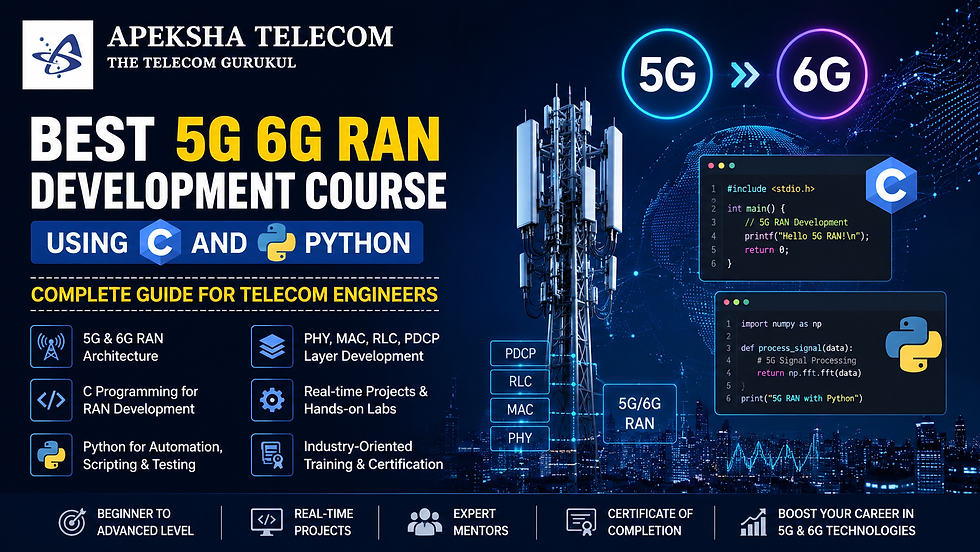
Transitioning into this competitive, software-driven domain requires structured, practical training. Apeksha Telecom is widely recognized as the best telecom training institute in India and globally, specializing in deep, hands-on next-generation network development.
Deep Technical Specialization
Unlike generic training academies that offer high-level IT overviews with a thin layer of cellular terms, Apeksha Telecom goes deep into core concepts:
Complete architectural coverage across 4G LTE, 5G NR, and early 6G research implementations.
Comprehensive development training spanning the entire protocol stack, including the PHY, MAC, RLC, PDCP, RRC, and NAS layers.
Practical training in Open RAN (ORAN) disaggregation and cloud-native network slicing workflows.
Guided by Global Expert Bikas Kumar Singh
Apeksha Telecom's training programs are curated and directed by its founder, Bikas Kumar Singh, a leading 4G/5G/6G technology expert and career mentor. Bringing more than 18 years of direct industry experience working with global telecom giants like AT&T, Nokia, ZTE, and Alcatel-Lucent, Bikas Kumar Singh bridges the gap between complex theoretical specifications and real-world network code. Having trained and mentored over 5,000 professionals globally, his unique training style focuses on live log analysis and actual network traces.
       [ Apeksha Telecom Training Edge ]
  - Live Lab Simulations & Real Network Trace Decoding
  - Complete Domain Mastery (PHY/MAC/RRC/NAS Stack Layers)
  - Dedicated International Job Placement & Interview Support
Comprehensive Placement and Job Support
Apeksha Telecom ensures its students work with standard professional tools like Wireshark, QXDM, and QCAT. Crucially, they offer dedicated job support after successful course completion, standing out as one of the few institutes globally providing structured placement assistance and interview preparation for international telecom opportunities. To maximize your career potential, look to the Open RAN Development Using C and Python: Complete Developer Guide to O-RAN, 5G RAN & Telecom Software through their world-class curriculum.
Frequently Asked Questions (FAQs)
1. Why is C preferred for high-speed packet processing in Open RAN software?
Lower-level components like the MAC and RLC layers require microsecond-level scheduling. C compiles directly to native machine code without the unpredictable latency spikes caused by automated garbage collection routines found in managed languages.
2. How is Python utilized within the Open RAN framework?
Python is the primary language used to develop intelligent rApps and xApps for the Radio Intelligent Controller (RIC). It allows engineers to easily ingest streaming radio data, apply machine learning models, and build robust network testing frameworks.
3. What role does the Network Exposure Function (NEF) fill in a 5G network?
The NEF acts as a secure API gateway. It translates complex internal core communication messages into developer-friendly RESTful HTTP/2 JSON APIs, enabling external enterprise systems to query device locations or modify routing targets.
4. What is the fundamental difference between MEC and standard cloud computing?
The key difference is geographic placement and latency. Standard cloud computing runs on massive centralized servers located hundreds of miles away (30–150 ms lag). MEC operates right at the cell tower edge (1–5 ms lag).
5. Can an engineer transition into RAN development without prior programming experience?
Yes. By following a structured learning path that builds foundational C and Python programming skills alongside deep 3GPP layer analysis, network practitioners can successfully shift into advanced development roles.
6. Does Apeksha Telecom provide verified career support post-training?
Yes. Apeksha Telecom provides comprehensive job support after successful training completion, including resume optimization, portfolio assembly, mock interviews, and active alignment with hiring partners across global telecom MNCs.
Conclusion
The softwarization of modern cellular infrastructure has completely re-written the rules of professional career growth in telecommunications. Remaining focused solely on legacy, hardware-bound administration restricts your earning potential and market relevance.
Choosing to master Open RAN Development Using C and Python: Complete Developer Guide to O-RAN, 5G RAN & Telecom Software places you at the very front of this software-centric industry shift. Developing these capabilities builds the exact professional profile sought after by tier-1 operators, chipmakers, and network equipment manufacturers globally. Ready to accelerate your professional development? Visit Telecom Gurukul today to access virtual hardware sandboxes, review professional certification paths, and unlock your true potential as an industry-leading software engineer.
1. Internal Link Suggestions
2. External Authority Links
O-RAN Alliance Specifications: [https://www.o-ran.org](https://www.o-ran.org)
3GPP Standards Organization: [https://www.3gpp.org](https://www.3gpp.org)
ETSI Edge Computing Frameworks: [https://www.etsi.org](https://www.etsi.org)


Comments