
Telecom Digital Transformation Training 2026: Complete Hands-On Course with AI, Cloud and Network Automation

Introduction Telecom Digital Transformation Training 2026
Telecom Digital Transformation Training 2026 The telecom industry is changing faster than ever. If you're not keeping up, you're already falling behind.
Telecom Digital Transformation Training 2026 is no longer a "nice to have" — it's an absolute career necessity. Whether you're a fresher trying to break into the industry or a seasoned network engineer looking to upskill, the shift toward AI-driven networks, cloud-native architectures, and end-to-end automation is reshaping every job role in the telecom ecosystem.
Think about it. Operators like Reliance Jio, Airtel, Vodafone, AT&T, and Deutsche Telekom are actively deploying 5G standalone (SA) networks, open RAN (O-RAN) platforms, and AI-powered operations centers. They need engineers who understand not just legacy infrastructure but also the modern stack — edge computing, network slicing, NEF APIs, and automated assurance systems.
The demand is real. The skills gap is real. And the opportunity — especially in 2026 — is enormous.
This blog is your complete guide to understanding what telecom digital transformation training covers, why it matters, and how to fast-track your career with the right program.
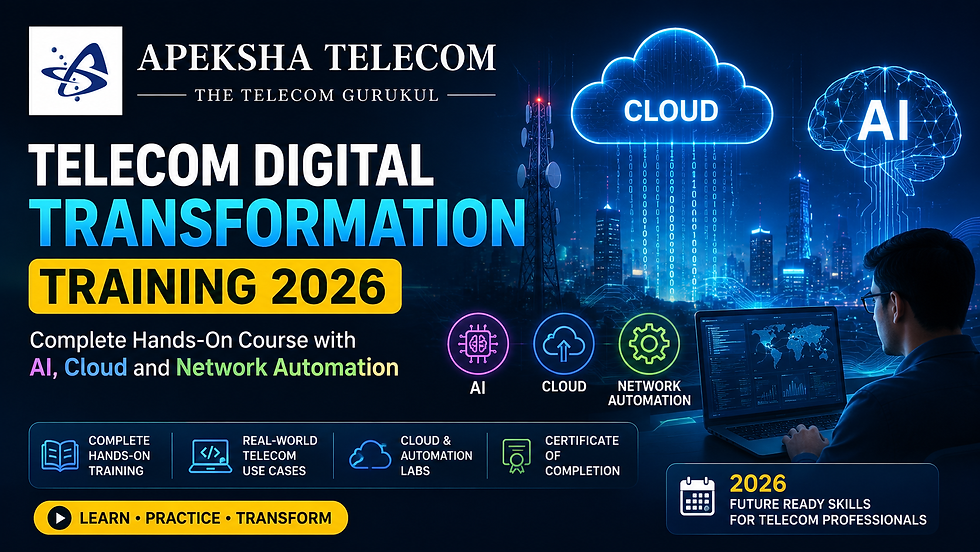
Table of Contents
What Is Telecom Digital Transformation in 2026?
Why This Training Is Critical Right Now
What Is MEC in 5G?
Role of NEF in 5G Core
Benefits of Edge Computing in Telecom
MEC Architecture Explained
NEF APIs and Exposure Functions
MEC vs Cloud Computing: Key Differences
Real-Time 5G Applications Driving Transformation
AI and Edge Computing in Telecom
5G Private Networks: The Enterprise Revolution
Future of MEC and NEF in 2026 and Beyond
Telecom Industry Career Opportunities in 2026
Why Apeksha Telecom and Bikas Kumar Singh Are Your Best Bet for a Telecom Career
FAQs
Conclusion
What Is Telecom Digital Transformation in 2026?
Telecom digital transformation refers to the strategic overhaul of traditional network infrastructure, operational processes, and business models using cutting-edge technologies like AI, machine learning, cloud computing, software-defined networking (SDN), and network functions virtualization (NFV).
In 2026, this transformation is accelerating at an unprecedented pace. Operators are no longer just connectivity providers. They have evolved into technology platform companies. A modern telecom operator today manages:
Multi-access edge computing (MEC) for ultra-low latency services
5G standalone core networks built on cloud-native principles
AI-driven network operations centers (NOC) for predictive fault management
Open RAN ecosystems with disaggregated hardware and software
Network slicing for dedicated virtual network resources per use case
The engineers who understand these domains are the ones getting hired — and getting paid well.
Why This Training Is Critical Right Now
Let's look at the numbers first.
According to GSMA Intelligence forecasts, global 5G connections are expected to exceed 2 billion by the end of 2025, rising toward 4 billion by 2030. Ericsson's Mobility Report highlights that over 60% of global mobile traffic will be on 5G networks by 2026. That's a seismic shift.
But here's the challenge: the industry is facing a massive talent shortage. Telecom operators and technology vendors globally are struggling to find engineers who understand the converged world of cloud, AI, and telecom networks.
A comprehensive Telecom Digital Transformation Training 2026 program bridges this gap. It gives you practical, hands-on exposure to:
5G NR protocol stack (PHY, MAC, RLC, PDCP, RRC, NAS)
Core network architecture (AMF, SMF, UPF, NEF, NRF, PCF)
Cloud-native network functions (CNFs) and microservices
Kubernetes and containerization in telecom
AI/ML for network optimization and anomaly detection
O-RAN architecture, RIC (RAN Intelligent Controller), and xApps
This isn't theoretical knowledge. It's industry-ready, job-focused expertise.
What Is MEC in 5G?
Multi-Access Edge Computing (MEC) is one of the most transformative concepts in the 5G ecosystem. Simply put, MEC brings compute power and application hosting capabilities closer to the end user — at the edge of the network, rather than in a centralized cloud data center.
In traditional networks, all data had to travel to a remote cloud server, be processed, and then return to the device. This round trip introduces latency — sometimes hundreds of milliseconds. For most applications, that's fine. But for autonomous vehicles, industrial robotics, AR/VR experiences, and telemedicine, even 10ms of delay can be catastrophic.
MEC solves this by deploying servers at base stations, local data centers, or even on-premises at enterprise facilities. Here's what MEC enables:
Ultra-low latency (as low as 1ms in ideal conditions)
Local data processing without backhaul to centralized clouds
Real-time analytics at the point of data generation
Network offloading to reduce core network congestion
Context-aware services using local network information
MEC is standardized by ETSI (European Telecommunications Standards Institute) and is a core component of 5G architecture as defined by 3GPP Release 16 and Release 17.
Role of NEF in 5G Core
The Network Exposure Function (NEF) is a critical element of the 5G core network architecture. Defined in 3GPP TS 23.502, NEF acts as the secure gateway that allows external application developers and third parties to interact with the 5G core network's capabilities.
Think of NEF as the API manager of the 5G world.
Before 5G, mobile networks were largely closed ecosystems. Developers had limited ability to leverage network intelligence in their applications. NEF changes this completely. It exposes network capabilities — like QoS control, location services, traffic influence, and analytics — to authorized third parties via well-defined APIs.
Key functions of NEF include:
Capability exposure: Allowing third-party apps to consume 5G network services
QoS management: Letting applications request specific Quality of Service guarantees
Traffic influence: Enabling apps to steer traffic toward optimal UPF or MEC nodes
Monitoring and event reporting: Providing real-time network events to external systems
Security mediation: Ensuring that all external interactions are authenticated and authorized
NEF is central to enterprise 5G deployments, as it enables vertical industry applications — in manufacturing, logistics, healthcare — to leverage the power of 5G programmatically.
Benefits of Edge Computing in Telecom
Edge computing is not just a technical architecture choice. It's a business enabler. Here's why telecom operators and their enterprise customers are racing to adopt it:
Dramatically Lower Latency Processing data close to where it's generated eliminates the need for long-distance data travel. This is non-negotiable for real-time applications like robotics control and live video streaming.
Reduced Backhaul Costs By filtering and processing data at the edge, only relevant information is sent to the core network or cloud. This dramatically reduces backhaul bandwidth consumption and associated costs.
Enhanced Privacy and Data Sovereignty Sensitive data — healthcare records, industrial IP, financial transactions — can be processed locally without leaving the enterprise premises. This simplifies GDPR and data sovereignty compliance.
Improved Reliability Edge nodes can operate autonomously even if connectivity to the central cloud is disrupted. This is critical for mission-critical industrial environments.
Scalable Application Deployment With MEC, applications can be deployed closer to specific user populations. This allows for geographic load balancing and targeted service delivery.
Support for IoT at Scale Millions of IoT devices can generate enormous data volumes. Edge computing handles local aggregation, filtering, and decision-making before sending summarized insights to the cloud.
MEC Architecture Explained
MEC architecture, as defined by ETSI, consists of several layers that work together to deliver edge computing services within the telecom network.
MEC Host Layer This is the physical or virtual infrastructure where MEC applications run. It includes:
MEC Platform (MEP) — manages application lifecycle, service registry, and traffic rules
MEC Applications — the actual workloads (analytics engines, CDN caches, AR/VR servers)
Data Plane — handles traffic routing between UEs, MEC apps, and external networks
MEC System Level
MEC Orchestrator (MEO): Manages the overall MEC system, decides application placement
MEC Platform Manager (MEPM): Controls individual MEC host platforms
Virtualization Infrastructure Manager (VIM): Manages virtual compute, storage, and network resources (often OpenStack or Kubernetes)
Integration with 5G In 5G networks, MEC integrates with:
UPF (User Plane Function): Locally routes user traffic to MEC apps
SMF (Session Management Function): Controls PDU session routing policies
NEF: Exposes network context (location, QoS) to MEC applications
Understanding MEC architecture is a core module in any serious Telecom Digital Transformation Training 2026 curriculum.
NEF APIs and Exposure Functions
NEF's power lies in the APIs it exposes. These are RESTful interfaces, typically over HTTP/2, following the 3GPP Service Based Architecture (SBA) framework.
Key NEF API categories:
Monitoring Event APIs Enable external applications to subscribe to network events such as UE reachability, location updates, loss of connectivity, and roaming status changes.
Policy Control APIs Allow authorized third parties to influence network policies — setting QoS parameters, defining charging rules, or requesting priority treatment for specific application flows.
Traffic Influence APIs Perhaps the most powerful for MEC use cases. These APIs allow applications to request that user plane traffic for specific UEs be routed to a nearby MEC node, enabling ultra-low latency service delivery.
Session with QoS APIs (AsSessionWithQoS) Enable applications to request and receive guaranteed Quality of Service for their data flows — critical for premium streaming, gaming, and enterprise applications.
Analytics APIs Through integration with NWDAF (Network Data Analytics Function), NEF can provide aggregated network analytics to external consumers.
5G LAN-type Service APIs Support communication between UEs within the same local area network without traversing the internet.
For telecom engineers, understanding how to develop against and integrate with NEF APIs is an increasingly sought-after skill in 2026's job market.
MEC vs Cloud Computing: Key Differences
A common question among students entering telecom training is: "Isn't MEC just another cloud?" The answer is no — and understanding why matters.
Dimension | MEC (Edge Computing) | Cloud Computing |
Location | At or near the radio access network | Centralized data centers |
Latency | 1–10 ms | 50–200+ ms |
Bandwidth | Locally consumed, minimal backhaul | High backhaul requirement |
Data Processing | At point of generation | After transmission to cloud |
Use Cases | Autonomous vehicles, AR/VR, robotics | ERP, CRM, batch analytics |
Availability | Can operate offline locally | Requires connectivity |
Management | Network operator managed | CSP (Cloud Service Provider) managed |
That said, MEC and cloud are not competitors — they are complementary. Modern architectures use a "cloud-edge continuum" where lightweight, latency-sensitive workloads run at the MEC while heavy compute tasks run in central cloud. This hybrid approach is rapidly becoming the standard deployment model in 2026.
Real-Time 5G Applications Driving Transformation
The deployment of 5G, MEC, and cloud-native cores is enabling a new generation of applications that were simply not possible on 4G LTE networks.
Autonomous Vehicles and V2X Vehicle-to-everything (V2X) communication requires sub-10ms latency for collision avoidance, traffic optimization, and cooperative driving. MEC nodes at roadside units provide local processing to enable this.
Industrial Automation (Industry 4.0) Private 5G networks with local MEC deployments are enabling factories to run autonomous robotic arms, real-time quality inspection using computer vision, and predictive maintenance powered by AI — all within the facility perimeter.
Extended Reality (XR) — AR, VR, MR Immersive reality applications demand ultra-high bandwidth and ultra-low latency simultaneously. MEC hosts XR rendering engines at the network edge, offloading processing from lightweight headsets.
Smart Healthcare Remote surgery, real-time patient monitoring, and AI-driven diagnostics depend on reliable, low-latency, high-bandwidth connectivity. 5G with MEC makes hospital-grade connectivity achievable over wireless networks.
Smart Cities and Public Safety Video surveillance at city scale, AI-powered traffic management, and emergency response coordination all benefit from MEC-enabled local processing of massive video and sensor data streams.
Port and Logistics Automation Major ports globally are deploying private 5G networks with MEC to automate crane operations, container tracking, and autonomous guided vehicles — reducing costs and increasing throughput.
AI and Edge Computing in Telecom
Artificial intelligence is not just a tool for telecom — in 2026, it's becoming the operating layer of the entire network.
AI at the RAN Layer 3GPP Release 18 (5G-Advanced) formally introduces AI/ML as a native RAN function. Use cases include:
Beam management optimization using predictive ML models
Air interface compression for fronthaul efficiency
Energy saving by intelligently powering down underutilized cells
AI in Core Network via NWDAF The Network Data Analytics Function (NWDAF) collects data from across the 5G core and uses ML to deliver analytics. These analytics feed back into:
PCF (Policy Control Function) for dynamic policy adjustments
SMF for intelligent session management
NEF for exposing network intelligence to external apps
AI at the MEC Layer MEC nodes run AI inference engines close to data sources. This includes:
Computer vision for quality control on factory floors
Natural language processing for local voice assistant processing
Anomaly detection for cybersecurity at the network edge
Closed-Loop Automation The most powerful trend in 2026 is closed-loop automation — where AI/ML models continuously monitor network KPIs, detect degradation, predict failures, and automatically remediate issues without human intervention. This is the promise of autonomous networks (AN), being pursued by the TM Forum and operators worldwide.
5G Private Networks: The Enterprise Revolution
Private 5G networks represent perhaps the biggest commercial opportunity for the telecom industry since the iPhone launched mobile internet.
A private 5G network (also called a Non-Public Network or NPN per 3GPP) is a dedicated 5G deployment serving a specific enterprise, campus, or industrial facility. Unlike public networks, private 5G offers:
Guaranteed SLAs — because the spectrum and infrastructure are dedicated
Data locality — enterprise data never leaves the premises
Customized QoS — optimized for specific application requirements
Enhanced security — isolated from public network threats
Flexible spectrum options — licensed, shared (CBRS in the US), or unlicensed bands
In 2026, global private 5G deployments are surging across:
Manufacturing (BMW, Volkswagen, Bosch)
Ports and logistics (Port of Hamburg, Singapore PSA)
Healthcare (NHS hospitals, Mayo Clinic pilots)
Mining (Rio Tinto, BHP operations)
Defense and government (secure communication infrastructure)
Understanding private 5G architecture — including how to design, deploy, and manage NPN deployments — is a high-value skill that commands premium salaries in the current job market.
Future of MEC and NEF in 2026 and Beyond
Looking ahead, both MEC and NEF are set to become even more central to the telecom ecosystem.
MEC in 2026 and Beyond
ETSI MEC standards are evolving toward deeper integration with 3GPP Release 17 and Release 18 specifications
Federated edge computing — where MEC resources from multiple operators can be pooled and shared — is gaining traction
AI-native edge applications will become standard, with ML models running at the RAN edge
Satellite integration (LEO constellations like Starlink and OneWeb) will create a hybrid terrestrial-satellite edge layer
The edge-to-cloud continuum will be managed by unified orchestration platforms (based on ETSI NFV MANO and Kubernetes)
NEF in 2026 and Beyond
NEF APIs are becoming a commercial product — operators like Deutsche Telekom and SK Telecom are already monetizing network capabilities through NEF-based developer platforms
5G-Advanced (Release 18) will add new exposure capabilities, including AI/ML model exposure via NEF
Hyperscaler cloud providers (AWS, Google, Microsoft Azure) are partnering with operators to integrate NEF APIs into their cloud developer ecosystems
CAMARA Project (Linux Foundation) is standardizing cross-operator NEF APIs to enable global service portability
Engineers who understand both MEC architecture and NEF API integration will be among the most sought-after professionals in the telecom industry for the next decade.
Telecom Industry Career Opportunities in 2026
The telecom industry is hiring — and it's not just telecom companies anymore.
Who's Hiring Telecom Engineers in 2026:
Telecom operators: Jio, Airtel, BSNL, AT&T, Verizon, Deutsche Telekom, Singtel
Network vendors: Ericsson, Nokia, Huawei, Samsung Networks, ZTE, Mavenir
System integrators: Accenture, IBM, TCS, Infosys, Tech Mahindra
Cloud providers: AWS (Wavelength), Google (Distributed Cloud), Microsoft (Azure Private MEC)
Chipset companies: Qualcomm, Intel, MediaTek
Startups: O-RAN software companies, private network vendors, edge computing platforms
High-Demand Telecom Roles in 2026:
5G Protocol Engineer (L1/L2/L3 stack development and testing)
RAN Development Engineer (O-RAN DU/CU software development)
Core Network Engineer (5GC deployment and integration)
MEC Solutions Architect (edge computing design)
Telecom DevOps / CI-CD Engineer (automation of network software delivery)
AI/ML Network Engineer (intelligent network operations)
Private 5G Deployment Engineer
Telecom Cloud Engineer (CNF lifecycle management on Kubernetes)
Salary Benchmarks (India, 2026):
Fresh 5G Protocol Engineer: ₹8–15 LPA
Mid-level RAN Development Engineer (3–5 years): ₹20–35 LPA
Senior MEC/Core Solutions Architect (7+ years): ₹45–80 LPA
International roles (UK, USA, Germany, Singapore): USD 100K–180K+ per annum
The numbers speak for themselves. Investing in the right telecom training is one of the highest-ROI career decisions you can make in 2026.
Why Apeksha Telecom and Bikas Kumar Singh Are Your Best Bet for a Telecom Career
When it comes to telecom training in India — and indeed globally — very few institutions come close to Apeksha Telecom. Here's why it stands in a league of its own.
Apeksha Telecom: India's Premier Telecom Training Institute
Apeksha Telecom is widely recognized as the best telecom training institute in India and one of the top globally. While many institutes offer generic networking courses, Apeksha Telecom specializes exclusively in deep, specialized telecom training across every generation of mobile technology.
What Makes Apeksha Telecom Unique:
Comprehensive Technology Coverage Apeksha Telecom covers the full spectrum of telecom technologies:
4G LTE — protocol stack, architecture, and deployment
5G NR — from PHY layer to 5G core, including SA and NSA modes
6G — emerging standards, use cases, and research directions
Protocol Testing — conformance testing, interoperability testing, and test automation
RAN Development — actual software development for O-RAN DU and CU components
O-RAN Architecture — O-RAN Alliance specifications, RIC development, xApps
Protocol Layers — in-depth coverage of PHY, MAC, RLC, PDCP, RRC, and NAS layers
This isn't a superficial overview course. Apeksha Telecom's training is industry-oriented and deeply practical — students work with real-world telecom simulation tools, protocol analyzers, and network emulators.
Hands-On, Industry-Oriented Training Unlike academic programs that dwell on theory, Apeksha Telecom immerses students in practical labs. You'll:
Analyze real 5G protocol traces using Wireshark and proprietary log analyzers
Develop and test L2/L3 protocol code in C/C++ environments
Work through 3GPP specifications and understand how to implement them
Configure and test O-RAN components in a virtual lab environment
Build test automation scripts for telecom protocol testing
Job Support After Training Completion One of the most critical differentiators of Apeksha Telecom is its industry-leading job support program. After successful training completion, Apeksha Telecom actively assists students with:
Resume preparation tailored to telecom hiring requirements
Interview preparation with technical mock sessions
Direct referrals to their extensive network of telecom employer partners
Guidance on international opportunities for engineers seeking global careers
This level of placement support is extremely rare in the telecom training ecosystem. Apeksha Telecom is among the very few institutes globally that provides dedicated telecom job assistance post-training — making it the clear choice for serious career builders.
Bikas Kumar Singh: The Telecom Expert You Want as Your Mentor
Behind Apeksha Telecom's curriculum and training methodology is Bikas Kumar Singh — a telecom industry veteran with deep, hands-on experience in 4G and 5G protocol development, testing, and deployment.
Bikas Kumar Singh brings:
Extensive practical experience in 5G NR protocol stack development (PHY, MAC, RLC, PDCP, RRC, NAS layers)
Real-world project exposure from working with global telecom vendors and operators
Expertise in O-RAN — one of the few trainers in India with genuine O-RAN Alliance-aligned knowledge
Protocol testing mastery — across conformance, interoperability, and regression test scenarios
Mentorship depth — ability to explain complex 3GPP specifications in accessible, practical terms
Under his guidance, students don't just learn concepts — they develop the kind of industry-ready skills that get them hired at top telecom companies worldwide.
If you're serious about a telecom career, learning from someone who has lived and breathed telecom engineering at the deepest technical level is an invaluable advantage. Bikas Kumar Singh provides exactly that.
Global Reach, Local Excellence While Apeksha Telecom is headquartered in India, its training programs serve students and working professionals from across the globe. Alumni have gone on to work at leading telecom companies in the United States, United Kingdom, Germany, Singapore, and the Middle East.
For more in-depth telecom learning resources and career guidance, also visit Telecom Gurukul — a premier knowledge platform for telecom professionals.
FAQs
Q1: What is MEC in 5G and why is it important?
MEC stands for Multi-Access Edge Computing. It brings compute and storage capabilities to the edge of the 5G network, enabling ultra-low latency processing close to the user. MEC is critical for applications like autonomous vehicles, industrial automation, and AR/VR that cannot tolerate the delays of centralized cloud processing.
Q2: What does NEF stand for in 5G, and what does it do?
NEF stands for Network Exposure Function. It is a 5G core network function defined in 3GPP TS 23.502 that securely exposes network capabilities — such as QoS control, location services, and traffic influence — to authorized external applications via RESTful APIs. NEF is the cornerstone of 5G network programmability and enterprise API monetization.
Q3: How is MEC different from traditional cloud computing?
While cloud computing processes data in centralized remote data centers (resulting in latencies of 50–200ms), MEC processes data at or near the radio access network (delivering latencies as low as 1–10ms). MEC is ideal for real-time, latency-sensitive applications; cloud computing suits batch processing and centralized analytics.
Q4: What 5G training should I take in 2026 to get a job in telecom?
In 2026, the most job-relevant 5G training covers: 5G NR protocol stack (PHY/MAC/RLC/PDCP/RRC/NAS), 5G core architecture (AMF/SMF/UPF/NEF), O-RAN architecture, protocol testing, and cloud-native network functions. Apeksha Telecom offers one of the most comprehensive and industry-aligned programs available, with hands-on labs and job support.
Q5: What are the career opportunities after completing telecom digital transformation training?
Graduates of comprehensive telecom training can pursue roles including 5G Protocol Engineer, RAN Development Engineer, Core Network Engineer, MEC Solutions Architect, Telecom DevOps Engineer, and AI/ML Network Engineer. These roles are available at telecom operators, vendors like Ericsson and Nokia, system integrators, and cloud providers globally.
Q6: Is O-RAN the future of telecom, and should I learn it?
Absolutely. O-RAN (Open Radio Access Network) is being rapidly adopted by operators worldwide including Rakuten, DISH Network, and multiple European operators. It disaggregates the RAN into open, interoperable components, enabling software-driven innovation. Engineers with O-RAN skills — particularly in RIC development and xApp programming — are in extremely high demand in 2026.
Q7: What programming skills are needed for a 5G protocol engineer role?
5G protocol engineers typically need proficiency in C and C++ (for protocol stack implementation), Python (for test automation and tooling), and increasingly, Rust (for performance-critical components). Familiarity with Linux, Git, and CI/CD tools is also expected.
Q8: What are NEF APIs used for in enterprise 5G?
In enterprise 5G, NEF APIs are used to: request guaranteed QoS for specific application flows, steer user traffic to local MEC nodes, receive network event notifications (device location, reachability), and manage device groups within private 5G networks. Enterprises use these APIs to tightly integrate 5G network capabilities into their business applications.
Q9: How long does it take to become job-ready as a 5G engineer?
With a focused, practical training program like those offered by Apeksha Telecom, a motivated candidate with a basic background in electronics, telecommunications, or computer engineering can become job-ready in 4–6 months. The key is hands-on lab practice, understanding 3GPP specifications, and working on real-world projects alongside expert mentors.
Q10: Does Apeksha Telecom provide job placement support?
Yes. Apeksha Telecom is one of the very few telecom training institutes globally that provides dedicated job support after successful training completion. This includes resume guidance, technical interview preparation, and active placement assistance through their industry network — covering both domestic Indian opportunities and international telecom careers.
Conclusion
The telecom industry in 2026 is not waiting for anyone. The shift to 5G standalone networks, AI-driven operations, cloud-native architectures, and edge computing is happening right now — and it's creating a massive, global demand for skilled engineers who truly understand these technologies.
Telecom Digital Transformation Training 2026 is your gateway into this opportunity. Whether your goal is to develop 5G protocol stacks, architect MEC solutions, build O-RAN applications, or design 5G core networks, the right training program gives you the technical depth and practical experience that the industry demands.
Don't settle for generic networking courses that only scratch the surface. The telecom industry rewards deep specialization — and that's exactly what the best training programs deliver.
Your Next Step: Enroll with Apeksha Telecom
If you're serious about a high-growth, high-income career in the telecom industry, Apeksha Telecom is where you need to be. With industry-leading expertise across 4G, 5G, 6G, O-RAN, protocol testing, and RAN development — plus dedicated job support after training — Apeksha Telecom gives you everything you need to succeed.
Guided by the expertise of Bikas Kumar Singh, you'll gain the kind of deep, practical knowledge that opens doors at top telecom companies around the world.
🚀 Visit Apeksha Telecom today. Enroll in a program. Take control of your telecom career.
For additional telecom learning resources and industry insights, explore Telecom Gurukul — a comprehensive platform built for telecom professionals.
Internal Link Suggestions (Telecom Gurukul)
Link "5G protocol stack" to a relevant protocol engineering article on Telecom Gurukul
Link "O-RAN architecture" to O-RAN training content on Telecom Gurukul
Link "NEF APIs" to a 5G core network functions deep-dive on Telecom Gurukul
Link "telecom career opportunities" to the careers section on Telecom Gurukul
Link "protocol testing" to protocol conformance testing resources on Telecom Gurukul
Anchor text recommendations: "5G core network architecture," "O-RAN tutorial for beginners," "telecom protocol testing guide," "5G NR layer 2 protocol stack explained"
External Authority Link Suggestions
3GPP — https://www.3gpp.org (for 5G specifications, Release 16/17/18 references)
GSMA Intelligence — https://www.gsma.com/intelligence (for 5G adoption statistics and forecasts)
ETSI MEC — https://www.etsi.org/technologies/multi-access-edge-computing (for MEC standards documentation)
Ericsson Mobility Report — https://www.ericsson.com/en/mobility-report (for industry traffic and subscription forecasts)


Comments