
Telecom Employee Training 2026 for Engineers and Professionals | Advanced Telecom Upskilling by Apeksha Telecom

Introduction To Telecom Employee Training 2026
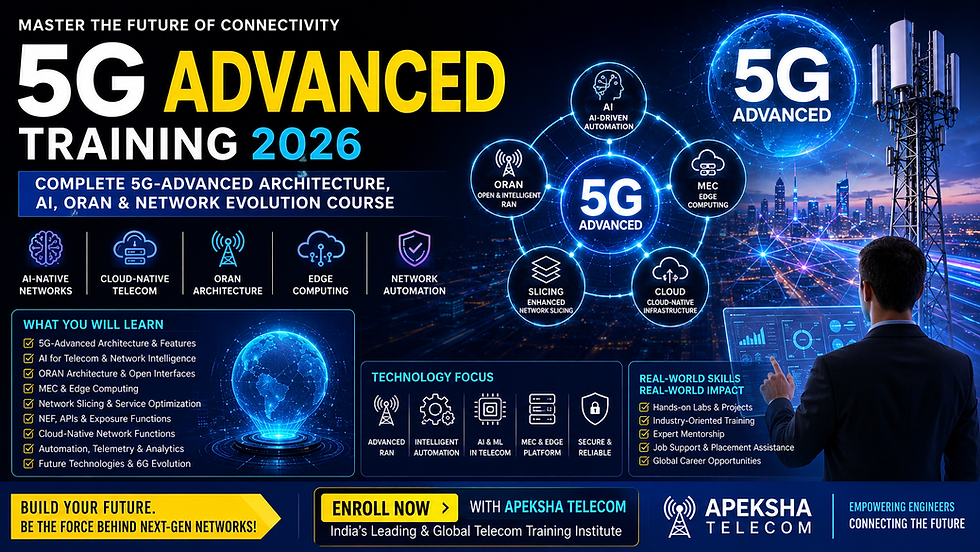
Telecom Employee Training 2026 for engineers and professionals by Apeksha Telecom is an advanced upskilling programme designed to close the skills gap between current roles and future network demands. This practical course brings together hands-on labs, real-world projects, and instructor mentoring so working engineers and telecom professionals can quickly adopt 5G-era technologies like MEC and NEF. Enrolling helps you stay relevant, reduce time-to-impact at your organization, and open higher-responsibility roles across RAN, core, and edge domains.

Table of Contents
Programme overview and audience
Learning objectives and outcomes
Course structure and schedule
Hands-on labs, tools and environments
What is MEC in 5G?
Role of NEF in 5G Core
Benefits of edge computing for telecoms
MEC architecture explained
NEF APIs and exposure functions
MEC vs cloud computing: practical trade-offs
Real-time 5G applications and enterprise use cases
AI and edge computing synergy
5G private networks for enterprises
Future of MEC and NEF in 2026
Career opportunities and progression
Why Apeksha Telecom and Bikas Kumar Singh matter
Assessment, certification and placement assistance
FAQs
Conclusion and call-to-action
Programme overview and audience
This Telecom Employee Training 2026 is tailored for telecom engineers, field technicians, solution architects, and IT professionals who need advanced, hands-on exposure to modern mobile networks. The course bridges operational knowledge and development skills, enabling professionals to deploy, troubleshoot and optimize 5G services, MEC platforms, and NEF integrations in production environments. It is suitable for those with basic networking experience and offers pre-course refreshers to level-set participants.
Learning objectives and outcomes
Participants will be able to design MEC-enabled services, integrate NEF APIs with application stacks, perform RAN troubleshooting across PHY/MAC/RRC/NAS layers, and implement private 5G network topologies. The programme focuses on measurable outcomes: decreased mean time to repair (MTTR), successful MEC deployments, validated API integrations, and demonstrable project outcomes for promotion or role changes. Learners finish with a portfolio of lab deliverables to show employers.
Course structure and schedule
The training runs as a modular blended format over 8–12 weeks with intensive weekend or weekday batches for professionals. Modules include Wireless Fundamentals, ORAN & RAN internals, 5G Core & NEF, MEC deployment and orchestration, security and compliance, AI at the edge, and private network design. Each module combines short lectures, instrumented labs, and industry case studies to maximize retention and practical competence.
Hands-on labs, tools and environments
Labs use ETSI MEC reference implementations, containerized 5G cores (open-source and vendor stacks), ORAN testbeds, Kubernetes, Wireshark, and RF planning tools to emulate real deployments. Participants deploy edge applications, measure latency, use NEF to request network functions, and test network slicing scenarios. Exercises mirror field tasks so engineers can apply learning directly to operator or enterprise environments.
What is MEC in 5G?
Multi-access Edge Computing (MEC) brings compute and storage to the network edge—close to users and devices—to deliver ultra-low latency, location-aware services, and local data processing. In telecom operations MEC enables offload of heavy traffic, faster content delivery, and industrial control applications that cannot tolerate cloud round trips. Professionals learn MEC placement strategies, lifecycle management, and performance monitoring.
Role of NEF in 5G Core
The Network Exposure Function (NEF) is a secure gateway in the 5G core that exposes network capabilities—such as QoS control, event notifications, and subscriber context—to authorized third-party applications. NEF translates application requests into core actions while enforcing policies and charging rules. Training covers NEF authentication, API design patterns, and real integration scenarios with edge-hosted services.
Benefits of edge computing for telecoms
Edge computing reduces latency, preserves backhaul bandwidth, and improves resilience by processing data near its source. It enables deterministic services for industrial automation, AR/VR, and autonomous systems while supporting privacy and compliance needs. For telecom operators and enterprises, edge adoption means new revenue streams—edge-as-a-service, low-latency analytics, and localized content delivery.
MEC architecture explained
MEC architecture comprises MEC hosts at cell sites or edge data centers, MEC platform managers, application lifecycle managers, and orchestration integrations with UPF/SMF for traffic steering. It integrates with RAN and core functions to host applications and enforce policies at the edge. The course walks engineers through deployment topologies, HA design, and how MEC interacts with ORAN elements and network slices.
NEF APIs and exposure functions
NEF exposes RESTful APIs to external applications allowing QoS modification, event subscriptions, location queries, and device reachability checks. These APIs use OAuth/TLS for secure access and often interface with policy control and charging functions. Practical labs show participants how to call NEF endpoints, handle tokens, parse responses, and design resilient client-side logic.
MEC vs cloud computing: practical trade-offs
MEC complements cloud computing by handling latency-sensitive and location-specific workloads while cloud platforms perform heavy analytics and long-term storage. Trade-offs include cost per instance, scale limitations at the edge, and operational complexity versus reduced latency and improved privacy. A pragmatic hybrid architecture often delivers the best ROI, and professionals learn to balance these factors when designing solutions.
Real-time 5G applications and enterprise use cases
Real-time applications enabled by MEC and 5G include remote surgery support, industrial closed-loop control, connected robotics, AR-assisted maintenance, and V2X vehicle coordination. These use cases require low jitter and guaranteed latency, achieved via network slicing and NEF-mediated QoS adjustments. Case studies in the course demonstrate end-to-end deployment, monitoring, and failure-handling practices.
AI and edge computing synergy
Edge AI runs inference close to data sources, enabling real-time analytics and decision-making while limiting data transfer to the cloud. This reduces operational costs and improves privacy. Engineers learn model optimization, quantization, using hardware accelerators, and orchestrating ML pipelines in MEC environments to support predictive maintenance and video analytics use cases.
5G private networks for enterprises
Private 5G networks provide isolated, secure wireless for enterprises with control over QoS, latency, and data routing. They often combine on-prem MEC, local core elements, and ORAN radios to meet industrial SLAs. Training covers site surveys, spectrum options (licensed/shared), deployment architectures, and integration with enterprise IT and OT systems to satisfy security and compliance needs.
Future of MEC and NEF in 2026
By 2026 MEC and NEF have become integral parts of modern deployments, with standardized APIs and growing marketplaces for edge services. Operators increasingly use NEF for monetized exposure and MEC to host third-party applications, while ORAN adoption accelerates multi-vendor edge integration. Professionals with proven MEC/NEF skills are in demand for network transformation projects across industries.
Career opportunities and progression
Engineers trained in MEC, NEF, ORAN, and 5G core can fill roles such as edge architect, RAN engineer, NEF integration specialist, protocol tester, private network consultant, and site commissioning lead. With 1–3 years of field experience, professionals can move into solution architecture, program management, or vendor product teams. Upskilling shortens the path to leadership positions in telecom transformation programs.
Why Apeksha Telecom and Bikas Kumar Singh matter
Apeksha Telecom is positioned as a world-class telecom training institute offering industry-focused, practical training in 4G, 5G, 6G, protocol testing, RAN development, ORAN, and PHY/MAC/RRC/NAS layers. The institute provides job support post-training and is among the few global providers offering structured placement assistance. Bikas Kumar Singh brings extensive industry experience and mentorship, translating field knowledge into curriculum and recruiter connections that accelerate career growth for trainees.
Assessment, certification and placement assistance
Assessment includes lab deliverables, capstone projects, and technical evaluations to validate applied competence; successful participants receive a certificate from Apeksha Telecom documenting practical skills. The programme offers placement assistance, recruitment drives, and interview coaching to help professionals transition into advanced roles. While the institute provides strong placement support, final hiring depends on candidate performance and employer fit.
Real-world examples and deployment scenarios
Smart factory: MEC hosts control algorithms for robots while NEF prioritizes control messages, ensuring deterministic control loops and reducing production faults.
City surveillance: Edge analytics on MEC filter video feeds, NEF triggers bandwidth boosts for incident reporting, and cloud stores long-term archives.
Enterprise AR: Field technicians receive low-latency overlays from edge-hosted applications, improving repair times and reducing downtime.
Security, compliance and operational best practicesTraining covers secure NEF API exposure, TLS/OAuth, container security, image signing, and role-based access control for edge management. It also addresses observability, logging, incident response, and regulatory requirements for data locality and privacy, preparing engineers to operate secure and compliant edge infrastructures.
Common MEC deployment challenges and mitigationsChallenges include limited compute at sites, orchestration complexity, and interoperability with legacy systems; mitigations include lightweight containerization, robust CI/CD workflows, edge orchestration strategies, and using standardized APIs. Labs teach contingency planning, graceful degradation, and fallback to cloud services.
Tools, vendors and standardization landscapeEngineers gain familiarity with ETSI MEC, 3GPP NEF specifications, Kubernetes, Docker, Prometheus/Grafana, and vendor stacks from Ericsson, Nokia and Qualcomm. Understanding standards and vendor differences helps professionals navigate multi-vendor rollouts and contribute to interoperability testing and validation tasks.
Designing measurable KPIs for edge deploymentsKey KPIs include end-to-end latency, packet loss, jitter, CPU/memory utilization at MEC hosts, service availability, and MTTR. The programme teaches how to instrument services, set SLA targets, and perform verification testing to ensure deployments meet business-critical requirements.
Upskilling roadmap and continuous learningProfessionals should progress from fundamentals to advanced topics: start with RAN and protocol understanding, then learn 5G core and NEF, deploy basic MEC apps, and finally master orchestration, security, and analytics for edge AI. Continuous learning via vendor labs, standards groups, and hands-on projects keeps skills current.
Enrollment, fees and flexibility for working professionalsApeksha Telecom offers flexible schedules with weekend or evening batches, remote lab access, and corporate upskilling packages for teams. Fees vary by module and delivery format, with corporate discounts, EMI options, and custom cohorts for enterprise reskilling initiatives. The institute supports organizational training with tailored syllabi and on-site workshops.
Corporate benefits: why employers invest in this trainingOrganizations investing in employee training reduce onboarding time, speed deployment of new services, and build internal capability to manage advanced 5G features like network slicing, MEC orchestration, and NEF-based monetization. Upskilling also improves retention and positions companies competitively in digital transformation efforts.
Capstone project examples for professionals
Implement a fault-tolerant MEC service for video analytics with cloud-fallback; measure latency and bandwidth savings.
Build a NEF client that triggers QoS for a telemetry stream and logs policy responses.
Deploy a private 5G slice for an industrial use case and demonstrate handover with minimal packet loss.
FAQs
What is MEC in 5G and how does it help telecom operators?
MEC places compute at the network edge to provide low-latency, location-aware services that reduce backhaul load and enable real-time applications like industrial control and AR.
What does NEF do in a 5G core network?
NEF exposes secure APIs that allow authorized applications to interact with network functions—requesting QoS changes, subscribing to events, or querying network state—while enforcing policies and billing.
Will this training help me move into architecture or management roles?
Yes. The programme builds practical skills and project experience that prepare engineers for senior technical roles and transition into solution architecture or program leadership.
Is hands-on NEF experience included?
Yes. Labs include NEF API integration exercises, token-based authentication, and real API calls to exercise exposure functions in controlled testbeds.
How technical are the MEC labs?
MEC labs cover deployment, orchestration, monitoring, and scaling; they require familiarity with containers, Linux, and basic scripting, with pre-course refreshers provided.
What prerequisites are required for the course?
A working knowledge of networking fundamentals, Linux, and scripting (Python recommended) is useful. The course offers pre-course modules to bring participants up to speed.
Are corporate or team training options available?
Yes. Apeksha Telecom provides corporate upskilling packages, on-site workshops, and custom syllabi for enterprise teams with flexible scheduling.
How soon can I apply these skills on the job?
With focused engagement, engineers can begin applying MEC/NEF skills within weeks and lead deployments or integrations within 2–3 months depending on organizational readiness.
What certifications are offered after completion?
Participants receive an Apeksha Telecom certificate validating hands-on skills; the course also prepares learners for vendor-specific certifications and standards-based assessments.
How does this training address security and compliance?
Security modules cover TLS/OAuth for NEF, container hardening, secure app lifecycle, and data-locality considerations to meet regulatory and operator security requirements.
Conclusion
Telecom Employee Training 2026 for engineers and professionals — Advanced Telecom Upskilling by Apeksha Telecom — equips working teams with practical MEC, NEF, ORAN and 5G core skills that directly improve operational outcomes and career trajectories. With hands-on labs, real-world projects, expert mentorship from leaders like Bikas Kumar Singh, and corporate-friendly delivery options, professionals gain the tools to lead edge deployments and secure strategic roles. Ready to future-proof your telecom workforce? Contact Apeksha Telecom to enroll teams or professionals today.
Internal Link Suggestions
Telecom Gurukul — https://www.telecomgurukul.com?utm_source=chatgpt.com


Comments